Empowering Breakthroughs in the Study of Paul’s Epistle to the Church at Colossae
Despite the wide availability of sources online, students of Colossians seeking to gain historical perspective or to engage in theological retrieval have worked with incredible limitations in terms of available sources. Several indices exist, but these are not comprehensive. Most older commentaries are stored in hard-to-read PDFs, and very few are translated out of the original language.
The Institute for Colossians Studies seeks to change this reality. In this phase of development, the Institute is working to make nearly 200 commentaries available, most of which are dated prior to 1900.
Patristic Era (100–500)
- Severian of Gabala
 Severian of Gabala (355 – 408/425) provided a simple and concise commentary on most of the text of Colossians.
 - Theodoret of Cyrus
 Theodoret (c. AD 393 – c. 458/466) wrote his commentaries on the Pauline Epistles prior to 448. What follows is a translation from the Greek from Patrologiae Cursus Completus, published in 1857.
 - Pelagius
 Pelagius (c. 354–418) likely wrote his commentaries on the Pauline epistles shortly before his departure from Rome in 410.
 - Origen
 Origen (c. 185 – c. 253) composed a significant number of commentaries. This translation is of a fragment of Origen’s commentary on Colossians.
Early Middle Ages and Pre-Scholastic Era (500–1050)
- Oecumenius of Trikka
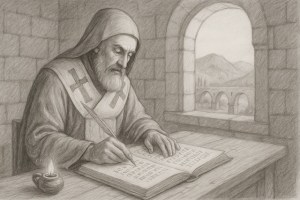 Oecumenius likely was active in the late 10th century and ministered in the city of Trikka, in modern Greece. He is mostly known for his commentaries.
 - Photius of Constantinople
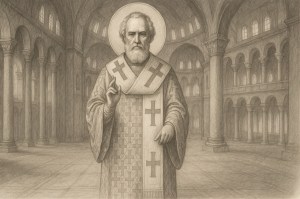 Photius I of Constantinople (c. 815 – 893) provides a number of brief comments on Colossians.
 Institute for Colossians Studies