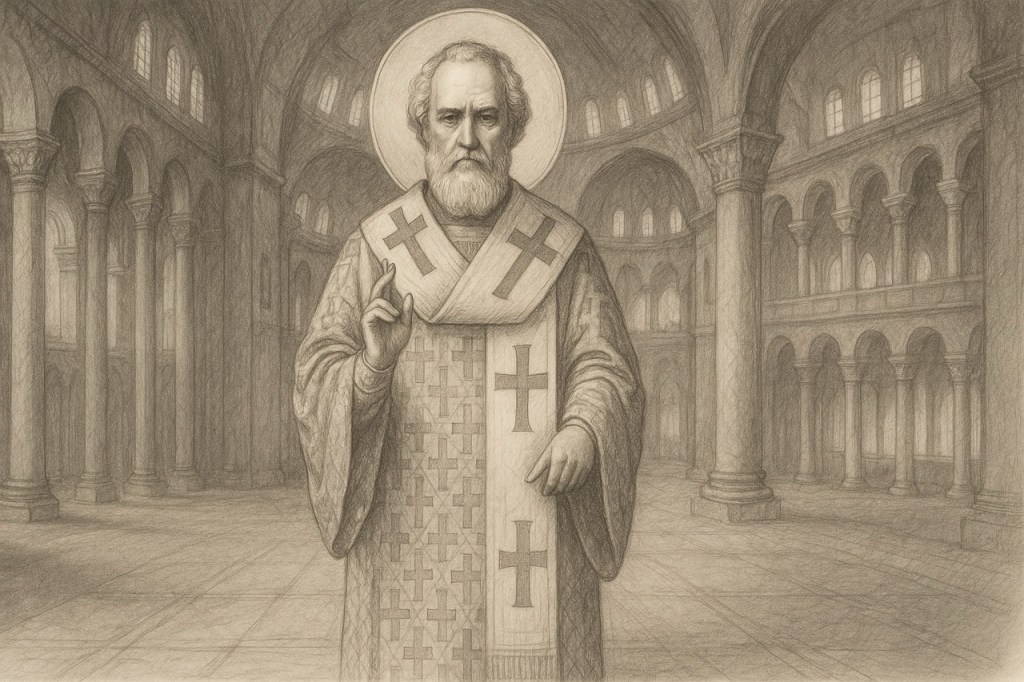
Photius I of Constantinople (c. 815 – 893) provides a number of brief comments on Colossians. These are included in Staab’s 1933 work, Pauluskommentare aus der Griechischen Kirche aus Katenenhandschriften gesammelt und herausgegeben.
Text
[631]
Col 1,17
“And he is before all things.” He did not say, “he came to be before all things,” but “he is before all things,” that is, whatever you may think of, you will find that he pre-exists and pre-subsists, eternally co-existing with the Father and the Spirit.
Col 1,20
“Having made peace,” this is a hyperbaton [word inversion]: having made peace through himself, that is, having done it himself, and not having procured peace for us through others. In what manner did he work this? “Through the blood,” he says, “of his cross”; for having been crucified for us and having shed his own blood for us through the cross, he made peace and reconciled us.
Col 1,21
“And enemies in your mind.” That is, we did not do our wicked deeds unwillingly or by some seizure, but with deliberation and having first fashioned our enmity toward God in our thoughts; thus we proceeded to deeds hostile to him. Therefore, the divine love for mankind is ineffable, because even though we were such, he both reconciled and accepted us.
Col 1,24
“And I will fill up in turn.” Christ, having been slapped and mocked and scourged and crucified for us, did not simply fulfill all things, but did so even beyond understanding, and he fulfilled it with an ineffable word. We have all, therefore, become debtors to endure in return for those countless and world-saving sufferings, and to bring in sufferings and tribulations for Christ and for his body, so that we may fill up in turn what Christ suffered for us. But to fill them up in turn, that is, to suffer equally and similarly and to be lacking in nothing, is impossible. But whatever we may suffer is a shortcoming in comparison to the tribulations of Christ. For how could the suffering of a master for a slave be filled up in turn by a slave for a master? For this is not equal nor similar, not by a long shot. Or the suffering of the sinless for sinners and offenders by that of those in sin for a benefactor and sinless one? And countless other examples. Therefore, whatever anyone might suffer, wishing to fill it up in turn, it is a shortcoming of…
[632]
…the tribulations of Christ that he fills up in turn. For this reason, the blessed Paul, who strove more than all for Christ, who suffered countless terrible things each day, said this, knowing and teaching it.
Col 2,17
It is possible to punctuate in two ways: by placing a stop after “body,” and after “Christ.”
Col 3,23
The verb “to work” is understood in common, by a change of construction: as working “for the Lord and not for men.”
Col 4,3
“That God may open.” The common syntax is: “that God may open to us a door for the word, to speak the mystery of Christ as I ought to speak, for which I am also in chains, that I may make it known.” But the divine Paul delivered the sentence using hyperbaton [word inversion].
Col 4,6
“Let your speech always be with grace.” “As though seasoned with salt.” For just as almost none of the foods that nourish the body are pleasant without salt and rendered into savory nourishment, so also the teaching word that nourishes the soul, if it is not seasoned with grace, will neither nourish nor be received.
Col 4,16
“that also in the church of the Laodiceans.” There was certainly something in what was written that also contributed to the correction of the Laodiceans. Or that they were more likely to pay attention to themselves when they saw the faults of others being rebuked.
“And the one from Laodicea.” Not the one from Paul to the Laodiceans—for then he would have said, “and the one in Laodicea”—but the one from the Laodiceans to Paul; for there was certainly something in it that would benefit the Colossians.
Col 4,17
He writes concerning the teacher, so that when he rebukes and exhorts, they may be persuaded, knowing what was declared to him by Paul. But perhaps…
[633]
…he was their bishop, or had been entrusted with another ministry of souls, which is why he says: a “ministry in the Lord” and not according to man.
Col 4,18
He wrote the word of greeting with his own hand, rather, so that they might be more affected seeing the hand of Paul.
A very great exhortation to bear trials nobly is to know and to remember always that this man is in chains.
Clearly, the grace with which they will fulfill all the commands. They need grace in order to be saved. For what could a person do without grace?
Greek Text
Source Link: https://archive.org/details/MN41481ucmf_2/page/n687/mode/2up
p. 631
Kol 1, 17
Καὶ αὐτός ἐστι πρὸ πάντων. οὐκ εἶπεν· ἐγένετο πρὸ πάντων, ἀλλ᾽· ἔστι πρὸ πάντων, τοῦτ᾽ ἔστιν ὃ ἂν ἐννοήσῃς, αὐτὸν προόντα καὶ προϋφεστῶτα εὑρήσεις ἀϊδίως συνυπάρχοντα τῷ πατρὶ καὶ τῷ πνεύματι.
Kol 1, 20
Εἰρηνοποήσας, τὸ ὑπερβατόν· εἰρηνοποιήσας δι ἑαυτοῦ, τοῦτ᾽ ἔστιν αὐτουργήσας, ἀλλ᾽ οὐ δι᾽ ἑτέρων ἡμῖν πραγματευσάμενος τὴν εἰρήνην. ποίῳ δὲ τρόπῳ ταύτην εἰργάσατο; διὰ τοῦ αἵματος, φησί, τῆς σταυρώσεως αὐτοῦ· σταυρωθεὶς γὰρ ὑπὲρ ἡμῶν καὶ διὰ τῆς σταυρώσεως τὸ οἰκεῖον αἷμα ἐκχέας ὑπὲρ ἡμῶν, εἰρήνευσε καὶ κατήλλαξεν ἡμãs.
Kol 1,21
Καὶ ἐχθροὺς τῇ διανοίᾳ. ἀντὶ τοῦ οὐκ ἄκοντες ἐπράττομεν τὰ ἔργα τὰ πονηρὰ καὶ κατά τινα συναρπαγήν, ἀλλὰ μετὰ μελέτης καὶ τὴν ἔχθραν τὴν πρὸς θεὸν τοῖς λογισμοῖς προτυπώσαντες· οὕτως ἐπὶ τὰς ἐχθρὰς αὐτῷ πράξεις ἐχωροῦμεν. διὸ ἄφατος ἡ θεία φιλανθρωπία, ὅτι καὶ τοιούτους ὄντας καὶ κατήλλαξε καὶ προσεδέξατο.
Kol 1,24
Καὶ ἀνταναπληρώσω. ὁ Χριστὸς ῥαπισθεὶς καὶ ἐμπαιχθεὶς καὶ μαστιχθεὶς καὶ σταυρωθεὶς ὑπὲρ ἡμῶν, οὐχ ἁπλῶς ἐπλήρωσε πάντα ἀλλὰ καὶ ὑπὲρ νοῦν, καὶ ἀφράστῳ λόγῳ ἐξεπλήρωσεν. χρεῶσται οὖν πάντες καθεστήκαμεν ἀντὶ τῶν μυρίων ἐκείνων καὶ σωσικόσμων παθῶν καὶ αὐτοὶ ὑπομένειν καὶ ἀντεισάγειν παθήματα καὶ θλίψεις ὑπὲρ Χριστοῦ καὶ τοῦ σώματος αὐτοῦ, ἵνα ἀνταναπληρώσωμεν ἃ ἔπαθεν ὁ Χριστὸς ὑπὲρ ἡμῶν. ἀλλὰ μὴν ἀνταναπληρῶσαι αὐτά, τοῦτ᾽ ἔστιν ἴσως καὶ ὁμοίως παθεῖν καὶ μηδὲν ἐλλείψειν, ἀδύνατον. ἀλλ᾽ ὅσα ἂν πάθωμεν, ὑστέρημά ἐστι πρὸς τὰς θλίψεις τοῦ Χριστοῦ. πῶς γὰρ ἂν καὶ ἀνταναπληρωθείη τὸ δεσπότην ὑπὲρ δούλου παθεῖν διὰ τοῦ δοῦλον ὑπὲρ δεσπότου; οὐ γὰρ ἴσον τοῦτο οὐδὲ ὅμοιον, πολλοῦ γε καὶ δεῖ. ἢ τὸ ἀναμάρτητον ὑπὲρ ἁμαρτωλῶν καὶ προσκεκρουκότων διὰ τοῦ τοὺς ἐν ἁμαρτίαις ὑπὲρ εὐεργέτου καὶ ἀναμαρτήτου; καὶ μυρία. διὸ ὅσα ἄν τις πάσχοι ἀνταναπληρῶσαι θέλων, υστέρημα τῶν
p. 632
θλίψεων τοῦ Χριστοῦ ἀνταναπληροῖ. διὸ καὶ ὁ μακάριος Παῦλος ὁ πάντων πλέον ὑπὲρ Χριστοῦ δραμών, ὁ καθ ἑκάστην ἡμέραν · μυρία πάσχων δεινά, τοῦτο εἰδὼς καὶ διδάσκων ἔλεγεν.
Kol 2, 17
Διττῶς ἐγχωρεῖ στίζεσθαι, καὶ ἐν τῷ σῶμα ὑποστίζοντας, καὶ ἐν τῷ Χριστοῦ.
Kol 3,23
Ἀπὸ κοινοῦ τὸ ἐργάζεσθαι, κατὰ μετάπτωσιν ὡς τῷ κυρίῳ καὶ οὐκ ἀνθρώποις ἐργαζόμενοι.
Kol 4,3
Ἵνα ὁ θεὸς ἀνοίξῃ. τὸ κοινὸν τῆς συντάξεως· ἵνα ὁ θεὸς ἀνοίξῃ ἡμῖν θύραν τοῦ λόγου λαλῆσαι τὸ μυστήριον τοῦ Χριστοῦ ὡς δεῖ με λαλῆσαι, δι ὃ καὶ δέδεμαι, ἵνα φανερώσω αὐτό. ὁ δὲ θεῖος Παῦλος καθ᾽ ὑπερβατὸν τὸν λόγον προήνεγκεν.
Kol 4,6
Ὁ λόγος ὑμῶν πάντοτε ἐν χάριτι. ὥσπερ ἅλατι ἔστω ἠρτυμένος· ὥσπερ γὰρ οὐδὲν τῶν σῶμα τρεφόντων σχεδὸν χωρὶς ἅλατος ἡδύνει καὶ εἰς τροφὴν εὔχυμον ἀναδίδοται, οὕτως καὶ ὁ διδασκαλικὸς λόγος ὁ τὴν ψυχὴν τρέφων, ἂν μὴ τῇ χάριτι ἠρτυμένος, οὔτε θρέψει, οὔτε ἀναδοθήσεται.
Kol 4,16
ἵνα καὶ ἐν τῇ Λαοδικέων. ἦν τι πάντως τῶν γραφέντων καὶ πρὸς τὴν διόρθωσιν τῶν Λαοδικέων συντεῖνον. ἢ ὅτι πλέον ἔμελλον προσέχειν ἑαυτοῖς, ὁρῶντες τὰ ἑτέρων ἐλεγχόμενα πλημμελήματα.
Καὶ τὴν ἐκ Λαοδικείας. οὐ τὴν ἀπὸ Παύλου πρὸς Λαοδικέας — ἢ γὰρ ἂν εἶπε· καὶ τὴν ἐν Λαοδικείᾳ — ἀλλὰ τὴν ἀπὸ Λαοδικέων πρὸς Παῦλον· ἦν γάρ τι πάντως ἐν αὐτῇ ὠφελοῦν τοὺς Κολοσσαεῖς.
Kol 4,17
Περὶ τοῦ διδασκάλου γράφει, ἵνα ἐπιτιμῶνται καὶ παραινούμενοι πείθωνται, εἰδότες τὰ δηλωθέντα αὐτῷ παρὰ τοῦ Παύλου. ἴσως δὲ
p. 633
Kol 2, 17-4, 18; 1 Thess 2,4-10
ἐπίσκοπος ἦν αὐτῶν, ἢ ἄλλην ἐγκεχείριστο ψυχῶν διακονίαν, διό φησιν· ἐν κυρίῳ διακονίαν καὶ οὐ κατ᾿ ἄνθρωπον οὖσαν.
Kol 4,18
Μᾶλλον αὐτὴν τοῦ ἀσπασμοῦ τὴν λέξιν ἰδίᾳ χειρὶ ἔγραψεν, ἵνα πάσχωσί τι πλέον τὴν χεῖρα ὁρῶντες τοῦ Παύλου.
Μεγίστη προτροπὴ πρὸς τὸ φέρειν γενναίως τοὺς πειρασμούς, τὸ εἰδέναι καὶ διὰ παντὸς μνημονεύειν εἶναι τοῦτον ἐν δεσμοῖς.
Δηλονότι μεθ’ ἧς πάντα τὰ ἐπιταγέντα πληρώσουσιν. χάριτος εἰς τὸ σωθῆναι δέονται. τί γὰρ ἂν ποιήσοι ἄνθρωπος ἄνευ χάριτος;
 Institute for Colossians Studies