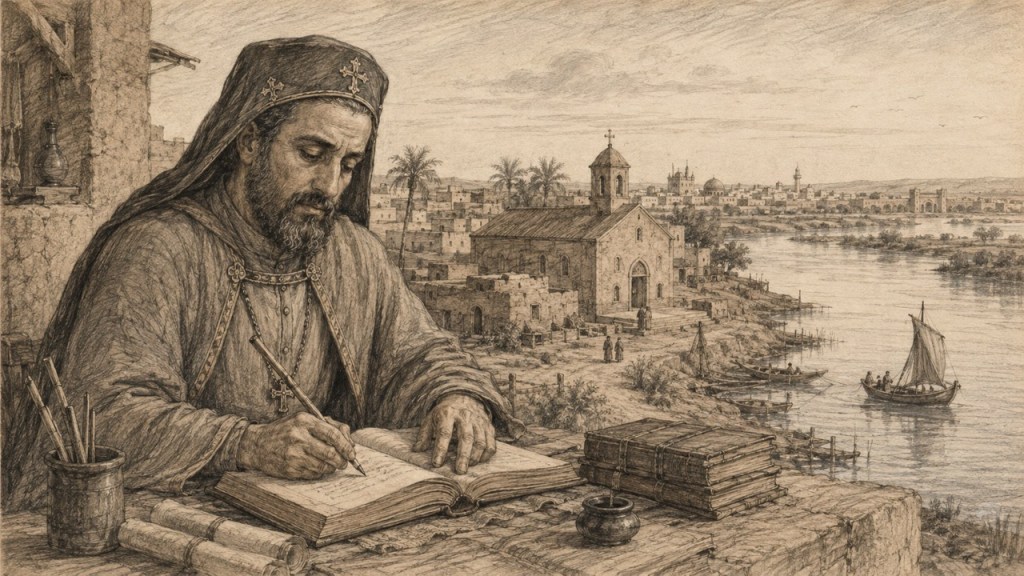
Isho’dad of Merv, bishop of Ḥadatha, compiled his Syriac commentaries around 850, and his brief treatment of Colossians is a compact repository of East-Syriac exegesis, deeply indebted to Theodore of Mopsuestia and preserving interpretations from Ḥanana, Theophilus the Persian, and Daniel bar Toubanetha. He reads the creation language of Colossians 1:16 as describing the renewal and reunification of a fractured cosmos rather than its first making, and takes Paul’s filling up of Christ’s afflictions in 1:24 as the still-unfinished labour of preaching. The text below follows Margaret Dunlop Gibson’s The Commentaries of Isho’dad of Merv, Bishop of Hadatha (c. 850 A.D.): In Syriac and English, vol. 5, pt. 2 (Cambridge: Cambridge University Press, 1916); no digital copy of the Syriac has been available, so only Gibson’s English is given, followed by her closing apparatus of parallels from Swete’s edition of Theodore.
Text
[78]
COLOSSIANS
Again, the Epistle to the Colossians.
f. 283 a
1The Blessed Apostle wrote this Epistle to the Colossians, when he had not yet seen them.1 Some say that Colosse was also in the province of Asia; 2and because some of the Jews who believed in Christ had gone round everywhere and persuaded the believing Gentiles that with faith in Christ they should keep also the Law; these came also to the Colossians for this reason.2 Therefore, when the Apostle heard, he writes them this Epistle, and confirms to them the faith they had received from Epaphras, and admonishes them not to walk after those of the Circumcision, etc.
BOOK I.
This, Who hath made us meet for a share in the inheritance of the Saints in light, 3that is to say, [God] has made you worthy by means of the knowledge of Him for the choir of Saints, when ye were strangers to religion. In light, that is to say, by means of the knowledge of [God].3
This, Translated us into the kingdom of His dear Son; the Greek says, the Son of His love.
Who is the likeness of the Invisible God; the Greek says, the Image, 4that is, in Him we see and form in our minds the invisible substance as in a visible Image.4
Ps. 89. 27 Ex. 4. 22 p. ܩܡܐ Gen. 6. 2 Rom. 8. 29 Heb. 12. 23
And the first-born of every creature. 5The name of first-born, in many places, Scripture indicates for honour, and not for priority of birth, like this, I will also make him the first-born, and Israel, my first-born, that is to say, worthy of honour, and it is evident that there were before them [men] who were called Sons of God, like this, the sons of Elohim saw, etc. Christ in the flesh also in priority of time is called the first-born of every creature; because He was first in immortal life, and the originator of regeneration; and in [the Epistle] to the Romans, [the Apostle] said plainly, that [Christ] might be the first-born among many brethren, who were in His likeness. Thus also in [the Epistle] to the Hebrews it is said, To the Church of the first-born, which are written [in Heaven]; shewing the greatness of the honour of which they were made worthy, and not that they were preferred to other brethren; and because he added every creature, he alludes to Him, that He is more honourable than all the creation.5
[79]
f. 283 b p. ܩܡܒ
And by Him were all things created that are in Heaven; 6he did not say by means of Him, but by Him; for he does not speak about the first creation, but about the renovation which was by Christ, who brought to one unity the creatures which had been rent asunder from one another;6 because Man is a link between all the creatures, those in Heaven and those on the earth. And because it was not evident by means of in Heaven and on the earth, he says, whether visible or invisible; because there are things in Heaven that are visible, like the Sun and the Moon and the Stars, specifying, he says, all that is visible and all that is invisible; all these, he says, in short, were united to Him, and have been strengthened by Him, and renewed by Him. And because it was supposed that what had been said about a man was incredible, he says, By Him were all [things] created; all things were created by His hand and by Him; saying, Be not surprised; for the authority was not in His nature, but in the Nature that dwells in Him, by whose hands all was created, and He is before all things. And after [the Apostle] has said this about His Divine nature; again he speaks about the Manhood; and it is no wonder if in speaking about the Man, he changes to the Godhead. This he did in the [Epistle] to the Philippians and in other places. And that in all things He might have the pre-eminence; and not only because He began first in the Resurrection, but He was also first in greatness of honour, for all creatures offer honour to His greatness on account of His unity with the Word.
Eph. 1. 23 f. 284 a p. ܩܡܓ
7As it pleased [God] that in Him should all fulness dwell. He calls the fulness of God both the Church and all Creation;7 and again he calls fulfilment Him who filleth all in all, saying It pleased God, that in Christ all the fulness of Creation should dwell, which is filled from Him, as He wished to unite it to Himself. Ḥanana says He gathered all beings as scattered members to one substance of the body of Christ; that Christ might be the filling up of all the defectiveness that is in you, being united and joined together like members to the head; and completed in Him by the power of grace, in all the fulness of God, that is to say, as in the place of a pure temple to God; and he constantly dwells in them. Others [say] that he calls all Creation the fulness. This of dwelling, that is to say, uniting; for He has united all the members of Faith to Himself, as to the Head of the body, in the same order as that found in Nature. Who, he says, is the Head of the body of the Church, who is the beginning, and the first-born from the dead; for what the head is naturally to the members of the body, so is the Christ to Believers, like one who unites [them] spiritually in one body, and sends life and preservation to holiness, etc.; and to all His members.
[80]
And by His means to reconcile all things unto Himself, 8by His death He reconciled all things, and this is the meaning of “His blood” and “by His Cross.”8
f. 284 b
And I fill up that which is behind of the afflictions of Christ, etc.; 9that is to say, because Christ suffered before for your advantage, to make you His Body by means of the Resurrection, whatever afflictions are wanting on your account, I fill up. What then was wanting? That since ye have learnt the things that were done by Him for your sakes, ye should receive the promises about them; but this could not be without toils and afflictions. On account of this therefore I suffer, going about and preaching the things that have been effected by Christ; while ye are believing by means of the love of your souls, ye receive relationship to Him, whereof I have been made a minister;9 it is evident that by means of toils and afflictions Paul increased faith in Christ amongst the Nation and the Gentiles.
The mystery that hath been hidden from the worlds; he calls the administration of our Lord a mystery. Jesus Christ is the fulfilment here, also in the [Epistles] to the Galatians and to the Ephesians.
He calls future life the things to which not one good will be wanting.
He in whom are now hid all the treasures of wisdom and of knowledge, 10but they will be revealed at the last.10
p. ܩܡܕ
11He calls the doctrines of men the syllogisms of the Philosophers;11 12he calls the rudiments of the world legal observances, that is to say, the keeping of days, and times and sabbaths, which are [derived] from the Sun and the Moon, which he calls elements, as he said in the [Epistle] to the Galatians.12
And not like Christ, in whom dwelleth all the fulness of the Godhead bodily. He calls the fulness of the Godhead also here all creation, heavenly things and earthly things, 13that is to say, they are united to Him and constructed in the likeness of a body, by means of union with Him; for this is evident, that all creatures are renewed by Christ; because they are linked to Him by natural affinity.13 Ḥanana says, In Him are fulfilled and completed all the intentions of God; not by a mere word, but bodily, that is to say, the Beings are bound together and riveted in the Body of Christ.
And ye also are completed in Him; 14that is to say, ye are filled from Him, and ye are thought worthy of union with Him, who is in the place of a Head to all invisible beings; because all have been united to Him bodily by means of affinity with His Manhood.14 Theophilus the Persian says In Him dwelleth all, etc., is not said on account of the dwelling of God the Word
[81]
f. 285 a p. ܩܡܗ
in Man; for it is not bodily that God the Word dwells in Christ, but divinely. Now [the Apostle] calls the fulness of God, the ranks of visible and invisible beings; whose Head Christ is called, as He united [them] in order; it is said, In whom dwelleth all the fulness bodily; because like a body, it forms completion through many and various members of which Christ has verily taken the oversight, which is in each one of the different members.
f. 285 b p. ܩܡܘ
Now, [the words] It dwelleth, is instead of, In Him completion is established, and remains, and persists; for Christ is said to be the Head of the Body of the Church, and the first-born from the dead, and the head of all principalities and powers, because in Him all things consist, he says, they are established in Him, for from Him they possess breath, and life, and knowledge, and strength; and in Him, he says, are hid all the treasures. Daniel bar Toubanetha says that God is not only good, but rather Goodness in person; and He is, and will be that which is like some substance to the rest of good things. It is not right that He alone should be happy, in the blessedness of His eternal essence; but that He should give a share also to others; just now as an earnest but afterwards fully; therefore He created some natures without life or feeling, making them share with Him only because they are in existence; although there is a great distance between His essence and theirs, like the Heavens, and the Luminaries, and the Elements; but above these things He brings to participation with Himself all things that are animated, but which do not possess life and feeling, like herbs and plants; but after these, living and sensitive bodies, that do not possess motion from place to place, like sponges, and shells. But He created for the fourth participation, those that possess existence, and animation, and life, and feeling, and the power of motion from place to place; like wild beasts, and cattle, and birds, and reptiles. He created Man a microcosm, the fifth participation, in whom are bound together visible and invisible beings; for because the Good One wishes to exalt the reasonable nature to a higher and more intimate communion, that is to say, in order that it might be one with Him in will, etc., which was not suitable to be accomplished in all natural individuals, He selected one individual of them all, the flower and beauty of Nature; and sanctified him to be the abode of His Godhead as representative of all creation, from which, and for the sake of which it was taken; and He gave him all things that were His own, lordship, etc., and this is the fulness of the Godhead. The fulness is participation in the Divine; which God caused the Creature to acquire bit by bit, naturally with Him; now He caused it
G. H. S. XI. 11
[82]
Eph. 1. 21 1 Tim. 2. 3 Titus 2. 13 f. 286 a p. ܩܡܙ Eph. 1. 22, 23 John 1. 3 2 Cor. 5. 17 f. 286 b
all to dwell in Christ; like some body that is composed of many members, in which nothing is wanting of [the parts] that are necessary; in order that no man apart from the Humanity of our Lord may give commands either by word or thought of all these glorious things of the Godhead, and its sublimities, the Blessed Apostle, in one place, in Timothy, names the Manhood of our Lord, God over all, and in another place, the great God and Saviour; in [another] place, Head of the Church; and [says] that in Him dwelleth all the fulness of the Godhead bodily, calling all creatures visible and invisible the fulness; and if it were not so, then just as all the human body dwells and is established in the Head, and from it all vivifying life flows to all the members; and all the members are kept and fixed in it as in completion; thus also all creatures, visible and invisible, stand in Christ our Lord as in a Head, and live and are preserved; and take from Him preservation and life and the support of their existence, as from a vivifying cause giving life and sustenance. But again, if Christ is God and Man; and in being God, is equal in nature to the Father and the Spirit; but in being Man, is equal in substance to all the creatures; therefore it is naturally said, that in Christ dwelleth all the fulness, etc.; for all the fulness of the Godhead, and of the Creation is bound and contained and dwells in Him; and to Him, he says, who is above all, hath [God] given to be Head to the Church, and the fulness of Him that filleth all in all. Now he said this, both from the beginning and from the completion together, that is to say, both from the first Creation out of nothing; for everything was by His means, and without Him, etc.; and again from the second creation, which takes place on the one hand, in a figure through Baptism, on the other hand, as in fact through the Resurrection; every-one, he says, that is in Christ is a new creature; old things have passed away, and everything, etc., but in Christ as the Head. Now he calls the Church a Body, and relates step by step, and says, Who is the likeness of the invisible God, etc., till the end of the passage; and by the putting off of His body, in the Greek, of His flesh, He exposed Principalities, etc., because, he says, He spoiled mortality, for the sake of the help of all; He also freed us from the tyranny of Demons, and completed the victory against them; that they might become an exposure and a shame, who have laboured vainly for our hurt, and have had no profit, because we shall be in immortal life. Joannes says, By the putting off His body He exposed; for [the Apostle] said this in that form, He made a show of them openly; and the purity of His body shews the confusion of those who
[83]
p. ܩܡܚ Matt. 27. 54 Mark 15. 39 Rom. 1. 4
in depravity revile Him; as Antipatrus, father of Herod, did before Cæsar, who stripped and shewed his body; because his accusers reproached him, that he had not really been victorious in the wars on behalf of Cæsar; and thenceforward he was much praised, because it was seen that his body was full of scars, before the king and his great men; and his enemies were ashamed; thus also the Son of God, by the putting off of His body, instead of a little contempt on account of God, was greatly honoured; as even the enemies exclaimed, Truly this man was the Son of God, from the wonders that took place at the time of His crucifixion; and He was declared to be the Son of God with power and by the Spirit, etc.; the putting off applying not to the Word but to the soul, which was deprived of its body and departed to Paradise; because the Word is not bounded, and does not depart; and also it possesses inseparable unity with His body. Behold nevertheless two natures! one which puts off, and one which was put off.
f. 287 a p. ܩܡܛ
That they might be subjected to the worshipping of Angels, like a person attempting something [which he has not seen]; 15for because it is said that the Law was given by means of the Angels, inasmuch as they were the ministers of its gift; on account of this those who trusted to the keeping of the Law brought also the Angels in between, as if they also were angry if the Law were not kept. Yet they [the Jews] shewed also the humility of the form, as if because of fear they did not depart from its observances; and he [Paul] persuades them not to live according to such humility; and as to their taking an excuse from the Angels, it is from the aberration of their minds they say what they do not know.15 This is being puffed up in his fleshly mind, that is to say, in bodily passions; and to shew that they were not teaching justly, he says, And not holding the Head, from which all the body, etc. It was right, he said, that they should be diligent about the things of the Christ, in Whom all the body of the Church is established by means of love, according to the grace which it has received from Him, and is able to increase with the increase of God.
Touch not, he says, that is to say, the bones of a dead man nor any polluted thing; and taste not flesh which is unclean; and handle not any [practice] belonging to the Heathen, nor [touch] the leper nor the sexually impure; this from the person of those who were his opponents.
Matt. 15. 13
He calls the commandments and doctrines of men, not the Law, but aural traditions; as our Lord said, Every plant which My Heavenly Father hath not planted shall be rooted up.
[84]
BOOK II.
This, Put off the old man, etc. He calls the sum of sins the Old Man; saying, 16Because ye have put off the mortal man and have been estranged from strange sins;16 either ye must put off the world, also the life that is attached to it, 17and put on the new (man) that is renewed daily, by knowledge from the Spirit, and comes at last to the likeness of Christ its Creator and cause;17 there neither being Jew, etc.
18He calls Aristarchus his fellow prisoner, because he had been bound along with him.18
Touching whom ye received commandments; 19they had not been commanded by Paul, but by Epaphra their Teacher who had preached the Gospel to them.19
He calls Luke, the Physician, either because he was a physician before his vocation, or that he received the gift of healing from the Spirit.
The Epistle to the Colossians is finished.
[137]
COLOSSIANS
1—1
Swete, Vol. I. p. 253, l. 1: Scribit Colossensibus beatus Paulus sicut scripsit Ephesiis quos antequam scriberet non uiderat.
2—2
Swete, I. p. 254, l. 7: sed propter illos qui ex circumcisione erant, qui omni in loco peragrantes illos qui ex gentibus crediderunt persuadere properabant ut cum illa fide quam in Christo habent etiam legis custodirent decreta; quia ergo et ad Colossenses uenerant et paulo minus aliquibus eorum suaserunt ut legitimis inseruirent decretis.
3—3
Swete, I. p. 258, l. 25: ‘haec (inquit) postulamus ante omnia, gratias agentes Deo pro uobis, quoniam dignos uos per suam cognitionem sanctorum collegio esse pronuntiauit, cum essetis alieni a pietate et idolorum eratis sectatores.’ nam quod dixit in lumine, ut dicat ‘per suam cognitionem;’ et quod dixit qui dignos uos habuit, hoc est, ‘dignos esse pronuntiauit.’ et quod illud est lucrum? ut sanctorum iungantur collegio.
4—4
Swete, I. p. 261, l. 12: bene inuisibilis adiecit, non quod sit et uisibilis Deus, sed ad ostensionem magnitudinis; si tamen in isto quasi in imagine inuisibilem illam naturam uidemus.
5—5
Swete, I. p. 264, l. 15: τὸ πρωτότοκος οὐκ ἐπὶ χρόνου λέγεται μόνον, ἀλλὰ γὰρ καὶ ἐπὶ προτιμήσεως πολλάκις. I. p. 265, l. 1: est quidem quando et in tempore utitur nominis huius translatione, saepe autem et honoris causa……l. 9: apostolus uero ad Hebraeos manifeste hoc idem ostendit, sic dicens: sed accessistis Sion monti
G. H. S. XI. 18
[138]
et ciuitati Dei uiui, Hierusalem caelesti et denis millibus angelorum nundinae et ecclesiae primitiuorum adscriptorum in caelo; ut dicat, ‘illorum qui multo honore digni habiti sunt.’ non enim uult dicere aliquos anteriores esse aliorum filiorum. et alibi: filius meus primogenitus Israel, hoc est ‘honorabilis mihi.’ nam et erant et alii ante Israel qui filiorum Dei nuncupatione digni fuerant habiti; de quibus Moyses dicit: uidentes filii Dei filias hominum quoniam bonae sunt, acceperunt sibi ab omnibus quibus elegerunt. sic et hoc in loco quod dixerat: primogenitus totius creaturae; hoc est, ‘super omnem creaturam honorabilis.’ si quidem dixisset absolute primogenitus, ‘honorabilem’ tantummodo dicebat. nam quia adiecit omnis creaturae, illum designauit qui ab omni honoratur creatura.
6—6
Swete, I. p. 267, l. 13: οὐκ εἶπεν δι’ αὐτοῦ, ἀλλ’ ἐν αὐτῷ· οὐ γὰρ τὴν πρώτην λέγει κτίσιν, ἀλλὰ τὴν ἐν αὐτῷ γενομένην ἀνάκτισιν, καθ’ ἣν τὰ πάντα διαλελυμένα εἰς συμφωνίαν ἤχθη μίαν. I. p. 267, l. 6: non dixit per ipsum, sed in ipso. nec enim de prima dicit creatura, sed illam creaturae reparationem quae in eo facta est, secundum quam omnia dudum dissoluta in unum sunt consensum perducta.
7—7
Swete, I. p. 275, l. 11: ‘plenitudinem Dei’ et ecclesiam uocat, necnon et omnia.
8—8
Swete, I. p. 276, l. 8: ‘omnia (inquit) in sua morte (hoc enim dicit ‘sanguinem’ et ‘crucem’), reconciliauit.’
9—9
Swete, I. p. 279, l. 21: ‘ὥστε (φησὶν) ἥδομαι καὶ πάσχων ὑπὲρ ὑμῶν· καὶ ἐπειδὴ προλαβὼν ὑπὲρ τῆς ὑμετέρας εὐεργεσίας ἔπαθεν ὁ Χριστός, ὥστε σῶμα ἑαυτοῦ ὑμᾶς ἀποφῆναι διὰ τῆς ἀναστάσεως, τὰ προσλείποντα ταῖς θλίψεσιν αὐτοῦ ταῖς ὑπὲρ ὑμῶν ἀναπληρῶ.’ τί δὲ ἦν τὸ προσλεῖπον; τὸ μαθόντας ὑμᾶς τίνα ἐστὶν τὰ ὑπὲρ ὑμῶν κατορθωθέντα παρ’ αὐτοῦ, δέξασθαι τὴν περὶ αὐτῶν ἐπαγγελίαν· τοῦτο δὲ ἄνευ πόνων καὶ θλίψεων γενέσθαι οὐδαμῶς οἷόν τε ἦν· ὑπὲρ δὴ τούτων πάσχω, περιϊὼν καὶ κηρύττων ἅπασιν τὰ κατορθωθέντα, ὥστε ὑμᾶς πιστεύσαντας τῇ διαθέσει τῆς ψυχῆς τὴν πρὸς αὐτὸν οἰκείωσιν δέξασθαι· τούτων γὰρ ἐγὼ κατέστην διάκονος.’ I. p. 279, l. 14: [et] quoniam praeueniens ad conferendum uobis beneficium passus est Christus, ut corpus suum uos per resurrectionem esse pronuntiaret, illa quae deerant tribulationum eius ab illis quae pro uobis erunt adimpleo ego. quid erat quod deerat? ut discentes, quae sunt illa quae correcta sunt pro uobis, suscipiatis de illis promissionem. hoc autem sine labore et tribulationibus fieri nequaquam potest. pro his ergo patior circumiens et praedicans omnibus illa quae sunt directa, ita ut uos credentes affectu animi propinquitatem illam quae ad eum est accipiatis; horum enim ego extiti minister.’
10—10
Swete, I. p. 284, l. 21: φανησομένων δὲ τότε ὁπότ’ ἂν φαίνηται καὶ αὐτός. I. p. 284, l. 2: uidebuntur autem tunc, cum adparuerit et ipse.
[139]
11—11
Swete, I. p. 285, l. 11: philosophiam dicit uerborum pomposam doctrinam.
12—12
Swete, I. p. 285, l. 18: secundum elementa mundi dicit dierum et temporum obseruantiam, eo quod ab elementis mundi perficiuntur ista. ‘elementum’ enim ‘mundi’ solem dicit et lunam, ex quibus dierum quoque et temporum cursus effici uidentur; sic enim illud et Galatis scribens dixit.
13—13
Swete, I. p. 286, l. 6: hoc est, ipsi coniuncta est, et quasi quoddam corpus in se retinet aptatum, propter illam copulationem quae ad eum est.
14—14
Swete, I. p. 286, l. 16: ‘etenim et uos eum habentes in uobis, digni estis habiti eius copulationi, qui et omnibus inuisibilibus uirtutibus in ordine capitis consistit, eo quod omnia ob cognationem ad illum sicut corpus coniuncta sunt.’
15—15
Swete, I. p. 294, l. 10: ἐπειδὴ δι’ ἀγγέλων ὁ νόμος ἐλέγετο δεδόσθαι, ὡς ἂν διακονησαμένων αὐτοῦ πρὸς τὴν δόσιν (καθὼς καὶ ὁ μακάριος Παῦλός φησίν· ΕἸ ΓᾺΡ Ὁ ΔΙ’ ἈΓΓΕΛΩΝ ΛΑΛΗΘΕῚΣ ΛΟΓΟΣ ἘΓΕΝΕΤΟ ΒΕΒΑΙΟΣ)· οἱ τὸν νόμον φυλάττειν αὐτοὺς ἀναπείθοντες προεβάλλοντο τοὺς ἀγγέλους, ὡς ἂν καὶ ἐκείνων ἀγανακτούντων, εἰ μὴ ὁ νόμος φυλάττοιτο· εἶτα καὶ μετριότητά τινα δῆθεν ἐπεδείκνυντο, ὡς ἂν δέει τῆς τοῦ νόμου φυλακῆς οὐκ ἐξιστάμενοι τῷ μηδὲ τοὺς ἀγγέλους περιορᾶν τοῦ νόμου τὴν καταφρόνησιν. ‘μὴ τοίνυν (φησὶν) τοῖς τὴν μετριότητα ταύτην ἐπιδεικνυμένοις καὶ βουλομένοις τοὺς ἀγγέλους προβάλεσθαι προσέχητε· ὑπὸ γὰρ τύφου διανοίας λέγουσιν ἃ μὴ ἴσασιν.’ I. p. 294, l. 1: eo quod per angelos lex dicebatur data esse, quasi ministrantibus illis in tempore quo lex dabatur, sicut beatus Paulus dicit: si enim quod per angelos narratum est uerbum fuit firmum. illi ergo qui legem custodire eos suadebant, proponebant etiam angelos indignari, si non lex fuerit custodita. deinde et humilitatem quandam simulantes ostendere properabant, quasi qui ob timorem ab obseruantia legis [non discederent, eo quod neque angeli sustinerent legis] contemptu[m]. ‘nolite (inquit) intendere illis, qui humilitatem hanc ostendunt et uolunt angelos proponere; elatione tamen sensus sui illa dicunt quae nesciunt, et ostendunt quia non iuste dicunt.’
16—16
Swete, I. p. 301, l. 15: ‘ex integro (inquit) conuenit uos mortalem deponentes hominem deponere etiam et actus consequentes illum.’
17—17
Swete, I. p. 301, l. 19: ‘consentanea agere debetis huic nouo quem induti estis, renouati et facti secundum imaginem eius, qui istius recreationis uobis auctor extitit;’ ut dicat, ‘Christi.’
18—18
Swete, I. p. 308, l. 14: deinde salutat eos ab Aristarcho, quem et captiuum suum edicit esse, utpote conligatum sibi.
19—19
Swete, I. p. 308, l. 17: dicit autem eos accepisse mandatum non ab alio aliquo, neque a se, sed ab illo qui praedicauerat eis euangelium.
Source Link: https://archive.org/details/commentariesofis0005isho_h2o7/page/78/mode/2up
 Institute for Colossians Studies