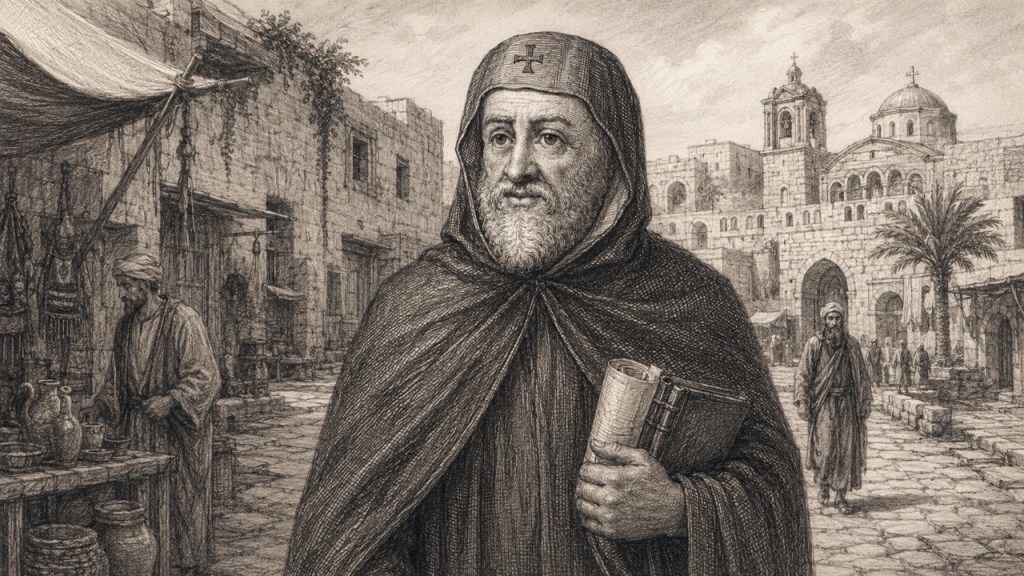
Ephraem the Syrian (c. 306–373), deacon of Edessa and the most celebrated of the Syriac fathers, is credited with a commentary on the Pauline epistles whose Syriac original is lost. It survives only in an Armenian version, which the Mekhitarist fathers of San Lazzaro rendered into Latin and published as S. Ephræm Syri commentarii in epistolas D. Pauli (Venice, 1893); the translation below follows that edition’s treatment of Colossians at pages 169–178. The English therefore stands two steps removed from Ephraem’s own words, and his authorship of the commentary in its transmitted form is not beyond dispute.
Text
TO THE COLOSSIANS.
The Colossians had been taught by Epaphroditus, who was one of them. After his instruction, some philosophers and Hebrews came to offend them. The Hebrews compelled them to observe the law, while the philosophers told them: This world was made from the disposition of created things, and not from nothing, as some teach you. Furthermore, when Paul learned this from Epaphroditus—that they had indeed received the Gospel, and that Hebrews and Gentiles were frequenting them—he set out to write to them, saying this at the very beginning of his Epistle:
Paul, an Apostle of Jesus Christ, and Timothy, brother.
Paul wrote the name of a brother along with that of an Apostle in his letter, to be a clear example to priests: for although the title of Presbyter is superior to that of Brother, he himself wrote things that are inferior to an Apostle with his own titles.
To the saints, he says, and to the faithful. He calls the baptized “saints,” and he names the catechumens “faithful.”
I give thanks to God the Father of our Lord, and not to the creator and maker of our Lord, with our prayers on your behalf preceding.
Especially when we heard of your true faith in the Lord Jesus Christ, and the great love you have for all the saints, that is, for all the poor.
Especially because of the hope, by which we expect that you will receive your offerings in heaven: which you have not heard now, but before.
[170]
For it was not preached to you alone, separately, with partiality, or as if in passing, but it was preached to you just as to the whole world. And just as throughout the whole world, so also this Gospel grows and bears fruit in all of you. But the fruit abounded and multiplied more among you from that time when you heard and saw the grace of God in truth.
As you learned from Epaphras, our dearest fellow servant, who is a faithful minister of Christ for you: that is, through his testimony and intercession, the ministry of Christ was made faithful to you. For he told us not of your carnal love, but of your love in the spirit, which you have towards us.
Therefore, from the day we heard, we have not ceased to pray for you, that you may be perfect in this knowledge, in all wisdom not of created things, as some compel you, but in all spiritual understanding: And that you may be fruitful, and moreover growing not in earthly knowledge, but in the knowledge of God: And that you may be strengthened in all virtue, that is, so that you may be able to perform for me all the virtues of faith alone according to the ministry which was given in the midst of the Church for the glory of God: namely, in all patience towards persecutors, and in longsuffering for the promises.
And that with joy you may give thanks on that day to the Father who made you worthy for a share of the lot, namely in the kingdom of heaven, which was evangelized to the saints, in the world of light. And he snatched us from the power of Satan, the offender of souls, whose example is the darkness which offends the body: and he transferred us, say, from the Gehenna prepared for you with Satan, and you are in the kingdom which the love of his Son gave to you,
[171]
For in him redemption was made for us through his cross and blood, and the expiation of the remission of sins, that is, through the sacrament of his baptism.
He who through his manifest works is the image of the invisible God: and he himself is the firstborn of all creation. He spoke of the flesh, which before all things was in the thought of the one clothing it.
And he himself is the head of the body of the Church, here and there, and he himself is the beginning of the resurrection, the firstborn of the dead. For just as when he was not the firstborn of the dying, he made him the firstborn of the resurrection, so he established and made him the elder, making him the firstborn of creatures, while he was born in the very age of the Apostle. Besides, just as his divinity was subjected to ignominy in his humanity, so he honored his humanity in his divinity.
In him, he says, were created the visible and the invisible, that is, all things that are and are to be made in both worlds: whether thrones or dominions. He spoke either of the kingdoms of the earth or of the thrones of the Apostles. He called them lords on account of the judicial tribunal of kings, who kill and save by their own power, like God; or on account of the future judgment of the Apostles, who decree their tributes, like lords, into eternal fire. Whether principalities or powers. This prevails over those above and those below, and over the hosts of that evil one.
And he is before all. This is what was said: In the beginning was the Word.
And he is the head of the body of the Church; that is, through him the Church was planted on earth.
And he is the firstborn of the dead in deed, but by the power of the word, so that in all things he himself holds the primacy. For just as he is before creatures, he is also before all the works of those below.
And in him all the fullness of God was pleased to dwell, either the Father in the Son, or the Son in the flesh.
[172]
And through him to reconcile: that is, by the same flesh he was reconciled with men, making peace in his blood through the cross in himself, both things in heaven and things on earth, namely those above with those below.
And you, who were once enemies of God through your evil works: But now you have been reconciled, not in a heavenly body, but in the members of his flesh: and through his death he has established you before himself as holy and blameless: that is, they have been cleansed by the washing of water, and have stood in his sight without blemish.
If, however, you remain firm in this faith of yours, which has cleansed you through the waters of baptism, and immovable from seductions and persecutions, and that you may be immovable from that promised hope of the Gospel, which was preached throughout the whole world: of which I, Paul, was made a minister among the Gentiles.
But I am not saddened by the passions which I have suffered and do suffer. Now therefore I rejoice in my sufferings for you, because I strive to fulfill in my flesh, say, that I may carry in myself the heap of the tribulations of Christ’s passions for the life of the world. For if he wished to be anathema from Christ for the life of the crucified, how much more would he give up the manifest life of his body for the Gentiles, namely for his body, which is the Church. That is, for the body of Christ I wish to fulfill the lack of his Church with the passions of my body: Of which I was made a minister, not according to my works but according to the mysteries of the dispensation of the divinity calling me from the road to Damascus. Which was given to me for them, that is, that in you I may fulfill the word of Christ.
For this mystery of the body and blood, which was hidden from the generations from the times of the ages, has now been revealed to his saints. To whom God willed to reveal through the washing of baptism,
[173]
what are the riches of the glory of the same living body, which is Christ, who is with you the hope of glory; because you hope in him, and you await the glory promised to you.
Which we also preached and announced to you, not to you only separately, but teaching every man in wisdom.
And this is my labor in fasts, and the striving of my struggle in prayer and persecution, led by God, who prevails in me, in the virtue which he gives me, and the works which he works through me: that I may confirm not one man, nor one Gentile people, but that I may establish every man perfect in Christ.
II.
Great is the labor of the struggle which I have in my prayers, not for you alone, but also for the Laodiceans and for those who have not seen my face in the flesh: But I do this so that, even absent, I may console their hearts from the sadness of their enemies, and that they may be instructed by charity into all the riches of fullness, in faithfulness, not in contention and stubbornness, together with the understanding of the knowledge of the mysteries of God, knowing that is, the mysteries of God, because he himself is the body of Christ.
For in him were revealed all the treasures of wisdom, that is, all the hidden promises of God.
Therefore, let no one deceive you with fallacious words.
For even if I am absent from you in body, yet in spirit I am with you. Gladden me as if I were present, not only through your good works, but also that the poverty of your faith may be made perfect.
Therefore, as you have received Jesus Christ, that is, the Gospel of Jesus Christ, walk in it.
[174]
Rooted and strengthened, lest one of those winds, either the sophists or the Hebrews, should move you. Be confirmed, therefore, in the faith which you have learned, so that through it you may be able to abound also in the giving of thanks.
Therefore, see that no one despoils you of this faith through the perseverance of philosophy, which makes faith blush: nor be led into error in the perseverance of the vanity of men: nor follow the elements of this world, that is, do not follow the four natures and think that all things were made from them and not from nothing: but walk in the doctrine of Christ.
Because in him dwells all the fullness of the divinity bodily, and not in the doctrines of men, who through their madness are the dwelling place of demons. But in him dwells all the fullness of the divinity. And it is filled and enriched by him. He used the very saying of his Lord, who said: “I am in the Father, and the Father is in me.” But he is the head of every principality and power, that is, the Lord and creator and leader of principalities and powers.
And in him you were circumcised, not with the circumcision of the Hebrews, which is done by the instrument of the hand in the despoiling of the flesh, when that is, the circumcised member is despoiled, but in the circumcision of Christ; this is the baptism of Christ, which strips you of your old humanity.
And in him you have risen with him through faith, that is, through your faith in the resurrection, you have as it were risen with him, before you had fallen, in the power of God. For he raised him from the dead for this reason, that he might grant us to acquire faith in the resurrection of the dead.
And you, who were once dead in your sins, he has made alive with him in the promise and has granted and forgiven all your sins through baptism.
[175]
And he has blotted out through his living commandments the sentence of sin written in the old law: for all the Gentiles were held by it in the sword and in destruction: and the curse of the law, standing against us, he took away from the midst of all men through his body, nailing it to the wood of the cross, because he himself was made a curse for us. And he not only took away the curse, but he also took away the name of divinity with which the idols were adorned.
And he despoiled the principalities and powers (of the idols), and made a public spectacle of them, because he taught that they were created things, and in them he showed the signs of his victory. For they were not sufficient to help their worshippers, lest they be led away from them, nor the name with which they were adorned, lest he should strip them of it.
Therefore, after so many great things have been done for you, let no one coming move you with weak things, namely in food, or in drink, or in a new moon festival, or in an annual Hebrew festival: for these, with the Sabbath, are traces of future times: but the body, in which these things are comprehended and destined, is Christ, whom we have preached.
Lest anyone, wishing to imitate the humility of our mind, should come and lead you astray, and not transfer you into the law of the Angels, that is, into the doctrine of priests: as if he had seen something, not from the Scripture of the spirit itself, but from his own sense: for such a one is puffed up in vain in his own inventions, because they are the inventions of the sense of his flesh: And he has not held to the head, Abraham: for it was promised to him that in his seed all the nations would be blessed: from which the whole body of the Church, strengthened by connections and conjunctions, that is, by all the testimonies and all the examples which are from the Scriptures of the spirit, is built up and grows into the increase of God, that is, into a spiritual, not a carnal, increase.
. Abraham
[176]
If therefore you have died with Christ from the creatures of this world, that is, from the earthly promises of the law; why are you still, as if living here in the world, initiated into this?
“Do not touch,” he says, “and do not handle.” That is, “do not touch,” he says, “a leper, and do not handle one who is constantly suffering from a discharge.” “And do not taste,” he says, “the food of the Gentiles.”
For these are the use of corruption, that is, because they have passed into old age, decay, and corruption. Perhaps because they are corrupt, the faithful sense called them this, not that the precepts of that doctrine are the use of corruption, but that they are of men, not of God.
But in these same things there is also some reason for wisdom and superstition: that is, for the sake of these things they conduct themselves wisely and humble themselves, so that through wisdom and humility they may captivate men into the observance of the law, and not to the sparing of the body; for they circumcise and torment the body; but not to any worthy honor for the fullness of the flesh: that is, they are in carnal senses, insofar as they are in the law, which defiles marriage in their eyes.
III.
Therefore, if you have risen with Christ in faith, seek the things that are above, that is, savor spiritual things: where Christ is sitting at the right hand of God, there let your minds be, not with the earthly things of the law.
For you have died to the rest of the world, and your life is hidden in Christ with God, that is, your secret life is hidden in Christ.
When Christ, your life, is revealed, then you also will be revealed in his glory, which he promised you in his first coming.
Therefore, put to death your members, that is, the body of your old
[177]
man: such as fornication, impurity, and the painful lusts of evil concupiscence with the rest.
For on account of these things the wrath of God comes in the end.
You were certainly not strangers to these sins, but you also once walked by will, when you lived in all of them.
But now strip off the old humanity with its deeds. And put on the new, which is renewed through baptism, and is made without sin in the likeness of the image of the form of its Creator.
Where there is neither Jew nor Gentile, nor circumcision, nor uncircumcision, nor Greek, nor Barbarian, nor master, nor slave: But what kind of place is it, in which all these things are not? Except baptism, and the kingdom of heaven; yet in the midst of each of them, Christ is all in all, universally.
Therefore, put on, and be sober, like the holy and elect of baptism, bowels of mercy, mercifully pitying one another.
And be thankful for those things which you have previously received.
And let the word of Christ dwell in you abundantly for teaching others also: and be full of grace for blessing; that is, let those full of grace praise God in their hearts.
IV.
In your prayer, be mindful also of us. See, I ask, the humility of the Apostle, that he asked his disciples to pray for him, that God might open to him a door of speech to speak the mystery of Christ.
But the door of speech is either the ear of the hearers, or the signs to be done by him: for by signs the door was opened, or by the ears
[178]
because they were inclined to listen to him. For on account of his mystery I am bound.
That I may make it manifest, among the saints, and speak with fear and trembling, as is fitting for me.
As for the rest, what concerns me, namely about the tribulation among us, and about our comfort, and about our joy in our tribulations, Tychicus, the faithful minister, will make known to you.
For this reason I sent him to you, that with him declaring to you our great tribulation, your hearts may have solace on account of your lesser tribulation, which you are enduring.
And say to Archippus: See to the ministry which you have received from the Lord, that you may hand it over full and perfect into his hand, who is to remain after you in the Lord.
Latin Text
Source Link: https://archive.org/details/commentariiinepi00ephruoft/page/168/mode/2up?view=theater
AD COLOSSENSES.
Colossenses edocti erant ab Epaphrodito, qui ex eis erat. Post hujus instructionem venerunt aliqui ex Philosophis, et Hebræis ad illos offendendos. Hebræi quidem ob legis observantiam cogebant cos: Philosophi autem illis dicebant: Ex dispositione creaturarum factus est hic mundus: non autem ex nihilo, sient nonnulli vos docent. Porro quum novit Paulus, et didicit ab Epaphrodito hæc dno. quod nimiruma acceperant illi Evangelium, et quod frequentarent ad eos Hebræi et Ethnici, aggreditur scribere ad illos, sie dieens in Epistolæ sme initio :
I.
Paulus Apostolus lesu Christi, et Timothens fratres.
Nomen fratris una cum Apostolo scripsit in Epistola sua Paulus, ut exemplo manifesto sit sacerdotibus: quamvis enim nomen Presbyteri superior sit Fratre, ipse tamen cum nominibus suis ea quæ Apostolo inferiora sunt scripsit.
Sanctis, inquit, et fidelibus. Sanetos baptizatos appellat. et fideles autem catechumnenos nominat.
Gratias ago Deo Patri Domini nostri, non autem creatori ae conditori Domini nostri, prævenientilms orationibus nostris pro vobis.
Maximè quando andirimus fidem restram veram in Domino Jesu Christo, et dilectionem vestram magnam, quam habetis in sanctos omnes, idest in omnes pauperes.
Præsertim propter spem. qua expectamus, in cælis vos accepturos oblata vestra: quam non quidem nune andistis, sed antea.
Non enim vobis solis seorsum personarum acceptione, ant velut obiter prædicatum est, sed praedicatum fuit vobis. sient universo mundo, Sicut antem per universum mundum. sic etiam crescid hoe Evangelium, et fructificat in cobis omnibus.
Magis autem abundavit, et multiplicatus est fructus apud vos ab eo tempore, quo audistis, et vidistis a gratiam Dei in veritate.
Sicut didicistis ab Epapbro charissimo conserro nostro, qui est fidelis pro robis minister Christi: per hujus scilicet testificationem atque intercessionem fidele factum est vobis ministerium Christi.
Ille enim narrarit nobis non dilectionem vestram carnalem, sed dilectionem restram in spiritu, quam habetis erga nos.
Ideo et nos, ex qua die audirimus, nou cessamus pro robis orare, ut perfecti sitis in hac scientia, in omui sapientin non creaturorum, sient nonnulli vos cogunt, sed in omni intellecta spiritali:
Et sitis fructificantes, et crescentes insuper non in terrena scientia, sed in scientia Dei:
Et in omni virtute confortemini, idest ut mihi omnes virtutes solins fidei possitis operare secundum ministerium. quod datum est in medio Ecclesiæ ad gloriam Dei: in omni scilicet patientia erga persecutores, et longanimitate ad promissa,
It cum gaudio gratias agatis in illa die Patri qui dignos ros fecit in partem sortis, in regnum nimirum coelormn, quod evangelizatum est sanctis, in mundo luminis.
Et eripuit nos de potestate satane offensoris animarum. cujus exemplum sunt tenebre, quæ offendunt corpus: et transtulit nos, puta, de gehema parata vobiscum satane.
et estis in repuum, quod dilectio Filii ejus dedit vobis,
In co enim facta est nobis redemptio per crucem ejas, et sanguinem, et expiatio remissionis peccatorum, idest per saeramentum baptismatis ejus.
Qui per manifesta opera sua est imago Dei invisibilis: et ipse est primogenitus omuis creature. De carne dixit, que ante omnia erat in cogitatione vestientis cam.
Et ipse est caput corporis Ecclesiæ hic et illic et ipse est principium resurrectionis, primogenitus mortuorum. Quemadmodum enim quuu non esset ille primogenitus morientium, fecit cum primogenitum resurrectionis, sie statuit senioremque effecit. faciens eum primogenitum creaturaruin, dum in ipsa zetate Apostoli natus erat.
Præter sicut ignominiæ subjeeta est divinitas ejus in humanitate sua, sic honoravit humanitatem suam in sua divinitate.
In ipso, ait, condita sunt risibilia, et invisibilia, omnia scilicet, quæ freta, atque facienda sunt in utroque mundo: sive throni, sire dominationes: aut de regnis terræ dixit, aut de thronis Apostolorumn. Dominos autem vocavit illos /propter judiciale tribunal regum, qui propria occidunt. et salvant potestate, ut Deus; vel propter futurum judicium Apostolorum.qui decernunt tributa sna, sient domini. in ignem æternum. Sive principatus, sire potestates. Hoc prævalet in supernos, et inferos, et in exercituum maligni illius.
Et ipse est ante omnes: istud est, quod dietum est: In principio erat Verbum.
Et ipse est caput corporis Ecclesiæ; idest. per cum plantata est Ecclesia in terra.
Et ipse est primogenitus mortuorum opere, sed verbi potestate ut sit in omnibus ipse primatum tevens.
Sient enim prior creaturis est ipse, prior est et universis operibus inferiorum.
Et in ipse complacuit omnem plenitudinem Dei inhabitare aut Patrem in Filio. ant Filium in carne.
Et per eum reconciliare: idest cadem carne reconeiliatus est cum hominibus: parificans, in sungaine suo per crucem in semetipso, sice que in calis, sive que in terra sunt, superos videlicet cum inferioribus.
Et cos, qui aliquando inimici eratis Dei per mala opera vestra:
Nunc autem reconciliati estis, non in coelesti corpore, sed in membris carnis ejus: et per mortem suam constituit vos coram se sanctos, et immaculatos: hoc est expiati sunt lavaero aqme, et steterunt in conspectu ejus sine maeula.
Si tamen permanetis firmi in fide ista vestra, quæ expurgavit vos per aquos baptismi, et immobiles ex seductionibus, et perseentionibus, et immobiles sitis a promissa illa spe Evangeliü. quod prædicatum est per anirersam orbem: cujus factus sum ego Paulus minister inter Gentes.
Nihil autem contristor de passionibus, quas passus sum. et patior. Nunc ergo gaudeo in passionibus pro vobis. quia implere studeo in carne mea: puta, ut congeriem tribulationis passionum Christi in meipso portem pro vita mundi. Si enim anathema fieri a Christo pro vita erneifixorum vellet, manifestam vitam corporis sui quanto magis traderet ille pro Ethnicis, nimirum pro corpore ejus, quod est Ecclesia. Idest. pro corpore Christi volo passionibus corporis mei implere defectum Ecclesiæ ejus:
Cujus factus sum ego minister, non secundum opera mea sed secundum mysteria dispensationis divinitatis vocantis me de itinere Damasci.
Quæ, data est mihi in cos. idest, ut in vobis impleum verbum Christi.
Nam mysterium hoc corporis, et sanguinis, quod absconditum erat a generationibus ex temporibus sæculoruun. nune manifestatum est sanetis ejus.
Quibus coluit Deus per lavacrum baptismatis manifestare, quæ sint diritiæ gloriæ ejusdem corporis vivi, quod est Christus, qui est vobisenm spes gloriæ; quia scilicet speratis in co, et expectatis gloriam vobis promissam.
Quam et nos praedicavimus vobis, et annuntiavimus non vobis tantum separatim, sed docentes omnem hominem in sapientia.
Et hie est labor meus in jejuniis, et studium certaminis in oratione, et persecutione, perductus a Deo. qui prævalet in me, in virtute, quam ille dat nihi, et operationes quas operatur per me: ut confirmem non unum hominem, neque unum populum Ethnienm sed ut constituam omnem hominem perfectum in Christo.
II.
Magnus est labor certaminis, quod ego habeo in orationibus, nou pro robis solis, sed etiam pro Laodiciensibus et pro iis, quicumque non viderant faciem meam in carne:
Hoc autem facio ut vel absens consoler corda ipsorum ex tristitia inimicorum corum, et ut instruantur a charitate in omnes divitias plenitudinis, in fidelitate, nou in contentione, et indocilitate, una cum intellectu agnitionis mysteriorum. Dei. agnoscendo scilicet et mysteria Dei, quia ipse est corpus Christi.
In ipso enim revelati sunt omnes thesauri sapienticemenin omnes videlicet promissiones Dei abscondita.
Nemo itaque ros decipiat verlis fallacibus.
Nam etsi corpore absens sum a vobis, sed spiritu adsum robis letificate me sient presentem, non per sola bona opera vestra, sed ut etiam perfecta sit penuria tidei vestre.
Sicut ergo accepistis Jesum Chistum. puta, Evangelium Jesu Christi, in ipso ambulate.
Rudicati, et consolidati, ne forte unus ex ventis illis, sive sophistis, sive Hebraeis, moveat vos.
Confirmamini ergo in fide, quam didicistis: ut per hane possitis abundare et in gratiarum actione.
Itaque ridete, nequis ros expoliet hae tide per philusophia persererationem, quæ erubescere tacit fidem: neque in errorem in perseverantia vanitatis hominum seducamini: neque per elementa Injus mandi, idest neque quatuor naturas sequamini et arbitremini ab illis omnia facta fuisse. et non ex nihilo: sed ambulate in doctrina Christi.
Quia in ipso inhabitat omnis plenitudo dirinitatis corporaliter, non autem in doctrinis hominum, qui sunt per insanias suas habitaculum dæmoniorum. In ipso autem habitat omnis plenitudo dirinitatis,
Et est illo repleta et pinguefacta. Ipsum Domini sui dictum usurpavit, dicentis: Ego in Patre sum, et Pater in me est. Est autem ille caput omnis principatus, et potestatis, Dominus scilicet, et creator, et dux principatumum. et potestatum.
Atque in ipso circumcisi estis, nou circumcisione Hebræorum, quæ fit istrumentu manus in expoliatione carnis. eum videlicet expoliatur membrum circumcismn, sed in circumcisione Christi; ea est baptismus Chuisti, qui exuit vos veterem humanitatem vestram.
Et in co resurrexistis cum co per fidem idest per fidem vestram de resurrectione quasi resurrexistis cum illo, antequam lapsi fuissetis, in virtute Dei. Siquidem propter hoe suscitavit illum a mortuis, ut daret nobis acquirere fidem resurrectionis mortuorum.
Et ros. qui olim mortai erutis in peccatis vestris, convivificavit cum illo in promissione et donarit dimisitque omnia pocenta vestra per baptismum.
Et delerit per viva mandata sua sententiam peccati in veteri seriptam: omnes enim Ethnici in gladio et in interitu detinebantur ei: et maledictionem legis perstantem contra nos per corpus suum tulit de medio, ab omnibus nempe hominibus affigens illam ligne crucis, co quod ipse fnit pro nobis maledictio.
Nec tantum maledictionem tulit. verunt etiam nomen divinitatis, quo decorabantur idola. abstulit.
Et expoliarit principatos, et potestates idolorum), et palam traduxit, quoniam edocuit, illa facta esse: et monstravit in illis signa victoriæ suæ. Siquidem non fuerunt satis ad adjuvandos adoratores suis, ne abducerentur ab eis: neque nomen, quo exornati erant, ne illns co exueret.
Nemo ergo post tot magnos res vobis factas veniens dimoveat ros intirmis rebus. in cibo videlicet, aut in pota, aut in neomrnie festo, aut annuali festivitate Hebreorum: have enim cum sabbato restigia sunt futurorum temporun: corpus autem, in quo comprehensa ae destinata lee sunt. Christus est, quem nos prædicavimus.
Nequis forte humilitatem mentis nostre volens imitari veniat, et seducat ros, neque transmitet in legem Angelorum. in doctrinam nimirum sacerdotum: quasi aliquid viderit. non ex ipsa Seriptura spiritus, sed ex sensu proprio: frustra enim inflatus est hujusmodi in adinventionibus suis, quia inventiones sensus carnis ejus sunt :
Et non tennerit a capite Abrahamo: illi enim promissum fuit, quod iu semine ejus benedicerentur omnes gentes: ex quo totum corpus Ecclesire consolidatum per necus, et conjunctiones, ennetis scilicet testimoniis, et omnibus exemplis, quæ a Seripturis spiritus sunt. construitur. crescitque in augmentom Dei, idest in angmentum spiritualem, non carnalem.
. Abraham
Si ergo mortui estis Christo a creaturi hujus mnudi, a terrenis nimirum promissis legis; quid arthur tumquam civentes hic in mundo cum isto inticiamini?
Ne tetigeris, inquit, neque contrectareris: idest, ne tetigeris, ait, leprosum, neque contrectaveris fluxu semper laborantem: neque, ait, gustaceris cibum Ethnicorum,
Hæc enim sunt usus corruptionis, idest, quia in vetustatem, deeretionem, et corruptionem abierunt. Fortassis quia illa corrupta sunt, sensus fideles have vocavit, non usus corruptionis præcepta illa sunt doctrinæ, non Dei, sed hominem.
In iisdem autem est et aliqua ratio sapientiæ, et superstitionis: idest, horum gratia sapienter se gerunt et humiliantur, ut per sapientiam, et humilitatem captivent homines in observationem legis, et non ad parcendum corpori; nam circumcidunt, et cruciant corpus; non antem in condignum honorem quendam ad plenitudinem carnis: idest, in sensibus carnalibus sunt, quatenus in lege sunt. que coinquinat matrimonium in oculis corum.
III.
Igitur, si consurreristis cum Christo in file, quæ sursum sunt, quærite, spiritualia videlicet sapite: ubi Christus est in dextera Dei sedens, ibidem sint mentes vestræ, non apud terrena legis.
Mortui enim estis a quiete mundi, et rita restra est abscondita in Christo apud Deum, vita scilicet vestra areana abscondita est in Christo.
Quum Christus revelabitur rita vestra, tune et ros revelabimini in gloria ejus, quam in adventu suo primo pollicitus est vobis.
Mortificate ergo membra restra, corpus videlicet veteris hominis vestri: ut sunt fornicatio, immuuwditia, et libidines dolorose conenpiscientiæ maie cum cæteris.
Propter hæc enim venit ira Dei in fine.
Non utique alieni ab istis peecatis vos eratis, sed et ros aliquando voluntate ambulabatis, cum riveritis in illis omnibus.
Nune autem expoliate ros reterem humanitatem cum actibus suis.
Et induite noram, quæ renovatur per baptismum. et efficitur sine peccato ad similitudinem imaginis formæ Creatoris sui.
Ubi non est Judous, neque Gentilis, nec ec circumcisio. neque præputium. nec Græcus, neque Barbarus, nee dominus, neque servus: Qualis autem locus est, in quo non sint have omnia? nisi baptisma, et regnum cælorum; in medio tamen miuscujusque eorum omnia in omnibus universim Christus est.
Induite ros ergo, et sobrii estote. sirut sancti, et electi baptismatis, riscera misericordie, clementer miserti vestri invicem.
Et grati estote propter ea, quæ prius accepistis.
Et cerbum Christi habitet in robis abundanter ad docendos alios quoque: atque pleni gratia estote ad benedicendum; idest pleni gratia landent Deum in cordibus suis.
IV.
In oratione memores simul estote et nostri. Vide. quaeso, humilitatem Apostoli, quoniam a discipulis suis postulabat ut pro eo orarent. at Deus aperiat ei ostirm sermonis ad loquendum mysterium Christi.
Ostium autem sermonis vel auris auditorum est. vel sigua per eum facienda: nam per sigua aperiebatur ostium, aut per aures quia inclinabantur ad auscultanıdıma en. Siquidem propter mysterium ejus rinctus sum.
I’t manifestem illud, inter sanctos, et loquar cum can timore et tremore, at convenit mihi.
Cæterum, quæ circa me sont, de tribulatione nimirum apud nos, et de confortatione nostra, atque de gaudio nostro in tribulationibus nostris, uotu faciet robis Tychicus fidelis minister.
Propter hoc enim misi eum ad ros, ut co declarante vobis de magna tribulatione nostra solatium habeant corda vestra ob minorem tribulationen vestram, quam sustinetis.
Et dicite Archippo: Vide ministerium, quod accepisti a Domino, ut plenum perfectumque tradas hoe in manum ejus. qui post te mansurus est in Domino.
 Institute for Colossians Studies