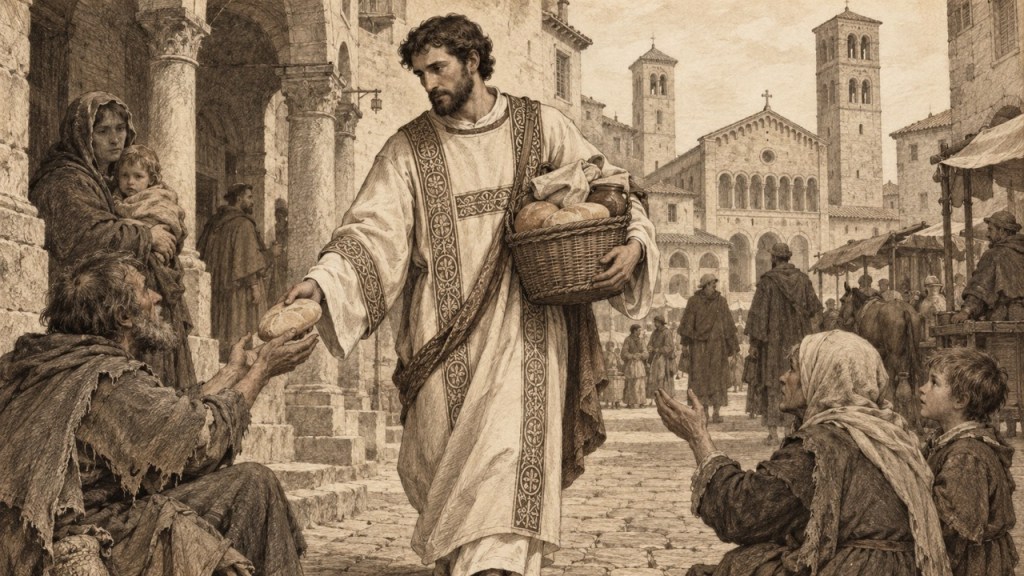
Florus of Lyon (d. c. 860), deacon of the church of Lyon, assembled an Expositio on the Pauline epistles built entirely from the works of Augustine. What follows is therefore not a commentary of Florus’s own composition but a catena — passages he selected from Augustine and arranged against the text of Colossians, so that the exegesis is Augustine’s and the editorial judgment is Florus’s.
SOURCE: Florus of Lyon. “In Epistolam ad Colossenses.” In Expositio in Epistolas Beati Pauli ex Operibus S. Augustini. Patrologia Latina 119, edited by J.-P. Migne, cols. 389–393. Paris: Garnier Frères, 1880. Internet Archive.
TRANSLATION: Florus of Lyon. Exposition on the Epistle to the Colossians from the Works of Saint Augustine. Translated by Phil Thompson. Greenville, SC: Institute for Colossians Studies, 2026.
Licensed under Creative Commons Attribution 4.0 International (CC BY 4.0): https://creativecommons.org/licenses/by/4.0/
Text
[page 1]
NINTH CENTURY
OF NICHOLAS I
ROMAN PONTIFF
EPISTLES AND DECREES
ACCURATELY REPRODUCED FROM MANSI’S MOST EXCELLENT EDITION OF THE COUNCILS AND ARRANGED IN CHRONOLOGICAL ORDER.
PRECEDED BY THE
COMPLETE WORKS
OF BLESSED SERVATUS LUPUS, ABBOT OF FERRIÈRES; FLORUS, DEACON OF LYON; RODULFUS OF BOURGES; WALTER OF ORLÉANS; AND ROTHAD II OF SOISSONS.
EDITED BY J.-P. MIGNE,
EDITOR OF THE UNIVERSAL LIBRARY OF THE CLERGY, OR COMPLETE COURSES IN EACH BRANCH OF ECCLESIASTICAL SCIENCE.
SINGLE VOLUME.
PARIS. AT THE PRESSES OF GARNIER BROTHERS, EDITORS AND SUCCESSORS TO J.-P. MIGNE, ON THE STREET CALLED AVENUE DU MAINE, 189, FORMERLY CHAUSSÉE DU MAINE, 127.
1880
[page 389]
ON THE EPISTLE TO THE COLOSSIANS.
ARGUMENT.
The Colossians, like the Laodiceans, are Asians, and they too had been anticipated by false apostles. The Apostle himself did not visit them either; rather, he corrects them as well by means of an epistle. For they had heard the word from Archippus, who accepted a ministry toward them. Therefore the Apostle, already in chains, writes to them from Ephesus by the deacon Tychicus and the acolyte Onesimus.
CHAPTER 1
“Paul, an apostle of Jesus Christ,” etc., up to “who has made us worthy to share in the lot of the saints in light.” (Col 1:1–12) That tunic of the Lord woven from the top down, etc., up to “it is a lot for you.” (Id., Expositions on the Psalms, Psalm 30, vol. 4, part 1, col. 246ff.)
“Who rescued us,” etc., up to “of the Son of his love.” (Col 1:13) Whoever you are reading this, and the grace of God, etc., up to “deliver us from evil.” (Id., Expositions on the Psalms, Psalm 105, vol. 4, part 2, col. 1416ff.)
“However, he does not say, my kingdom is not here, but it is not from here,” etc., up to “not from here.” (Id., Tractates on the Gospel of John, vol. 4, part 2, col. 1939ff.)
If the love by which the Father loves his Son, etc., up to “is begotten.” (Id., On the Trinity, Book 15, vol. 8, col. 1082ff.)
If the love by which the Father loves his Son, etc., up to “is begotten.” (Id., On the Trinity, Book 20, vol. 8, col. 1082ff.)
If we truly want to defend free will, etc., up to “into the adoption of sons.” (Id., Letter to Vitalis, vol. 2, col. 281ff.)
“In whom we have,” etc., up to “the image of the invisible God.” (Col 1:14–15) It is not difficult to see the devil defeated, etc., up to “not a spirit.” (Id., On the Trinity, Book 13, vol. 8, col. 1028ff.)
To a certain extent a human being will be an imitator of God like an image, etc., up to “the image of the king.” (Id., Sermon on the Ten Strings, vol. 5, part 1, col. 82.)
In the first three precepts of the Decalogue, which relate to God, etc., up to “but with him.” (Id., Letter to Januarius, Book 2, vol. 2, col. 213.)
“The firstborn of all creation,” etc., up to “all things hold together in him.” (Col 1:15–17) According to the form of God it was said, “Before all the hills he begot me,” etc., up to “head” of the body of the Church. (Id., On the Trinity, Book 2, vol. 8, col. 857.)
The Catholic faith, which distinguishes between the Creator and the creature, etc., up to “all things to be reconciled in him.” (Id., Against Secundinus the Manichaean, vol. 8, col. 381ff.)
“And he is the head,” etc., up to “he himself holding first place.” (Col 1:18) It is one thing to only become wise through the wisdom of God, etc., up to “is most rightly said.” (Id., The Christian Combat, vol. 6, col. 301ff.)
The whole Christ is preached according to the Church, that is, head and body, etc., up to “the city of the great King.” (Id., Sermon on the Three Ways of Understanding Christ, vol. 5, part 2, col. 1499ff.)
Therefore it is no surprise if for the sake of an example, etc., up to “who was given to us.” (Id., On the Trinity, Book 7, vol. 8, col. 938.)
“Because it pleased God that in him,” etc., up to “the creation which is under heaven.” (Col 1:19–23) Through that unique sacrifice, in which the mediator was offered, etc., up to “they see the face of the Father.” (Id., Enchiridion, vol. 6, col. 261.)
“Of which I became,” etc., up to “was given to me for you.” (Col 1:23–25) We must understand the person of the Church, etc., up to “the age will be finished.” (Id., Expositions on the Psalms, Psalm 61, vol. 4, part 1, col. 730ff.)
See what the Apostle said, that in him Christ, etc., up to “in my flesh.” (Id., Expositions on the Psalms, Psalm 86, vol. 4, part 2, col. 1104.)
He says, “To make up what is lacking in the afflictions”—not my own, but Christ’s, etc., up to “he would not be persecuting.” (Col 1:24) (Id., Expositions on the Psalms, Psalm 44, vol. 4, part 1, col. 513.)
“To fulfill the word of God,” etc., up to “works in me in power.” (Col 1:25–29) First, wishing to show me, O Lord my God, how you resist the proud, etc., up to “they became fools.” (Id., Confessions, Book 7, vol. 1, col. 740ff.)
For your Word, the eternal truth of your higher creation, etc., up to “like a punishment.” (Id., Confessions, Book 7, vol. 1, col. 748.)
CHAPTER 2
“For I want you to know,” etc., up to “abounding in him in thanksgiving.” (Col 2:1–7) The cause of all human vices
[page 391]
is pride, etc., up to “and is learned.” (Id., On the Spirit and the Letter, vol. 10, part 1, col. 237.)
Now all these things which the Word made flesh for us, etc., up to “might be called.” (Id., On the Trinity, Book 13, vol. 8, col. 282ff.)
“See to it that no one,” etc., up to “not according to Christ.” (Col 2:8) What is Juno? etc., up to “warning that they should be avoided.” (Id., Sermon on the Kalends of January, vol. 5, part 1, col. 1024.)
An answer must be given to those people who disparage the books of our salvation, etc., up to “to have extracted the opinion.” (Id., The Literal Meaning of Genesis, vol. 3, part 1, col. 262.)
“Because in him dwells,” etc., up to “of principality and power.” (Col 2:9–10) God, who is everywhere present, and everywhere fully present, etc., up to “it is a wickedness to want to judge.” (Id., Letter to Dardanus on the Presence of God, vol. 2, col. 845ff.)
It is therefore enough to know that something corporeal, etc., up to “he used the word.” (Id., The Literal Meaning of Genesis, Book 12, vol. 3, part 2, col. 459.)
“The mountain on which it pleased God to dwell,” etc., up to “and you in me.” (Id., Expositions on the Psalms, Psalm 67, vol. 4, part 1, col. 826ff.)
“In whom also you were circumcised,” etc., up to “raised him from the dead.” (Col 2:11–12) Unless that Sabbath itself is also among the prophecies, etc., up to “of the body of flesh.” (Id., Against Faustus the Manichaean, Book 12, vol. 8, col. 354.)
He certainly did not mean two things to be understood, etc., up to “which is called the mind.” (Id., On the Trinity, Book 14, vol. 8, col. 1053.)
“In the circumcision of Christ,” and the rest. (Col 2:11) The resurrection of Christ, which occurred indeed on the third day of his passion, etc., up to “you savor things upon the earth.” (Id., Sermons on the Words of the Apostle, vol. 5, part 1, col. 916.)
“And when you were dead,” etc., up to “all trespasses.” (Col 2:13) He called it foreskin, etc., up to “we are to be stripped.” (Id., Letter to Bishop Paulinus, vol. 2, col. 641.)
“Wiping out what was against us,” etc., up to “nailing it to the cross.” (Col 2:14) Our body, therefore, is dead because of sin, etc., up to “of sins.” (Id., On the Forgiveness of Sins and Baptism of Infants, Book 2, vol. 10, part 1, col. 180.)
You, he says, humiliated the proud one like a wounded man, etc., up to “where he is proud.” (Id., Expositions on the Psalms, Psalm 88, vol. 4, part 2, col. 1126ff.)
“The holy victim by which the handwritten record was wiped out,” etc., up to “the lion and the dragon.” (Id., Confessions, Book 9, vol. 1, col. 778ff.)
“Stripping the principalities,” etc., up to “in himself.” (Col 2:15) From where did the devil receive the outward power to kill the Lord’s flesh, etc., up to “redeeming sinners.” (Id., On the Trinity, Book 4, vol. 8, col. 899ff.)
For when he says that he stripped himself of the flesh, etc., up to “will be completed in the resurrection.” (Id., Against Faustus the Manichaean, vol. 6, col. 300ff.)
He made an example of principalities, that is, he gave an example, etc., up to “they force to serve.” (Id., Letter to Bishop Paulinus, from the book on The Christian Combat, vol. 6, col. 291ff.)
“Therefore let no one judge you,” etc., up to “but the body is Christ’s.” (Col 2:16–17) Our two fathers who were pleasing maintained the order, etc., up to “is read aloud for confirmation.” (Id., Against Faustus the Manichaean, vol. 8, col. 236ff.)
All things that were spoken to the ancient people of Israel, etc., up to “signified the pilgrim members.” (Id., Tractates on the Gospel of John, Tractate 28, vol. 3, part 2, col. 1626.)
First, that error of the Jews must be refuted, by which they think, etc., up to “the fleshly celebration should now cease.” (Id., Against the Jews, vol. 8, col. 52ff.)
“Let no one deceive you,” etc., up to “in any honor to the satisfaction of the flesh.” (Col 2:18–23) In these words a certain facial expression must be employed in the pronunciation, etc., up to “Christ had arrived.” (Id., Letter to Bishop Paulinus, vol. 2, col. 640.)
“Walking in vain, puffed up,” etc., up to “for the growth of faith.” (Col 2:18–19) Not only the empty talkers, however, etc., up to “may be delivered from evil.” (Id., Tractates on the Gospel of John, Tractate 98, vol. 3, part 2, col. 1884.)
“But if you have died,” etc., up to “in the world do you decree?” (Col 2:20) Whatever he suffered, in him we too suffered, etc., up to “of the head and of the body.” (Id., Expositions on the Psalms, Psalm 62, vol. 4, part 1, col. 749.)
Where you find differently and differently, a certain death occurred there, etc., up to “we lived in order to die.” (Id., Tractates on the Gospel of John, Tractate 23, vol. 3, part 2, col. 1588.)
CHAPTER 3
“Therefore, if you have been raised up together,” etc., up to “not the things that are on the earth.” (Col 3:1–2) We have certainly not yet risen as Christ did, etc., up to “For in hope we were saved.” (Id., Against Faustus the Manichaean, vol. 8, col. 251.)
The change which will have no corruption, etc., up to “is in us.” (Id., Sermon on the Resurrection of the Dead, vol. 5, part 2, col. 1627.)
If you want to be heaven: purge the earth from your heart, etc., up to “is in heaven.” (Id., Expositions on the Psalms, Psalm 96, vol. 4, col. 1243.)
“With the sound of the horn trumpet?” etc., up to “we do not wage war according to the flesh.” (Id., Expositions on the Psalms, Psalm 97, vol. 4, part 2, col. 1256.)
According to this faith and hope and love by which, etc., up to “is nothing but the Church.” (Id., Letter to Januarius, vol. 2, col. 205ff.)
“Set your minds on the things that are above,” etc., up to “we ought to strip off.” (Col 3:2–9) (Id., Eighty-Three Different Questions, Question 29, vol. 6, col. 18ff.)
If God formed both the human from the earth and the beasts from the earth, etc., up to “not the things that are on the earth.” (Id., The Literal Meaning of Genesis, Book 6, vol. 3, part 1, col. 348.)
“For you have died,” up to “with him in glory.” (Col 3:3–4) It is manifest, and easily recognized by anyone paying attention,
[page 393]
etc., up to “we considered madness.” (St. Augustine, Letter to Januarius, vol. 2, col. 208.)
Because like grass they will quickly wither, etc., up to “you will appear with him in glory.” (Id., Expositions on the Psalms, Psalm 36, vol. 4, part 1, col. 357ff.)
Therefore all good faithful rich people, etc., up to “you will appear in glory.” (Id., Sermon on the Words in the Proverbs of Solomon, chapter 13, verse 7, vol. 5, part 1, col. 215.)
Let us therefore be upright in heart. The time of glory, etc., up to “you will appear in glory.” (Id., Tractates on the Gospel of John, Tractate 28, vol. 3, part 2, col. 1225.)
“Therefore put to death,” etc. (Col 3:5) Let us be put to death and rise again, etc., up to “slavery.” (Id., Sermon on the Resurrection of the Dead, vol. 5, part 2, col. 1627.)
“Fornication,” etc. (Col 3:5) Nor the greedy, etc., up to “he would doubt.” (Id., On Baptism, Against the Donatists, vol. 9, col. 89.)
“Stripping off,” etc. (Col 3:9) The old man, etc., up to “the image of God.” (Id., Against Faustus the Manichaean, vol. 8, col. 746.)
The blood, he says, etc., up to “of sins.” (Tractates on the First Epistle of John, vol. 3, part 2, col. 1982.)
Him who is being renewed, etc., up to “modesty, patience.” He sufficiently showed where a human being is created in the image of God, etc., up to “might be renewed in knowledge.” (Id., The Literal Meaning of Genesis, Book 3, vol. 3, part 1, col. 292.)
If therefore we are renewed in the spirit of our mind, etc., up to “we put on through faith.” (Id., On the Trinity, Book 14, vol. 8, col. 1004ff.)
This renewal and reformation of the mind according to God, etc., up to “is not itself renewed.” (Id., On the Trinity, Book 14, vol. 8, col. 389ff.)
“Bearing with one another,” etc., up to “so also you.” (Col 3:13) By washing the feet of the disciples who were already good and clean, the Lord signified, etc., up to “may be loosed in heaven.” (Id., Tractates on the Gospel of John, Tractate 38, vol. 3, part 2, col. 1794ff.)
“But above all things,” etc., up to “in all wisdom.” (Col 3:14–16) That tunic cast by lot signifies the unity of all parts, etc., up to “gathers all into one.” (Id., Tractates on the Gospel of John, Tractate 18, vol. 3, part 2, col. 1949.)
“Teaching and admonishing,” etc., up to “to God and the Father through him.” (Col 3:16–17) For not everyone who sounds with his lips, etc., up to “of his Holy Spirit.” (Id., Letter on the Grace of the New Testament, vol. 2, col. 563.)
“Wives, be subject,” etc., up to “fearing God.” (Col 3:18–22) There is also a natural order, etc., up to “happiness.” (Id., Questions on the Heptateuch, Question 152, vol. 3, part 1, col. 590.)
How many in our communion truly, etc., up to “will not lose his reward.” (Id., Against Faustus the Manichaean, vol. 8, col. 255ff.)
This rule is proposed to you, etc., up to “that he might love.” (Id., Sermons on the Words of the Gospel, vol. 5, part 1, col. 118.)
Domestic peace is the ordered arrangement of those living together, etc., up to “of the beneficence of providing.” (Id., Prosper’s Sentences Drawn from Augustine, vol. 10, part 2, col. 1872ff.)
“Whatever you do,” etc., up to “partiality with God.” (Col 3:23–25) God approves it by innocence, etc., up to “partiality with God.” (Id., Prosper’s Sentences Drawn from Augustine, vol. 10, part 2, col. 1869-1877.)
The name and condition of slavery, etc., up to “the son is corrected.” (Id., ibid., col. 1873.)
CHAPTER 4
“Masters, what is just,” etc., up to “you have in heaven.” (Col 4:1) Even if our righteous fathers had slaves, etc., up to “to tolerate that they are slaves.” (Id., The City of God, Book 19, vol. 7, col. 644.)
Just as in the authorities of human society, etc., up to “so God in all things.” (Id., Prosper’s Sentences Drawn from Augustine, vol. 10, part 2, col. 1873.)
Those who say that the teaching of Christ is contrary, etc., up to “to be of the republic.” (Id., Letter to Marcellinus, vol. 2, col. 532.)
“Devote yourselves to prayer,” etc., up to “have been a comfort to me.” (Col 42–11) John says Even if anyone has sinned, etc., up to “he may intercede.” (Id., Tractates on the First Epistle of John, vol. 2, col. 532.)
“Epaphras greets you,” etc., up to “be with you. Amen.” (Col 4:12–18) If we say that this perseverance, so praiseworthy, etc., up to “that it may be persevered by us.” (Id., On Rebuke and Grace, vol. 10, part 1, col. 921ff.)
[page 1]
SÆCULUM IX
NICOLAI I
PONTIFICIS ROMANI
EPISTOLÆ ET DECRETA
AD PRÆSTANTISSIMAM EDITIONEM CONCILIORUM MANSI ACCURATISSIME EXPRESSA ET JUXTA TEMPORUM SERIEM DIGESTA.
PRÆCEDUNT
B. SERVATI LUPI ABBATIS FERRARIENSIS; FLORI DIACONI LUGDUNENSIS, RODULFI BITURICENSIS, WALTERII AURELIANENSIS, ROTHADI II SUESSIONENSIS,
OPERA OMNIA
ACCURANTE J.-P. MIGNE,
Bibliothecæ Cleri universæ SIVE CURSUUM COMPLETORUM IN SINGULOS SCIENTIÆ ECCLESIASTICÆ RAMOS EDITORE.
TOMUS UNICUS.
PARISIIS APUD GARNIER FRATRES EDITORES ET J.-P. MIGNE SUCCESSORES, IN VIA DICTA: AVENUE DU MAINE, 189, OLIM CHAUSSÉE DU MAINE, 127.
1880
[page 389]
IN EPISTOLAM AD COLOSSENSES.
ARGUMENTUM.
Colossenses, et hi sicut et Laodicenses sunt Asiani, et ipsi præventi erant a pseudoapostolis. Nec ad hos accessit ipse Apostolus : sed et hos per epistolam corrigit. Audierant enim verbum ab Archippo, qui ministerium in eos accepit. Ergo Apostolus jam ligatus scribit eis ab Epheso per Tychycum diaconum, et Onesimum Acolytum.
CAPUT PRIMUM.
Paulus apostolus Jesu Christi, etc., usque ad qui dignos nos fecit in partem sortis sanctorum in lumine. Tunica illa Domini desuper texta, etc., usque ad tibi sors est. (Id., tract. in psal. XXX, tom. IV, part. I, col. 246 et seq.)
Qui eripuit nos, etc., usque ad filii dilectionis suæ. Quisquis hæc legis, et gratiam Dei, etc., usque ad libera nos a malo. (Id., tract. in psal. CV, tom. IV, part. II, col. 1416 et seq.)
Non ait autem, meum regnum non est hic, sed non est hinc, etc., usque ad non hinc (Id., tract. in Evang. sec. Joan., tom. IV, part. II, col. 1939, et seq.)
Si charitas qua Pater diligit Filium suum, etc., usque ad est genitus. (Id., lib. XV de Trin., tom. VIII, col. 1082 et seq.)
Si charitas qua Pater diligit Filium suum, etc., usque ad est genitus. (Id., lib. XX de Trin., tom. VIII, col. 1082 et seq.)
Si vere volumus defendere liberum arbitrium, etc. usque ad in adoptionem filiorum. (Id., epist. ad Vital. tom. II, col. 281 et seq.)
In quo habemus, etc., usque ad imago Dei invisibilis. Non est difficile videre diabolum victum, etc., usque ad non spiritus. (Id., lib. XIII, de Trin., tom, VIII, col. 1028 et seq.)
Ad quemdam modum erit homo imitator Dei velut imago, etc. usque ad imaginem regis. (Id., lib. De decem chordis, tom. V, part. I, col. 82.)
In tribus primis præceptis decalogi, quæ ad Deum pertinent, etc., usque ad sed cum illo. (Id., lib. II, ad Jan., tom. II, col. 213.)
Primogenitus omnis creaturæ, etc., usque ad omnia in ipso constant. Secundum formam Dei dictum est, Ante omnes colles genuit me, etc., usque ad caput corporis Ecclesiæ. (Id., lib. II de Trin., tom. VIII, col. 857.)
Fides catholica quæ inter Creatorem creaturamque distinguit, etc., usque ad omnia reconciliari in ipsum. (Id., lib. contr. Secund., tom. VIII, col. 381 et seq.)
Et ipse est caput, etc., usque ad ipse primatum tenens. Aliud est sapientem tantum fieri per sapientiam Dei, etc., usque ad rectissime dicitur. (Id., lib. de Agon Christian., tom. VI, col. 301 et seq.)
Totus Christus secundum Ecclesiam, id est caput et corpus prædicatur, etc., usque ad civitas Regis magni. (Id., serm. quod trib. modis Christ. intell., tom. V, part. II, col. 1499 et seq.)
Non igitur mirum si propter exemplum, etc., usque ad qui datus est nobis. (Id., lib. VII, de Trin., tom. VIII, col. 938.)
Quia in ipso complacuit, etc., usque ad creatura quæ sub cælo est. Per illud singulare sacrificium, in quo mediator est immolatus, etc., usque ad vident faciem Patris. (Id., lib. Enchir., tom. VI, col. 261.)
Cujus factus sum, etc., usque ad data est mihi in vobis. Debemus intelligere personam Ecclesiæ, etc., usque ad sæculum finitum erit. (Id., tract. in psal. LXI, tom. IV, part. I, col. 730 et seq.)
Videte quid dixit Apostolus, quia in ipso Christus, etc., usque ad in carne mea. (Id., tract. in psal.LXXXVI, tom. IV, part. II, col. 1104.)
Ut suppleam, inquit, quæ desunt pressurarum non mearum, sed Christi, etc., usque ad non persequeretur. (Id., tract. in psal. XLIV, tom. IV, part. I, col. 513.)
Ut impleam verbum Dei, etc., usque ad operatur in me in virtute. Primo volens ostendere mihi, Domine Deus meus, quam resistas superbis, etc., usque ad stulti facti sunt. (Id., lib. VII Confess., tom. I, col. 740 et seq.)
Verbum enim tuum æterna veritas superioris creaturæ tuæ, etc., usque ad sicut supplicium. (Id., lib. VII Confess., tom. I, col. 748.)
CAPUT II.
Volo enim vos scire, etc., usque ad abundantes in illo in gratiarum actione. Vitiorum omnium humanorum
[page 391]
causa, est superbia, etc. usque ad et discitur. (Id., lib. de Spir. et litt., tom. X, part. I, col. 237.)
Hæc autem omnia quæ pro nobis Verbum caro factum, etc., usque ad vocarentur. (Id., lib. XIII, de Trin. tom. VIII, col. 282 et seq.)
Videte ne quis, etc., usque ad non secundum Christum. Quid est Juno? etc., usque ad cavendos esse admonens. (Id., serm. de Kal. Jan. tom. V, part. I, col. 1024.)
Respondendum est hominibus qui calumniari libris nostræ salutis, etc., usque ad eruisse sententiam. (Id., lib. de Gen. ad litt., tom. III, part, I, col. 262.)
Quia in ipso inhabitat, etc., usque ad principatus et potestatis. Deus qui ubique præsens est, et ubique totus præsens, etc., usque ad nefas est velle judicare. (Id., lib. ad Dard. de præs., tom. II, col. 845 et seq.)
Satis est ergo scire corporale aliquid, etc., usque ad verbo usus est. (Id., lib. XII de Gen. ad litt. tom. III, part. II, col. 459.)
Montem in quo placuit Deo habitare in eo, etc., usque ad et tu in me. (Id., tract. in psal. LXVII, tom. IV, part. I, col. 826 et seq.)
In quo et circumcisi, etc., usque ad suscitavit illum a mortuis. Illud sabbatum nisi et ipsum inter prophetias, etc. usque ad corporis carnis. (Id., lib. XII contr. Faust. tom. VIII, col. 354.)
Non duas utique res intelligi voluit, etc. usque ad quæ mens vocatur. (Id., lib. XIV de Trin. tom. VIII, col. 1053.)
In circumcisione Christi, et cætera. Resurrectio Christi quæ facta est tertio quidem die passionis, etc., usque ad sapitis super terram. Id., ex verb. apost. tom. V, part. I, col. 916.)
Et vos cum mortui essetis, etc., usque ad omnia delicta. Præputium vocavit, etc., usque adexspoliandi sumus. (Id., lib. ad Paul. episc., tom. II. col. 641.)
Deles quod adversus nos, etc., usque ad affigens illud cruci. Nostrum ergo corpus mortuum est propter peccatum, etc., usque ad peccatorum. (Id., lib. II de Baptismo parv. tom. X, part. I, col. 180.)
Tu, inquit, humiliasti sicut vulneratum superbum, etc., usque ad ubi superbus est. (Id., tract. in psal.LXXXVIII, tom. IV, part. II, col. 1126 et seq.)
Victimam sanctam qua deletum est chirographum, etc. usque ad leo et draco. (Id., lib. IX, Confes.,tom. I, col. 778 et seq.)
Exspolians principatus, etc., usque ad in semetipso. Unde accepit diabolus exterius potestatem Dominicæ carnis occidendæ, etc., usque ad redimens peccatores. (Id., lib. IV de Trin., tom. VIII, col. 899 et seq.)
Quod enim dicit exuisse se carnem, etc., usque ad resurrectione complebitur. (Id., lib. contr. Faust.tom. VI, col. 300 et seq.)
Principatus examplavit, id est exemplum dedit, etc., usque ad servire cogunt. (Id., lib. ad Paul. episc. ex lib. de Agon. Christ., tom. VI, col. 291 et seq.)
Nemo ergo vos judicet, etc., usque ad corpus autem Christi. Patres nostri qui duo placuerunt, tenuerunt ordinem, etc., usque ad recitatur ad confirmationem. (Id., lib. contr. Faust., tom. VIII, col. 236 et seq.)
Omnia quæ dicta sunt antiquo populo Israel, etc., usque ad membra peregrinantia significabat. (Id., tract. 28 in Evang. sec. Joan., tom. III, part. II, col. 1626.)
Primo Judæorum ille redarguendus est error, quo putant, etc., usque ad carnalis celebratio jam quiescat. (Id., lib. adver. Jud., tom. VIII, col. 52 et seq.)
Nemo vos seducat, etc., usque ad in honore aliquo ad saturitatem carnis. In his verbis adhibenda est quædam pronuntiatio in vultu, etc., usque ad Chritus advenerat. (Id., lib. ad Paul. episc., tom. II, col. 640.)
Ambulans frustra inflatus, etc., usque ad in augmentum fidei. Non autem solum vaniloquos, etc., usque ad liberetur a malo. (Id., tract. 98 in Evang. sec. Joan., tom. III, part. II, col. 1884.)
Si autem mortui, etc., usque ad in mundo decernitis? Quidquid passus est, in illo et nos passi sumus, etc., usque ad capitis et corporis. (Id., tract. in psal. LXII, tom. IV, part. I, col 749.)
Ubi invenis aliter et aliter, facta est ibi quædam mors, etc., usque ad viximus ut moreremur. (Id. tract.23 in Evang. sec. Joan., tom. III, part. II, col. 1588.)
CAPUT III.
Igitur si consurrexistis, etc., usque ad non quæ super terram. Nondum utique resurreximus sicut Christus etc., usque ad Spe enim salvi facti sumus. (Id., lib. contr. Faust., tom. VIII, col. 251.)
Commutatio quæ corruptionem non habebit, etc., usque ad est in nobis. (Id., serm. de Resur. mort.,tom. V, part. II, col. 1627.)
Si vis esse cœlum : purga de corde tuo terram, etc. usque ad in cœlis est. (Id., tract. in psal. XCVI, tom. IV, col. 1243.)
In voce tubæ corneæ? etc., usque ad non secundum carnem militamus. (Id., tract. in psal. XCVII, tom. IV, part. II, col. 1256.)
Secundum hanc fidem et spem et dilectionem qua, etc., usque ad non nisi Ecclesia est. (Id., lib. ad Januar., tom. II, col. 205 et seq.)
Quæ sursum sunt sapite, etc., usque ad nos debemus exuere. (Id., lib. Quæst. LXXXIII, q. 29, tom. VI, col. 18 et seq.)
Si Deus et hominem de terra, et bestias de terra formavit, etc., usque ad non quæ super terram. Id., lib. VI de Gen. ad litt., tom. III, part. I, col. 348.)
Mortui enim estis, usque ad cum ipso in gloria. Manifestum est, et cuivis advertenti facile cognitum,
[page 393]
etc., usque ad æstimabamas insaniam. (S. Aug., lib. ad Jan. tom. II, col. 208.)
Quoniam tanquam fenum citi arescent, etc., usque ad cum ipso apparebitis in gloria. (Id., tract. in psal. XXXVI, tom. IV, part. I, col. 357 et seq.)
Omnes ergo divites boni fideles, etc., usque ad apparebitis in gloria. (Id., serm. de verb. in Prov. Salom., cap. XIII, v. 7, tom. V, part. I, col. 215.)
Simus ergo recti corde. Tempus gloriæ, etc., usque ad apparebitis in gloria. (Id., tract 28 in Evang. sec. Joan., tom. III, part. II col. 1225.)
Mortificate ergo, etc. Mortificemur et resurgimus, etc., usque ad servitus. (Id. lib. de Resur. mort.,tom. V, part. II, col. 1627.)
Fornicationem, etc. Neque avari, etc., usque ad dubitaret. (Id., lib. de Bapt., tom. IX, col. 89.)
Exspoliantes, etc. Veterem hominem, etc., usque ad imaginem Dei. (Id., lib. c. Faust., tom. VIII, col. 746.)
Sanguis, inquit, etc., usque ad peccatorum. (Serm. in. epist. Joan. tom. III, part. II, col. 1982.)
Eum qui renovatur etc., usque ad modestiam, patientiam. Satis ostendit ubi sit homo creatus ad imaginem Dei, etc., usque ad agnitione renovaretur. (Id. lib. III de Gen. ad litt., tom. III, part. I, col. 292.)
Si ergo spiritu mentis renovamur, etc., usque ad induimus per fidem. (Id., lib. XIV de Trinit., tom. VIII, col 1004 et seq.)
Ista renovatio reformatioque mentis secundum Deum, etc., usque ad non ipsaque renovatur. (Id., lib. XIV de Trinit., tom. VIII, col. 389 et seq.)
Supportantes, etc., usque ad ita et vos. Lavando pedes jam bonorum atque mundorum discipulorum significavit Dominus, etc., usque ad solvatur in cœlo. (Id., tract. 38 in Evang. sec. Joan., tom. III, part. II, col. 1794 et seq.)
Super omnia autem, etc., usque ad in omni sapientia. Tunica illa sortita, omnium partium significat unitatem, etc., usque ad in unum omnes colligit. (Id. tract. 18 in Evang. sec. Joan. tom. III, part. II, col. 1949.)
Docentes et commonentes, etc. usque ad Deo et Patri per ipsum. Neque enim omnis qui labiis personat, etc., usque ad sancti Spiritus sui. (Id., lib. de Grat. Novi Testam., tom. II, col. 563.)
Mulieres subditæ estote, etc. usque ad timentes Deum. Est etiam ordo naturalis, etc., usque adfelicitatem. (Id., lib. Quæst. in Gen. lit. 152, tom. III, part. I, col. 590 )
Quam multi in nostra communione veraciter, etc., usque ad non perdet mercedem suam. (Id., lib. contr. Faust., tom. VIII, col. 255 et seq.)
Hæc tibi regula proponitur, etc., usque ad utamaret. (Id., ser. de verb. Evang., tom. V, part. I, col. 118.)
Pax domestica est ordinata cohabitantium, etc., usque ad providendi beneficentiæ. (Id., Sent. Prosperi, tom. X. part. II, col. 1872 et seq.)
Quodcunque facitis, etc., usque ad acceptio apud Deum. Eam Deus innocentia probat, etc., usque adacceptio apud Deum. (Id., lib. Sent. Prosperi, tom, X, part. II, col. 1869-1877.)
Nomen et conditionem servitutis, etc., usque ad emendatur filius. (Id., ibid., col. 1873.)
CAPUT IV.
Domini quod justum est, etc., usque ad habetis in cælo. Etiamsi habuerint servos justi parentes nostri, etc., usque ad tolerare quod serviunt. (Id., lib. XIX de Civit. Dei, tom. VII, col. 644.)
Sicut in potestatibus societatis humanæ, etc., usque ad ita Deus in omnibus. (Id., lib. Sent. Prosperi,tom X, part. II, col. 1873.).
Qui doctrinam Christi adversam dicunt, etc., usque ad esse reipublicæ. (Id., epist. ad Marcel., tom. II, col. 532.)
Orationi instate, etc., usque ad mihi fuerunt solatio. Joannes dicit : Etsi quis peccaverit, etc., usque ad interpellet. (Id., serm. ni Epist. Joan., tom. II, col. 532.)
Salutat vos Epaphras, etc., usque ad vobiscum. Amen. Si dixerimus istam perseverantiam tam laudabilem, etc., usque ad perseveretur a nobis. (Id., lib. de Cor. et grat., tom. X, part. I, col. 921 et seq.)
 Institute for Colossians Studies