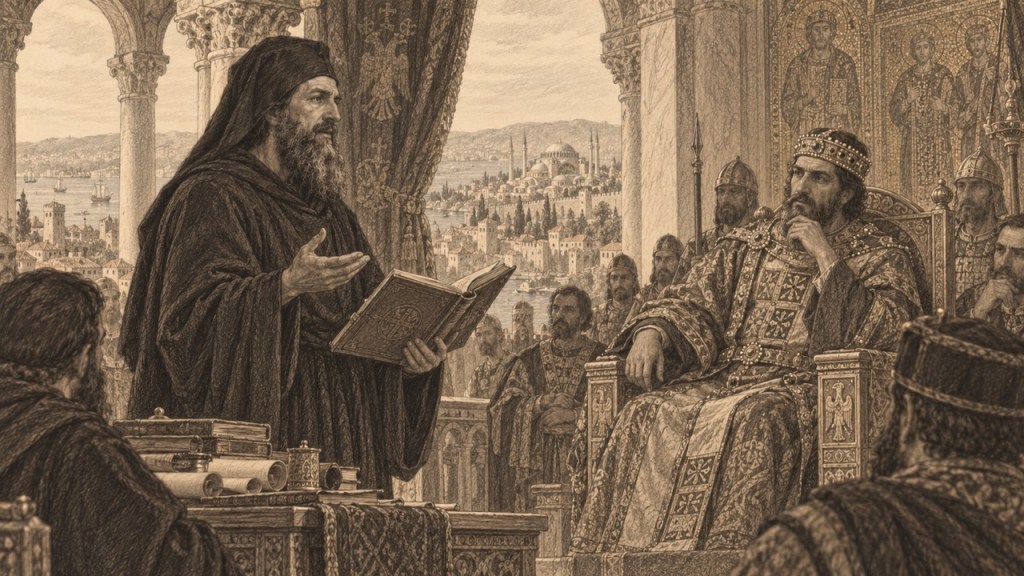
Euthymius Zigabenus (d. after 1118), a monk of Constantinople writing under the patronage of Alexios I Komnenos, produced commentaries on the Psalms, the Gospels and the Pauline epistles, along with the heresiological Dogmatic Panoply. His work on Colossians is an abridging commentary in the Byzantine manner, leaning heavily on Chrysostom and Theodoret and compressing their exegesis into compact scholia.
SOURCE: Euthymius Zigabenus. Ἑρμηνεία εἰς τὰς ιδʹ ἐπιστολὰς τοῦ ἀποστόλου Παύλου καὶ εἰς τὰς ζʹ καθολικάς, vol. 2. Edited with prologue and notes by Nikēphoros Kalogeras. Athens: Adelphoi Perrē, 1887.
TRANSLATION: Euthymius Zigabenus. Commentary on the Epistle to the Colossians. Translated by Phil Thompson. Greenville, SC: Institute for Colossians Studies, 2026.
Licensed under Creative Commons Attribution 4.0 International (CC BY 4.0): https://creativecommons.org/licenses/by/4.0/
Text
[page 113]
THE EPISTLE TO THE COLOSSIANS
INTRODUCTION
Colossae[^1] was a city in Phrygia near Laodicea, whose inhabitants, the Colossians, even after their faith in Christ, still held to many Greek and Jewish observances. They also thought that believers were brought to God through angels, and not through Christ, as certain deceivers had secretly crept in among them and persuaded them that this was the case. Having learned these things, the great Paul writes to them from Rome, not having seen them himself, but having heard about them from Epaphras (also called Epaphroditus), who was sent by the Apostle and preached the word of the Gospel to them. Epaphras was also a Colossian. The present Epistle bears a great resemblance to the Epistle to the Ephesians, since he wrote this one too, like that one, while bound in chains in Rome.
1. Paul, an apostle of Jesus Christ by the will of God,
These things have been discussed in the epistle to the Ephesians, for its prologue is of the same kind.
1. And Timothy our brother,
For it is likely that he too was known to the Colossians.
[^1]: In other copies, “Colossae” [Κολοσσαί] or “Colosae” [Κολοσαί]. — NIKEPHOROS KALOGERAS, ZIGABENUS VOL. 2.
[page 114]
2. To the saints in Colossae,
“Saints” either according to their faith or according to their conduct. For a “saint” is one who is set apart for God and purified.
2. Faithful brothers in Christ.
“Faithful brothers” according to Christ; for according to our faith in Christ we are all brothers of one another, having been adopted as sons by the same Father, and having become his heirs by being well-pleasing to him. And we are called faithful not only because we have believed, but also because we have been entrusted with the mysteries of God, which not even angels knew before us.
2. Grace to you and peace from God our Father, and the Lord Jesus Christ.
These things have also been spoken and explained in the epistle to the Romans (Rom 1:7).
A. Thanksgiving for the Colossians, who have been brought near to God in hope.
3. We give thanks to God, the Father of our Lord Jesus Christ,
“We give thanks” because of your faith.
3. Praying always for you;
So that you may advance in what is good.
4. Having heard of your faith in Christ Jesus
“Your faith in Christ Jesus”; meaning either faith directed toward Christ, or faith according to the commandments of Christ.
4. And the love that you have for all the saints, because of the 5. hope laid up for you in heaven,
For both faith and love have come about because of hope. By “hope laid up” he means the hoped-for and abiding good things in heaven, which God has prepared for those who love him.
[page 115]
5. Of which you previously heard in the word of the truth of the gospel,
The hope “of which you previously heard” [lit. learned beforehand]; concerning which you heard in the preaching of the truth of the gospel. For the preaching proclaims truth, and there is no falsehood in it. And by saying “of the gospel,” he reminded them of the proclaimed benefits and graces of God.
6. Which has come to you, just as it is in the whole world;
Here he shows them favor, speaking as though the Gospel had not merely come to them and then departed again, but still remains present. The expression “has come” [τοῦ παρόντος, lit. “is present”] is metaphorical. And since many are established in their doctrines by having many who share them, he added for this reason that it is “just as it is in the whole world.”
6. And it is bearing fruit and growing, just as it does among you.
“And it is bearing fruit” everywhere, through the practices of its commandments,[^2] by which it bears as fruit the multifaceted virtues; and “growing” by many joining it, and increasing the multitude of the Church.
6. Since the day you heard and knew the grace of God
“Just as it is also bearing fruit among you,” as has been said, since the day you heard and intimately knew the grace of God toward mankind—his benevolence, his countless good things.
6. In truth;
And you knew it “in truth” of realities, but not in bare words; for the signs and wonders confirmed the truth of the preaching.
7. Just as you learned from Epaphras, our beloved fellow servant,
[^2]: That is, the commandments of “the Gospel.”
[page 116]
Who preached among you. He demonstrates the man’s trustworthiness both by calling him “beloved and fellow servant” as a fellow apostle, and by what follows.
7. Who is a faithful minister of Christ on your behalf;
A true servant of Christ. A servant “on your behalf,” that is, on behalf of your salvation. You must therefore consider him trustworthy, and not doubt anything he has proclaimed to you.
8. Who also made known to us your love in the Spirit.
“Your love in the Spirit,” meaning your spiritual love, the godly love you have for all the saints, as previously established.
B. Prayer for them for practical wisdom, for the power of endurance, with thanksgiving for their familiarization with God through purification.
9. For this reason we also, since the day we heard it, have not ceased praying for you and asking that you may be filled with the knowledge of his will
“For this reason”—what reason? Because we heard of your faith and love. “Asking that you may be filled,” that is, that you may perfectly know “the knowledge of the will” of God. For you knew it, but not perfectly; for you are still lacking, and especially in thinking that you are brought to God through angels and not through Christ. For if we had to be saved through angels, he would not have sent the Son; he would not have given him up to death for us.
9. In all spiritual wisdom and understanding;
So that you may know it, as was said, “in all spiritual wisdom and understanding,” which again is “spiritual.” For through these comes the knowledge of his will, and not through worldly wisdom. Here he rebukes the Greek learning, by which they were being led astray. By “all wisdom” he means perfect wisdom.
10. To walk worthily of the Lord, fully pleasing to him,[^3]
[^3]: Commonly the manuscripts have “for you to walk” [περιπατῆσαι ὑμᾶς].
[page 117]
So as to live worthily of the one who gave you life. Explaining what “worthily” means, he added that it is “fully pleasing” to him.
10. Bearing fruit in every good work
This is still further explanation. It refers back to “that you may be filled.”
10. And growing in the knowledge of God,
Into a greater knowledge, not of the nature of God (for this is completely unapproachable), but of his will, as was said before.
11. Being strengthened with all power according to his glorious might, for all endurance and patience with joy.
Supplied with much power from God. “Being strengthened for all endurance” of external temptations, and “patience” toward one another. “Endurance and patience with joy.” For one must rejoice in both because of the surpassing rewards. “Being strengthened according to his glorious might,” that is, strengthened by God as is fitting, in proportion to the might of his glory. “Glory” that prevails everywhere and rules over all.
12. Giving thanks to the Father,
“We are,” clearly. He attributes the thanksgiving to the Father, imitating the Son, who himself attributes his own achievements to the Father, as we have often said.
12. Who has qualified you to share in the inheritance of the saints
Who has ranked you with the saints; who has made you capable and worthy not only of “the inheritance of the saints,” but also of sharing in their portion. For it is possible to be in the same inheritance and yet not have the same share of the inheritance.
12. In the light;
Both in the future and in the present; that is, in knowledge and in truth.
[page 118]
13. He delivered us from the domain of darkness,
From the tyranny of the devil. By saying “domain” [ἐξουσίας], he indicated the great power the tyrant held over us.
13. And transferred us to the kingdom of the Son of his love;
It is a great thing to deliver from the tyranny of darkness, but to also lead into the kingdom of his Son, so as to be ruled by him, is much greater. “Of the Son of his love,” that is, his beloved Son.
C. Concerning the creation and re-creation in Christ by connection to God.
14. In whom we have redemption,
Freedom from that slavery.
14. The forgiveness of sins.
And not only “redemption,” but also the forgiveness of sins, which is a further increase and addition to freedom.
15. He is the image of the invisible God,
A natural image is one thing, and an imitative image is another. The former does not have a natural difference from its cause, but a hypostatic one, as the Son is to the Father; for they share one nature, but two hypostases. The latter, conversely, does not have a hypostatic difference from the archetype, but a natural one, like an image of Christ to Christ. For their hypostasis is one, but they have two natures. For the nature of painted matter is one, and that of Christ according to his humanity is another. And in the case of the natural image, the identity is according to essence, or deity. But in the case of the imitative image, the likeness is according to appearance, or form. Therefore, the Son is properly the image of God. Man is also called his image, but with respect to ruling authority, since he is also called a son of God. But why is the angel called neither image nor son? Because in that case, the exalted state of the angelic nature would quickly have cast humans into polytheism, if angels
[page 119]
had possessed these titles. But here, the lowly and humble state of human nature guarantees safety, and for this reason the Scripture confidently bestows such honor here, but no longer there.
15. The firstborn of all creation;
Begotten “before all creation” according to his pre-eternal generation; or “before all creation,” whether invisible or visible, which he will make clear as he proceeds, saying that “he is before all things.” But some, interpreting “all creation” as the new creation, say that Christ is its firstborn, as the firstfruits and choice portion of the Church, adding to support their argument the words: “and he is the head of the body, the church.”[^4]
16. For by him all things were created, things in heaven and things on earth, visible and invisible,
“By him” [ἐν αὐτῷ, lit. “in him”] stands for “through him,” as he will say moving forward.
16. Whether thrones, or dominions, or rulers, or authorities;
Speaking of the heavenly powers, he divides them into orders: “whether thrones,” he says, “or” the rest. The formula “whether this, or that” is comprehensive of all things, and by the things mentioned it also indicates the things omitted.
16. All things through him
“Have come into being,” clearly, or “have been created.”
16. And for him were created;
And upon him they depend, and upon him hangs the existence of all things. For he not only brought them from non-being into being, but he also holds them together, and they look to him as to the one who sustains and provides for them. Thus, if anything were torn away from his providence, it would be lost and destroyed.
[^4]: “Some interpreting say,” etc. The one who interpreted the passage before us in this way is Photius, and see his interpretation in the Amphilochia, Question 162.
[page 120]
17. And he is before all things,
“Created things,” clearly.
17. And in him all things hold together;
They have their cohesion and endurance. He continuously turns the same points over, with a succession of words, as with rapid blows, pulling up by the roots the destructive doctrines of the heretics.
18. And he is the head[^5] of the body, the church,
He did not say “of the fullness,” although implying exactly this, but appropriating us to himself, he called himself our “head,” while simultaneously proclaiming his lovingkindness: that the Creator of every nature did not disdain to become the head of the Church, as the firstfruits and choice portion according to his humanity. For the head is of the same essence as the rest of the body, yet more honorable.
18. He is the beginning,
“Of all things,” as the Creator of every nature, or “of the Church,” as its choice portion. But some manuscripts read “who is the firstfruits” [ἀπαρχή], he says, just as an offering and sacrifice sanctifies the mass from which it was offered.
18. The firstborn from the dead,
As having initiated the resurrection from the dead and immortal life. For since he became “the firstfruits of those who have fallen asleep” (1 Cor 15:20), he is rightly called also the “firstborn from the dead,” as the first to burst forth from the womb of Hades into the renewed and eternal life through the resurrection, inaugurating this resurrection and life for us.
18. That in everything he might be preeminent.[^6]
That he might be shown to be “preeminent in all things,” both the invisible
[^5]: The reading “head” [κεφαλὴ] without the article should be noted, as it is peculiar to our manuscript, whereas the manuscripts known to me read “the head” [ἡ κεφαλή]. [^6]: The common reading is “that he might be in all things…” [ἵνα γένηται ἐν πᾶσιν αὐτὸς…]. But the phrase “all things” [τὰ πάντα] I read in none of the manuscripts known to me.
[page 121]
and the visible; for indeed he is before all heavenly and earthly beings, and he rose before all, as has been said, and is the first of the Church.
19. For in him all the fullness was pleased to dwell;
“The fullness” of deity, as we will find as we proceed. For the whole Son dwelt in the assumed human nature; that is, his entire deity, and not just a part of it, for it is indivisible. It can also be stated differently: that both the Father and the Spirit were pleased to dwell in Christ, not by their hypostatic properties, lest they too should appear to have become incarnate, but by their identity of will. For the Father was well-pleased and sent, the Son descended and became incarnate, and the Spirit cooperated and overshadowed; for the mystery of the supernatural Trinity is mutually loving. And Christ is the Son, the anointer is the Father, and the anointing is the Holy Spirit. For Peter says in Acts, “how God anointed him with the Holy Spirit” (Acts 10:38). Some understand “fullness” to mean that of the Church, as being filled from many, which God was pleased should dwell in Christ, that is, under his protection.[^7]
20. And through him to reconcile all things[^8] to himself,
And again he was pleased to make peace through him with all the nations to himself. For if he says elsewhere that he reconciles men to the Father (Eph 2:16), it clearly means to himself as well; for both the former enmity and the later reconciliation are common to the blessed Trinity.
20. Making peace by the blood of his cross, through him, whether things on earth,[^9] or things in heaven.[^10]
[^7]: Cf. Theodoret on this passage (Vol. 3, p. 601). [^8]: In other copies, “the all things” [τὰ πάντα]. But the Author also writes in his explanation: “all the nations” [τὰ πάντα ἔθνη]. [^9]: The word “you might say” [εἴπῃς, rendered here as “whether you speak of things on earth”] is repeated in the explanation as well. And I believe it is a reading peculiar to Euthymius, found in none of the manuscripts known to me. [Translator’s note: The Greek lemma includes the word εἴπῃς, though omitted in modern critical texts.] [^10]: The manuscripts known to me commonly write “things in the heavens” [τὰ ἐν τοῖς οὐρανοῖς].
[page 122]
Clarifying the manner of the reconciliation, he added that it was “by his blood,” meaning by his slaughter. Indicating the type of slaughter, he added “of his cross.” For this death is harsher than all others, being shameful and accursed, as is said in the epistle to the Galatians (Gal 3:13). He made peace among the things on earth, both toward each other and toward God; for men were in rebellion not only against God, having apostatized from him, but also against one another, divided in many ways and fighting each other. And the “things in heaven,” meaning the angels, he reconciled to men, since the angels had been at enmity with men as enemies of their common Master and friends of their common enemy. How is it then, that when Christ has reconciled you to himself and to the Father, you think you are brought to God by angels, who were at enmity with you, as has been said, until Christ reconciled you to them? For when they saw a man in heaven—I mean the assumed human nature—then they finally chose to appear on earth as well.
D. Concerning the drawing in of the Gentiles in the body and passion of Christ through faith.
21. And you, who once were alienated and hostile in mind, doing evil deeds,
“Making peace,” as has been said, also with you, who were once alienated and his enemies by working evil, the deeds of the evil demon. But you were “alienated and hostile” not by the compulsion of the devil, but by your own choice; this is what “in mind” signifies. For you willfully turned away from God. And having turned away, you consequently fell under the tyranny of Satan.
21. He has now reconciled in his body of flesh 22. by his death,
Again he states the manner of the reconciliation, saying that “he has reconciled [you] in his body of flesh,” that is, in his flesh. The phrasing is a circumlocution. “In his flesh,” not simply by being scourged or struck, but by dying.
[page 123]
22. In order to present you holy and blameless and above reproach before him.
So that through such a death of his, he might present you before him “holy,” as having been washed clean through baptism; “blameless,” through the keeping of his commandments; and “above reproach,” as being incontrovertible in all things.
23. If indeed you continue in the faith, stable and steadfast,
“If indeed you continue in the faith,” not simply, but “stable and steadfast”; for it is possible to continue yet be shaken.
23. And not shifting from the hope of the gospel that you heard,
“From the hope” preached to you, which you learned. By “hope of the gospel” he means the hoped-for good things, or even Christ himself, in whom we believers hope, as in a redeemer and savior.
23. Which has been proclaimed in all creation under heaven;
From the faith of the many he makes them firmer still.
23. And of which I, Paul, became a minister.
Of which gospel “I, Paul, became a minister,” whom you have heard of, and know by reputation to be a teacher of the world.
E. Concerning the restorative teaching through his labors leading to presentation before God.
24. Now I rejoice in my sufferings for your sake,
I rejoice in my sufferings for your sake, which I suffer for you Gentiles. In general, for those entrusted to me.
24. And in my flesh I am filling up[^11] what is lacking in Christ’s afflictions,
[^11]: The manuscripts known to me read “filling up in turn” [ἀνταναπληρῶ]. But the Author, while writing “these things I fill” [πληρῶ] in his explanation of the passage, uses this very word “ἀνταναπληρῶ” in his interpretation of the following verse.
[page 124]
The present statement has the following aim: that the things lacking for Christ—namely, whatever he would have suffered had he lived until now—these things I am fulfilling in his stead; that is, I am undergoing them in my body, as one completing his ministry after him. Thus, what I suffer are his sufferings. And he did not merely suffer for mankind until he died, but even after his death he continues to suffer through us who suffer in his stead. Therefore, the Apostle does not say these things to exalt himself, but desiring to show that Christ is still even now caring for them.
24. For the sake of his body, that is, the church;
And I “fill up” these things on behalf of his body, that is, the Church of the believers, of which he himself is the head, as discussed above, and for which he himself suffered and died.
25. Of which I became a minister
A steward, providing it with both preaching and teaching. In other places he calls himself a minister of Christ, as his apostle and servant; and in other places again an apostle of the Gospel, as a herald.
25. According to the stewardship from God that was given to me for you,
In the epistle to the Ephesians, discoursing on the present topic, he said that it was “according to the gift of God’s grace that was given to me by the working of his power” (Eph 3:7). Thus, by “stewardship” here he means the grace and working given to him for the Gentiles, to teach them.
25. To make the word of God fully known;
Which was “given to me,” so that I might fully preach the gospel.
26. The mystery hidden for ages and generations,
[page 125]
He calls the evangelical preaching a “mystery,” as having been hidden not only from all men, but also from all the heavenly powers, and known only to the Holy Trinity. “Hidden” from all “for ages and generations,” that is, from the beginning.
26. But has now[^12] been revealed to his saints;
Of old and from above it was determined and typified, “but has now been revealed,” though not to all, nor to just anyone, but “to his saints.”
26. To them God chose to make known how great among the Gentiles are the riches of the glory of this mystery,
To reveal the surpassing glory of the mystery in Christ, seen especially among the Gentiles. For it is also seen among the Jews, but more so among the Gentiles, the great glory of the mystery. For to elevate men who were more senseless than stones suddenly to the dignity of angels through mere words and faith alone, without any toil, is truly a surpassing glory of the mystery; just as if someone were to suddenly turn a dog ruined by hunger and mange into a human being, and seat him upon a royal throne. They used to worship stones and the earth, but now they have learned that they are superior to both heaven and the sun. They were captives and prisoners of the devil, but now they trample his head, give him commands, and scourge him. Being slaves to demons, they have now become the body of the Master of the heavenly powers, and sons and heirs of God. Truly surpassing and intense is the glory of this mystery.
27. Which is Christ in you,
Moving from the mystery in Christ to Christ himself, and again considering him to be a mystery (for in him the mystery of the divine incarnation took place; and if in him, then he himself is also a mystery), he says: “Which is Christ in you,” remaining among you through faith in him. But if he is among you, how can you think that angels bring you to God?
[^12]: The word “now” [νῦν] I classify among the readings peculiar to our manuscript, as the manuscripts known to me have “at this present time” [νυνὶ].
[page 126]
27. The hope of glory.
For he is the hope of our future glory, as we hope to receive it through him. Or, in another sense: he himself is our hoped-for glory, just as he is our life and enjoyment, as the source and cause of these things.
28. Him we proclaim, warning everyone and teaching everyone with all wisdom,
“We,” he says, “proclaim,” not angels. And “with all wisdom,” not human wisdom, but divine; for the mystery in Christ does not need Greek wisdom for interpretation, but spiritual wisdom supplied from above, in which the deceivers have no share.
28. That we may present everyone mature in Christ Jesus;
“Everyone,” meaning everyone who obeys. And “mature” [τέλειον, perfect] in virtues, or in the knowledge of the mystery in Christ. For the one who knows what Christ did is truly mature.
29. For this I toil, struggling
“For this”: to present them, as has been said. And if I show such zeal for your well-being, how much more ought you to do so. Then he shows that the work is divine.
29. With all his energy that he powerfully works within me.
For he himself, working in me through his grace, gives me power for the task at hand.
[page 127]
F. On those possessing wisdom in Christ not being subjected to deceitful human wisdom.
1. For I want you to know how great a struggle I have for you[^13] and for those at Laodicea, and for all who have not seen me face to face;
“And for all who have not seen” me bodily; for they saw him with the eyes of the mind.[^14] He calls “struggle” his care and anxiety for them; although he had not seen them bodily, he nonetheless held them in his care and agonized over them.
2. That their hearts may be encouraged,
“I have a struggle,” he says, that the souls of those who have not seen me may be healed. For they are being shaken and troubled by the so-called philosophers and the false teachers of the circumcision.
2. Being knit together in love
United in the truth of the preaching with love and without compulsion or force.
2. And to reach all the riches of full assurance
And to a great intensity “of full assurance”; that is, in very abundant assurance. So that in an abundance of assurance they might be united to the truth, and not merely in word and bare assent.
2. Of understanding
“Of the full assurance” which belongs to “understanding”; which comes from understanding; for the one who understands is then fully assured.
[^13]: The manuscripts known to me have “concerning you” [περὶ ὑμῶν]. [^14]: We realized it was necessary to correct in this way the words erroneously set down in the manuscript as follows: “…have seen me; for they saw their bodies bodily” etc.
[page 128]
2. And the knowledge of God’s mystery, which is Christ; [Greek text: τοῦ Θεοῦ καὶ Πατρὸς καὶ τοῦ Χριστοῦ, “of God and the Father and of Christ”]
So as to know the mystery correctly, which belongs to the Father and the Son. And if it belongs to these, it clearly belongs to the Holy Spirit as well; for the first was well-pleased, and the last worked, as has been shown above.
3. In whom are hidden all the treasures of wisdom and knowledge.
“In whom,” in Christ, as the Word [Λόγος]. For wisdom and knowledge belong to the Word.[^15] By saying “treasures” he showed the abundance; by saying “all,” that he is ignorant of nothing; and by saying “hidden,” that only he knows them, and not a single one of the heavenly powers.
4. I say this in order that no one may delude you with plausible arguments.
“I say this” (namely, that all the treasures of wisdom and knowledge are in him), so that you may seek wisdom and knowledge from him, and not[^16] from human philosophers, who deceive with plausible arguments.
5. For though I am absent in body, yet I am with you in spirit,
By the gift of clairvoyance “I am with you” and see the deceivers.
5. Rejoicing to see your good order,
Rejoicing over you and seeing your good order.
5. And the firmness of your faith in Christ.
Firmness not only against trials, but also against deception. The praise is general, but it looks only to those who are acting rightly.
6. Therefore, as you received Christ Jesus the Lord, so walk in him;
[^15]: The bracketed word [Λόγου, of the Word], being very difficult to read in the manuscript, was written according to our conjecture. [^16]: The context obviously requires the addition of “not” [μὴ].
[page 129]
Since you received him through faith in him, by which he is wont to enter in, conduct yourselves in his commandments.
7. Rooted and built up in him,
Founded in him and growing by the advancements made through virtues.
7. And established in the faith, just as you were taught,
This is for those who are shaken.
7. Abounding in it with thanksgiving.
Giving thanks to God abundantly for it; that is, for the faith, because through it you were delivered from darkness and saw the light. And understand an “abundance” of thanksgiving as being great thanksgiving.
8. See to it that no one takes you captive by philosophy and empty deceit,
Watch out lest anyone become the one who takes you captive,[^17] gently and noiselessly slipping in and tearing you away from the Church, that is, from the orthodox faith. He called the worldly philosophy also “empty deceit,” as being useful for nothing profitable to the soul.
8. According to human tradition,
“By philosophy,” which is “according to human tradition,” of the men who invented it.
8. According to the elemental spirits of the world,
And again which is “according to the elemental spirits of the world,” that is, occupied with them. For Thales worshipped water; Diogenes, air; Hippasus, fire. And the rest of the choir of worldly philosophers established their impious philosophy in their discourses concerning the elements.
8. And not according to Christ.
[^17]: The word “takes you captive” [κλεπταγωγῶν, lit. “leads away by stealth”] is among those not yet treasured in lexicons.
[page 130]
“Which is,” clearly; for that philosophy is alien to the doctrines “according to Christ.” Or, according to another explanation: by “human tradition” he means that concerning[^18] the course of the sun and the moon. And “elemental spirits” again, the sun and the moon, as he also said in the epistle to the Galatians (Gal 4:3, 9). For indeed, both Greeks and Jews observed the movements of these stars. The former out of philosophy, but the Jews out of the Law. And the Greeks more so than the Jews. But neither the former’s observation nor the latter’s is “according to Christ.”
9. For in him the whole fullness of deity dwells
In Christ, as has been discussed and explained above. Thus the whole deity dwells in him, yet is not circumscribed within his animated body. But how it is possible both to dwell in him by hypostatic union, and to be everywhere because of being uncircumscribed, we will explain through an example, even if it falls far short of the truth. Just as the first-created light in the beginning, being incorporeal and unrestrained, was mixed into the solar body, and while being in it, is everywhere in the world by its rays, and though enclosed, is nevertheless not prevented from illuminating all things; so too God, having become man, is both in the assumed human nature and fills all things. And I think that it is also according to this principle[^19] that the Lord himself calls himself the light (John 812) and Malachi called him the sun of righteousness (Mal 42).
9. Bodily;
That is, it dwells in him essentially and hypostatically, and not relatively, nor merely by energy and grace, as in other men who are worthy of his indwelling. The word “bodily” stands for “as the soul dwells in the body,” meaning without confusion and without division, even if these are divided at death. For the indwelling in Christ is beyond nature. Therefore he did not just say “dwells,” but “fully dwells” [κατοικεῖ], conveying that it is completely indivisible.
10. And you have been filled in him,
[^18]: The bracketed word [περὶ, concerning] is written in the manuscript as “παρά” [from/by]. [^19]: The manuscript reads “and the things according to the principle.”
[page 131]
And by possessing him, who enters in by faith, as has been said, “you have been filled” with wisdom and knowledge yourselves, as was previously said, and you have no need of worldly philosophy, or conversely, of the wisdom according to the Law. Therefore, since you have the fountain, draw from it by being pleasing to him; “for everyone who asks,” he says, “receives,” and so on (Matt 78). Or in another sense that just as the whole fullness of deity is in his assumed human nature, so also it is in us. For even if it is in him essentially, and in us relatively, nevertheless, in terms of its entirety, the fullness of deity is also in you, and you have been filled in him.
10. Who is the head of all rule and authority.
He who is superior to all, but not of the same essence with them, because of his deity. Or “head” in the sense of being the cause[^20] of every created nature. For by “rule and authority” he signified every created thing.
G. That connection to God also encompasses the things of the Law spiritually for living together with Christ.
11. In him also you were circumcised with a circumcision made without hands,
Through him legislating baptism; for this he calls a “circumcision made without hands.” “Circumcision,” because it strips away sins; for these are superfluous and useless, just like the foreskin of the procreative member. And “made without hands,” because it is spiritual and mystical; for it is performed not by a human knife, but by the action of the Spirit.
11. By putting off the body of the sins of the flesh,
You were circumcised by putting off the body from the sins of the flesh; that is, the body having stripped off the sins of the flesh and cast them away, which it wore around itself and was clothed in like a garment. For those who are baptized, stripping naked, simultaneously strip off the sins they committed through the flesh. Or sins which they committed as fleshly and earth-bound beings, the soul having been dragged down with the body.
11. By the circumcision of Christ;
[^20]: The manuscript has “cause” [αἰτία] in the nominative case.
[page 132]
By the circumcision according to Christ; for baptism is circumcision according to Christ, being commanded by him, which circumcises not just one member of the body, but the whole body, or rather the whole man.
12. Having been buried with him in baptism,[^21]
In the immersions of baptism, which are a symbol of burial. “Having been buried with him” with respect to sins; for he was buried bodily.
12. In which you were also raised with him through faith in the powerful working of God,
With Christ you were also raised up, the old, death-dealing sins having been buried in the font, and us emerging alive, like newborns. You were “raised with him” through the working of faith in God. For by believing that God raises up, just as he raises the dead in body, so also the dead in soul—meaning those dead in their active working[^22] of the good—you were “raised with him.” For again, the emergences in baptism are a symbol of resurrection. But he was raised bodily, while you were raised spiritually.
12. Who raised him from the dead.[^23]
Through faith, he says, in God the Father “who raised him from the dead.” He attributes his resurrection to the Father, imitating the Son, who himself attributed his own achievements to the Father (John 5:19, 30), not as being unable himself, but honoring him thus.
13. And you, who were dead in your trespasses and the uncircumcision of your flesh, God made alive together with him,
“Dead” due to the lack of active working toward the good. He calls the excess of sins, which clung to their flesh, “uncircumcision.” But how did he do this?
13. Having forgiven us all our trespasses,
[^21]: “Through baptism” [διὰ τοῦ βαπτίσματος]. This reading is found only in our manuscript, as the manuscripts known to me commonly have “in baptism” [ἐν τῷ βαπτίσματι]. [^22]: The word “active working” [ἐνεργησία], repeated also in the explanation of the next verse, is among those not yet treasured in lexicons. But I think that in both passages one ought rather to write “lack of active working” [ἀνενεργησίᾳ]. [^23]: In other copies, “from dead” [ἐκ νεκρῶν, without the article], as the Author also uses in his explanation.
[page 133]
By letting go of your death-dealing sins and forgiving you the penalty you owed for them. And not only did he forgive them, but he also wiped them out. Hence he added:
14. By canceling the record of debt that stood against us with its legal demands,
By “record of debt” he means a spiritual one, on which everyone’s sins were written by an incorporeal hand. Or “record of debt” in another sense means men’s assent to be slaves to sin, which became like a bond of slavery. For we sold ourselves to sin, taking pleasures as the price. For a certain pleasure precedes every sin, stirred by which we sin. He wiped out such a record, as if in water, by the decrees [δόγμασιν] of the preaching, clearly having been believed; or by the decrees concerning baptism. For by commanding us to be baptized (Matt 28:19), he also washed away what was written on this record through the water of the font.
14. This he set aside,
The record which was against us, as has been said, making us liable to punishment. He did not say merely that he washed it away, but that he “canceled” it [ἐξήλειψε, wiped it out entirely], as an intensification, so that not even a trace of a letter remained.
14. And he took it away entirely,
And this too is an intensification. And how did he take it away?
14. Nailing it to the cross,[^24]
For just as by becoming a curse he removed the curse of the Law, as is said in the epistle to the Galatians (Gal 3:13), and by becoming sin he removed our sins; so too, being nailed to the cross, he nailed the record of debt that was against us, and tore it apart with the nails of his all-holy flesh.
15. He disarmed the rulers and authorities and put them to open shame,
Having stripped off his garments, and being shown naked on the cross,
[^24]: The manuscripts known to me write “nailing it [αὐτὸ] to the cross.”
[page 134]
“he put to open shame the rulers and the authorities,” meaning the demons, who rule over and exercise authority over those who obey them. He exposed them publicly “openly,” that is, in the presence of many. For when the sun was darkened, the veil was torn, the earth shook, the rocks were split, and many dead were raised, the great power of the one who voluntarily was crucified was demonstrated, and the great weakness of the demons, unable to restrain such divine signs, was exposed. And he was glorified, while they were put to shame. It can also be explained differently: that after becoming incarnate, “stripping off” the demonic powers which human nature had put on like a garment; or “stripping” them off by removing their holds (for holds, just as with garments for wrestlers, are for demons the causes of sins; for through them they drag us into sins); having “stripped” them off, then, as has been said, he put them to open shame by being made a public spectacle himself on the cross.
15. Triumphing over them in him.
Having celebrated a triumph over them on the cross. A triumph is a procession and festival over the defeated. Having made a public spectacle of them, cast down from their tyranny. Therefore he also said: “Now will the ruler of this world be cast out” (John 12:31).
H. That the types of the fleshly law are useful for fleshly people, not for spiritual people who live in the power of Christ.
16. Therefore let no one pass judgment on you in questions of food and drink,[^25]
Now at last he takes up the rebukes, but sparingly. Therefore, he says, let no one condemn you for eating or drinking without observance; that is, do not tolerate those who blame you for these things. For this is characteristic of Jewish petty-mindedness.
16. Or with regard to a festival or a new moon or a Sabbath.
[^25]: The common reading of the manuscripts known to me is “in food or in drink” [ἐν βρώσει ἢ ἐν πόσει].
[page 135]
Or if they condemn you again regarding some part of a Jewish festival that you do not observe. By saying “with regard to” [ἐν μέρει, lit. “in part”], he showed that the deceivers were observing the festivals, the new moons, and the Sabbaths only in part, not keeping their observances entirely, since they were partly Christianizing and partly Judaizing.
17. These are a shadow of the things to come,
“These,” clearly the legal requirements, are a shadow and type of the things of the New Covenant. “Of the things to come,” that is, when the old law held sway, since that entire law is shadowy and typical.
17. But the substance belongs to Christ.
In contrast to the shadow he supplied the “substance” [σῶμα, body]. Those things, he says, are a type. But the truth is Christ’s; that is, it has now come about in Christ.
18. Let no one disqualify you,
To disqualify [καταβραβεύειν] properly means not to award the prize to the victor, but to another; which is to mistreat the victor. Let no one, therefore, he says, mistreat you who are victorious in your blameless faith and conduct, nor deprive you of the prize, transferring you to foreign traditions. He is hinting now at the matter concerning angels; for the deceivers said that one must call upon angels for help and for access to God, and not Christ; for to call upon Christ for these things is too great for us.
18. Insisting
“Insisting” [Θέλων, lit. “wishing”] to mistreat you and striving to shift you to what they teach.
18. On asceticism and worship of angels,
And they do this “in asceticism” [ταπεινοφροσύνῃ, humility], as they suppose, but in truth also “in worship of angels,” since they serve the angels.
18. Going on in detail about visions,
[page 136]
The one who teaches this clearly enters into matters he has neither seen nor knows. And yet he acts as though he has both seen and knows.
18. Puffed up without reason by his sensuous mind,
Vainly exalting himself over this futile doctrine, as if he had invented it himself. He suffers this “by his sensuous mind” [lit. “the mind of his flesh”]; that is, by a fleshly intellect, and not a spiritual one; by human reasoning, and not divine.
19. And not holding fast to the Head,
Not clinging to the Head, which is Christ, as being above all, as Creator of both angels and men. For what do you have of the members—that is, the angels—if you let go of the head?[^26] If you fall away from there, you are lost.
19. From whom the whole body, nourished and knit together through its joints and ligaments, grows
“From whom,” from Christ, “the whole body” of the Church (for the discussion is now about this) “through its joints,” that is, the connections and unions of the members from which it is composed, and through its “ligaments” and tight bands, holding it together like sinews, “nourished” and receiving its grace from him, “and knit together,” that is, being at peace with God and with itself, “grows” spiritually. For he added:
19. With a growth that is from God.
Growth according to God; the growth that comes from an excellent way of life. He also expounded this thought more broadly in the epistle to the Ephesians (Eph 4:16).
20. If with Christ you died to the elemental spirits of the world, why, as if you were still alive in the world, do you submit to regulations
If you died together with Christ through baptism, as he also said above (“having been buried with him,” he says, “in baptism”); and you “died,” as far as the elemental spirits of the world are concerned, regarding no longer being enslaved to them (about which it was also spoken above, where it says “according to human tradition, according to the elemental spirits of the world”), why, as if you had not died with him but were still living in the world and in the present life, “do you submit to regulations” and are taught the things of men, abandoning the things of Christ,[^27] with whom you died and with whom you were raised? Then he posits another regulation, the one concerning the observance of foods.
21. Do not handle, Do not taste, Do not touch;[^28]
[^26]: Or according to another form, “might you have” [ἔχῃ]. [^27]: Perhaps it should be written “the things from Christ” [τὰ παρὰ Χριστοῦ]. [^28]: “Do not touch” [θίξῃς] is the reading of the manuscript. But the manuscripts known to me commonly have “θίγῃς”.
[page 137]
He mocks those who teach the observance of foods, as though they were practically saying: “Do not handle” this, “Do not taste” that, nor “touch” this, leading them away as if from terrible things.
22. All of which perish as they are used,
“All of which” foods go “to corruption as they are used,” that is, after they are consumed. For this is what “as they are used” [τῇ ἀποχρήσει] means.
22. According to human precepts and teachings;
You “submit to regulations,” as was said, “according to the precepts and teachings” of the deceivers. And yet the observances of foods belonged to the old legislation. But since this has been rendered obsolete, as being typological, the truth having now come, whatever shadowy element someone from that system introduces into the truth is henceforth reckoned as human precepts. Or in another sense, he hints here at the practices of the Greeks.
23. These have indeed an appearance of wisdom
The practices regarding abstinence from certain foods have a certain appearance of wisdom (for they teach self-control), but since they make one look back to the old things, they are untimely and superfluous. For we, having been freed from the Law, must practice self-control voluntarily and of our own free will.
23. In promoting self-made religion
Again, “These are” done “in self-made religion”; for since the religion of the Law has now ceased, these people voluntarily observe the old rites, and not out of any necessity.
23. And asceticism and severity to the body,
And done out of asceticism [ταπεινοφροσύνη, humility] and disdain for the body, so that the one teaching these things may appear pious and contemptuous of the body.
23. But they are of no value in stopping the indulgence of the flesh.
Done “not in any honor” of the flesh; “for stopping” and caring for it, for one must replenish what is emptied, but to its dishonor, when one ought to honor and care for it, as much as is reasonable, as a yoke-fellow.[^29] For it was on account of this flesh that foods were created.
1. If then you have been raised with Christ, seek the things that are above,
Being with him above in your mind; for Jewish observances and anything of that sort belong to the old life, and to the earthly way of life; but you, having received a new life, ought to possess the heavenly way of life, the spiritual one.
1. Where Christ is,
Where Christ is, with whom you were raised in baptism, and to whom you were made like.
1. Seated at the right hand of God.
Wow! Where he has drawn their minds upward! What great confidence he has filled them with! “At the right hand” indicates genuine sonship; for with God there is no right or left, for these belong to bodies. And “seated” indicates royal power and enjoyment.
[^29]: Theophylact on this passage: “But they do not use the body in honor, depriving it and taking away its authority and not allowing it to rule voluntarily.”
[page 139]
2. Set your minds on things that are above,
“Set your minds on things that are above”; imagine the things above.
2. Not on things that are on earth; for you have died,
Not on earthly and perishable things. He is not speaking here about necessities, and things for the sustenance of the body, but about superfluous things. “For you have died” as far as these are concerned. But even if he is speaking simply about all the matters of the present life, it is nothing new; for Christ also commanded not to be anxious about food or clothing, or generally about tomorrow (Matt 6:25).
3. And your life is hidden with Christ in God.
The life here is not your life (for you died to the present world in baptism), but your life is some other life, that is,[^30] enjoyment and delight and glory, which is not seen now, but is hidden from you, being with God, as it is heavenly. “With Christ,” where Christ is. These statements are preparatory steps to lead them away from luxury and comfort here. For while discoursing about the observance of foods, he arrived at this point unsuspected; for he is accustomed to doing this often, knowing that a rebuke delivered without being suspected has great power.
I. Exhortation to purification, sanctification, philanthropy, love of God, love of learning, reverent psalmody, conduct directed toward God, and thanksgiving.
4. When Christ who is your life appears, then you also will appear with him in glory.
Since Christ is our life, as the Giver of life, both granting us the new life, and because “in him we live and move and have our being” (Acts 17:28); when he appears at his Second Coming,
[^30]: The bracketed word [ἤτοι, that is], being very difficult to read in the manuscript, was written according to our conjecture.
[page 140]
then you also will appear with him in glory, that is, living the glorious and blessed life.
5. Put to death therefore what is earthly in you,
And indeed, by dying with Christ in baptism, they put them to death. But he is not advising them now about the sins they committed previously, but about those that occur after baptism. And what he means by their “members,” hear what follows:
5. Sexual immorality, impurity, passion, evil desire, and covetousness,
He calls these their “members that are on the earth.” “Members,” because they constitute the earthly and fleshly mindset, which he is also accustomed to calling the “old self” (Rom 66; Eph 422), and because they are attached to and grow upon it like members. And “on the earth,” because they have their operation only on the earth, and are left behind on the earth. For the other members, those of the Lord’s body, even if they operate on earth, will nevertheless also be resurrected with the body, and will be caught up in the air, and will perform on it the meeting of the Lord (1 Thess 417); “for,” he says, “this perishable body must put on the imperishable” (1 Cor 1553). But those sinful members, decaying along with it, are no longer resurrected with the body. And since this fleshly mindset comes into being within us and is ours, cultivated by us, its members are consequently both ours and are called so. For the things of what is ours are entirely ours as well by the principle of appropriation. Thus, by “sexual immorality” he also included adultery. And by “impurity” he indicated every unlawful intercourse. And by “passion” he revealed every sin more generally. Adding “evil desire,” he showed that every sin comes from an evil desire; for there is also a good desire, from which conversely every virtue comes. Just as he placed “sexual immorality” before the others, as it is more troublesome and dominant, so also he placed “covetousness”—that is, the love of money—last, as it was prevalent among the Colossians.
5. Which is idolatry;
[page 141]
For the money-lover or gold-lover, locking up his silver or gold, cherishes it as a god, and honors and guards it, just as idolaters do their idols.
6. On account of these the wrath of God is coming upon the sons of disobedience.
Upon those who are intimate with disobedience; that is, upon the disobedient, those who refuse to turn away from them.
7. In these you too once walked,
“In these” sins.
7. When you were living in them.
When you were living the life in them, the life in sins; for now you are living a different life, one delivered from them.
8. But now you must put them all away,[^31]
Just as we do, so must you; or just as the other churches do. “All” meaning all wicked things, as many as came upon you.
8. Anger, wrath, malice,
The one who is “angry” [ὀργιζόμενος] has the passion in disposition; “for be angry,” he says, “and do not sin” (Ps 45 LXX). But the one given to “wrath” [θυμούμενος] is already displaying something more; “for they have wrath,” he says, “like the likeness of a serpent” (Ps 584 LXX). By adding “malice,” he showed that both are evil, or that they are offspring of malice. Having spoken more generally above, he now adds more specifically, and rather the things that surface more easily.
8. Slander,
Directed at one another, or even at God.
8. And obscene talk from your mouth.
He added “from your mouth” to emphasize the filth; for it defiles the mouth itself.
[^31]: The manuscripts known to me write “the all things” [τὰ πάντα].
[page 142]
9. Do not lie to one another,
By saying “one another” he indicated all fellow believers or even fellow countrymen.
9. Seeing that you have put off the old self with its practices;
This has also been discussed in the epistle to the Ephesians (Eph 4:22), and will be discussed now as well. The Apostle calls “self” [ἄνθρωπον, man] sometimes the soul, which he also names the inner man; sometimes the body, which he calls the outer man; sometimes the composite of both; sometimes the corrupted volition, as in the present passage, which he also calls the “old self”; and sometimes the good volition, as he will proceed to say, which he calls the new self. Therefore, this volition, or inclination, he calls a “self,” not only because it is human, but also more so because a person is made either good or evil by it, and because it holds the governing authority of free will within a person, and of the impulse toward virtue or vice. For it is not the substance of a human being that either brings one up to the kingdom or leads one into punishment, but volition. And because of this we either love or hate a person. And not simply because he is a human being,[^32] but he names it a “self” in this way. By “old self” he means the corrupted volition, as belonging to the old life, and as being weak to resist passions, and as being ugly and rotten. By “new,” again, he designates the good volition, as belonging to the new life, and as being strong for battle, and as being beautiful and fully vigorous; for as much as it grows, that much it flourishes. What then, does he say? “Having put off the old self with its practices,” that is, the corrupted volition, as has been said, together with its works. So above he commanded to put its members to death, but here he commands to cast it away entirely.
10. And have put on the new self, which is being renewed in knowledge
In proportion to knowledge; for inasmuch as a person knows the will of God
[^32]: Perhaps it should be written “alone” [μόνη]; that is, it is not merely volition alone that is a self, but etc.
[page 143]
and the mystery of God’s incarnation (for instance, why he became incarnate, and what he accomplished, and what he bestowed upon us), so much is his volition renewed; that is, it advances and flourishes.
10. After the image of its creator.
Just as Christ too was renewed when he rose from the dead, as regards his assumed human nature. And he said “put on,” demonstrating the ease of the change for the better, and so that we might possess the indicated new self continually, and so that we might wear it as an adornment.
11. Here there is not Greek and Jew, circumcised and uncircumcised,
With him, with Christ, there is no difference of nations, or of noble or ignoble birth (for Greek and Jew are nations; and circumcision and uncircumcision are marks of noble and ignoble birth), since he seeks one thing in all people: godliness.
11. Barbarian, Scythian, slave, free;
The barbarian is of lesser status than the Greek, and the Scythian in turn is baser than the barbarian, and the slave in turn is more dishonored than the Scythian. There is therefore no partiality with God.
11. But Christ is all, and in all.
“But Christ is all” to all believers; for instance, nation, nobility, rank, wealth, glory, and such things. “And in all” believers is Christ, as the head in the members and the body.
12. Put on then, as God’s chosen ones, holy and beloved, compassionate hearts, kindness, humility, meekness, and patience,
The exhortation is accompanied by praise. As “holy” not simply, but “as chosen ones”; that is, holy not only in faith, but also in conduct. And “beloved” is an addition indicating double holiness. “Put on,” like a garment that covers and adorns the one who wears it. And he did not say, show almsgiving to the needy, but “compassionate hearts” of all kinds, so that the compassions
[page 144]
might become paternal, which is an expression of a more sympathetic disposition. And since “meekness” is an intensification of “patience,” he advises “meekness” for the more perfect, and “patience” for the less perfect.
13. Bearing with one another,
As brothers and peers in Christ.
13. And, if one has a complaint against another, forgiving each other;
And remitting to yourselves, that is, to one another, your complaints.
13. As the Lord has forgiven you, so you also must forgive.
And do not simply forgive, but in imitation of Christ. For he forgave you many great past sins, and forgave them completely and perfectly, so that not even a trace of them was left behind. Therefore, you also forgive one another the grievances that you owe one another.
14. And above all these put on love,
“Put on,” clearly. “Love,” that for one another; for it is possible to demonstrate both almsgiving and the rest without love.
14. Which binds everything together in perfect harmony.
“The bond” of the fullness of the virtues. For what the undergirding cables are to a ship, and the strapping timbers to a house, and the sinews to a body, this also is love to the totality of the virtues, holding them together and not letting them slip away and perish.
15. And let the peace of God rule in your hearts,[^33]
Not anger, not desire, nor anything of these, but peace, which the Lord left to us (“Peace,” he says, “I leave with you,” John 1427), which is pure and firm; for human peace is unstable, and not pure. Let this peace of God, then, mediate among the thoughts of your hearts; let it preside over your reflections, so that all turmoil may flee, driven away from there. Or to put it another way whenever two thoughts are battling,
[^33]: The common reading of the manuscripts known to me is “your” [ὑμῶν]. And from the explanation, the Author also appears to have read it this way.
[page 145]
let the peace of God arbitrate between them, and it will surely vigorously vindicate the more just one. For example, was someone unjustly insulted? Two thoughts are born. One commands him to retaliate, the other to bear it. Are they wrestling with one another? Let the peace of God judge, and it will certainly give the prize of victory to the one advising to bear it, by persuading him that the Lord too, when insulted, endured it.
15. To which indeed you were called in one body,
Through which “you were also called” into the faith, so that, being at peace with God, you might also be at peace with one another. Being “in one body,” that is, having become one body with one head, which is Christ. One body, so that as members of one another, you might hold fast to one another and to Christ, but not so that you might rebel; for the members do not rebel against one another.
15. And be thankful.
Give thanks to God for all things, both for the pleasant and the painful, as he manages our affairs beneficially in all things.
J. On living in harmony with one’s own household; during which, acting prudently and economically toward outsiders.
16. Let the word of God dwell in you richly,
The teaching, the doctrines, the exhortation. Let it “dwell” abundantly through much learning and abundant knowledge. For just as the one who is rich in money is able to bear condemnation and loss, so the one who is rich in the divine word is able to endure every misfortune, being sustained by it and roused to good courage.
16. In all wisdom;
By “wisdom” here he meant virtue; for every virtue is wisdom, just as every vice is folly; “for,” he says, “my wounds stink and fester because of my foolishness” (Ps 38:5). Therefore, if sins come from foolishness, the body acting foolishly when it sins, then righteous deeds come from wisdom. For how is it not a mark of wisdom
[page 146]
to judge rightly and to choose the practice of what is good and beneficial? Therefore David also said again concerning the virtues: “Whoever is wise will observe these things” (Ps 107:43). “In all” virtue, he says. For there is need of both word and virtue; for perfection is in both practice and contemplation.
16. Teaching and admonishing one another in all wisdom, with psalms and hymns and spiritual songs,
The word “continue” must be supplied. For since reading continually seems laborious and burdensome, he transfers them also to other things, which are themselves both profitable and beneficial, by the alteration and succession of such tasks, at the same time lightening their toil, and at the same time preserving the profit for them, gathering it from every side. For from the Psalms of David all teaching is acquired; for this Book is a storehouse of all spiritual philosophy, both practical and contemplative, while also teaching the cure for every passion.[^34] And by “hymns” he now means ones different from those in the Psalms. For hymns properly belong to the angels, who do not sing psalms, but hymn God; that is, they praise, bless, and glorify. And “songs,” he says, which the people of that time used to compose. These were praises to God offered with a most sweet and harmonious melody. These matters were also discussed in the epistle to the Ephesians.[^35]
16. With thankfulness
“And songs,” he says, performed by divine gift [grace]; for it was a mark of a spiritual gift to compose divine songs. And it is likely that they also composed certain hymns by grace. For “with grace” is preserved for these as well.
16. Singing in your hearts to God.
Not with the mouth only, but also with the mind; for this is what it means to sing to the Lord. But with the mouth only is to sing not to the Lord, but to the air. Here the word “singing” must be understood more universally, applying to Psalms, hymns, and songs. For all require attention. Or
[^34]: Add the Prologue of the Author to the commentaries on the Psalms, where he most elegantly sets forth the profit from the study of the Psalms. Patrologia Vol. 128, p. 41. [^35]: In the explanation of verse 19 of chapter 5.
[page 147]
to explain it differently: “singing in your hearts to the Lord” even when you are not singing with your mouth; that is, while walking, or doing some other work.
17. And whatever you do, in word or deed,[^36] do everything in the name of the Lord Jesus, giving thanks to God the Father through him.
“Do,” clearly; that is, naming Christ, calling upon him for help in word or deed, placing his wondrous, saving, and fearful name before the opposing demons. Do not call upon an angel for help before him; for the angel will not listen, seeing his Master so dishonored. And both “through him” and “with him”[^37] are well said: the latter because of his equality and consubstantiality with the Father; and the former because he deigned to become our mediator and high priest, when the Word became flesh according to the Scripture.
18. Wives, submit to your husbands, as is fitting[^38] in the Lord.
He added “in the Lord,” teaching that the Lord also desires this. He means not only because of the law of nature, but also because of the Lord. He does not exhort concerning these matters in all his Epistles, but where he knew that marital relations were conflicted.
19. Husbands, love your wives, and do not be harsh with them.
“Do not be harsh with them”; that is, do not become angry, do not fight. For wives must submit to their husbands, so that the husbands may love them more. And husbands must love their wives, so that the wives may submit to them more. Since, then, yielding belongs to wives, and loving belongs to husbands, each must contribute their own part. For in this way the union will be preserved, as good order is maintained. Let neither the husband exercise arbitrary power over the wife because he rules, nor let the wife despise the husband because she is loved.
[^36]: “Or deed” [ἢ ἔργῳ]. But according to the manuscripts known to me: “or in deed” [ἢ ἐν ἔργῳ]; and according to Chrysostom “in word in deed” [ἐν λόγῳ ἐν ἔργῳ]. [^37]: The phrase “with him” [σὺν αὐτῷ] is an explanation of the apostolic text “in the name of the Lord Jesus” [ἐν τῷ ὀνόματι Κυρίου Ἰησοῦ]. [^38]: The reading “is fitting” [προσῆκεν] appears newly to me; for the manuscripts known to me write “is fitting” [ἀνῆκεν].
[page 148]
20. Children, obey your parents in everything, for this pleases the Lord.
“In everything,” as much as does not oppose godliness.
21. Fathers, do not provoke your children, lest they become discouraged.
He did not say, “love them,” for he knew that they were compelled to this by nature, but rather “do not provoke them”; that is, do not make the children more contentious by never giving way, but sometimes also yield to them.
22. Slaves, obey in everything those who are your earthly masters,
“In everything” that is fitting. By saying “your earthly masters,” he showed that in the greater part they are free from men; that is, in soul, and they are not hindered in soul from serving Christ.
22. Not by way of eye-service, as people-pleasers,
“Do not obey by way of eye-service”; that is, do not serve only when the eyes of your masters are watching you, but also when they do not see; for the former is from fear of masters, but the latter is from fear of God, who always sees. “Not as people-pleasers,” but as God-pleasers.
22. But with sincerity of heart,
In uprightness; for to serve when the master is watching, but to slack off and despise the work when he is not watching, is hypocrisy, duplicity, and crookedness.
22. Fearing God;
The sleepless and all-surveying eye.
23. Whatever you do,[^39] work heartily,
[^39]: In the manuscripts known to me, the reading of this verse is set down variously: either “and whatever you do” [καὶ πᾶν ὅτι ἐὰν ποιῆτε]; or “whatever you do” [πᾶν ὅτι ἂν ποιεῖτε]; or “and whatever you do” [καὶ πᾶν ὃ ἐὰν ποιῆτε]. To these readings is now added that of our manuscript.
[page 149]
From inner disposition, out of goodwill. Not out of slavish necessity, but from free choice.
23. As for the Lord and not for men,
Doing what you work at as to Christ, to the true Lord, to the Lord of lords.
24. Knowing that from the Lord you will receive the inheritance as your reward.
Giving the reason for their slavery and its toils as a gift from the inheritance, from the inheritance owed to you also from God and our common Father, to whom you too were adopted as sons through baptism. Or to put it differently: the reward from the bestowal of the inheritance and the recompense of Christ.
24. You are serving the Lord.[^40]
These masters of yours are not truly masters. By means of them you are serving the Lord, by serving his servants.
25. For the wrongdoer will be paid back for the wrong he has done,
“The wrongdoer” against his own master, by despising him or neglecting his owed duties, will receive back in the time of the universal recompense “the wrong he has done”; that is, what he has stored up for himself through this wrongdoing: namely, punishment. Or “the wrong he has done” means “insofar as he did wrong,” according to the wrongdoing he committed, which is what it deserves.
25. And there is no partiality.
With God; for he does not grant inheritances to masters while despising slaves, but he either honors or punishes those who are worthy of it. For all are one in the Lord, whether free or slave, and there is no difference of fortune with him.
[^40]: “For you serve the Lord” [Τῷ γὰρ Κυρίῳ]. In the manuscripts known to me it reads “for you serve the Lord Christ” [τῷ γὰρ Κυρίῳ Χριστῷ].
[page 150]
1. Masters, treat your slaves justly and fairly,
“Justly,” that they should have an abundance of necessities, so as not to be squeezed by want and therefore forced to do wrong; and “fairly,” that when you receive service from them, you give in return what is necessary for the working body.
1. Knowing that you also have a Master in heaven.
And finally, whatever you do to these slaves, God will also do to you; “for with the measure you use,” he says, “it will be measured to you” (Matt 7:2).
2. Continue steadfastly in prayer,
But since continuing steadfastly in it often breeds laziness and listlessness, he added:
2. Being watchful in it
Being sober and not nodding off or wandering in mind.
2. With thanksgiving.
For one must give thanks in prayers not only for the other benefits done to us, but also for the ability to pray, which is given to us by God so that through it we may converse with him and bring before him whatever we might desire.
3. Praying at the same time also for us,
Look at his humility. He seeks prayer from his disciples, though he is incomparably more powerful than they.
3. That God may open to us a door for the word,
[page 151]
An entrance for the evangelical word, a reception for the preaching; for the Romans who bound me have shut their ears to me.
3. To declare the mystery of Christ,
The evangelical preaching.
3. On account of which I am in prison;
By the Romans, as has been said.
4. That I may make it clear, which is how I ought to speak.
“Praying,” he says, that I may preach it with boldness, holding nothing back. He does not ask them to pray that he be released, but that he may speak boldly; for he held this in higher esteem. The bonds he considered an ornament and a glory, and he especially prided himself in them, as being laid upon him for the Master’s sake. And while his body was bound, his word was unleashed, doing its own work, and he could not bear to remain quiet.
5. Walk in wisdom toward outsiders,
In prudence, in guardedness, paying attention so as not to give them any pretext against you. By “outsiders” he means those outside the faith, those foreign to the Church. For one must “walk in wisdom” toward insiders as well, but much more toward outsiders; for the former are friends, but the latter are enemies.
5. Making the best use of the time.
Purchasing the time of our present life; that is, freeing it from the other stumbling blocks and trials—those brought upon the careless not on account of the faith, but for other pretexts. For example, if they do not pay their taxes, if they do not lay down the prices for goods, if they strike Greeks and otherwise insult them, if they do not honor the rulers as is fitting, and anything of this sort. For giving pretexts for trials in such matters is utter folly; for the unbelievers will seem to have just cause to hate the believers, and will be harsher toward them. And also in another sense: purchasing this “time,” which is not ours but belongs to the unbelievers, as they hold power in it, so that you too may live in it. And purchasing
[page 152]
it not with gold or silver, but in exchange for these things giving honor, submission, humility, and the other appropriate duties in which godliness is not harmed. But when our life appears with Christ, as was previously said above, then at last, when that time is ours, you will be honored and exalted.
6. Let your speech always be gracious, seasoned with salt,
“Let it be,” clearly, or “let it become”; that is, sweet and at the same time astringent. Tempered with grace and salt; with sweetness and astringency, so that on the one hand it may be approachable, and on the other not easily despised; so that it may smooth out the rough and uneven soul, while tightening the one that is puffed up and dissipating.
6. So that you may know how you ought to answer each person.
It is fitting that you “know” how you must converse with each person; for one speaks differently to the believer, and differently to the unbeliever. And again, differently to the Jew, differently to the Greek. And again, differently to the ruler, differently to the subject. And differently to the rich, differently to the poor. In short, to vary the discourse and adapt it to the differences of those you meet: to men, to women, to the old, to the young, according to the condition of each.
7. Tychicus will tell you all about my activities. He is a beloved brother and faithful minister and fellow servant in the Lord.
“And fellow servant” alongside the Lord; for there were certain things that should not be disclosed by letters. Thus, as “beloved” he knows all my affairs; as “faithful” he does not lie; and as “fellow servant,” he is certainly a sharer with me in my sufferings. Thus, in every way he established his trustworthiness for them.
8. I have sent him to you for this very purpose,
For this very reason. Then he states why.
8. That I may know how you are,
[page 153]
How you are doing; for even while in bonds, he cared exceedingly for the Churches.
8. And that he may encourage your hearts.
And that he may console you. From this it appears that they themselves were also in afflictions, whether because of him, or because of their own trials.
9. And with him Onesimus, our faithful and beloved brother, who is[^41] one of you.
This Onesimus is the slave of Philemon.
9. They will tell you of everything that has taken place here.
The circumstances in which I am.
10. Aristarchus my fellow prisoner greets you,
This is the one who was taken up together with him from Jerusalem (Acts 27:2). He called him “fellow prisoner” because he underwent the experiences of prisoners together with him; for they were led and dragged about and exposed to all manner of ill-treatment, being insulted, beaten, starved, and stripped naked.
10. And Mark the cousin of Barnabas
For Barnabas was also distinguished.[^42]
10. (Concerning whom you have received instructions—if he comes to you, welcome him),
You were instructed to welcome him not just simply, but clearly with honor. He did not say from where they received the instructions. But it is likely either from this great Paul himself, having sent them word beforehand concerning him through someone, or from his uncle.
11. And Jesus who is called Justus.
[^41]: “Who is” [ὅστις ἐστὶν] instead of “who is” [ὅς ἐστιν], as the manuscripts known to me commonly provide. [^42]: Concerning this Mark, see 2 Tim 411. And concerning Barnabas, Acts 132.
[page 154]
I think this man was a Corinthian.
11. These are the only men of the circumcision
He said this concerning those who greeted them.
11. Among my fellow workers for the kingdom of God,
So that God might rule even over the godless men here, so that they too might come under the kingdom of God through faith. “These are the only ones,” he says, not as if the others with him were not fellow workers, but because these were struggling alongside him and speaking out boldly more than those others; for perhaps the others did not yet dare to speak out boldly.
11. And they have been a comfort to me.[^43]
Acting zealously in my stead, and doing and suffering all things for the sake of the preaching.
12. Epaphras, who is one of you, a servant of Christ, greets you,
This is the one who preached to them, whom he also mentioned in the prologue of the epistle. And this man is a Colossian. He praises him, making the man more venerable to them, so that they might pay more attention to him.
12. Always struggling on your behalf in his prayers, that you may stand mature and fully assured in all the will of God.[^44]
So that you may stand unshaken in the faith, becoming mature and full of every will of God; that is, fulfilling every divine will.
13. For I bear him witness that he has worked hard for you and for the brothers[^45] in Laodicea and in Hierapolis.
By “hard work” [ζῆλον, zeal] here he means intense and fervent love.
[^43]: The reading “to me” [ἐμοί] is newly apparent, as the manuscripts known to me have “to me” [ἐγενήθησάν μοι]. [^44]: “The will of God” [θελήματι Θεοῦ]. But the manuscripts known to me have “the will of the God” [θελήματι τοῦ Θεοῦ]. [^45]: The word “brothers” [ἀδελφῶν] I find in none of the manuscripts known to me. Let this reading too be placed among those peculiar to our manuscript, unless one supposes it arose from an explanatory addition.
[page 155]
14. Luke the beloved physician greets you, as does Demas.
This Luke is the Evangelist, “beloved” for his virtues.
15. Give my greetings to the brothers at Laodicea,
Being neighbors.
15. And to Nympha and the church in her house.
For his whole household believed. And this person was someone distinguished.
16. And when this letter has been read among you, have it also read in the church of the Laodiceans;
See how he glues and joins them together.
16. And see that you also read the letter from Laodicea.
“Have it,” clearly; that is, make sure that you also read the one written from Laodicea to me,[^46] so that you may learn what kind of disposition they have toward me, and emulate it. However, he wishes the one written by him to the Colossians to be read in the church of the Laodiceans, so that they too might be profited by it.
17. And say[^47] to Archippus, “See that you fulfill the ministry that you have received in the Lord.”
This Archippus was left as their teacher and overseer. And I think he too was a local, adorned with all good advantages. Therefore, he calls his oversight and care of them a “ministry.” “See,” he says, that is, pay attention, “that you fulfill it.” The ministry “in the Lord,” the one according to Christ, the Master’s ministry, “which you received” through the Lord, by the will of the Lord.
18. I, Paul, write this greeting with my own hand.
This has been discussed at the end of the first epistle to the Corinthians,
[^46]: The letter of the Laodiceans to Paul, clearly, and not as some have supposed, the letter of Paul to them. Cf. Theodoret on this passage (Vol. 3, p. 625). [^47]: Commonly the manuscripts known to me have “and say” [καὶ εἴπατε].
[page 156]
and you should look for it there. But it is likely that, seeing the letters written by his own hand, they would feel some deep emotion toward them.
18. Remember my chains.
Which I undergo for you; which I wear for the sake of those who believe. And this was sufficient to stir them up to a warmer love for him and to make them nobler for the struggles.
18. Grace be with you.
The assistance, or favor, of the Lord.
18. Amen.
Truly may it be so.
[^1]: In other copies, “Colossae” [Κολοσσαί] or “Colosae” [Κολοσαί].
[^2]: That is, the commandments of “the Gospel.”
[^3]: Commonly the manuscripts have “for you to walk” [περιπατῆσαι ὑμᾶς].
[^4]: “Some interpreting say,” etc. The one who interpreted the passage before us in this way is Photius, and see his interpretation in the Amphilochia, Question 162.
[^5]: The reading “head” [κεφαλὴ] without the article should be noted, as it is peculiar to our manuscript, whereas the manuscripts known to me read “the head” [ἡ κεφαλή].
[^6]: The common reading is “that he might be in all things…” [ἵνα γένηται ἐν πᾶσιν αὐτὸς…]. But the phrase “all things” [τὰ πάντα] I read in none of the manuscripts known to me.
[^7]: Cf. Theodoret on this passage (Vol. 3, p. 601).
[^8]: In other copies, “the all things” [τὰ πάντα]. But the Author also writes in his explanation: “all the nations” [τὰ πάντα ἔθνη].
[^9]: The word “you might say” [εἴπῃς, rendered here as “whether you speak of things on earth”] is repeated in the explanation as well. And I believe it is a reading peculiar to Euthymius, found in none of the manuscripts known to me. [Translator’s note: The Greek lemma includes the word εἴπῃς, though omitted in modern critical texts.]
[^10]: The manuscripts known to me commonly write “things in the heavens” [τὰ ἐν τοῖς οὐρανοῖς].
[^11]: The manuscripts known to me read “filling up in turn” [ἀνταναπληρῶ]. But the Author, while writing “these things I fill” [πληρῶ] in his explanation of the passage, uses this very word “ἀνταναπληρῶ” in his interpretation of the following verse.
[^12]: The word “now” [νῦν] I classify among the readings peculiar to our manuscript, as the manuscripts known to me have “at this present time” [νυνὶ].
[^13]: The manuscripts known to me have “concerning you” [περὶ ὑμῶν].
[^14]: We realized it was necessary to correct in this way the words erroneously set down in the manuscript as follows: “…have seen me; for they saw their bodies bodily” etc.
[^15]: The bracketed word [Λόγου, of the Word], being very difficult to read in the manuscript, was written according to our conjecture.
[^16]: The context obviously requires the addition of “not” [μὴ].
[^17]: The word “takes you captive” [κλεπταγωγῶν, lit. “leads away by stealth”] is among those not yet treasured in lexicons.
[^18]: The bracketed word [περὶ, concerning] is written in the manuscript as “παρά” [from/by].
[^19]: The manuscript reads “and the things according to the principle.”
[^20]: The manuscript has “cause” [αἰτία] in the nominative case.
[^21]: “Through baptism” [διὰ τοῦ βαπτίσματος]. This reading is found only in our manuscript, as the manuscripts known to me commonly have “in baptism” [ἐν τῷ βαπτίσματι].
[^22]: The word “active working” [ἐνεργησία], repeated also in the explanation of the next verse, is among those not yet treasured in lexicons. But I think that in both passages one ought rather to write “lack of active working” [ἀνενεργησίᾳ].
[^23]: In other copies, “from dead” [ἐκ νεκρῶν, without the article], as the Author also uses in his explanation.
[^24]: The manuscripts known to me write “nailing it [αὐτὸ] to the cross.”
[^25]: The common reading of the manuscripts known to me is “in food or in drink” [ἐν βρώσει ἢ ἐν πόσει].
[^26]: Or according to another form, “might you have” [ἔχῃ].
[^27]: Perhaps it should be written “the things from Christ” [τὰ παρὰ Χριστοῦ].
[^28]: “Do not touch” [θίξῃς] is the reading of the manuscript. But the manuscripts known to me commonly have “θίγῃς”.
[^29]: Theophylact on this passage: “But they do not use the body in honor, depriving it and taking away its authority and not allowing it to rule voluntarily.”
[^30]: The bracketed word [ἤτοι, that is], being very difficult to read in the manuscript, was written according to our conjecture.
[^31]: The manuscripts known to me write “the all things” [τὰ πάντα].
[^32]: Perhaps it should be written “alone” [μόνη]; that is, it is not merely volition alone that is a self, but etc.
[^33]: The common reading of the manuscripts known to me is “your” [ὑμῶν]. And from the explanation, the Author also appears to have read it this way.
[^34]: Add the Prologue of the Author to the commentaries on the Psalms, where he most elegantly sets forth the profit from the study of the Psalms. Patrologia Vol. 128, p. 41.
[^35]: In the explanation of verse 19 of chapter 5.
[^36]: “Or deed” [ἢ ἔργῳ]. But according to the manuscripts known to me: “or in deed” [ἢ ἐν ἔργῳ]; and according to Chrysostom “in word in deed” [ἐν λόγῳ ἐν ἔργῳ].
[^37]: The phrase “with him” [σὺν αὐτῷ] is an explanation of the apostolic text “in the name of the Lord Jesus” [ἐν τῷ ὀνόματι Κυρίου Ἰησοῦ].
[^38]: The reading “is fitting” [προσῆκεν] appears newly to me; for the manuscripts known to me write “is fitting” [ἀνῆκεν].
[^39]: In the manuscripts known to me, the reading of this verse is set down variously: either “and whatever you do” [καὶ πᾶν ὅτι ἐὰν ποιῆτε]; or “whatever you do” [πᾶν ὅτι ἂν ποιεῖτε]; or “and whatever you do” [καὶ πᾶν ὃ ἐὰν ποιῆτε]. To these readings is now added that of our manuscript.
[^40]: “For you serve the Lord” [Τῷ γὰρ Κυρίῳ]. In the manuscripts known to me it reads “for you serve the Lord Christ” [τῷ γὰρ Κυρίῳ Χριστῷ].
[^41]: “Who is” [ὅστις ἐστὶν] instead of “who is” [ὅς ἐστιν], as the manuscripts known to me commonly provide.
[^42]: Concerning this Mark, see 2 Tim 411. And concerning Barnabas, Acts 132.
[^43]: The reading “to me” [ἐμοί] is newly apparent, as the manuscripts known to me have “to me” [ἐγενήθησάν μοι].
[^44]: “The will of God” [θελήματι Θεοῦ]. But the manuscripts known to me have “the will of the God” [θελήματι τοῦ Θεοῦ].
[^45]: The word “brothers” [ἀδελφῶν] I find in none of the manuscripts known to me. Let this reading too be placed among those peculiar to our manuscript, unless one supposes it arose from an explanatory addition.
[^46]: The letter of the Laodiceans to Paul, clearly, and not as some have supposed, the letter of Paul to them. Cf. Theodoret on this passage (Vol. 3, p. 625).
[^47]: Commonly the manuscripts known to me have “and say” [καὶ εἴπατε].
[page 113]
Η ΠΡΟΣ ΚΟΛΑΣΣΑΕΙΣ ΕΠΙΣΤΟΛΗ
ΥΠΟΘΕΣΙΣ
Κολασσαὶ (α) πόλις ἦν Φρυγίας ἐγγὺς Λαοδικείας, ἣν οἱ οἰκοῦντες Κολασσαεῖς μετὰ τὴν εἰς Χριστὸν πίστιν ἔτι πολλὰς εἶχον παρατηρήσεις ἑλληνικάς τε καὶ ἰουδαϊκάς. Ὤοντο δὲ καὶ δι’ ἀγγέλων προσάγεσθαι τῷ Θεῷ τοὺς πιστεύοντας, ἀλλ’ οὐ διὰ Χριστοῦ, πλάνων τινῶν παρεισφθαρέντων αὐτοῖς, καὶ οὕτως ἔχειν ἀναπειθόντων. Ἃ μεμαθηκὼς ὁ μέγας Παῦλος ἐπιστέλλει τούτοις ἀπὸ Ῥώμης, οὐχ ἑωρακὼς μὲν αὐτούς, ἀκούσας δὲ περὶ αὐτῶν παρὰ Ἐπαφρᾶ, τοῦ καὶ Ἐπαφροδίτου προσαγορευομένου, ὃς καὶ ἐκήρυξεν αὐτοῖς τὸν λόγον τοῦ Εὐαγγελίου, παρὰ τοῦ Ἀποστόλου ἀποσταλείς. Κολασσαεὺς δὲ ἦν καὶ ὁ Ἐπαφρᾶς. Πολλὴν δὲ ἐμφέρειαν ἔχει ἡ παροῦσα Ἐπιστολὴ πρὸς τὴν πρὸς Ἐφεσίους, ἐπειδὴ καὶ ταύτην, ὥσπερ ἐκείνην, ἀπὸ Ῥώμης ἔγραψε δεδεμένος.
ΚΕΦΑΛΑΙΟΝ ΠΡΩΤΟΝ
1. Παῦλος Ἀπόστολος Ἰησοῦ Χριστοῦ διὰ θελήματος Θεοῦ,
Εἴρηται περὶ τούτων ἐν τῇ πρὸς Ἐφεσίους ἐπιστολῇ· τοιοῦτον γὰρ καὶ τὸ ἐκείνης προοίμιον.
1. Καὶ Τιμόθεος ὁ ἀδελφός,
Εἰκὸς γὰρ καὶ τοῦτον γνωρίζεσθαι τοῖς Κολασσαεῦσιν.
(α) Ἐν ἄλλ. « Κολοσσαί », ἢ « Κολοσαί ». ΝΙΚΗΦ. ΚΑΛΟΓΕΡΑ, ΖΙΓΑΒΗΝΟΣ ΤΟΜ. Β’.
[page 114]
2. Τοῖς ἐν Κολασσαῖς ἁγίοις,
« Ἁγίοις » ἢ κατὰ τὴν πίστιν ἢ κατὰ τὴν πολιτείαν. Ἅγιος γὰρ ὅ τε ἀφωρισμένος τῷ Θεῷ ὅ τε ἡγνισμένος.
2. Πιστοῖς ἀδελφοῖς ἐν Χριστῷ.
Κατὰ Χριστὸν « πιστοῖς ἀδελφοῖς »· κατὰ γὰρ τὴν εἰς Χριστὸν πίστιν ἀδελφοὶ πάντες ἀλλήλων ἐσμέν, τῷ αὐτῷ Πατρὶ υἱοθετηθέντες, καὶ κληρονόμοι αὐτοῦ γενόμενοι δι’ εὐαρεστήσεως. Λεγόμεθα δὲ πιστοὶ οὐ μόνον διὰ τὸ πιστεῦσαι, ἀλλὰ καὶ διὰ τὸ πιστευθῆναι τὰ παρὰ τοῦ Θεοῦ μυστήρια, ἅπερ οὐδὲ ἄγγελοι πρὸ ἡμῶν ᾔδεσαν.
2. Χάρις ὑμῖν καὶ εἰρήνη ἀπὸ Θεοῦ, Πατρὸς ἡμῶν, καὶ Κυρίου Ἰησοῦ Χριστοῦ.
Καὶ ἐν τῇ πρὸς Ῥωμαίους ἐπιστολῇ ταῦτα καὶ εἴρηται καὶ ἡρμήνευται (α).
Α’ Εὐχαριστία ὑπὲρ Κολασσαέων οἰκειωθέντων Θεῷ ἐπ’ ἐλπίδι.
3. Εὐχαριστοῦμεν τῷ Θεῷ καὶ Πατρὶ τοῦ Κυρίου ἡμῶν Ἰησοῦ Χριστοῦ,
« Εὐχαριστοῦμεν » διὰ τὴν πίστιν ὑμῶν.
3. Πάντοτε περὶ ὑμῶν προσευχόμενοι·
Ἵνα προκόπτητε εἰς τὸ ἀγαθόν.
4. Ἀκούσαντες τὴν πίστιν ὑμῶν ἐν Χριστῷ Ἰησοῦ
« Τὴν ἐν Χριστῷ Ἰησοῦ πίστιν ὑμῶν »· ἤτοι τὴν εἰς Χριστόν, τὴν κατὰ τὰς ἐντολὰς τοῦ Χριστοῦ.
4. Καὶ τὴν ἀγάπην, τὴν εἰς πάντας τοὺς ἁγίους, διὰ τὴν ἐλ- 5. πίδα τὴν ἀποκειμένην ὑμῖν ἐν τοῖς οὐρανοῖς,
Καὶ ἡ πίστις γὰρ καὶ ἡ ἀγάπη διὰ τὴν ἐλπίδα γέγονεν. « Ἐλπί-
(α) Ῥωμ. α’, 7.
[page 115]
δα δὲ ἀποκειμένην » λέγει τὰ ἐλπιζόμενα καὶ μένοντα ἐν οὐρανοῖς ἀγαθά, ἃ ἡτοίμασεν ὁ Θεὸς τοῖς ἀγαπῶσιν αὐτόν.
5. Ἣν προηκούσατε ἐν τῷ λόγῳ τῆς ἀληθείας τοῦ Εὐαγγελίου,
« Ἣν » ἐλπίδα προμεμαθήκατε· περὶ ἧς ἠκούσατε ἐν τῷ κηρύγματι τῆς ἀληθείας τοῦ Εὐαγγελίου· τὸ γὰρ κήρυγμα ἀλήθειαν κηρύσσει, καὶ οὐδέν τι ψεῦδος ἐν αὐτῷ. « Τοῦ Εὐαγγελίου » δὲ εἰπών, ἀνέμνησεν αὐτοὺς τῶν καταγγελλομένων εὐεργεσιῶν καὶ χαρίτων τοῦ Θεοῦ.
6. Τοῦ παρόντος εἰς ὑμᾶς, καθὼς καὶ ἐν παντὶ τῷ κόσμῳ·
Ἐνταῦθα χαρίζεται αὐτοῖς, ὡς μὴ παραγενομένου τούτοις τοῦ Εὐαγγελίου, καὶ αὖθις ἀποστάντος, ἀλλὰ παραμένοντος ἔτι. Μεταφορικὴ δὲ ἡ λέξις « τοῦ παρόντος ». Ἐπεὶ δὲ πολλοὶ ἐκ τοῦ πολλοὺς ἔχειν κοινωνοὺς τῶν δογμάτων στηρίζονται, διὰ τοῦτο προσέθηκεν, ὅτι « καθὼς καὶ ἐν παντὶ τῷ κόσμῳ ».
6. Καὶ ἔστι καρποφορούμενον καὶ αὐξανόμενον, καθὼς καὶ ἐν ὑμῖν.
« Καὶ ἔστι πανταχοῦ καρποφορούμενον » μὲν (α) ταῖς ἐργασίαις τῶν ἐντολῶν αὐτοῦ, δι’ ὧν φέρει καρποὺς τὰς πολυειδεῖς ἀρετάς· « αὐξανόμενον » δὲ τῷ πολλοὺς προσχωρεῖν αὐτῷ, καὶ αὔξειν εἰς πλῆθος τῆς Ἐκκλησίας.
6. Ἀφ’ ἧς ἡμέρας ἠκούσατε καὶ ἐπέγνωτε τὴν χάριν τοῦ Θεοῦ
« Καθὼς καὶ ἐν ὑμῖν ἐστι καρποφορούμενον », ὡς εἴρηται, ἀφ’ ἧς ἡμέρας ἠκούσατε καὶ ἐπέγνωτε τὴν χάριν τοῦ Θεοῦ, τὴν εἰς τοὺς ἀνθρώπους, τὴν εὐεργεσίαν, τὰ μυρία ἀγαθά.
6. Ἐν ἀληθείᾳ·
Ἐπέγνωτε δὲ « ἐν ἀληθείᾳ » πραγμάτων, ἀλλ’ οὐκ ἐν λόγοις ψιλοῖς· τὰ γὰρ σημεῖα καὶ τὰ θαύματα τὴν ἀλήθειαν τοῦ κηρύγματος ἐβεβαίωσαν.
7. Καθὼς καὶ ἐμάθετε ἀπὸ Ἐπαφρᾶ, τοῦ ἀγαπητοῦ συνδούλου ἡμῶν,
(α) « Τὸ Εὐαγγέλιον » δηλονότι.
[page 116]
Κηρύξαντος παρ’ ὑμῖν. Δείκνυσι δὲ τὸ τοῦ ἀνδρὸς ἀξιόπιστον ἀπό τε τοῦ εἰπεῖν αὐτὸν « ἀγαπητὸν καὶ σύνδουλον » ὡς συναπόστολον, καὶ ἀπὸ τῶν ἐφεξῆς.
7. Ὅς ἐστι πιστὸς ὑπὲρ ὑμῶν διάκονος τοῦ Χριστοῦ·
Ἀληθὴς ὑπηρέτης τοῦ Χριστοῦ. Ὑπηρέτης δὲ « ὑπὲρ ὑμῶν »· ἤγουν ὑπὲρ τῆς σωτηρίας ὑμῶν. Χρὴ οὖν ὑμᾶς ἀξιόπιστον αὐτὸν ἡγεῖσθαι, καὶ μὴ ἀμφιβάλλειν ἐν μηδενὶ τῶν παρ’ αὐτοῦ καταγγελθέντων ὑμῖν.
8. Ὁ καὶ δηλώσας ἡμῖν τὴν ὑμῶν ἀγάπην ἐν Πνεύματι.
« Τὴν ὑμῶν ἐν Πνεύματι ἀγάπην »· τὴν πνευματικὴν ἀγάπην ὑμῶν· τὴν κατὰ Θεόν, ἣν ἔχετε πρὸς πάντας τοὺς ἁγίους, ὡς προδιείληπται.
Β’ Εὐχὴ περὶ αὐτῶν εἰς σοφίαν πρακτικήν, εἰς δύναμιν ὑπομονῆς, σὺν εὐχαριστίᾳ, τῆς οἰκειώσεως τῆς ἐν καθάρσει.
9. Διὰ τοῦτο καὶ ἡμεῖς ἀφ’ ἧς ἡμέρας ἠκούσαμεν, οὐ παυόμεθα ὑπὲρ ὑμῶν προσευχόμενοι καὶ αἰτούμενοι, ἵνα πληρωθῆτε τὴν ἐπίγνωσιν τοῦ θελήματος αὐτοῦ
« Διὰ τοῦτο »· ποῖον ; διότι ἠκούσαμεν τὴν πίστιν καὶ τὴν ἀγάπην ὑμῶν. « Αἰτούμενοι δὲ ἵνα πληρωθῆτε »· τουτέστιν ἵνα τελείως γνῶτε « τὴν ἐπίγνωσιν τοῦ θελήματος » τοῦ Θεοῦ. Ἔγνωτε μὲν γάρ, ἀλλ’ οὐ τελείως· ἔτι γὰρ ἐλλείπεσθε, καὶ μάλιστα ἐπὶ τῷ οἴεσθαι δι’ ἀγγέλων προσάγεσθαι τῷ Θεῷ καὶ μὴ διὰ τοῦ Χριστοῦ. Εἰ γὰρ δι’ ἀγγέλων ἔδει σώζεσθαι, οὐκ ἂν τὸν Υἱὸν ἔπεμψεν· οὐκ ἂν ἐξέδωκεν αὐτὸν ὑπὲρ ἡμῶν εἰς θάνατον.
9. Ἐν πάσῃ σοφίᾳ καὶ συνέσει πνευματικῇ·
Ἵνα δὲ γνῶτε, ὡς εἴρηται, « ἐν πάσῃ σοφίᾳ πνευματικῇ καὶ συνέσει πάλιν « πνευματικῇ ». Διὰ τούτων γὰρ ἡ ἐπίγνωσις τοῦ θελήματος αὐτοῦ γίνεται, καὶ οὐ διὰ τῆς ἔξωθεν σοφίας. Καθάπτεται δὲ τῆς ἑλληνικῆς παιδείας, δι’ ἧς ἐπλανῶντο. « Πᾶσαν δὲ σοφίαν » λέγει τὴν τελείαν.
10. Περιπατῆσαι (*) ἀξίως τοῦ Κυρίου εἰς πᾶσαν ἀρέσκειαν,
(*) Κοινῶς τὰ ἀντίγραφα « περιπατῆσαι ὑμᾶς » ἔχουσιν.
[page 117]
Ὥστε ζῆσαι ἀξίως τοῦ ζωώσαντος. Τί δέ ἐστι τὸ « ἀξίως » ἑρμηνεύων, ἐπήγαγεν, ὅτι « εἰς πᾶσαν ἀρέσκειαν » αὐτοῦ.
10. Ἐν παντὶ ἔργῳ ἀγαθῷ καρποφοροῦντες
Καὶ τοῦτο ἔτι ἐφερμηνευτικόν ἐστιν. Ἀναφέρεται δὲ πρὸς τό· « ἵνα » πληρωθῆτε ».
10. Καὶ αὐξανόμενοι εἰς τὴν ἐπίγνωσιν τοῦ Θεοῦ,
Εἰς πλείονα ἐπίγνωσιν οὐ τῆς φύσεως τοῦ Θεοῦ (αὕτη γὰρ παντάπασιν ἀνεπιχείρητος), ἀλλὰ τοῦ θελήματος αὐτοῦ, ὡς προείρηται.
11. Ἐν πάσῃ δυνάμει δυναμούμενοι κατὰ τὸ κράτος τῆς δόξης αὐτοῦ, εἰς πᾶσαν ὑπομονὴν καὶ μακροθυμίαν μετὰ χαρᾶς.
Ἐν πολλῇ δυνάμει χορηγουμένῃ ἀπὸ Θεοῦ. « Δυναμούμενοι εἰς » πᾶσαν ὑπομονὴν » μὲν τῶν πειρασμῶν τῶν ἔξωθεν, « μακροθυμίαν » δὲ τὴν εἰς ἀλλήλους. « Ὑπομονὴν δὲ καὶ μακροθυμίαν μετὰ χαρᾶς ». Δεῖ γὰρ ἐν ἀμφοτέραις χαίρειν διὰ τὰς ὑπερβαλλούσας ἀντιδόσεις. « Δυναμούμενοι δὲ κατὰ τὸ κράτος τῆς δόξης αὐτοῦ »· τουτέστιν ὡς εἰκὸς ἀπὸ Θεοῦ δυναμωθῆναι ἀναλόγως τῷ κράτει τῆς δόξης αὐτοῦ. « Δόξης » δὲ τῆς πανταχοῦ κρατούσης, καὶ κατὰ πάντων βασιλευούσης.
12. Εὐχαριστοῦντες τῷ Πατρί,
« Ἐσμέν » δηλονότι. « Τῷ Πατρὶ » δὲ τὴν εὐχαριστίαν ἀνατίθησι, μιμούμενος τὸν Υἱόν, ὃς τῷ Πατρὶ καὶ αὐτὸς τὰ ἑαυτοῦ ἀνατίθησι κατορθώματα, καθὼς πολλάκις εἰρήκαμεν.
12. Τῷ ἱκανώσαντι ὑμᾶς ὡς τὴν μερίδα τοῦ κλήρου τῶν ἁγίων
Τῷ κατατάξαντι ὑμᾶς μετὰ τῶν ἁγίων· τῷ ἱκανοὺς καὶ ἀξίους ποιήσαντι μὴ μόνον « τοῦ κλήρου τῶν ἁγίων », ἀλλὰ καὶ τῆς μερίδος αὐτῶν. Ἔστι γὰρ καὶ ἐν τῷ αὐτῷ κλήρῳ εἶναι καὶ μὴ τὴν αὐτὴν ἔχειν μερίδα τῆς κληρονομίας.
12. Ἐν τῷ φωτί·
Ἔν τε τῷ μέλλοντι ἔν τε τῷ παρόντι· τουτέστι τῇ γνώσει καὶ τῇ ἀληθείᾳ.
[page 118]
13. Ὃς ἐρρύσατο ἡμᾶς ἐκ τῆς ἐξουσίας τοῦ σκότους,
Ἐκ τῆς τυραννίδος τοῦ διαβόλου. « Ἐξουσίας » δὲ εἰπών, πολλὴν ἐνέφηνε τὴν καθ’ ἡμῶν δυναστείαν τοῦ τυράννου.
13. Καὶ μετέστησεν εἰς τὴν βασιλείαν τοῦ Υἱοῦ τῆς ἀγάπης αὐτοῦ·
Μέγα μὲν καὶ τὸ τῆς τυραννίδος τοῦ σκότους ἀπαλλάξαι· τὸ δὲ καὶ εἰς τὴν βασιλείαν τοῦ Υἱοῦ αὐτοῦ ἀγαγεῖν, ὥστε ὑπ’ αὐτοῦ βασιλεύεσθαι, πολλῷ μεῖζον. « Τοῦ Υἱοῦ δὲ τῆς ἀγάπης αὐτοῦ »· τουτέστι τοῦ ἀγαπητοῦ Υἱοῦ αὐτοῦ.
Γ’ Περὶ τῆς ἐν Χριστῷ κτίσεως καὶ ἀνακτίσεως τῆς κατὰ συνάφειαν Θεοῦ.
14. Ἐν ᾧ ἔχομεν τὴν ἀπολύτρωσιν,
Τὴν ἀπὸ τῆς δουλείας ἐκείνης ἐλευθερίαν.
14. Τὴν ἄφεσιν τῶν ἁμαρτιῶν.
Καὶ οὐ μόνον « τὴν ἀπολύτρωσιν », ἀλλὰ καὶ τὴν ἄφεσιν τῶν ἁμαρτιῶν, ὅπερ αὔξησις ἔτι καὶ προσθήκη τῆς ἐλευθερίας.
15. Ὅς ἐστιν εἰκὼν τοῦ Θεοῦ τοῦ ἀοράτου,
Ἄλλο φυσικὴ εἰκὼν καὶ ἄλλο μιμητική. Ἡ μὲν γὰρ οὐ φυσικὴν ἔχει διαφορὰν πρὸς τὸ αἴτιον, ἀλλ’ ὑποστατικήν, ὡς ὁ Υἱὸς πρὸς τὸν Πατέρα· μία μὲν γὰρ τούτων φύσις, δύο δὲ ὑποστάσεις· ἡ δὲ τοὐναντίον, οὐχ ὑποστατικὴν διαφορὰν ἔχει πρὸς τὸ ἀρχέτυπον, ἀλλὰ φυσικήν, ὡς ἡ εἰκὼν τοῦ Χριστοῦ πρὸς τὸν Χριστόν. Μία μὲν γὰρ ὑπόστασις τούτων, δύο δὲ φύσεις. Ἄλλη γὰρ φύσις ὑλογραφίας, καὶ ἄλλη Χριστοῦ κατὰ τὸ ἀνθρώπινον. Καὶ ἐπὶ μὲν τῆς φυσικῆς κατὰ τὴν οὐσίαν, ἤτοι θεότητα, ἡ ταυτότης. Ἐπὶ δὲ τῆς μιμητικῆς κατὰ τὴν ἰδέαν, ἤτοι μορφήν, ἡ ὁμοίωσις. Κυρίως μὲν οὖν εἰκὼν τοῦ Θεοῦ ὁ Υἱός. Λέγεται δὲ εἰκὼν αὐτοῦ καὶ ὁ ἄνθρωπος, ἀλλὰ κατὰ τὸ ἀρχικόν, ἐπεὶ καὶ υἱὸς Θεοῦ προσαγορεύεται. Διὰ τί δὲ μήτε εἰκὼν μήτε υἱὸς ὁ ἄγγελος κέκληται; διότι ἐκεῖ μὲν τὸ ἀνηγμένον τῆς ἀγγελικῆς φύσεως ταχέως ἂν εἰς πολυθείαν τοὺς ἀνθρώπους ἐνέβαλεν, εἰ καὶ
[page 119]
ταύτας εἶχε τὰς προσηγορίας. Ἐνταῦθα δὲ τὸ εὐτελὲς καὶ ταπεινὸν τῆς ἀνθρωπίνης φύσεως ἐγγυᾶται τὴν ἀσφάλειαν καὶ διὰ τοῦτο ἐνταῦθα μὲν θαρραλέως ἡ Γραφὴ τίθησι τὴν τοιαύτην τιμήν, ἐκεῖ δὲ οὐκέτι.
15. Πρωτότοκος πάσης κτίσεως·
« Πρὸ πάσης κτίσεως » γεννηθεὶς κατὰ τὴν προαιώνιον αὐτοῦ γέννησιν· ἢ « πρὸ πάσης κτίσεως » ὧν ἀοράτου καὶ ὁρατῆς· ὃ καὶ παρακατιὼν δηλώσει λέγων· ὅτι « καὶ αὐτός ἐστι πρὸ πάντων ». Τινὲς δὲ « πᾶσαν κτίσιν » τὴν καινὴν ἑρμηνεύοντες, φασὶ πρωτότοκον αὐτῆς εἶναι τὸν Χριστόν, ὡς τῆς Ἐκκλησίας ἀπαρχὴν καὶ ἐξαίρετον, ἐπάγοντες εἰς πίστιν τοῦ λόγου τό· « καὶ αὐτός ἐστιν ἡ κεφαλὴ τοῦ σώματος » τῆς Ἐκκλησίας » (α).
16. Ὅτι ἐν αὐτῷ ἐκτίσθη τὰ πάντα, τὰ ἐν τοῖς οὐρανοῖς καὶ τὰ ἐπὶ τῆς γῆς, τὰ ὁρατὰ καὶ τὰ ἀόρατα,
Τὸ « ἐν αὐτῷ » ἀντὶ τοῦ δι’ αὐτοῦ, ὡς προϊὼν ἐρεῖ.
16. Εἴτε θρόνοι, εἴτε κυριότητες, εἴτε ἀρχαί, εἴτε ἐξουσίαι·
Εἰπὼν περὶ τῶν ἐπουρανίων δυνάμεων, διαιρεῖ ταύτας εἰς τάγματα· « εἴτε θρόνοι », φησίν, εἶεν, εἴτε τὰ λοιπά. Τὸ δέ· εἴτε τόδε, εἴτε τόδε, τῶν πάντων ἐστὶ περιληπτικόν, καὶ ἀπὸ τῶν ῥηθέντων καὶ τὰ παραλελειμμένα δηλοῖ.
16. Τὰ πάντα δι’ αὐτοῦ
« Γέγονε » δηλονότι, ἢ « ἔκτισται ».
16. Καὶ εἰς αὐτὸν ἔκτισται·
Καὶ εἰς αὐτὸν ἤρτηται, καὶ εἰς αὐτὸν κρέμαται ἡ πάντων ὑπόστασις. Οὐ μόνον γὰρ αὐτὸς αὐτὰ ἐκ τοῦ μὴ ὄντος εἰς τὸ εἶναι παρήγαγεν, ἀλλὰ καὶ αὐτὸς αὐτὰ συγκρατεῖ, καὶ εἰς αὐτὸν ἀφορῶσιν, ὡς εἰς συνοχέα καὶ προνοητήν. Ὥστε ἂν ἀποσπασθῇ τῆς αὐτοῦ προνοίας, ἀπόλωλε καὶ διέφθαρται.
(α) « Τινὲς ἑρμηνεύοντες φασὶ » κέξ. Ὁ οὕτω τὸ προκείμενον ῥητὸν ἑρμηνεύσας ἐστὶν. ὁ Φώτιος, καὶ ὅρα τὴν ἑρμηνείαν ἐν τοῖς Ἀμφιλοχίοις, Ἐρώτ. ΡΞΒ’.
[page 120]
17. Καὶ αὐτός ἐστι πρὸ πάντων,
« Τῶν κτιστῶν » δηλονότι.
17. Καὶ τὰ πάντα ἐν αὐτῷ συνέστηκεν·
Τὴν σύστασιν καὶ διαμονὴν ἔχει. Συνεχῶς δὲ τὰ αὐτὰ στρέφει, τῇ συνεχείᾳ τῶν ῥημάτων, καθάπερ πυκναῖς τισι πληγαῖς, ἀνασπῶν ῥιζόθεν τὰ ὀλέθρια δόγματα τῶν αἱρετικῶν.
18. Καὶ αὐτός ἐστι κεφαλὴ (*) τοῦ σώματος τῆς Ἐκκλησίας,
Οὐκ εἶπε « τοῦ πληρώματος », καίτοι αὐτὸ τοῦτο δηλῶν, ἀλλ’ οἰκειῶν ἡμᾶς αὐτῷ « κεφαλὴν » ἡμῶν ἐκάλεσεν αὐτόν, ἅμα καὶ τὴν φιλανθρωπίαν αὐτοῦ κηρύττων, ὅτι ὁ πάσης φύσεως δημιουργὸς οὐκ ἀπηξίωσε κεφαλὴ γενέσθαι τῆς Ἐκκλησίας, ὡς ἀπαρχὴ καὶ ἐξαίρετος κατὰ τὸ ἀνθρώπινον· ἡ γὰρ κεφαλὴ ὁμοούσιος μέν ἐστι τῷ λοιπῷ σώματι, τιμιωτέρα δέ.
18. Ὅς ἐστιν ἀρχή,
« Πάντων », ὡς δημιουργὸς πάσης φύσεως, ἢ « τῆς Ἐκκλησίας », ὡς ἐξαίρετος. Τινὰ δὲ τῶν ἀντιγράφων « ὅς ἐστιν ἀπαρχή », φησί, καθάπερ ἐπὶ προσφορᾶς καὶ θυσίας ἁγιαζούσης τὰ ἐξ ὧν προσηνέχθη.
18. Πρωτότοκος ἐκ τῶν νεκρῶν,
Ὡς προκατάρξας τῆς ἐκ νεκρῶν ἀναστάσεως καὶ ἀθανάτου ζωῆς. Ἐπεὶ γὰρ « ἀπαρχὴ γέγονε τῶν κεκοιμημένων » (α), εἰκότως καλεῖται καὶ « πρωτότοκος ἐκ τῶν νεκρῶν », ὡς πρῶτος ἐκραγεὶς τῆς τοῦ ᾅδου γαστρὸς εἰς τὴν διὰ τῆς ἀναστάσεως παλινζωίαν καὶ ἀειζωίαν, καὶ τὴν ἀνάστασιν καὶ ζωὴν ταύτην ἐγκαινίσας ἡμῖν.
18. Ἵνα γένηται τὰ πάντα ἐν πᾶσιν (**) αὐτὸς πρωτεύων.
Ἵνα δειχθῇ καὶ « τὰ πάντα πρωτεύων ἐν πᾶσι » τοῖς τε ἀοράτοις
(*) Σημειωτέα ἡ γραφὴ « κεφαλὴ » ἀνάρθρως, ὡς ἰδιάζουσα τῷ ἡμετέρῳ χειρογράφῳ, τῶν γνωστῶν μοι ἀντιγράφων γραφόντων « ἡ κεφαλή ». — (α) Α’ Κορινθ. ιε’, 20. — (**) Συνήθης γραφὴ « ἵνα γένηται ἐν πᾶσιν αὐτὸς » κέξ. Τὸ δὲ « τὰ πάντα » ἐν οὐδενὶ τῶν γνωστῶν μοι ἀντιγράφων ἀναγινώσκω.
[page 121]
τοῖς τε ὁρατοῖς· καὶ γὰρ πρὸ πάντων τέ ἐστιν ἐπουρανίων καὶ ἐπιγείων, καὶ πρὸ πάντων ἀνέστη, ὡς εἴρηται, καὶ πρῶτος τῆς Ἐκκλησίας ἐστίν.
19. Ὅτι ἐν αὐτῷ εὐδόκησε πᾶν τὸ πλήρωμα κατοικῆσαι·
« Τὸ πλήρωμα » τῆς θεότητος, ὡς προϊόντες εὑρήσομεν· ἐν γὰρ τῷ προσλήμματι ὅλος ὁ Υἱὸς κατώκησε· τουτέστιν ὅλη ἡ θεότης αὐτοῦ, καὶ οὐ μέρος αὐτῆς· ἀμέριστος γάρ. Ἔστι δὲ καὶ ἑτέρως εἰπεῖν· ὅτι καὶ ὁ Πατὴρ καὶ τὸ Πνεῦμα ἐν τῷ Χριστῷ εὐδόκησαν κατοικῆσαι οὐ ταῖς ὑποστατικαῖς ἰδιότησιν, ἵνα μὴ καὶ οὗτοι σεσαρκῶσθαι δόξωσιν, ἀλλὰ τῷ ταὐτῷ τῆς θελήσεως. Ὁ μὲν γὰρ Πατὴρ εὐδόκησε καὶ ἀπέστειλεν, ὁ δὲ Υἱὸς κατῆλθε καὶ ἐσαρκώθη. τὸ δὲ Πνεῦμα συνήργησε καὶ ἐπεσκίασε· φιλάλληλον γὰρ τὸ τῆς ὑπερφυοῦς Τριάδος μυστήριον. Καὶ Χριστὸς μὲν ὁ Υἱός, χρίστης δὲ ὁ Πατήρ, χρῖσμα δὲ τὸ Πνεῦμα τὸ ἅγιον. Φησὶ γὰρ ὁ Πέτρος ἐν ταῖς Πράξεσιν· « ὃν ἔχρισεν ὁ Θεὸς τῷ Πνεύματι τῷ ἁγίῳ » (α). Τινὲς δὲ νοοῦσι « πλήρωμα » τὸ τῆς Ἐκκλησίας, ὡς ἐκ πολλῶν πεπληρωμένης, ὃ εὐδόκησεν ὁ Θεὸς κατοικεῖν ἐν τῷ Χριστῷ· τουτέστιν ὑπὸ τὴν σκέπην αὐτοῦ (β).
20. Καὶ δι’ αὐτοῦ ἀποκαταλλάξαι πάντα (*) εἰς αὐτόν,
Καὶ αὖθις εὐδόκησε δι’ αὐτοῦ εἰρηνοποιῆσαι τὰ πάντα ἔθνη πρὸς αὐτόν. Εἰ γὰρ καὶ ἀλλαχοῦ φησιν, ὅτι τῷ Πατρὶ καταλλάττει τοὺς ἀνθρώπους (γ), ἀλλὰ καὶ ἑαυτῷ δηλονότι· κοινὴ γὰρ τῇ μακαρίᾳ Τριάδι καὶ ἡ προτέρα ἔχθρα, καὶ ἡ ὑστέρα καταλλαγή.
20. Εἰρηνοποιήσας διὰ τοῦ αἵματος τοῦ σταυροῦ αὐτοῦ, δι’ αὐτοῦ, εἴτε τὰ ἐπὶ τῆς γῆς εἴπῃς (**), εἴτε τὰ ἐν οὐ-
(α) Πράξ. ι’, 38. — (β) Πρβλ. Θεοδώρ. ἐν λ. (Τόμ. Γ’, σελ. 601). — () Ἐν ἄλλ. « τὰ πάντα ». Ἀλλὰ καὶ ὁ Συγγραφεὺς ἐν τῇ ἐξηγήσει γράφει· « τὰ πάντα ἔθνη ». — (γ) Ἐφεσ. β’, 16. — () Τὸ « εἴπῃς » ἐπαναλαμβάνεται καὶ ἐν τῇ ἐξηγήσει. Καὶ ἔστιν, οἶμαι, ἰδιάζουσα τῷ Εὐθυμίῳ γραφή, ἐν οὐδενὶ τῶν γνωστῶν μοι ἀντιγράφων ἀπαντῶσα. — () Κοινῶς τὰ ἀντίγραφα « τὰ ἐν τοῖς οὐρανοῖς » γράφουσιν.
[page 122]
ρανοῖς ». Σαφηνίζων δὲ καὶ τὸν τρόπον τῆς καταλλαγῆς, ἐπήγαγεν, ὅτι « διὰ τοῦ αἵματος » ἑαυτοῦ, ἤγουν διὰ σφαγῆς. Δηλῶν δὲ καὶ τὸ εἶδος τῆς σφαγῆς, προσέθηκεν, ὅτι « τοῦ σταυροῦ »· οὗτος γὰρ ὁ θάνατος χαλεπώτερος πάντων, ὡς ἐπονείδιστος καὶ κατηραμένος, καθὼς ἐν τῇ πρὸς Γαλάτας εἴρηται (α). Τὰ μὲν οὖν ἐπὶ γῆς εἰρηνοποίησε πρός τε ἑαυτὰ καὶ πρὸς τὸν Θεόν· ἐστασίαζον γὰρ οἱ ἄνθρωποι οὐ μόνον πρὸς τὸν Θεόν, ἀποστάντες αὐτοῦ, ἀλλὰ καὶ πρὸς ἀλλήλους, εἰς πολλὰ διηρημένοι καὶ ἀλλήλοις μαχόμενοι. Τὰ δὲ « ἐν οὐρανοῖς »· ἤτοι τοὺς ἀγγέλους, εἰρηνοποίησε πρὸς τοὺς ἀνθρώπους, ἐχθραίνοντας τοῖς ἀνθρώποις, ὡς ἐχθροῖς τοῦ κοινοῦ Δεσπότου, καὶ φίλοις τοῦ κοινοῦ ἐχθροῦ. Πῶς οὖν, τοῦ Χριστοῦ ὑμᾶς καταλλάξαντος ἑαυτῷ τε καὶ τῷ Πατρί, ὑμεῖς διὰ τῶν ἀγγέλων προσάγεσθαι νομίζετε, τῶν ἐχθραινόντων ὑμῖν, ὡς εἴρηται, μέχρις ἂν ὁ Χριστὸς ὑμᾶς ἐκείνοις ἀποκατήλλαξεν ; ὅτε γὰρ εἶδον τὸν ἄνθρωπον ἐν οὐρανοῖς, λέγω δὴ τὸ πρόσλημμα, τότε λοιπὸν καὶ αὐτοὶ ἐπὶ γῆς φαίνεσθαι εἵλοντο.
Δ’ Περὶ ἐθνῶν προσαγωγῆς τῆς ἐν σώματι Χριστοῦ καὶ πάθει διὰ πίστεως.
21. Καὶ ὑμᾶς ποτε ὄντας ἀπηλλοτριωμένους καὶ ἐχθροὺς τῇ διανοίᾳ ἐν τοῖς ἔργοις τοῖς πονηροῖς,
« Εἰρηνοποιήσας », ὡς εἴρηται, καὶ ὑμᾶς, ὄντας ποτὲ ἀπηλλοτριωμένους καὶ ἐχθροὺς αὐτοῦ ἐν τῷ ἐργάζεσθαι τὰ πονηρά· τὰ τοῦ πονηροῦ δαίμονος. « Ἀπηλλοτριωμένους δὲ καὶ ἐχθροὺς » οὐ κατὰ βίαν τοῦ διαβόλου, ἀλλὰ κατὰ προαίρεσιν ὑμῶν· τοῦτο γὰρ δηλοῖ τὸ « τῇ » διανοίᾳ »· ἑκουσίως μὲν γὰρ ἀπέστητε τοῦ Θεοῦ. Ἀποστάντες δὲ λοιπὸν ὑπὸ τὴν τυραννίδα τοῦ Σατανᾶ ἐγεγόνατε.
21. Νυνὶ δὲ ἀποκατήλλαξεν ἐν τῷ σώματι τῆς σαρκὸς αὐτοῦ 22. διὰ τοῦ θανάτου,
Πάλιν τίθησι καὶ τὸν τρόπον τῆς καταλλαγῆς, λέγων, ὅτι « ἀπο» κατήλλαξεν ὑμᾶς ἐν τῷ σώματι τῆς σαρκὸς αὐτοῦ »· τουτέστιν ἐν τῇ σαρκὶ αὐτοῦ. Περίφρασις δὲ ὁ λόγος. « Ἐν τῇ σαρκὶ δὲ αὐτοῦ » οὐχ ἁπλῶς μαστιγωθείς, οὐδὲ πληγείς, ἀλλὰ καὶ ἀποθανών.
(α) Γαλάτ. ε’, 11.
[page 123]
22. Παραστῆσαι ὑμᾶς ἁγίους καὶ ἀμώμους καὶ ἀνεγκλήτους κατενώπιον αὐτοῦ.
Ὥςτε διὰ τοῦ τοιούτου θανάτου αὐτοῦ παραστῆσαι ὑμᾶς ἐνώπιον αὐτοῦ « ἁγίους » μέν, ὡς ἀπορρυφέντας διὰ τοῦ βαπτίσματος· « ἀμώμους » δέ, διὰ τῆς φυλακῆς τῶν ἐντολῶν αὐτοῦ· « ἀνεγκλήτους » δέ, ὡς ἐπὶ πᾶσιν ἀκαταγνώστους.
23. Εἴ γε ἐπιμένετε τῇ πίστει τεθεμελιωμένοι καὶ ἑδραῖοι
« Εἴ γε ἐπιμένετε τῇ πίστει » οὐχ ἁπλῶς, ἀλλὰ « τεθεμελιωμένοι καὶ ἑδραῖοι »· ἔστι γὰρ ἐπιμένειν καὶ σαλευόμενον.
23. Καὶ μὴ μετακινούμενοι ἀπὸ τῆς ἐλπίδος τοῦ Εὐαγγελίου, οὗ ἠκούσατε,
« Ἀπὸ τῆς ἐλπίδος » τῆς εὐαγγελισθείσης ὑμῖν, ἣν μεμαθήκατε. « Ἐλπίδα δὲ τοῦ Εὐαγγελίου » λέγει τὰ ἐλπιζόμενα ἀγαθά, ἢ καὶ αὐτὸν τὸν Χριστόν, εἰς ὃν οἱ πιστοὶ ἐλπίζομεν, ὡς εἰς λυτρωτὴν καὶ σωτῆρα.
23. Τοῦ κηρυχθέντος ἐν πάσῃ τῇ κτίσει τῇ ὑπὸ τὸν οὐρανόν·
Ἀπὸ τῆς τῶν πολλῶν πίστεως καὶ τούτους ἑδραιοτέρους ποιεῖ.
23. Οὗ ἐγενόμην ἐγὼ Παῦλος διάκονος.
Οὗτινος Εὐαγγελίου « ἐγενόμην διάκονος ἐγὼ Παῦλος », ὃν ἠκούσατε, καὶ διὰ τῆς φήμης γνωρίζετε διδάσκαλον τῆς Οἰκουμένης.
Ε’ Περὶ τῆς διὰ τῶν πόνων αὐτοῦ διδαχῆς, ἀνακτητικῆς εἰς παράστασιν Θεοῦ.
24. Νῦν χαίρω ἐν τοῖς παθήμασί μου ὑπὲρ ὑμῶν,
Χαίρω ἐν τοῖς ὑπὲρ ὑμῶν παθήμασί μου, ἃ πάσχω ὑπὲρ ὑμῶν τῶν ἐθνῶν. Κοινῶς τῶν ἐμπιστευθέντων μοι.
24. Καὶ ἀναπληρῶ (*) τὰ ὑστερήματα τῶν θλίψεων τοῦ Χριστοῦ ἐν τῇ σαρκί μου,
(*) Τὰ γνωστὰ μοι τῶν ἀντιγράφων « ἀνταναπληρῶ » ἔχουσιν. Ἀλλὰ καὶ ὁ Συγγρα-
[page 124]
φεὺς ἐν μὲν τῇ τοῦ ῥητοῦ ἐξηγήσει γράφει· « ταῦτα ἐγὼ ἀντ’ ἐκείνου πληρῶ ». Ἐν δὲ τῇ τοῦ ἑπομένου στίχου ἑρμηνείᾳ χρῆται αὐτῇ ταύτῃ τῇ λέξει « ἀνταναπληρῶ ». — (α) Ἐφεσ. γ’, 7.
Ὁ παρὼν λόγος τοιοῦτον ἔχει σκοπόν· ὅτι τὰ ἐλλείποντα τῷ Χριστῷ· ἤγουν ὅσα παθεῖν ἔμελλεν, εἴπερ ἔζη μέχρι τοῦ νῦν, ταῦτα ἐγὼ ἀντ’ ἐκείνου πληρῶ· ἤγουν ὑφίσταμαι ἐν τῷ σώματί μου, οἷα μετ’ ἐκεῖνον τὴν ἐκείνου διακονίαν ἀνύων. Ὥστε καὶ ἃ ἐγὼ πάσχω, ἐκείνου πάθη εἰσί. Καὶ οὐ μόνον ἕως ἀπέθανεν ἔπασχεν ὑπὲρ τῶν ἀνθρώπων, ἀλλὰ καὶ μετὰ θάνατον ἔτι πάσχει δι’ ἡμῶν τῶν ἀντ’ ἐκείνου πασχόντων. Οὐ τοίνυν ἑαυτὸν ἐπαίρων ταῦτά φησιν ὁ Ἀπόστολος, ἀλλὰ τὸν Χριστὸν δεῖξαι βουλόμενος ἔτι καὶ νῦν ὑπὲρ αὐτῶν φροντίζοντα.
24. Ὑπὲρ τοῦ σώματος αὐτοῦ, ὅ ἐστιν ἡ Ἐκκλησία·
« Ἀνταναπληρῶ » δὲ ταῦτα ὑπὲρ τοῦ σώματος αὐτοῦ, τοῦτ’ ἔστιν ἡ Ἐκκλησία τῶν πιστῶν, ἧς αὐτός ἐστιν ἡ κεφαλή, ὡς ἀνωτέρω διείληπται, ὑπὲρ ἧς καὶ αὐτὸς πάσχων ἀπέθανεν.
25. Ἧς ἐγενόμην ἐγὼ διάκονος
Οἰκονόμος, χορηγῶν αὐτῇ καὶ τὸ κήρυγμα καὶ τὴν διδασκαλίαν. Ἐν ἄλλοις μὲν οὖν τοῦ Χριστοῦ διάκονον ἑαυτὸν λέγει, ὡς Ἀπόστολον καὶ ὑπηρέτην αὐτοῦ· καὶ ἐν ἄλλοις αὖθις τοῦ Εὐαγγελίου Ἀπόστολον, ὡς κήρυκα.
25. Κατὰ τὴν οἰκονομίαν τοῦ Θεοῦ τὴν δοθεῖσάν μοι εἰς ὑμᾶς,
Καὶ ἐν τῇ πρὸς Ἐφεσίους ἐπιστολῇ περὶ τοῦ νῦν προκειμένου διαλεγόμενος εἴρηκεν, ὅτι « κατὰ τὴν δωρεὰν τῆς χάριτος τοῦ Θεοῦ τὴν » δοθεῖσάν μοι κατὰ τὴν ἐνέργειαν τῆς δυνάμεως αὐτοῦ » (α). Ὥστε « οἰκονομίαν » ἐνταῦθα τὴν χάριν καὶ ἐνέργειαν λέγει τὴν δοθεῖσαν αὐτῷ εἰς τὰ ἔθνη, εἰς τὸ διδάσκειν αὐτά.
25. Πληρῶσαι τὸν λόγον τοῦ Θεοῦ·
« Δοθεῖσάν μοι », ὥστε ἐντελῶς κηρύξαι τὸ Εὐαγγέλιον.
26. Τὸ μυστήριον τὸ ἀποκεκρυμμένον ἀπὸ τῶν αἰώνων καὶ ἀπὸ τῶν γενεῶν,
[page 125]
Τὸ εὐαγγελικὸν κήρυγμα λέγει « μυστήριον », ὡς ἀποκεκρυμμένον οὐ μόνον πᾶσιν ἀνθρώποις, ἀλλὰ καὶ πάσαις ταῖς ἐπουρανίαις δυνάμεσι, καὶ μόνῃ τῇ ἁγίᾳ Τριάδι γινωσκόμενον. « Ἀποκεκρυμμένον δὲ » πᾶσιν ἀπὸ τῶν αἰώνων καὶ ἀπὸ τῶν γενεῶν »· τουτέστιν ἀπ’ ἀρχῆς.
26. Νῦν (*) δὲ ἐφανερώθη τοῖς ἁγίοις αὐτοῦ·
Πάλαι μὲν καὶ ἄνωθεν ὡρίσθη καὶ διετυπώθη, « νῦν δὲ ἐφανερώθη », πλὴν οὐ πᾶσιν, οὐδὲ τοῖς τυχοῦσιν, ἀλλὰ « τοῖς ἁγίοις ».
26. Οἷς ἠθέλησεν ὁ Θεὸς γνωρίσαι τίς ὁ πλοῦτος τῆς δόξης τοῦ μυστηρίου τούτου ἐν τοῖς ἔθνεσιν,
Φανερῶσαι τίς ἡ ὑπερβολὴ τῆς δόξης τοῦ κατὰ Χριστὸν μυστηρίου, ἐν τοῖς ἔθνεσι φαινομένη μάλιστα. Φαίνεται μὲν γὰρ καὶ ἐν τοῖς Ἰουδαίοις, πλέον δὲ ἐν τοῖς ἔθνεσιν, ἡ πολλὴ δόξα τοῦ μυστηρίου. Τὸ γὰρ ἀνθρώπους λίθων ἀναισθητοτέρους ἀναγαγεῖν ἀθρόον εἰς ἀγγέλων ἀξίωμα διὰ ψιλῶν ῥημάτων καὶ πίστεως μόνης χωρὶς πάσης ἐργωδίας ὄντως ὑπερβολικὴ δόξα τοῦ μυστηρίου, ὥσπερ ἂν εἴ τις κύνα λιμῷ καὶ ψώρᾳ διεφθαρμένον ἐξαίφνης ἄνθρωπον ποιήσοι, καὶ ἐπὶ τοῦ θρόνου δείξοι τοῦ βασιλικοῦ. Τοὺς λίθους προσεκύνουν καὶ τὴν γῆν, νῦν δὲ ἔμαθον, ὅτι καὶ οὐρανοῦ καὶ ἡλίου κρείττονές εἰσιν. Αἰχμάλωτοι καὶ δεσμῶται ἦσαν τοῦ διαβόλου, νῦν δὲ καταπατοῦσιν αὐτοῦ τὴν κεφαλήν, καὶ ἐπιτάττουσιν αὐτῷ καὶ μαστίζουσιν. Δοῦλοι τῶν δαιμόνων ὄντες, γεγόνασι νῦν σῶμα τοῦ Δεσπότου τῶν ἐπουρανίων δυνάμεων, καὶ υἱοὶ καὶ κληρονόμοι Θεοῦ. Ὄντως ὑπερβολικὴ καὶ ἐπιτεταμένη ἡ δόξα τοῦ μυστηρίου τούτου.
27. Ὅς ἐστι Χριστὸς ἐν ὑμῖν,
Ἀπὸ τοῦ κατὰ Χριστὸν μυστηρίου ἐπ’ αὐτὸν μεταβὰς τὸν Χριστόν, καὶ τοῦτον αὖθις νοήσας μυστήριον (ἐν αὐτῷ γὰρ γέγονε τὸ μυστήριον τῆς θείας ἐνανθρωπήσεως. Εἰ δὲ ἐν αὐτῷ, αὐτός ἐστιν ἄρα καὶ μυστήριον), φησίν· « Ὅς Χριστός ἐστιν ἐν ὑμῖν », διὰ τῆς εἰς αὐτὸν πίστεως παραμένων ὑμῖν. Εἰ δὲ ἐν ὑμῖν ἐστι, πῶς ἀγγέλους νομίζετε προσάγειν ὑμᾶς τῷ Θεῷ;
(*) Τὸ « νῦν » ἐν ταῖς ἰδιαζούσαις τῷ ἡμετέρῳ χειρογράφῳ τάσσω γραφαῖς, τῶν γνωστῶν μοι ἀντιγράφων « νυνὶ » ἐχόντων.
[page 126]
27. Ἡ ἐλπὶς τῆς δόξης·
Οὗτος γάρ ἐστιν ἐλπὶς τῆς μελλούσης δόξης ἡμῶν, ἐλπιζόντων δι’ αὐτοῦ λαβεῖν αὐτήν. Ἢ καὶ ἄλλως· αὐτός ἐστιν ἡ ἐλπιζομένη δόξα ἡμῶν, ὥσπερ καὶ ζωὴ καὶ ἀπόλαυσις, ὡς πηγὴ καὶ αἴτιος τούτων.
28. Ὃν ἡμεῖς καταγγέλλομεν, νουθετοῦντες πάντα ἄνθρωπον, καὶ διδάσκοντες πάντα ἄνθρωπον ἐν πάσῃ σοφίᾳ,
« Ἡμεῖς, φησί, καταγγέλλομεν », ἀλλ’ οὐκ ἄγγελοι. « Ἐν πάσῃ δὲ » σοφίᾳ », οὐκ ἀνθρωπίνῃ, ἀλλὰ θείᾳ· τὸ γὰρ κατὰ Χριστὸν μυστήριον οὐχ ἑλληνικῆς σοφίας δεῖται πρὸς ἑρμηνείαν, ἀλλὰ πνευματικῆς, ἄνωθεν χορηγουμένης, ἧς ἀμέτοχοί εἰσιν οἱ ἀπατεῶνες.
28. Ἵνα παραστήσωμεν πάντα ἄνθρωπον τέλειον ἐν Χριστῷ Ἰησοῦ·
« Πάντα » μὲν τὸν πειθόμενον. « Τέλειον » δὲ ἐν ταῖς ἀρεταῖς, ἢ ἐν τῇ γνώσει τοῦ κατὰ Χριστὸν μυστηρίου. Ὁ γὰρ εἰδὼς τί ἐποίησεν ὁ Χριστός, τέλειος ὄντως ἐστίν.
29. Εἰς ὃ καὶ κοπιῶ, ἀγωνιζόμενος
« Εἰς ὅ »· εἰς τὸ παραστῆσαι, ὡς εἴρηται. Εἰ δὲ ἐγὼ τοσαύτην ἐνδείκνυμαι σπουδὴν ὑπὲρ τῶν ὑμετέρων ἀγαθῶν, πολλῷ μᾶλλον ὑμεῖς ὀφείλετε. Εἶτα δείκνυσι θεῖον ὂν τὸ ἔργον.
29. Κατὰ τὴν ἐνέργειαν αὐτοῦ, τὴν ἐνεργουμένην ἐν ἐμοὶ ἐν δυνάμει.
Αὐτὸς γὰρ ἐνεργῶν ἐν ἐμοὶ διὰ τῆς αὐτοῦ χάριτος, δύναμίν μοι δίδωσιν εἰς τὸ προκείμενον ἔργον.
[page 127]
ΚΕΦΑΛΑΙΟΝ ΔΕΥΤΕΡΟΝ
ΣΤ’ Περὶ τοῦ μὴ ὑπάγεσθαι ἀνθρωπίνῃ σοφίᾳ ἀπατηλῇ τοὺς ἐν Χριστῷ τὴν σοφίαν ἔχοντας.
1. Θέλω γὰρ ὑμᾶς εἰδέναι ἡλίκον ἀγῶνα ἔχω ὑπὲρ ὑμῶν (*) καὶ τῶν ἐν Λαοδικείᾳ, καὶ ὅσοι οὐχ ἑωράκασι τὸ πρόσωπόν μου ἐν σαρκί·
« Καὶ ὅσοι οὐχ ἑωράκασί » με σωματικῶς· ἑώρων γὰρ αὐτὸν τοῖς τῆς διανοίας ὀφθαλμοῖς (α). « Ἀγῶνα » δὲ λέγει τὴν ὑπὲρ αὐτῶν φροντίδα καὶ μέριμναν, οὓς καίτοι σωματικῶς μὴ ἰδών, ὅμως διὰ φροντίδος εἶχε καὶ ἠγωνία ὑπὲρ αὐτῶν.
2. Ἵνα παρακληθῶσιν αἱ καρδίαι αὐτῶν,
« Ἀγῶνα ἔχω », φησίν, ἵνα θεραπευθῶσιν αἱ ψυχαὶ τῶν μὴ ἰδόντων με. Σαλεύονται γὰρ καὶ ταράσσονται παρὰ τῶν λεγομένων φιλοσόφων καὶ τῶν ἐκ περιτομῆς ψευδοδιδασκάλων.
2. Συμβιβασθέντων ἐν ἀγάπῃ
Ἑνωθέντων εἰς τὴν ἀλήθειαν τοῦ κηρύγματος μετὰ ἀγάπης καὶ χωρὶς ἀνάγκης καὶ βίας.
2. Καὶ εἰς πάντα πλοῦτον τῆς πληροφορίας
Καὶ κατὰ πολλὴν ἐπίτασιν « τῆς πληροφορίας »· ἤγουν ἐν πάνυ πολλῇ πληροφορίᾳ. Ὥστε ἐν περιουσίᾳ πληροφορίας συμβιβασθῆναι εἰς τὴν ἀλήθειαν, καὶ μὴ ἐν λόγῳ μόνῳ καὶ καταθέσει ψιλῇ.
2. Τῆς συνέσεως
« Τῆς πληροφορίας » δὲ τῆς οὔσης « τῆς συνέσεως »· τῆς γενομένης ἀπὸ τῆς συνέσεως· ὁ συνιεὶς γὰρ πληροφορεῖται λοιπόν.
(*) Τὰ γνωστά μοι τῶν ἀντιγράφων « περὶ ὑμῶν » ἔχουσιν. — (α) Οὕτω διορθωθῆναι δεῖν ἔγνωμεν τὰ πλημμελῶς ἐν τῷ χειρογράφῳ οὑτωσὶ κείμενα· « …. ἑωράκασί » με· σωματικῶς γὰρ ἑώρων αὐτῶν » κέξ.
[page 128]
2. Εἰς ἐπίγνωσιν τοῦ μυστηρίου τοῦ Θεοῦ καὶ Πατρὸς καὶ τοῦ Χριστοῦ·
Ὥστε ἐπιγνῶναι ὀρθῶς τὸ μυστήριον, ὅπερ ἐστὶ τοῦ Πατρὸς καὶ τοῦ Υἱοῦ. Εἰ δὲ τούτων, καὶ τοῦ ἁγίου Πνεύματος δηλονότι· ὁ μὲν γὰρ εὐδόκησεν, ὁ δὲ ἐνήργησεν, ὡς ἀνωτέρω δεδήλωται.
3. Ἐν ᾧ εἰσι πάντες οἱ θησαυροὶ τῆς σοφίας καὶ τῆς γνώσεως ἀπόκρυφοι·
« Ἐν ᾧ » Χριστῷ, ὡς Λόγῳ. [Λόγου] (α) γὰρ ἡ σοφία καὶ ἡ γνῶσις. Τῷ μὲν οὖν εἰπεῖν « θησαυροὺς » τὸ πολὺ ἔδειξε· τῷ δὲ « πάν» τες » τὸ μηδὲν αὐτὸν ἀγνοεῖν· τῷ δὲ « ἀπόκρυφοι » τὸ μόνον αὐτὸν εἰδέναι καὶ μηδεμίαν τῶν ἐπουρανίων δυνάμεων.
4. Τοῦτο δὲ λέγω, ἵνα μή τις ὑμᾶς παραλογίζηται ἐν πιθανολογίᾳ.
« Τοῦτο δὲ λέγω » (τὸ ἐν αὐτῷ δηλαδὴ εἶναι πάντας τοὺς θησαυροὺς τῆς σοφίας καὶ τῆς γνώσεως), ἵνα παρ’ αὐτοῦ ζητῆτε σοφίαν καὶ γνῶσιν, ἀλλὰ [μὴ] (β) παρὰ ἀνθρώπων φιλοσόφων, ἀπατώντων ἐν πιθανολογίᾳ.
5. Εἰ γὰρ καὶ τῇ σαρκὶ ἄπειμι, ἀλλὰ τῷ πνεύματι σὺν ὑμῖν εἰμι,
Τῷ διορατικῷ χαρίσματι « σὺν ὑμῖν εἰμι » καὶ ὁρῶ τοὺς ἀπατεῶνας.
5. Χαίρων καὶ βλέπων ὑμῶν τὴν τάξιν,
Χαίρων ἐφ’ ὑμῖν καὶ βλέπων ὑμῶν τὴν εὐταξίαν.
5. Καὶ τὸ στερέωμα τῆς εἰς Χριστὸν πίστεως ὑμῶν.
Τὸ στερρὸν οὐ πρὸς πειρασμοὺς μόνον, ἀλλὰ καὶ πρὸς ἀπάτην. Κοινὸν μὲν οὖν τὸ ἐγκώμιον, ὁρᾷ δὲ πρὸς μόνους τοὺς κατορθοῦντας.
6. Ὡς οὖν παρελάβετε τὸν Χριστὸν Ἰησοῦν τὸν Κύριον, ἐν αὐτῷ περιπατεῖτε·
(α) Ἡ ἐν ἀγκύλαις λέξις, λίαν δυσανάγνωστος οὖσα ἐν τῷ χειρογράφῳ, ἐγράφη κατ’ εἰκασίαν ἡμετέραν· — (β) Τὴν τοῦ « μὴ » προσθήκην ἀπαιτεῖ προφανῶς ἡ ἔννοια.
[page 129]
Ἐπειδὴ παρελάβετε αὐτὸν διὰ τῆς εἰς αὐτὸν πίστεως, ᾗ συνεισέρχεσθαι εἴωθεν, ἐν ταῖς ἐντολαῖς αὐτοῦ πολιτεύεσθε.
7. Ἐρριζωμένοι καὶ ἐποικοδομούμενοι ἐν αὐτῷ,
Τεθεμελιωμένοι ἐν αὐτῷ καὶ αὐξανόμενοι ταῖς προκοπαῖς ταῖς διὰ τῶν ἀρετῶν.
7. Καὶ βεβαιούμενοι ἐν τῇ πίστει, καθὼς ἐδιδάχθητε,
Τοῦτο πρὸς τοὺς σαλευομένους.
7. Περισσεύοντες ἐν αὐτῇ ἐν εὐχαριστίᾳ.
Περισσῶς εὐχαριστοῦντες τῷ Θεῷ ὑπὲρ αὐτῆς· ἤγουν ὑπὲρ τῆς πίστεως, ὅτι δι’ αὐτῆς ἀπηλλάγητε τοῦ σκότους, καὶ εἴδετε τὸ φῶς. Περισσείαν δὲ εὐχαριστίας νόει μοι τὴν πολλὴν εὐχαριστίαν.
8. Βλέπετε, μή τις ὑμᾶς ἔσται ὁ συλαγωγῶν διὰ τῆς φιλοσοφίας καὶ κενῆς ἀπάτης,
Προσέχετε, μήποτε ἔσται τις ὁ κλεπταγωγῶν (α) ὑμᾶς τῷ ἠρέμα καὶ ἀψοφητὶ παρεισδύναι καὶ ἀποσπάσαι ὑμᾶς ἀπὸ τῆς Ἐκκλησίας· ἤτοι τῆς ὀρθῆς πίστεως. Τὴν ἔξω δὲ φιλοσοφίαν ὠνόμασε καὶ « κενὴν » ἀπάτην », ὡς εἰς οὐδὲν ὠφέλιμον ψυχῇ χρησιμεύουσαν.
8. Κατὰ τὴν παράδοσιν τῶν ἀνθρώπων,
« Διὰ τῆς φιλοσοφίας », τῆς οὔσης « κατὰ τὴν παράδοσιν τῶν ἀν» θρώπων », τῶν εὑραμένων αὐτήν.
8. Κατὰ τὰ στοιχεῖα τοῦ κόσμου,
Καὶ αὖθις οὔσης « κατὰ τὰ στοιχεῖα τοῦ κόσμου »· ἤγουν καταγινομένης περὶ αὐτά. Θαλῆς μὲν γὰρ τὸ ὕδωρ ἐσέβετο. Διογένης δὲ τὸν ἀέρα. Ἵππασος δὲ τὸ πῦρ. Καὶ ὁ λοιπὸς δὲ τῶν ἔξω φιλοσόφων χορὸς ἐν τοῖς περὶ τῶν στοιχείων λόγοις τὴν ἀσεβῆ φιλοσοφίαν ἑαυτῶν συνεστήσαντο.
8. Καὶ οὐ κατὰ Χριστόν.
(α) Ἡ λέξις « κλεπταγωγῶν » τῶν μήπω ἐν τοῖς λεξικοῖς τεθησαυρισμένων ἐστίν. ΝΙΚΗΦ. ΚΑΛΟΓΕΡΑ, ΖΙΓΑΒΗΝΟΣ ΤΟΜ. Β’.
[page 130]
« Οὔσης » δηλονότι· τῶν γὰρ « κατὰ Χριστὸν » δογμάτων ἀλλοτρία ἐστὶν ἐκείνη ἡ φιλοσοφία. Ἢ καὶ καθ’ ἕτερον λόγον· « παράδο» σιν τῶν ἀνθρώπων » λέγει τὴν [περὶ] (α) τοῦ δρόμου τοῦ ἡλίου καὶ τῆς σελήνης. Καὶ « στοιχεῖα » πάλιν, τὸν ἥλιον καὶ τὴν σελήνην, ὡς καὶ ἐν τῇ πρὸς Γαλάτας εἴρηκεν (β). Καὶ γὰρ καὶ Ἕλληνες καὶ Ἰουδαῖοι παρετήρουν τὰς κινήσεις τῶν ἀστέρων τούτων. Ἀλλ’ οἱ μὲν ἀπὸ φιλοσοφίας, Ἰουδαῖοι δὲ ἀπὸ τοῦ Νόμου. Πλέον δὲ τῶν Ἰουδαίων οἱ Ἕλληνες. Οὔτε δὲ ἡ ἐκείνων, οὔτε μὴν ἡ τούτων παρατήρησις ἐστι « κατὰ Χριστόν ».
9. Ὅτι ἐν αὐτῷ κατοικεῖ πᾶν τὸ πλήρωμα τῆς θεότητος
Ἐν τῷ Χριστῷ, ὡς ἀνωτέρω διείληπται καὶ διηρμήνευται. Κατοικεῖ μὲν οὖν ἐν αὐτῷ ὅλη ἡ θεότης, οὐ περιγέγραπται δὲ ἐν τῷ ἐμψυχωμένῳ σώματι αὐτοῦ. Ἀλλὰ πῶς ἔνεστι καὶ ἐν αὐτῷ κατοικεῖν τῇ καθ’ ὑπόστασιν ἑνώσει, καὶ πανταχοῦ εἶναι διὰ τὸ ἀπερίγραπτον, ἐροῦμεν διὰ παραδείγματος, εἰ καὶ πολὺ λειπομένου τῆς ἀληθείας. Ὥσπερ τὸ πρωτόγονον φῶς ἐν ἀρχῇ ἀσώματον καὶ ἄσχετον ὄν, ἐνεκράθη τῷ ἡλιακῷ σώματι, καὶ ἐν αὐτῷ ὄν, πανταχοῦ τοῦ κόσμου ταῖς ἀκτῖσίν ἐστι, καὶ περικλειόμενον, ὅμως οὐ κωλύεται εἰς τὸ πάντα καταφωτίζειν· οὕτω καὶ ὁ Θεὸς ἐνανθρωπήσας καὶ ἐν τῷ προσλήμματί ἐστι, καὶ πάντα πληροῖ. Οἶμαι δὲ ὅτι καὶ κατὰ τὸν λόγον (γ) τοῦτον αὐτός τε ἑαυτὸν ὁ Κύριος φῶς ὀνομάζει (δ) καὶ ὁ Μαλαχίας δὲ ἥλιον δικαιοσύνης αὐτὸν ἐκάλεσεν (ε).
9. Σωματικῶς·
Τουτέστιν οὐσιωδῶς καὶ καθ’ ὑπόστασιν κατοικεῖ ἐν αὐτῷ, ἀλλ’ οὐ σχετικῶς, οὐδὲ ἐνεργείᾳ καὶ χάριτι, ὥσπερ ἐν τοῖς ἄλλοις ἀνθρώποις τοῖς ἀξίοις τῆς ἐνοικήσεως αὐτοῦ. Ἡ « σωματικῶς » ἀντὶ τοῦ ὡς οἰκεῖ ἐν σώματι ψυχή· ἀσυγχύτως δηλονότι καὶ ἀδιαιρέτως, εἰ καὶ ἐν τῷ θανάτῳ ταῦτα διαιροῦνται. Ἡ γὰρ κατὰ Χριστὸν κατοίκησις ὑπὲρ φύσιν. Διὸ οὐδὲ « οἰκεῖ », εἶπεν, ἀλλὰ « κατοικεῖ », τὸ παντελῶς ἀδιαίρετον ἐμφαίνων.
10. Καί ἐστε ἐν αὐτῷ πεπληρωμένοι,
(α) Ἡ ἐν ἀγκύλαις λέξις ἐν τῷ χειρογράφῳ γέγραπται « παρά ». — (β) Γαλάτ. δ’, 3. 9. — (γ) Τὸ χειρόγρ. « καὶ τὰ κατὰ τὸν λόγον ». — (δ) Ἰωάνν. η’, 12. — (ε) Μαλαχ. δ’, 2.
[page 131]
Καὶ ἐν τῷ ἔχειν αὐτόν, τῇ πίστει συνερχόμενον, ὡς εἴρηται, « ἐστὲ » πεπληρωμένοι » καὶ αὐτοὶ σοφίας καὶ γνώσεως, ὡς προείρηται, καὶ οὐδὲν δεῖσθε τῆς ἔξω φιλοσοφίας, ἢ τῆς κατὰ νόμον αὖθις σοφίας. Τὴν οὖν πηγὴν ἔχοντες, ἐκ ταύτης ἀρύεσθε διὰ τοῦ εὐαρεστεῖν αὐτῷ· « πᾶς γάρ, φησίν, ὁ ζητῶν εὑρίσκει » καὶ τὰ ἑξῆς (α). Ἢ καὶ ἑτέρως· ὅτι ὥσπερ ἐν τῷ προσλήμματί ἐστι πᾶν τὸ πλήρωμα τῆς θεότητος, οὕτω καὶ ἐν ἡμῖν. Εἰ γὰρ καὶ ἐν ἐκείνῳ μὲν οὐσιωδῶς, ἐν ἡμῖν δὲ σχετικῶς, ὅμως κατὰ τὸ ὅλον εἶναι καὶ ἐν ὑμῖν τὸ πλήρωμα τῆς θεότητος πεπληρωμένοι ἐστὲ καὶ ὑμεῖς ἐν τούτῳ.
10. Ὅς ἐστιν ἡ κεφαλὴ πάσης ἀρχῆς καὶ ἐξουσίας.
Ὁ πάντων ἀνώτερος, ἀλλ’ οὐχ ὁμοούσιος διὰ τὴν θεότητα. Ἢ κατὰ τὸ εἶναι αἰτίαν (β) πάσης κτιστῆς φύσεως. Διὰ γὰρ « τῆς ἀρχῆς καὶ τῆς ἐξουσίας » πᾶν κτιστὸν ἐδήλωσεν.
Ζ’ Ὅτι ἡ πρὸς Θεὸν συνάφεια καὶ τὰ τοῦ νόμου περιέχει πνευματικῶς εἰς τὸ συζῆν Χριστῷ.
11. Ἐν ᾧ καὶ περιετμήθητε περιτομῇ ἀχειροποιήτῳ,
Δι’ οὗ νομοθετήσαντος τὸ βαπτίζεσθαι· τοῦτο γὰρ λέγει « περιτο» μὴν ἀχειροποίητον ». « Περιτομὴν » μέν, ὡς περιαιροῦν τὰ ἁμαρτήματα· περισσὰ γὰρ ταῦτα καὶ ἄχρηστα, καθάπερ καὶ ἡ ἀκροβυστία τοῦ παιδογόνου μορίου. « Ἀχειροποίητον » δέ, ὡς πνευματικήν τε καὶ μυστικήν· οὐ γὰρ ἀνθρωπίνῃ μαχαίρᾳ, ἀλλὰ τῇ τοῦ Πνεύματος ἐνεργεῖται.
11. Ἐν τῇ ἀπεκδύσει τοῦ σώματος τῶν ἁμαρτιῶν τῆς σαρκός,
Περιετμήθητε δὲ ἐν τῇ ἐκδύσει τοῦ σώματος, τῇ ἀπὸ τῶν ἁμαρτιῶν τῆς σαρκός· ἤγουν ἀπεκδυθέντος τοῦ σώματος τὰς ἁμαρτίας τῆς σαρκὸς καὶ ἀπορρίψαντος αὐτάς, ἃς περιέκειτο, καὶ ἐνεδέδυτο δίκην ἱματίου. Ἀπογυμνούμενοι γὰρ οἱ βαπτιζόμενοι, συναποδύονται καὶ τὰς ἁμαρτίας, ἃς διὰ τῆς σαρκὸς ἐνήργησαν. Ἢ ἅς, ὡς σαρκικοὶ καὶ γεώδεις, ἔπραξαν, συγκατασπασθείσης τῷ σώματι καὶ τῆς ψυχῆς.
11. Ἐν τῇ περιτομῇ τοῦ Χριστοῦ·
(α) Ματθ. ζ’, 8. — (β) Τὸ χειρόγρ. « αἰτία » κατ’ ὀνομαστικήν.
[page 132]
Ἐν τῇ κατὰ Χριστὸν περιτομῇ· τὸ βάπτισμα γάρ ἐστι περιτομὴ κατὰ Χριστόν, ὡς παρ’ αὐτοῦ ἐνταλθέν, ὃ περιτέμνει οὐ μόριον ἓν τοῦ σώματος, ἀλλ’ ὅλον τὸ σῶμα, μᾶλλον δὲ καὶ ὅλον τὸν ἄνθρωπον.
12. Συνταφέντες αὐτῷ διὰ τοῦ βαπτίσματος (*),
Ἐν ταῖς καταδύσεσι τοῦ βαπτίσματος, αἳ σύμβολόν εἰσι ταφῆς. « Συνταφέντες δὲ αὐτῷ » κατὰ τὰς ἁμαρτίας· ἐκεῖνος γὰρ ἐτάφη κατὰ σῶμα.
12. Ἐν ᾧ καὶ συνηγέρθητε διὰ τῆς πίστεως τῆς ἐνεργείας τοῦ Θεοῦ,
Ὧ Χριστῷ καὶ συνηγέρθητε πάλιν, τῶν μὲν παλαιῶν καὶ νεκρωτικῶν ἁμαρτιῶν ἐνταφεισῶν τῇ κολυμβήθρᾳ, ἡμῶν δὲ ἀναδύντων ζώντων, ὡς ἀρτιγενῶν. « Συνηγέρθητε » δὲ αὐτῷ διὰ τῆς ἐνεργείας τῆς πίστεως, τῆς εἰς Θεόν. Πιστεύσαντες γάρ, ὅτι ὁ Θεὸς ἐγείρει, ὥσπερ τοὺς νεκροὺς τῷ σώματι, οὕτω καὶ τοὺς νεκροὺς τῇ ψυχῇ· ἤγουν τῇ ψυχικῇ ἐνεργησίᾳ (α) τοῦ καλοῦ, « συνηγέρθητε » αὐτῷ. Σύμβολον γὰρ αὖθις ἐγέρσεως αἱ ἐν τῷ βαπτίσματι ἀναδύσεις. Ἀλλ’ ἐκεῖνος μὲν ἠγέρθη σωματικῶς, ὑμεῖς δὲ ψυχικῶς.
12. Τοῦ ἐγείραντος αὐτὸν ἐκ τῶν νεκρῶν (**).
Τῆς πίστεώς φησι τοῦ Θεοῦ καὶ Πατρὸς « τοῦ ἐγείραντος αὐτὸν » ἐκ νεκρῶν ». Τῷ Πατρὶ δὲ τὴν ἔγερσιν αὐτοῦ ἀνατίθησι, μιμούμενος τὸν Υἱόν, ὃς καὶ αὐτὸς τῷ Πατρὶ τὰ ἑαυτοῦ κατορθώματα ἐπεγράφετο (β), οὐχ ὡς αὐτὸς ἀδυνατῶν, ἀλλ’ ἐκεῖνον οὕτω τιμῶν.
13. Καὶ ὑμᾶς, νεκροὺς ὄντας ἐν τοῖς παραπτώμασι καὶ τῇ ἀκροβυστίᾳ τῆς σαρκὸς ὑμῶν, συνεζωοποίησε σὺν αὐτῷ,
« Νεκροὺς » διὰ τὴν πρὸς τὸ καλὸν ἐνεργησίαν. « Ἀκροβυστίαν » δὲ λέγει τὴν περιττότητα τῶν ἁμαρτημάτων, ἥτις ἐπέκειτο τῇ σαρκὶ αὐτῶν. Πῶς δὲ τοῦτο ἐποίησεν ;
13. Χαρισάμενος ὑμῖν πάντα τὰ παραπτώματα,
(*) « Διὰ τοῦ βαπτίσματος ». Καὶ ἡ γραφὴ αὕτη μόνον ἐν τῷ ἡμετέρῳ χειρογράφῳ κεῖται, τῶν γνωστῶν μοι ἀντιγράφων κοινῶς ἐχόντων « ἐν τῷ βαπτίσματι ». — (α) Ἡ λέξις « ἐνεργησία » ἐπαναλαμβανομένη καὶ ἐν τῇ τοῦ μεθεπομένου στίχου ἐξηγήσει τῶν μήπω ἐν τοῖς λεξικοῖς τεθησαυρισμένων ἐστίν. Ἀλλ’ οἶμαι, ὅτι καὶ ἐν τοῖς δυσὶ χωρίοις « ἀνενεργησίᾳ » μᾶλλον γράφειν δεῖ. — (**) Ἐν ἄλλ. « ἐκ νεκρῶν », ὡς καὶ ὁ Συγγραφεὺς ἐν τῇ ἐξηγήσει. — (β) Ἰωάνν. ε’, 19. 30.
[page 133]
Ἀφεὶς ὑμῖν τὰ νεκροποιὰ ἁμαρτήματα, καὶ χαρισάμενος ὑμῖν ἣν ὑπὲρ αὐτῶν ὠφείλετε δίκην. Καὶ οὐ μόνον ἀφῆκεν ὑμῖν αὐτά, ἀλλὰ καὶ ἐξήλειψεν. Διὸ καὶ ἐπήγαγεν·
14. Ἐξαλείψας τὸ καθ’ ἡμῶν χειρόγραφον τοῖς δόγμασιν,
« Χειρόγραφον » νοητὸν λέγει, ἐν ᾧ ἐγράφοντο χειρὶ ἀσωμάτῳ τὰ ἑκάστου ἁμαρτήματα. Ἢ « χειρόγραφον » ἄλλως τὴν πρὸς τὸ δουλεύειν τῇ ἁμαρτίᾳ κατάθεσιν τῶν ἀνθρώπων, δίκην γραμματίου δουλείας γεγενημένην. Ἀπημπολήσαμεν γὰρ ἑαυτοὺς τῇ ἁμαρτίᾳ, λαβόντες τίμημα τὰς ἡδονάς. Πάσης γὰρ ἁμαρτίας προηγεῖταί τις ἡδονή, ὑφ’ ἧς ἐρεθιζόμενοι ἁμαρτάνομεν. Ἐξήλειψε δὲ τὸ τοιοῦτον χειρόγραφον, ὡς ἐν ὕδατι, τοῖς δόγμασι τοῦ κηρύγματος, πιστευθεῖσι δηλονότι· ἢ τοῖς περὶ τοῦ βαπτίσματος δόγμασιν. Ἐντειλάμενος γὰρ βαπτίζεσθαι (α) ἀπήλειψε καὶ τὰ ἐγγεγραμμένα τούτῳ διὰ τοῦ τῆς κολυμβήθρας ὕδατος.
14. Ὃ ἦν ὑπεναντίον ἡμῖν,
« Ὃ » χειρόγραφον ἦν καθ’ ἡμῶν, ὡς εἴρηται, κολάσει ὑποδίκους ποιοῦν ἡμᾶς. Οὐκ εἶπε δέ, ὅτι ἀπήλειψεν, ἀλλ’ ὅτι « ἐξήλειψε » κατ’ ἐπίτασιν, ὡς μηδὲ ἴχνος γράμματος ἐναπομεῖναι.
14. Καὶ αὐτὸ ἦρκεν ἐκ τοῦ μέσου,
Καὶ τοῦτο ἐπίτασις. Πῶς δὲ αὐτὸ ἦρκεν ;
14. Προσηλώσας τῷ σταυρῷ (*),
Ὥσπερ γὰρ καταραθεὶς ἀνεῖλε τὴν κατάραν τοῦ Νόμου, ὡς ἐν τῇ πρὸς Γαλάτας εἴρηται (β), καὶ ἁμαρτία γενόμενος ἀνεῖλε τὰς ἁμαρτίας ἡμῶν· οὕτως ἄρα καὶ προσηλωθεὶς τῷ σταυρῷ προσήλωσε τὸ χειρόγραφον τὸ καθ’ ἡμῶν, καὶ διέρρηξε τοῦτο τοῖς ἥλοις τῆς παναγίας αὐτοῦ σαρκός.
15. Ἀπεκδυσάμενος τὰς ἀρχὰς καὶ τὰς ἐξουσίας ἐδειγμάτισεν ἐν παρρησίᾳ,
Ἀπεκδυσάμενος τὰ ἱμάτια, καὶ γυμνὸς δειχθεὶς ἐπὶ τοῦ σταυροῦ,
(α) Ματθ. κη’, 19. — (*) Τὰ γνωστά μοι τῶν ἀντιγράφων « προσηλώσας αὐτὸ τῷ » σταυρῷ » γράφουσιν. — (β) Γαλάτ. γ’, 13.
[page 134]
« ἐδειγμάτισε τὰς ἀρχὰς καὶ τὰς ἐξουσίας »· ἤτοι τοὺς δαίμονας, τοὺς κατάρχοντας καὶ κατεξουσιάζοντας τῶν πειθομένων αὐτοῖς. Ἐδημοσίευσεν αὐτὰς « ἐν παρρησίᾳ »· τουτέστιν ἐνώπιον πολλῶν. Τοῦ γὰρ ἡλίου σκοτισθέντος, καὶ τοῦ καταπετάσματος σχισθέντος, καὶ τῆς γῆς σεισθείσης, καὶ τῶν πετρῶν ῥαγεισῶν, καὶ πολλῶν νεκρῶν ἐγερθέντων, ἐδείχθη μὲν ἡ πολλὴ δύναμις τοῦ ἑκουσίως σταυρωθέντος, ἠλέγχθη δὲ ἡ πολλὴ ἀσθένεια τῶν δαιμόνων, μὴ δυναμένων ἐπισχεῖν τὰς τοιαύτας θεοσημείας. Καὶ ὁ μὲν ἐδοξάσθη, οἱ δὲ κατῃσχύνθησαν. Ἔστι δὲ καὶ ἑτέρως εἰπεῖν· ὅτι μετὰ τὸ ἐνανθρωπῆσαι « ἀπεκδυσάμενος » τὰς δαιμονικὰς δυνάμεις, ἃς ἡ ἀνθρωπίνη φύσις περιεβέβλητο δίκην ἱματίου, ἢ « ἀπεκδυσάμενος » αὐτὰς διὰ τοῦ ἀπεκδύσασθαι τὰς λαβὰς αὐτῶν (λαβαὶ δὲ, ὡς τοῖς μαχομένοις τὰ ἱμάτια, οὕτω καὶ τοῖς δαίμοσι τὰ αἴτια τῶν ἁμαρτιῶν· δι’ αὐτῶν γὰρ ἕλκουσιν ἡμᾶς εἰς τὰς ἁμαρτίας), « ἀπεκδυσάμενος » οὖν αὐτάς, ὡς εἴρηται, ἐνεδειγμάτισεν αὐτὰς διὰ τοῦ δειγματισθῆναι ἑαυτὸν ἐπὶ τοῦ σταυροῦ.
- Θριαμβεύσας αὐτοὺς ἐν αὐτῷ.
Θρίαμβον κατ’ αὐτῶν τελέσας ἐν τῷ σταυρῷ. Θρίαμβος δέ ἐστιν ἡ κατὰ τῶν ἡττημένων πομπὴ καὶ πανήγυρις. Θεατρίσας αὐτούς, καταβεβλημένους ἀπὸ τῆς τυραννίδος αὐτῶν. Διὸ καὶ ἔλεγε· « νῦν ὁ » ἄρχων τοῦ κόσμου τούτου ἐκβέβληται ἔξω » (α).
Η’ Ὅτι οἱ τοῦ σαρκικοῦ νόμου τύποι σαρκικοῖς χρήσιμοι, οὐ πνευματικοῖς, τοῖς ἐν δυνάμει Χριστοῦ ζῶσιν.
16. Μὴ οὖν τις ὑμᾶς κρινέτω ἐν βρώσει ἢ πόσει (*),
Ἤδη λοιπὸν ἅπτεται τῶν ἐλέγχων, πεφεισμένως δέ. Μὴ οὖν τις ὑμᾶς κατακρινέτω ἐπὶ βρώσει ἢ πόσει, ὡς ἀπαρατηρήτως ἐσθίοντας ἢ πίνοντας· τουτέστι μὴ ἀνέχεσθε τῶν ἐπὶ τούτοις μεμφομένων ὑμῖν. Τῆς ἰουδαϊκῆς γὰρ τοῦτο σμικρολογίας.
16. Ἢ ἐν μέρει ἑορτῆς ἢ νουμηνίας ἢ σαββάτων.
(α) Ἰωάνν. ιβ’, 31. — (*) Κοινὴ τῶν γνωστῶν μοι ἀντιγράφων γραφὴ « ἐν βρώσει » ἢ ἐν πόσει ».
[page 135]
Ἢ κατακρινόντων αὖθις ὑμᾶς ἐπὶ μέρει ἑορτῆς ἰουδαϊκῆς, μὴ φυλαττομένῳ παρ’ ὑμῶν. « Ἐν μέρει » δὲ εἰπών, ἔδειξεν ὅτι ἐκ μέρους οἱ ἀπατεῶνες ἐφύλαττον καὶ τὰς ἑορτὰς καὶ τὰς νουμηνίας καὶ τὰ σάββατα, μὴ τηροῦντες ὅλας τὰς παρατηρήσεις αὐτῶν, ἅτε ἐκ μέρους μὲν χριστιανίζοντες, ἐκ μέρους δὲ ἰουδαίζοντες.
17. Ἅ ἐστι σκιὰ τῶν μελλόντων,
« Ἅ », τὰ νομικὰ δηλονότι, σκιὰ καὶ τύπος εἰσὶ τῶν τῆς καινῆς Διαθήκης. « Τῶν μελλόντων », ὅτε ὁ παλαιὸς νόμος ἐκράτει, ἐπεὶ καὶ ὅλος ὁ νόμος ἐκεῖνος σκιώδης ἐστὶ καὶ τυπικός.
17. Τὸ δὲ σῶμα τοῦ Χριστοῦ.
Πρὸς τὴν σκιὰν ἀπέδωκε καὶ « σῶμα ». Ἐκεῖνα μέν, φησί, τύπος. Ἡ δὲ ἀλήθεια τοῦ Χριστοῦ ἐστι· τουτέστι νῦν ἐπὶ τοῦ Χριστοῦ γέγονεν.
18. Μηδεὶς ὑμᾶς καταβραβευέτω
Καταβραβεύειν κυρίως ἐστὶ τὸ μὴ παρέχειν τὸ βραβεῖον τῷ νικήσαντι, ἀλλ’ ἑτέρῳ· ὅπερ ἐστὶν ἐπηρεάζειν τῷ νικήσαντι. Μηδεὶς οὖν, φησίν, ὑμῖν ἐπηρεαζέτω, νικῶσιν ἐν τῇ ἀμωμήτῳ πίστει καὶ πολιτείᾳ, μηδὲ ἀποστερείτω τοῦ βραβείου, μεταφέρων ὑμᾶς ἐπὶ ξένας παραδόσεις. Αἰνίττεται δὲ νῦν τὸ περὶ τῶν ἀγγέλων· ἔλεγον γὰρ οἱ ἀπατεῶνες, ὅτι χρὴ τοὺς ἀγγέλους ἐπικαλεῖσθαι εἰς βοήθειαν καὶ εἰς προσαγωγήν, τὴν εἰς Θεόν, καὶ οὐχὶ τὸν Χριστόν· τὸ γὰρ ἐπικαλεῖσθαι εἰς ταῦτα τὸν Χριστὸν μεῖζον ἢ καθ’ ἡμᾶς.
18. Θέλων
« Θέλων » τὸ ἐπηρεάζειν ὑμῖν καὶ σπουδάζων τὸ μεταφέρειν ὑμᾶς, ἐφ’ ᾧ δογματίζουσιν.
18. Ἐν ταπεινοφροσύνῃ καὶ θρησκείᾳ τῶν ἀγγέλων,
Τοῦτο δὲ ποιοῦσιν « ἐν ταπεινοφροσύνῃ » μέν, ὡς οἴονται, τῇ δὲ ἀληθείᾳ καὶ « ἐν θρησκείᾳ τῶν ἀγγέλων », ὡς λατρεύοντες τοῖς ἀγγέλοις.
18. Ἃ μὴ ἑώρακεν ἐμβατεύων,
[page 136]
Ὁ τοῦτο δογματίζων δηλονότι ἐμβαίνει εἰς πράγματα, ἃ οὐκ εἶδεν, οὐδὲ οἶδεν. Καὶ ὅμως οὕτω διάκειται, ὡς καὶ ἰδὼν καὶ εἰδώς.
18. Εἰκῆ φυσιούμενος ὑπὸ τοῦ νοὸς τῆς σαρκὸς αὐτοῦ,
Μάτην ἐπαιρόμενος ἐπὶ τῷ ματαίῳ δόγματι τούτῳ, ὡς αὐτὸς τοῦτο ἐφευρών. Τοῦτο δὲ πάσχει « ὑπὸ τοῦ νοὸς τῆς σαρκὸς αὐτοῦ »· τουτέστιν ὑπὸ σαρκικῆς διανοίας, καὶ οὐ πνευματικῆς· ὑπὸ ἀνθρωπίνου λογισμοῦ, καὶ οὐ θείου.
19. Καὶ οὐ κρατῶν τὴν κεφαλήν,
Οὐκ ἐχόμενος τῆς κεφαλῆς, ἥτις ἐστὶν ὁ Χριστός, ὡς ὑπεράνω πάντων, ὡς δημιουργὸς καὶ ἀγγέλων καὶ ἀνθρώπων. Τί γάρ, τὴν κεφαλὴν ἀφείς, ἔχει (α) τῶν μελῶν· ἤτοι τῶν ἀγγέλων; Ἐὰν ἐκεῖθεν ἐκπέσῃς, ἀπόλωλας.
19. Ἐξ οὗ πᾶν τὸ σῶμα διὰ τῶν ἁφῶν καὶ συνδέσμων ἐπιχορηγούμενον καὶ συμβιβαζόμενον αὔξει
« Ἐξ οὗ » Χριστοῦ « πᾶν τὸ σῶμα » τῆς Ἐκκλησίας (περὶ ταύτης γὰρ νῦν ὁ λόγος) « διὰ τῶν ἁφῶν »· ἤτοι συνάψεων καὶ ἑνώσεων τῶν μελῶν, ἐξ ὧν σύγκειται, καὶ διὰ τῶν « συνδέσμων » καὶ συσφίγξεων, δίκην νεύρων συνεχόντων αὐτήν, « ἐπιχορηγούμενον » καὶ δεχόμενον τὴν ἐξ αὐτοῦ χάριν, « καὶ συμβιβαζόμενον »· τουτέστιν εἰρηνευόμενον πρός τε τὸν Θεὸν καὶ πρὸς ἑαυτό, « αὔξει » πνευματικῶς. Ἐπήγαγε γάρ·
19. Τὴν αὔξησιν τοῦ Θεοῦ.
Τὴν κατὰ Θεόν· τὴν ἀπὸ τῆς ἀρίστης πολιτείας. Τοῦτο δὲ τὸ νόημα καὶ ἐν τῇ πρὸς Ἐφεσίους ἐπιστολῇ τέθεικε πλατύτερον (β).
20. Εἰ οὖν ἀπεθάνετε σὺν Χριστῷ ἀπὸ τῶν στοιχείων τοῦ κόσμου, τί ὡς ζῶντες ἐν κόσμῳ δογματίζεσθε ;
Εἰ συναπεθάνετε τῷ Χριστῷ διὰ τοῦ βαπτίσματος, ὡς καὶ ἀνωτέρω εἴρηκε (« συνταφέντες γάρ, φησίν, αὐτῷ ἐν τῷ βαπτίσματι ») (γ)· « ἀπεθάνετε » δέ, ὅσον πρὸς τὰ στοιχεῖα τοῦ κόσμου, ὅσον πρὸς τὸ
(α) Ἢ καθ’ ἕτερον τύπον « ἔχῃ ». — (β) Ἐφεσ. δ’, 16. — (γ) Ὅρ. ἀνωτ. στίχ. 12.
[page 137]
μὴ δουλεύειν αὐτοῖς (περὶ ὧν αὖθις ἀνωτέρω εἴρηται, ἔνθα τὸ « κατὰ » τὴν παράδοσιν τῶν ἀνθρώπων, κατὰ τὰ στοιχεῖα τοῦ κόσμου ») (α), διὰ τί, ὡς μὴ συναποθανόντες αὐτῷ, ἀλλ’ ὡς ἔτι ζῶντες ἐν τῷ κόσμῳ καὶ ἐν τῇ παρούσῃ ζωῇ « δογματίζεσθε » καὶ διδάσκεσθε τὰ παρὰ ἀνθρώπων, ἀφέντες τὰ περὶ Χριστοῦ (β), ᾧ συναπεθάνετε, καὶ ᾧ συνηγέρθητε; Εἶτα τίθησι καὶ ἕτερον δόγμα, τὸ περὶ τῆς παρατηρήσεως τῶν βρωμάτων.
21. Μὴ ἅψῃ, μηδὲ γεύσῃ, μηδὲ θίξῃς (*)·
Κωμῳδεῖ τοὺς παρατηρεῖν τὰ βρώματα διδάσκοντας, ὡς μονονουχὶ τοιαῦτα λέγοντας· « μὴ ἅψῃ » τοῦδε, μὴ « γεύσῃ » ἐκείνου, μηδὲ ἐγγίσῃς τῷδε, ὡς δεινῶν τινων ἀπάγοντας.
22. Ἅ ἐστι πάντα εἰς φθορὰν τῇ ἀποχρήσει,
« Ἅ » πάντα βρώματά ἐστι χωροῦντα « εἰς φθορὰν τῇ ἀποχρήσει »· τουτέστι μετὰ τὴν χρῆσιν. Τοῦτο γὰρ δηλοῖ τὸ « τῇ ἀποχρήσει ».
22. Κατὰ τὰ ἐντάλματα καὶ διδασκαλίας τῶν ἀνθρώπων·
« Δογματίζεσθε » δέ, ὡς εἴρηται, « κατὰ τὰ ἐντάλματα καὶ διδα» σκαλίας » τῶν ἀπατεώνων. Καὶ μὴν αἱ παρατηρήσεις τῶν βρωμάτων τῆς παλαιᾶς ἦσαν νομοθεσίας. Ἀλλ’ ἐπεὶ αὕτη ἐσχόλασεν, ὡς τυπική, ἐλθούσης ἤδη τῆς ἀληθείας, τοῦ λοιποῦ ὡς ἐντάλματα ἀνθρώπων λογίζονται, ὅσα τις ἐκεῖθεν σκιώδη ἐπεισαγάγῃ τῇ ἀληθείᾳ. Ἢ καὶ ἑτέρως ἐνταῦθα τὰ Ἑλλήνων αἰνίττεται.
23. Ἅτινά ἐστι λόγον μὲν ἔχοντα σοφίας
Τὰ περὶ ἀποχῆς τινων βρωμάτων ἔχουσι μέν τινα λόγον σοφίας (ἐγκράτειαν γὰρ διδάσκουσιν), ἀλλ’ ἐπειδὴ πρὸς τὰ παλαιὰ βλέπειν ποιοῦσιν, ἄκαιρά εἰσι καὶ περιττά. Δεῖ γὰρ ἡμᾶς ἐλευθερωθέντας τοῦ Νόμου, αὐθαιρέτως καὶ οἰκειοθελῶς ἐγκρατεύεσθαι.
23. Ἐν ἐθελοθρησκείᾳ
Πάλιν δὲ « ἅτινά ἐστιν ἐν ἐθελοθρησκείᾳ » γινόμενα· τῆς θρησκείας
(α) Ὁμοίως στίχ. 8. — (β) Ἴσ. γραπτέον « τὰ παρὰ Χριστοῦ ». — (*) « θίξῃς » τὸ χειρόγραφον. Τὰ δὲ γνωστὰ μοι τῶν ἀντιγράφων κοινῶς « θίγῃς » ἔχουσιν.
[page 138]
γὰρ τῆς νομικῆς παυθείσης ἤδη, οὗτοι ἐθελουσίως θρησκεύουσι τὰ παλαιά, καὶ οὐκ ἐξ ἀνάγκης τινός.
23. Καὶ ταπεινοφροσύνῃ καὶ ἀφειδίᾳ σώματος,
Καὶ διὰ ταπεινοφροσύνην καὶ καταφρόνησιν σώματος γινόμενα, ἵνα δόξῃ ὁ ταῦτα διδάσκων εὐλαβὴς καὶ καταφρονητὴς τοῦ σώματος.
23. Οὐκ ἐν τιμῇ τινι πρὸς πλησμονὴν τῆς σαρκός.
« Οὐκ ἐν τιμῇ τινι » τῆς σαρκὸς γινόμενα· « πρὸς πλησμονὴν » καὶ θεραπείαν αὐτῆς· δεῖ γὰρ τὸ κενούμενον ἀναπληροῦν, ἀλλ’ ἐπ’ ἀτιμίᾳ ταύτης, δέον τιμᾶν αὐτὴν καὶ θεραπεύειν, ὅσον εἰκός, ὡς σύζυγον (α). Ἐπεὶ καὶ διὰ ταύτην ἐκτίσθησαν τὰ βρώματα.
ΚΕΦΑΛΑΙΟΝ ΤΡΙΤΟΝ
1. Εἰ οὖν συνηγέρθητε τῷ Χριστῷ, τὰ ἄνω ζητεῖτε,
Συνόντες αὐτῷ ἄνω κατὰ διάνοιαν· αἱ γὰρ ἰουδαϊκαὶ παρατηρήσεις καὶ εἴ τι τοιοῦτον τῆς παλαιᾶς ζωῆς εἰσι, καὶ τῆς κάτω πολιτείας· ὑμεῖς δὲ καινὴν ζωὴν λαβόντες, τὴν ἄνω πολιτείαν ἔχειν ὀφείλετε, τὴν πνευματικήν.
1. Οὗ ὁ Χριστός ἐστιν,
Ὅπου ἐστὶν ὁ Χριστός, ᾧ συνηγέρθητε ἐν τῷ βαπτίσματι, καὶ ᾧ ὡμοιώθητε.
1. Ἐν δεξιᾷ τοῦ Θεοῦ καθήμενος.
Βαβαί! ποῦ τὸν νοῦν αὐτῶν ἀνήγαγεν. Πόσου φρονήματος ἐνέπλησεν. Τὸ μὲν οὖν « ἐν δεξιᾷ » τὴν γνησιότητα δηλοῖ· παρὰ Θεῷ
(α) Θεοφύλ. ἐν λ. « Αὐτοὶ δὲ οὐκ ἐν τιμῇ τῷ σώματι χρῶνται, ἀποστεροῦντες αὐτὸ » καὶ τὴν ἐξουσίαν ἀφαιρούμενοι καὶ μὴ συγχωροῦντες ἑκουσίως κρατεῖν »,
[page 139]
γὰρ δεξιὰ ἢ ἀριστερὰ οὐκ εἰσί· σωμάτων γὰρ ταῦτα. Τὸ δὲ « καθῆ» σθαι » τὴν βασιλείαν καὶ ἀπόλαυσιν.
2. Τὰ ἄνω φρονεῖτε,
« Τὰ ἄνω » διανοεῖσθε· τὰ ἄνω φαντάζεσθε.
2. Μὴ τὰ ἐπὶ τῆς γῆς· ἀπεθάνετε γάρ,
Μὴ τὰ γεώδη καὶ φθαρτά. Οὐ περὶ τῶν ἀναγκαίων δὲ λέγει νῦν, καὶ τῶν πρὸς σύστασιν τοῦ σώματος, ἀλλὰ τῶν περιττῶν. « Ἀπεθά» νετε γὰρ » ὅσον πρὸς ταῦτα. Εἰ δὲ καὶ περὶ πάντων ἁπλῶς λέγει τῶν πραγμάτων τοῦ παρόντος βίου, καινὸν οὐδέν· καὶ γὰρ καὶ ὁ Χριστὸς ἐνετείλατο μὴ μεριμνᾶν περὶ τροφῆς ἢ ἐνδύματος, ἢ ὅλως περὶ τῆς αὔριον (α).
3. Καὶ ἡ ζωὴ ὑμῶν κέκρυπται σὺν τῷ Χριστῷ ἐν τῷ Θεῷ.
Ἡ ἐνταῦθα ζωὴ οὐκ ἔστιν ἡ ζωὴ ὑμῶν (τῷ παρόντι γὰρ κόσμῳ ἀπεθάνετε ἐν τῷ βαπτίσματι), ἀλλ’ ἑτέρα τίς ἐστιν ἡ ζωὴ ὑμῶν, [ἤτοι] (β) ἡ ἀπόλαυσις καὶ τρυφὴ καὶ δόξα, ἥτις νῦν οὐ φαίνεται, ἀλλὰ κέκρυπται ἀφ’ ὑμῶν, παρὰ τῷ Θεῷ οὖσα, ὡς ἐπουράνιος. « Σὺν » τῷ Χριστῷ »· ὅπου καὶ ὁ Χριστὸς ἐστιν. Ταῦτα δὲ προκατασκευαστικά εἰσι τοῦ ἀπαγαγεῖν αὐτοὺς τῆς ἐνταῦθα τρυφῆς καὶ ἀνέσεως. Περὶ γὰρ τῆς παρατηρήσεως τῶν βρωμάτων διαλεγόμενος, ἦλθεν ἀνυπόπτως ἐπὶ τοῦτο· καὶ γὰρ εἴωθε πολλάκις οὕτω ποιεῖν, εἰδώς, ὅτι μεγάλα δύναται ἔλεγχος ἀνυπόπτως γινόμενος.
Θ’ Παραίνεσις καθάρσεως, ἁγιασμοῦ, φιλανθρωπίας, φιλοθεότητος, φιλομαθίας, ψαλμωδίας εὐφήμου, εἰς Θεὸν διαγωγῆς, εὐχαριστίας.
4. Ὅταν ὁ Χριστὸς φανερωθῇ ἡ ζωὴ ἡμῶν, τότε καὶ ὑμεῖς σὺν αὐτῷ φανερωθήσεσθε ἐν δόξῃ.
Ἐπεὶ ὁ Χριστός ἐστιν ἡ ζωὴ ἡμῶν, ὡς ζωοδότης, καὶ τὴν καινὴν ζωὴν χαρισάμενος, καὶ ὅτι « ἐν αὐτῷ ζῶμεν καὶ κινούμεθα καὶ ἐ» σμέν » (γ)· ὅταν φανερωθῇ ἐκεῖνος κατὰ τὴν δευτέραν Παρουσίαν
(α) Ματθ. ς’, 25. — (β) Ἡ ἐν ἀγκύλαις λέξις ἐγράφη καθ’ ἡμετέραν εἰκασίαν, δυσανάγνωστος οὖσα ἐν τῷ χειρογράφῳ. — (γ) Πράξ. ιζ’, 28.
[page 140]
αὐτοῦ, τότε καὶ ὑμεῖς σὺν αὐτῷ φανερωθήσεσθε ἐν δόξῃ· τουτέστι ζῶντες τὴν ζωὴν τὴν ἔνδοξον καὶ μακαρίαν.
5. Νεκρώσατε οὖν τὰ μέλη ὑμῶν τὰ ἐπὶ τῆς γῆς,
Καὶ μὴν συναποθανόντες τῷ Χριστῷ ἐν τῷ βαπτίσματι, ἐνέκρωσαν αὐτά. Ἀλλ’ οὐ περὶ τῶν προγεγονότων ἁμαρτημάτων παραινεῖ νῦν, ἀλλὰ περὶ τῶν ἐπιγινομένων μετὰ τὸ βάπτισμα. Τίνα δὲ λέγει « μέλη » αὐτῶν, τὰ ἐφεξῆς ἄκουσον·
5. Πορνείαν, ἀκαθαρσίαν, πάθος, ἐπιθυμίαν κακὴν καὶ τὴν πλεονεξίαν,
Ταῦτα ὀνομάζει « μέλη » αὐτῶν « τὰ ἐπὶ τῆς γῆς ». « Μέλη » μέν, ὡς συνιστῶντα τὸ γήϊνον καὶ σαρκικὸν φρόνημα, ὃ καὶ « παλαιὸν ἄν» θρωπον » ὀνομάζειν εἴωθε (α), καὶ ὡς ἐπικείμενα καὶ ἐπιπεφυκότα αὐτῷ δίκην μελῶν. « Ἐπὶ τῆς γῆς » δὲ, ὡς ἐπὶ τῆς γῆς μόνον ἔχοντα τὴν ἐνέργειαν, καὶ ἐπὶ τῆς γῆς ἀφιέμενα. Τὰ γὰρ ἄλλα μέλη τὰ τοῦ κυρίου σώματος, εἰ καὶ αὐτὰ ἐπὶ τῆς γῆς ἐνεργεῖ, ἀλλὰ καὶ συναναστήσεται τῷ σώματι, καὶ εἰς τὸν ἀέρα ἁρπαγήσεται, καὶ ἐπ’ αὐτοῦ ἐνεργήσει τὴν ὑπάντησιν τοῦ Κυρίου (β)· « δεῖ γάρ, φησί, τὸ » φθαρτὸν τοῦτο ἐνδύσασθαι ἀφθαρσίαν » (γ)· ἐκεῖνα δὲ συμφθειρόμενα οὐκέτι συνανίστανται τῷ σώματι. Ἐπεὶ δὲ τὸ σαρκικὸν τοῦτο φρόνημα ἐν ἡμῖν τε γίνεται καὶ ἡμέτερόν ἐστι, περιεπόμενον ὑφ’ ἡμῶν, ἄρα καὶ τὰ μέλη αὐτοῦ ἡμέτερα καὶ εἰσὶ καὶ λέγονται. Τὰ γὰρ τοῦ ἡμετέρου, καὶ ἡμέτερά εἰσι πάντως τῷ λόγῳ τῆς οἰκειώσεως. Διὰ μὲν οὖν τῆς « πορνείας » καὶ τὴν μοιχείαν περιέλαβεν. Διὰ δὲ τῆς « ἀ» καθαρσίας » πᾶσαν παράνομον μίξιν ἐνέφηνεν. Διὰ δὲ τοῦ « πάθους » πᾶσαν ἁμαρτίαν καθολικώτερον ἐδήλωσεν. Ἐπαγαγὼν δὲ τὴν « κα» κὴν ἐπιθυμίαν », ἔδειξεν, ὅτι πᾶσα ἁμαρτία ἐξ ἐπιθυμίας κακῆς γίνεται· ἔστι γὰρ καὶ καλὴ ἐπιθυμία, ἐξ ἧς αὖθις γίνεται πᾶσα ἀρετή. Ὥσπερ δὲ πρὸ τῶν ἄλλων τὴν « πορνείαν » τέθεικεν, ὡς πλέον ἐνοχλοῦσαν καὶ ἐπικρατεστέραν· οὕτω καὶ τελευταίαν τὴν « πλεονε» ξίαν »· ἤτοι φιλοχρηματίαν, ὡς πλεονάζουσαν παρὰ Κολασσαεῦσιν.
5. Ἥτις ἐστὶν εἰδωλολατρεία·
(α) Ῥωμ. ς’, 6. Ἐφεσ. δ’, 22. — (β) Α’ Θεσσαλ. δ’, 17. — (γ) Α’ Κορινθ. ιε’, 53.
[page 141]
Ὁ γὰρ φιλάργυρος, ἢ φιλόχρυσος κατακλείσας τὸ ἀργύριον ἢ τὸ χρυσίον περιέπει, ὡς Θεόν, καὶ τιμᾷ καὶ φυλάττει, ὡς οἱ εἰδωλολάτραι τὰ εἴδωλα.
6. Δι’ ἃ ἔρχεται ἡ ὀργὴ τοῦ Θεοῦ ἐπὶ τοὺς υἱοὺς τῆς ἀπειθείας.
Ἐπὶ τοὺς οἰκείους τῆς ἀπειθείας· ἤγουν ἐπὶ τοὺς ἀπειθεῖς, τοὺς μὴ πειθομένους ἀποστῆναι αὐτῶν.
7. Ἐν οἷς καὶ ὑμεῖς περιεπατήσατέ ποτε,
« Ἐν οἷς » ἁμαρτήμασιν.
7. Ὅτε ἐζῆτε ἐν αὐτοῖς.
Ὅτε τὴν ἐν ἐκείνοις ζωὴν ἐζῆτε, τὴν ἐν ἁμαρτίαις· νῦν γὰρ ἑτέραν ζῆτε τὴν ἀπηλλαγμένην ἐκείνων.
8. Νυνὶ δὲ ἀπόθεσθε καὶ ὑμεῖς πάντα (*),
Ὥσπερ καὶ ἡμεῖς, οὕτω καὶ ὑμεῖς· ἢ ὥσπερ αἱ ἄλλαι Ἐκκλησίαι. « Πάντα » δέ, τὰ φαῦλα, ὅσα ὑμῖν ἐπεγένετο.
8. Ὀργήν, θυμόν, κακίαν,
Ὁ μὲν ὀργιζόμενος ἐν διαθέσει ἔχει τὸ πάθος· « ὀργίζεσθε γάρ, » φησί, καὶ μὴ ἁμαρτάνετε » (α). Ὁ δὲ θυμούμενος ἤδη τι καὶ πλέον ἐνδείκνυται· « θυμὸς γάρ, φησίν, αὐτοῖς κατὰ τὴν ὁμοίωσιν τοῦ ὄ» φεως » (β). Τὴν « κακίαν » δὲ ἐπαγαγών, ἔδειξεν, ὅτι κακὰ καὶ ἀμφότερα, ἢ ὅτι κακίας εἰσὶν ἔκγονα. Ἀνωτέρω δὲ καθολικώτερον εἰπών, νῦν καὶ ἰδικώτερον προστίθησι, καὶ μᾶλλον τὰ ἐπιπολάζοντα.
8. Βλασφημίαν,
Τὴν εἰς ἀλλήλους, εἴτε καὶ εἰς τὸν Θεόν.
8. Αἰσχρολογίαν ἐκ τοῦ στόματος ὑμῶν.
Τὸ « ἐκ στόματος » προσέθηκεν εἰς ἔμφασιν ῥύπου· ῥυποῖ γὰρ καὶ αὐτὸ τὸ στόμα.
(*) Τὰ γνωστά μοι τῶν ἀντιγράφων « τὰ πάντα » γράφουσιν. — (α) Ψαλμ. δ’, 5. — (β) Αὐτόθ. νζ’, 4.
[page 142]
9. Μὴ ψεύδεσθε εἰς ἀλλήλους,
Εἰπὼν « ἀλλήλους » πάντας ἐδήλωσε τοὺς ὁμοπίστους ἢ καὶ ὁμογενεῖς.
9. Ἀπεκδυσάμενοι τὸν παλαιὸν ἄνθρωπον σὺν ταῖς πράξεσιν αὐτοῦ·
Εἴρηται περὶ τούτου καὶ ἐν τῇ πρὸς Ἐφεσίους (α), ῥηθήσεται δὲ καὶ νῦν. Ὁ Ἀπόστολος ἄνθρωπον λέγει ποτὲ μὲν τὴν ψυχήν, ἣν καὶ ἐντὸς ἄνθρωπον ὀνομάζει· ποτὲ δὲ τὸ σῶμα, ὃ καὶ ἐκτὸς ἄνθρωπον προσαγορεύει· ποτὲ δὲ τὸ συναμφότερον· ποτὲ δὲ τὴν διεφθαρμένην προαίρεσιν, ὡς ἐπὶ τοῦ προκειμένου, ἣν καὶ « παλαιὸν ἄνθρωπον » καλεῖ· ποτὲ δὲ τὴν ἀγαθὴν προαίρεσιν, ὡς προϊὼν ἐρεῖ, ἣν καὶ νέον ἄνθρωπον προσαγορεύει. Ταύτην οὖν τὴν προαίρεσιν· ἤτοι γνώμην, ἄνθρωπον μὲν καλεῖ, οὐ μόνον ὡς ἀνθρωπίνην, ἀλλὰ καὶ μᾶλλον ὡς τοῦ ἀνθρώπου ἀπὸ ταύτης γινομένου ἢ καλοῦ ἢ κακοῦ, καὶ ὡς τὸ κῦρος ἔχουσαν τῆς ἐν τῷ ἀνθρώπῳ αὐτεξουσιότητος, καὶ τῆς ἐπ’ ἀρετὴν ἢ κακίαν ὁρμῆς. Οὐ γὰρ ἡ οὐσία τοῦ ἀνθρώπου ἢ εἰς βασιλείαν ἀνάγει, ἢ εἰς κόλασιν εἰσάγει, ἀλλ’ ἡ προαίρεσις. Καὶ διὰ ταύτην ἄνθρωπόν τινα ἢ φιλοῦμεν ἢ μισοῦμεν. Καὶ οὐ διότι μόνον (β) ἐστὶν ἄνθρωπος, ἀλλ’ οὕτω μὲν ἄνθρωπον αὐτὴν ὀνομάζει. « Παλαιὸν δὲ » ἄνθρωπον » τὴν διεφθαρμένην προαίρεσιν, ὡς τοῦ παλαιοῦ βίου, καὶ ὡς ἀσθενῆ πρὸς ἀντίστασιν παθῶν, καὶ ὡς δυσειδῆ καὶ σαπράν. « Νέον » δὲ πάλιν τὴν ἀγαθὴν προσαγορεύει, ὡς τῆς καινῆς ζωῆς, καὶ ὡς ἰσχυρὰν εἰς παράταξιν, καὶ ὡς εὐειδῆ καὶ ἀκμαιοτάτην· ὅσον γὰρ αὔξει, τοσοῦτον ἀκμάζει. Τί οὖν, φησίν ; « ἀπεκδυσάμενοι τὸν πα» λαιὸν ἄνθρωπον σὺν ταῖς πράξεσιν αὐτοῦ »· ἤγουν τὴν διεφθαρμένην, ὡς εἴρηται, προαίρεσιν, μετὰ τῶν ἔργων αὐτῆς. Ἄνω μὲν οὖν τὰ μέλη αὐτοῦ νεκρῶσαι προσέταξεν, ἐνταῦθα δὲ ὅλον αὐτὸν ἀπορρῖψαι κελεύει.
10. Καὶ ἐνδυσάμενοι τὸν νέον, τὸν ἀνακαινούμενον εἰς ἐπίγνωσιν
Κατ’ ἐπίγνωσιν· ὅσον γὰρ ἐπιγινώσκει ὁ ἄνθρωπος τὸ θέλημα τοῦ
(α) Ἐφεσ. δ’, 22. — (β) Ἴσ. γραπτέον « μόνη »· δηλαδὴ οὐ μόνη αὐτὴ ἡ προαίρεσίς ἐστιν ἄνθρωπος, ἀλλ’ » κέξ.
[page 143]
Θεοῦ καὶ τὸ μυστήριον τῆς τοῦ Θεοῦ ἐνανθρωπήσεως (οἷον διὰ τί ἐνηνθρώπησε, καὶ τί κατώρθωσε, καὶ τίνα ἡμῖν ἐχαρίσατο), τοσοῦτον ἡ προαίρεσις αὐτοῦ ἀνακαινοῦται· τουτέστι προκόπτει καὶ ἀκμάζει.
10. Κατ’ εἰκόνα τοῦ κτίσαντος αὐτόν.
Ὥσπερ καὶ ὁ Χριστὸς ἀνεκαινίσθη ἀναστὰς ἐκ νεκρῶν, ὅσον κατὰ τὸ πρόσλημμα. « Ἐνδυσάμενοι » δὲ εἶπε, τὸ εὔκολον δεικνὺς τῆς ἐπὶ τὰ κρείττω μεταβολῆς, καὶ ὥστε διηνεκῶς ἔχειν ἡμᾶς τὸν δηλωθέντα νέον ἄνθρωπον, καὶ ὥστε, ὡς κόσμῳ, κεχρῆσθαι τούτῳ.
11. Ὅπου οὐκ ἔνι Ἕλλην καὶ Ἰουδαῖος· περιτομὴ καὶ ἀκροβυστία·
Παρ’ ᾧ, Χριστῷ, οὐκ ἔστι διαφορὰ γενῶν, ἢ εὐγενείας καὶ δυσγενείας (Ἕλλην μὲν γὰρ καὶ Ἰουδαῖος, γένη· περιτομὴ δὲ καὶ ἀκροβυστία, εὐγενείας καὶ δυσγενείας γνωρίσματα), ἓν ἐν πᾶσιν ἐπιζητοῦντι, τὴν εὐσέβειαν.
11. Βάρβαρος, Σκύθης· δοῦλος, ἐλεύθερος·
Τοῦ μὲν Ἕλληνος εὐτελέστερος ὁ βάρβαρος, τοῦ δὲ βαρβάρου πάλιν φαυλότερος ὁ Σκύθης, καὶ τοῦ Σκύθου αὖθις ἀτιμώτερος ὁ δοῦλος. Οὐκ ἔστιν οὖν παρὰ Θεῷ προσωποληψία.
11. Ἀλλὰ τὰ πάντα καὶ ἐν πᾶσι Χριστός.
« Ἀλλὰ τὰ πάντα » πᾶσι τοῖς πιστοῖς ὁ Χριστός· οἷον γένος, εὐγένεια, ἀξίωμα, πλοῦτος, δόξα καὶ τὰ τοιαῦτα. « Καὶ ἐν πᾶσι » τοῖς πιστοῖς ὁ Χριστός, ὡς ἐν μέλεσι καὶ σώματι κεφαλή.
12. Ἐνδύσασθε οὖν, ὡς ἐκλεκτοὶ τοῦ Θεοῦ ἅγιοι καὶ ἠγαπημένοι, σπλάγχνα οἰκτιρμῶν, χρηστότητα, ταπεινοφροσύνην, πραότητα, μακροθυμίαν·
Μετ’ ἐγκωμίου ἡ παραίνεσις. Ὡς « ἅγιοι » οὐχ ἁπλῶς, ἀλλ’ « ὡς » ἐκλεκτοί »· τουτέστιν οὐ κατὰ τὴν πίστιν μόνον ἅγιοι, ἀλλὰ καὶ κατὰ τὴν πολιτείαν. Καὶ τὸ « ἠγαπημένοι » δὲ προσθήκη τῆς διπλῆς ἁγιότητος. « Ἐνδύσασθε » δέ, δίκην ἱματίου, σκέποντος καὶ κοσμοῦντος τὸν ἐνδεδυμένον αὐτό. Καὶ οὐκ εἶπεν, ὅτι ἐλεημοσύνην πρὸς τοὺς δεομένους, ἀλλὰ « σπλάγχνα οἰκτιρμῶν » παντοίων, ἵνα οἱ οἰκτιρμοὶ
[page 144]
πατρικοὶ γένωνται, ὃ συμπαθεστέρας διαθέσεως ἔμφασις. Ἐπεὶ δὲ ἡ « πραότης » ἐπίτασίς ἐστι τῆς « μακροθυμίας », « πραότητα » μὲν παραινεῖ τοῖς τελειοτέροις, « μακροθυμίαν » δὲ τοῖς ἀτελεστέροις.
13. Ἀνεχόμενοι ἀλλήλων,
Ὡς ἀδελφοὶ καὶ ὁμότιμοι ἐν Χριστῷ.
13. Καὶ χαριζόμενοι ἑαυτοῖς, ἐάν τις πρός τινα ἔχῃ μομφήν·
Καὶ ἀφιέντες ἑαυτοῖς· ἤγουν ἀλλήλοις τὰς μέμψεις.
13. Καθὼς καὶ ὁ Χριστὸς ἐχαρίσατο ὑμῖν· οὕτω καὶ ὑμεῖς.
Καὶ μὴ ἁπλῶς ἀφίετε, ἀλλὰ κατὰ μίμησιν τοῦ Χριστοῦ. Ἐκεῖνος γὰρ ἀφῆκεν ὑμῖν πολλὰ καὶ μεγάλα προημαρτημένα, καὶ πάντα καὶ τελείως, ὡς μηδὲ ἴχνος τούτων ἀπολειφθῆναι. Οὕτως οὖν καὶ ὑμεῖς ἀλλήλοις ἀφίετε τὰ ἐγκλήματα, ὅσα ὑμῖν ὀφείλουσιν.
14. Ἐπὶ πᾶσι δὲ τούτοις τὴν ἀγάπην,
« Ἐνδύσασθε » δηλονότι. « Ἀγάπην » δέ, τὴν εἰς ἀλλήλους· ἔστι γὰρ ἐνδείξασθαι καὶ ἐλεημοσύνην, καὶ τὰ ἑξῆς χωρὶς ἀγάπης.
14. Ἥτις ἐστὶ σύνδεσμος τῆς τελειότητος·
« Σύνδεσμος » τοῦ πληρώματος τῶν ἀρετῶν. Ὅπερ γάρ ἐστι νηὶ ὑποζώματα, καὶ οἰκίᾳ ἱμαντώσεις, καὶ σώματι νεῦρα, τοῦτο καὶ τῇ ὁλότητι τῶν ἀρετῶν ἡ ἀγάπη, συνέχουσα ταύτας καὶ οὐκ ἀφιεῖσα διαρρεῖν καὶ οἴχεσθαι.
15. Καὶ ἡ εἰρήνη τοῦ Θεοῦ βραβευέτω ἐν ταῖς καρδίαις ἡμῶν (*),
Μὴ θυμός, μὴ ἐπιθυμία, μηδέ τι ἐκ τούτων, ἀλλ’ εἰρήνη, ἣν ὁ Κύριος ἀφῆκεν ἡμῖν· (« εἰρήνην γάρ, φησί, τὴν ἐμὴν ἀφίημι ὑμῖν ») (α), ἡ καθαρὰ καὶ βεβαία· ἡ γὰρ ἀνθρωπίνη σφαλερά, καὶ οὐ καθαρά. Αὕτη οὖν, ἡ τοῦ Θεοῦ, μεσιτευέτω τοῖς λογισμοῖς τῶν καρδιῶν ὑμῶν· αὕτη ἐπιστατείτω ταῖς ἐννοίαις ὑμῶν, ὥστε πάντα τάραχον δραπετεύειν, ἀπελαυνόμενον ἐκεῖθεν. Ἢ καὶ ἄλλως· ὅταν δύο λογισμοὶ μά-
(*) Κοινὴ τῶν γνωστῶν μοι ἀντιγράφων γραφὴ « ὑμῶν ». Ἀλλ’ ἐκ τῆς ἐξηγήσεως καὶ ὁ Συγγραφεὺς οὕτω φαίνεται ἀνεγνωκώς. — (α) Ἰωάνν. ιδ’, 27.
[page 145]
χωνται, ἡ τοῦ Θεοῦ εἰρήνη διαιτάτω αὐτοῖς, καὶ πάντως ἀρρενωπῶς δικαιώσει τὸν δικαιότερον· οἷον ὑβρίσθη τις ἀδίκως; ἐτέχθησαν δύο λογισμοί. Ὁ μὲν ἀμύνασθαι κελεύει, ὁ δὲ ἐνεγκεῖν. Παλαίουσιν ἀλλήλοις; κρινάτω ἡ εἰρήνη τοῦ Θεοῦ, καὶ δώσει πάντως τὸ βραβεῖον τῆς νίκης τῷ παραινοῦντι φέρειν, πείθουσα, ὅτι καὶ ὁ Κύριος ὑβριζόμενος ἠνείχετο.
15. Εἰς ἣν καὶ ἐκλήθητε ἐν ἑνὶ σώματι,
Δι’ ἣν « καὶ ἐκλήθητε » εἰς τὴν πίστιν, ἵνα, πρὸς τὸν Θεὸν εἰρηνεύοντες, εἰρηνεύητε καὶ πρὸς ἀλλήλους. « Ἐν ἑνὶ σώματι » ὄντες· ἤγουν ἓν σῶμα γενόμενοι μιᾶς κεφαλῆς, ἥτις ἐστὶν ὁ Χριστός. Ἕν σῶμα, ἵνα, ὡς ἀλλήλων μέλη, ἀλλήλων ἔχησθε καὶ Χριστοῦ, ἀλλ’ οὐχ ἵνα στασιάζητε· τὰ μέλη γὰρ οὐ στασιάζει πρὸς ἄλληλα.
15. Καὶ εὐχάριστοι γίνεσθε.
Ὑπὲρ πάντων χάριν ὁμολογεῖτε τῷ Θεῷ, καὶ ὑπὲρ τῶν ἡδέων καὶ τῶν λυπηρῶν, ὡς πάντα συμφερόντως οἰκονομοῦντι τὰ καθ’ ἡμᾶς.
Ι’ Τὰ πρὸς οἰκείους ὁμονοητικῶς· ἐν ᾧ τὰ πρὸς ἀλλοτρίους ἐμφρόνως, οἰκονομικῶς.
16. Ὁ λόγος τοῦ Θεοῦ ἐνοικείτω ἐν ὑμῖν πλουσίως,
Ἡ διδασκαλία, τὰ δόγματα, ἡ παραίνεσις. « Ἐνοικείτω » δὲ δαψιλῶς διὰ πολυμαθείας καὶ δαψιλοῦς ἐπιγνώσεως. Ὥσπερ γὰρ ὁ ἐν χρήμασι πλούσιος δύναται καταδίκην καὶ ζημίαν ἐνεγκεῖν, οὕτως ὁ ἐν λόγῳ θείῳ πλούσιος πᾶσαν συμφορὰν ὑπομεῖναι δύναται, συγκροτούμενος ἐκεῖθεν καὶ εἰς εὐψυχίαν διεγειρόμενος.
16. Ἐν πάσῃ σοφίᾳ·
« Σοφίαν » ἐνταῦθα τὴν ἀρετὴν ἐκάλεσε· πᾶσα γὰρ ἀρετὴ σοφία ἐστίν, ὥσπερ καὶ πᾶσα κακία ἀφροσύνη· « προσώζεσαν γάρ, φησί, καὶ » ἐσάπησαν οἱ μώλωπές μου ἀπὸ προσώπου τῆς ἀφροσύνης μου » (α). Εἰ οὖν τὰ ἁμαρτήματα ἀπὸ μωρίας, μωραινομένου, ὅτε ἁμαρτάνει, τοῦ σώματος, ἄρα τὰ κατορθώματα ἀπὸ σοφίας. Πῶς γὰρ οὐ σοφίας
(α) Ψαλμ. λζ’, 5. ΝΙΚΗΦ. ΚΑΛΟΓΕΡΑ, ΖΙΓΑΒΗΝΟΣ ΤΟΜ. Β.
[page 146]
τὸ κρίνειν ὀρθῶς καὶ προαιρεῖσθαι τὴν ἐργασίαν τοῦ καλοῦ καὶ συμφέροντος; Διὸ καὶ ὁ Δαυΐδ περὶ τῶν ἀρετῶν αὖθις ἔλεγεν· « Τίς σοφὸς » καὶ φυλάξει ταῦτα » (α); « Ἐν πάσῃ », φησίν, ἀρετῇ. Δεῖ γὰρ τῷ λόγῳ καὶ ἀρετῆς· ἐν πράξει γὰρ καὶ θεωρίᾳ ἡ τελειότης.
16. Διδάσκοντες καὶ νουθετοῦντες ἑαυτοὺς ψαλμοῖς καὶ ὕμνοις καὶ ᾠδαῖς πνευματικαῖς,
Προσυπακουστέον τὸ « διατελεῖτε ». Ἐπεὶ γὰρ τὸ διηνεκῶς ἀναγινώσκειν ἐπίπονον καὶ φορτικὸν δοκεῖ, μεταφέρει τούτους καὶ ἐφ’ ἕτερα, κερδαλέα καὶ αὐτὰ καὶ ὠφέλιμα, τῇ ὑπαλλαγῇ καὶ διαδοχῇ τῶν τοιούτων ἔργων ἅμα μὲν κουφίζων αὐτοῖς τὸν κάματον, ἅμα δὲ τὸ κέρδος φυλάττων τούτοις, πανταχόθεν συμποριζόμενον. Ἀπὸ γὰρ τῶν Ψαλμῶν τοῦ Δαυΐδ πᾶσα διδασκαλία προσγίνεται· ταμιεῖον γὰρ ἡ Βίβλος αὕτη πάσης πνευματικῆς φιλοσοφίας, πρακτικῆς τε καὶ θεωρητικῆς, ἅμα καὶ παντὸς πάθους θεραπείαν διδάσκουσα (β). « Ὕ» μνους » δὲ νῦν ἑτέρους λέγει παρὰ τοὺς ἐν τοῖς Ψαλμοῖς. Ὕμνοι γὰρ κυρίως οἱ τῶν ἀγγέλων, οἵτινες οὐ ψάλλουσιν, ἀλλ’ ὑμνοῦσι τὸν Θεόν· ἤγουν αἰνοῦσιν, εὐλογοῦσι, δοξάζουσιν. « Ὠδὰς » δέ, φησίν, ἃς ἐποίουν οἱ τότε. Ἦσαν δὲ αἶνοι εἰς Θεὸν μετὰ μέλους ἡδίστου καὶ ἐναρμονίου προσφερόμενοι. Εἴρηται περὶ τούτων καὶ ἐν τῇ πρὸς Ἐφεσίους ἐπιστολῇ (γ).
16. Ἐν χάριτι
« Καὶ ᾠδαῖς », φησί, ταῖς ἐν χαρίσματι θείῳ γινομέναις· χαρίσματος γὰρ ἦν καὶ τὸ μουσουργεῖν θείας ᾠδάς. Εἰκὸς δὲ καὶ ὕμνους τινὰς ἐν χάριτι ποιεῖν. Σώζεται γὰρ καὶ εἰς αὐτοὺς τὸ « ἐν χάριτι ».
16. ᾌδοντες ἐν ταῖς καρδίαις ὑμῶν τῷ Κυρίῳ.
Μὴ τῷ στόματι μόνον, ἀλλὰ καὶ τῷ νοΐ· οὕτω γάρ ἐστιν ᾄδειν τῷ Κυρίῳ. Τῷ δὲ στόματι μόνον, οὐ τῷ Κυρίῳ, ἀλλὰ τῷ ἀέρι ᾄδειν ἐστίν. Ἐνταῦθα δὲ τὸ « ᾄδοντες » καθολικώτερον δεῖ νοεῖν, ἐπί τε Ψαλμῶν καὶ ὕμνων καὶ ᾠδῶν. Πάντα γὰρ δεῖται προσοχῆς. Ἢ καὶ
(α) Αὐτόθ. ργ’, 43. — (β) Ἔπιθι τὸ Προοίμιον τοῦ Συγγραφέως εἰς τὰ τῶν Ψαλμῶν ὑπομνήματα, ἔνθα γλαφυρώτατα ἐκτίθησι τὴν ἐκ τῆς τῶν Ψαλμῶν μελέτης ὠφέλειαν. Πατρολογ. Τόμ. ΡΚΗ’, σελ. 41. — (γ) Ἐν τῇ ἐξηγήσει τοῦ στίχ. 19. τοῦ ε’ κεφ.
[page 147]
ἑτέρως εἰπεῖν· « ᾄδοντες ἐν ταῖς καρδίαις ὑμῶν τῷ Κυρίῳ » καὶ ὅτε οὐκ ᾄδετε τῷ στόματι· ἤγουν βαδίζοντες, ἢ ἕτερόν τι ἐργαζόμενοι.
17. Καὶ πᾶν ὅ τι ἂν ποιῆτε, ἐν λόγῳ ἢ ἔργῳ (*), πάντα ἐν ὀνόματι Κυρίου Ἰησοῦ, εὐχαριστοῦντες τῷ Θεῷ καὶ Πατρὶ δι’ αὐτοῦ.
« Ποιεῖτε » δηλονότι· τουτέστιν ὀνομάζοντες τὸν Χριστόν, καλοῦντες εἰς βοήθειαν τοῦ λόγου ἢ τοῦ ἔργου, προτάττοντες τὸ ὄνομα αὐτοῦ τὸ θαυμαστὸν καὶ σωτήριον καὶ φοβερὸν τοῖς ἀντικειμένοις δαίμοσιν. Μηδὲ ἄγγελον πρὸ ἐκείνου καλέσῃς εἰς βοήθειαν· οὐκ εἰσακούσεται γὰρ βλέπων τὸν αὐτοῦ Δεσπότην οὕτως ἀτιμαζόμενον. Καὶ τὸ « δι’ αὐτοῦ » καὶ « σὺν αὐτῷ » (α) καλῶς λέγεται· τὸ μὲν διὰ τὸ ἴσον καὶ ὁμοούσιον τῷ Πατρί· τὸ δέ, ἐπειδὴ μεσίτης ἡμῶν καὶ ἀρχιερεὺς ἠξίωσε γενέσθαι, ὅταν ὁ λόγος σὰρξ ἐγένετο κατὰ τὴν Γραφήν.
18. Αἱ γυναῖκες, ὑποτάσσεσθε τοῖς ἀνδράσιν, ὡς προσῆκεν (**) ἐν Κυρίῳ.
Τὸ « ἐν Κυρίῳ » προσέθηκε, διδάσκων, ὅτι καὶ ὁ Κύριος οὕτω βούλεται. Μὴ μόνον φησὶ διὰ τὸν νόμον τῆς φύσεως, ἀλλὰ καὶ διὰ τὸν Κύριον. Οὐκ ἐν πάσαις δὲ ταῖς Ἐπιστολαῖς περὶ τούτων παραινεῖ, ἀλλ’ ὅπου ᾔδει στασιαζούσας τὰς γαμικὰς ὁμιλίας.
19. Οἱ ἄνδρες ἀγαπᾶτε τὰς γυναῖκας καὶ μὴ πικραίνεσθε πρὸς αὐτάς.
« Μὴ πικραίνεσθε πρὸς αὐτάς »· τουτέστι μὴ θυμοῦσθε, μὴ μάχεσθε. Δεῖ γὰρ τὰς μὲν γυναῖκας ὑποτάττεσθαι τοῖς ἀνδράσιν, ἵνα πλέον ἀγαπῶσιν αὐτάς. Τοὺς δὲ ἄνδρας ἀγαπᾶν τὰς γυναῖκας, ἵνα πλέον ὑποτάττωνται αὐτοῖς. Ἐπεὶ οὖν τὸ μὲν εἴκειν τῶν γυναικῶν· τὸ δὲ φιλεῖν τῶν ἀνδρῶν, χρὴ τὸ ἑαυτοῦ συνεισφέρειν ἕκαστον. Οὕτω γὰρ ἂν ἡ συζυγία συντηρηθήσεται, φυλαττομένης τῆς εὐταξίας. Μήτε ὁ ἀνὴρ διὰ τὸ ἄρχειν αὐθεντείτω τῆς γυναικός, μήτε ἡ γυνὴ διὰ τὸ φιλεῖσθαι καταφρονείτω τοῦ ἀνδρός.
(*) « Ἢ ἔργῳ ». Κατὰ δὲ τὰ γνωστὰ μοι τῶν ἀντιγράφων· « ἢ ἐν ἔργῳ »· καὶ κατὰ τὸν Χρυσόστομον « ἐν λόγῳ ἐν ἔργῳ ». — (α) Τὸ « σὺν αὐτῷ » ἐπεξήγησίς ἐστι τῶν ἐν τῷ ἀποστολικῷ κειμένῳ « ἐν τῷ ὀνόματι Κυρίου Ἰησοῦ ». — (**) Καινοφανής μοι ἡ τοῦ « προσῆκεν » γραφή· τὰ γὰρ γνωστὰ μοι τῶν ἀντιγράφων « ἀνῆκεν » γράφουσιν.
[page 148]
20. Τὰ τέκνα, ὑπακούετε τοῖς γονεῦσι κατὰ πάντα· τοῦτο γάρ ἐστιν εὐάρεστον τῷ Κυρίῳ.
« Κατὰ πάντα », ὅσα οὐκ ἐναντιοῦται τῇ εὐσεβείᾳ.
21. Οἱ πατέρες μὴ ἐρεθίζετε τὰ τέκνα ὑμῶν, ἵνα μὴ ἀθυμῶσιν.
Οὐκ εἶπεν, ὅτι ἀγαπᾶτε· ᾔδει γὰρ αὐτοὺς ὑπὸ τῆς φύσεως εἰς τοῦτο καταναγκαζομένους, ἀλλ’ ὅτι « μὴ ἐρεθίζετε »· τουτέστι μὴ φιλονεικότερα ποιεῖτε τὰ τέκνα τῷ μηδαμοῦ παραχωρεῖν, ἀλλ’ ἔστιν ὅτε καὶ συγχωρεῖτε αὐτοῖς.
22. Οἱ δοῦλοι, ὑπακούετε κατὰ πάντα τοῖς κατὰ σάρκα κυρίοις,
« Κατὰ πάντα » τὰ προσήκοντα. « Τοῖς κατὰ σάρκα δὲ κυρίοις » εἰπών, ἐδήλωσεν, ὅτι κατὰ τὸ μεῖζον ἐλεύθεροί εἰσιν ἀνθρώπων· ἤγουν κατὰ ψυχήν, καὶ οὐκ ἐμποδίζονται κατὰ ψυχὴν δουλεύειν Χριστῷ.
22. Μὴ ἐν ὀφθαλμοδουλείαις, ὡς ἀνθρωπάρεσκοι,
« Μὴ ἐν ὀφθαλμοδουλείαις ὑπακούετε »· τουτέστι μὴ μόνον, ὅτε οἱ ὀφθαλμοὶ τῶν δεσποτῶν ὁρῶσιν ὑμᾶς, δουλεύετε, ἀλλὰ καὶ ὅτε οὐχ ὁρῶσι· τὸ μὲν γὰρ τοῦ φόβου τῶν δεσποτῶν, τὸ δὲ τοῦ φόβου τοῦ Θεοῦ, τοῦ ἀεὶ ὁρῶντος. « Μὴ ὡς ἀνθρωπάρεσκοι », ἀλλ’ ὡς θεάρεστοι.
22. Ἀλλ’ ἐν ἁπλότητι καρδίας,
Ἐν εὐθύτητι· τὸ γὰρ ὁρῶντος μὲν τοῦ δεσπότου δουλεύειν, μὴ ὁρῶντος δὲ ῥᾳθυμεῖν καὶ καταφρονεῖν ὑπόκρισίς ἐστι καὶ διπλόη καὶ σκολιότης.
22. Φοβούμενοι τὸν Θεόν·
Τὸν ἀκοίμητον καὶ πανεπίσκοπον ὀφθαλμόν.
23. Πᾶν ὃ ἐὰν ποιῆτε (*), ἐκ ψυχῆς ἐργάζεσθε,
(*) Ἐν τοῖς γνωστοῖς μοι τῶν ἀντιγράφων διαφόρως κεῖται ἡ τοῦ στίχου τούτου γραφή· ἤτοι « καὶ πᾶν ὅτι ἐὰν ποιῆτε »· ἢ « πᾶν ὅτι ἂν ποιεῖτε »· ἢ « καὶ πᾶν ὃ ἐὰν » ποιῆτε ». Ταῖς γραφαῖς ταύταις προστίθεται νῦν καὶ ἡ τοῦ ἡμετέρου χειρογράφου.
[page 149]
Ἐκ διαθέσεως, ἐξ εὐνοίας. Μὴ ἐξ ἀνάγκης δουλικῆς, ἀλλ’ ἐκ προαιρέσεως ἐλευθέρας.
23. Ὡς τῷ Κυρίῳ, καὶ οὐκ ἀνθρώποις.
Ὡς τῷ Χριστῷ ποιοῦντες, ὃ ἐργάζεσθε, τῷ κυρίως Κυρίῳ, τῷ Κυρίῳ τῶν κυρίων.
24. Εἰδότες, ὅτι ἀπὸ Κυρίου λήψεσθε τὴν ἀνταπόδοσιν τῆς κληρονομίας·
Τὴν αἰτίαν τῆς δουλείας καὶ τῶν ἐκείνης πόνων ἀπὸ τῆς κληρονομίας δόσιν, ἀπὸ τῆς κληρονομίας, τῆς ἐποφειλομένης καὶ ὑμῖν ἐκ τοῦ Θεοῦ καὶ κοινοῦ Πατρός, ᾧ καὶ ὑμεῖς υἱοθετήθητε διὰ τοῦ βαπτίσματος. Ἢ καὶ ἑτέρως· τὴν ἀπὸ τῆς κληροδοσίας καὶ μισθαποδοσίας τοῦ Χριστοῦ.
24. Τῷ γὰρ Κυρίῳ (*) δουλεύετε.
Οὐ δοῦλοί εἰσιν οἱ κύριοι ὑμῶν οὗτοι. Δι’ ὧν μέσων τῷ Κυρίῳ δουλεύετε, τοῖς δούλοις αὐτοῦ δουλεύοντες.
25. Ὁ δὲ ἀδικῶν κομιεῖται, ὃ ἠδίκησεν·
« Ὁ δὲ ἀδικῶν » τὸν κύριον ἑαυτοῦ ἐν τῷ καταφρονεῖν αὐτοῦ ἢ καταρρᾳθυμεῖν τῶν ὀφειλομένων ἔργων κομιεῖται ἐν τῷ καιρῷ τῆς κοινῆς ἀνταποδόσεως « ὃ ἠδίκησεν »· ἤγουν ὃ διὰ τῆς ἀδικίας ταύτης ἐθησαύρισεν ἑαυτῷ· τουτέστι κόλασιν. Ἢ « ὃ ἠδίκησεν » ἀντὶ τοῦ καθὸ ἠδίκησε· κατὰ τὴν ἀδικίαν, ἣν ἐποίησεν· ὅ ἐστιν ἀξίως αὐτῆς.
25. Καὶ οὐκ ἔστι προσωποληψία.
Παρὰ τῷ Θεῷ· οὐ γὰρ τοῖς μὲν δεσπόταις κληροδοτεῖ, τῶν δὲ δούλων καταφρονεῖ, ἀλλὰ τοὺς ἀξίους ἢ τιμᾷ ἢ τιμωρεῖ. Οἱ πάντες γὰρ ἓν εἰσιν ἐν Κυρίῳ, κἂν ἐλεύθερος, κἂν δοῦλος, καὶ τύχης διαφορὰ παρ’ αὐτῷ οὐκ ἔστιν.
(*) « Τῷ γὰρ Κυρίῳ ». Ἐν τοῖς γνωστοῖς μοι τῶν ἀντιγράφων « τῷ γὰρ Κυρίῳ » Χριστῷ » κεῖται.
[page 150]
ΚΕΦΑΛΑΙΟΝ ΤΕΤΑΡΤΟΝ
1. Οἱ κύριοι, τὸ δίκαιον καὶ τὴν ἰσότητα τοῖς δούλοις παρέχετε,
« Δίκαιον » γὰρ ἐν ἀφθονίᾳ τούτους εἶναι τῶν πρὸς χρείαν, ὡς μὴ τῇ ἐνδείᾳ πιέζεσθαι, καὶ διὰ τοῦτο ἀναγκάζεσθαι κακουργεῖν· καὶ « ἰσότης », ὅτε λαμβάνων τὴν ἀπ’ αὐτῶν δουλείαν ἀντιδίδως τὰ πρὸς τὴν χρείαν τοῦ δουλεύοντος σώματος.
1. Εἰδότες, ὅτι καὶ ὑμεῖς ἔχετε Κύριον ἐν οὐρανῷ.
Καὶ λοιπὸν οἷα ποιεῖτε ὑμεῖς τοῖς δούλοις τούτοις, τοιαῦτα καὶ ὁ Θεὸς ποιήσει ὑμῖν· « ἐν ᾧ γάρ, φησί, μέτρῳ μετρεῖτε, ἀντιμετρηθή» σεται ὑμῖν » (α).
2. Τῇ προσευχῇ προσκαρτερεῖτε,
Ἐπεὶ δὲ τὸ προσκαρτερεῖν αὐτῇ ῥᾳθυμίαν καὶ ἀκηδίαν πολλάκις ἐμποιεῖ, ἐπήγαγεν·
2. Γρηγοροῦντες ἐν αὐτῇ
Νήφοντες καὶ μὴ νυστάζοντες ἢ ῥεμβόμενοι.
2. Ἐν εὐχαριστίᾳ.
Δεῖ γὰρ ἐν ταῖς προσευχαῖς εὐχαριστεῖν οὐ μόνον ἕνεκεν τῶν ἄλλων εἰς ἡμᾶς εὐεργετημάτων, ἀλλὰ καὶ ἕνεκεν τοῦ προσεύχεσθαι, δοθέντος ἡμῖν ἐκ Θεοῦ πρὸς τὸ διὰ τούτου ἐντυγχάνειν αὐτῷ καὶ ἀναφέρειν, περὶ ὧν ἂν βουλοίμεθα.
3. Προσευχόμενοι ἅμα καὶ περὶ ἡμῶν,
Ὅρα ταπείνωσιν. Τὴν παρὰ τῶν μαθητῶν προσευχὴν ἐπιζητεῖ ὁ ἀσυγκρίτως πλεῖον αὐτῶν δυνάμενος.
3. Ἵνα ὁ Θεὸς ἀνοίξῃ ἡμῖν θύραν τοῦ λόγου,
(α) Ματθ. ζ’, 2.
[page 151]
Εἴσοδον τοῦ εὐαγγελικοῦ λόγου, παραδοχὴν τοῦ κηρύγματος· ἀπέκλεισαν γάρ μοι τὰς ἀκοὰς ἑαυτῶν οἱ δεσμήσαντές με Ῥωμαῖοι.
3. Λαλῆσαι τὸ μυστήριον τοῦ Χριστοῦ,
Τὸ εὐαγγελικὸν κήρυγμα.
3. Δι’ ὃ καὶ δέδεμαι·
Ὑπὸ Ῥωμαίων, ὡς εἴρηται.
4. Ἵνα φανερώσω αὐτό, ὡς δεῖ με λαλῆσαι.
« Προσευχόμενοι », φησίν, ἵνα κηρύξω αὐτὸ μετὰ παρρησίας, μηδὲν ὑποστειλάμενος. Οὐ ζητεῖ εὔχεσθαι αὐτούς, ἵνα ἀπολυθῇ, ἀλλ’ ἵνα παρρησιάσηται· τοῦτο γὰρ εἶχε προτιμότερον. Τὰ δεσμὰ δὲ κόσμον ἡγεῖτο καὶ δόξαν, καὶ μάλιστα τούτοις ἐνεκαλλωπίζετο, ὡς διὰ τὸν Δεσπότην ἐπιβληθεῖσιν αὐτῷ. Καὶ τὸ μὲν σῶμα αὐτοῦ ἐδέδετο, ὁ δὲ λόγος ἐλέλυτο, καὶ τὸ οἰκεῖον ἐποίει, καὶ ἠρεμεῖν οὐκ ἠνείχετο.
5. Ἐν σοφίᾳ περιπατεῖτε πρὸς τοὺς ἔξω,
Ἐν φρονήσει, ἐν φυλακῇ, προσέχοντες, ὥστε μὴ δοῦναι αὐτοῖς ἀφορμήν τινα καθ’ ὑμῶν. « Ἔξω » δὲ λέγει τοὺς ἔξω τῆς πίστεως, τοὺς ἀλλοτρίους τῆς Ἐκκλησίας. Δεῖ μὲν γὰρ καὶ πρὸς τοὺς ἔσω « ἐν » σοφίᾳ » περιπατεῖν, πολλῷ δὲ πλέον ἐν τοῖς ἔξω· οὗτοι μὲν γὰρ φίλοι, ἐκεῖνοι δὲ ἐχθροί.
5. Τὸν καιρὸν ἐξαγοραζόμενοι·
« Τὸν καιρὸν » τῆς ἐνταῦθα ζωῆς ἡμῶν ἐξωνούμενοι· τουτέστιν ἐλευθεροῦντες ἀπὸ τῶν ἄλλων σκανδάλων καὶ πειρασμῶν, τῶν μὴ διὰ τὴν πίστιν, ἀλλὰ δι’ ἄλλας προφάσεις ἐπαγομένων τοῖς μὴ προσέχουσιν· οἷον εἰ μὴ παρέχουσι τὰ τέλη, εἰ μὴ καταβάλλονται τιμήματα τῶν ὠνίων, εἰ πλήττουσιν Ἕλληνας, καὶ ἄλλως ὑβρίζουσιν, εἰ μὴ τιμῶσι τοὺς ἄρχοντας, ὡς προσήκει, καὶ εἴ τι τοιοῦτον. Τὸ γὰρ ἐν τοῖς τοιούτοις παρέχειν ἀφορμὰς πειρασμῶν πολλῆς ἐστιν ἀνοίας· δόξουσι γὰρ οἱ ἄπιστοι δικαίως ἀπεχθάνεσθαι τοῖς πιστοῖς, καὶ χαλεπώτεροι τούτοις ἔσονται. Καὶ ἑτέρως δέ· « τὸν καιρὸν » τοῦτον οὐχ ἡμέτερον ὄντα, ἀλλὰ τῶν ἀπίστων, ὡς ἐνδυναστευόντων αὐτῷ, ἐξωνούμενοι, ὥστε καὶ ὑμᾶς ἐμπολιτεύεσθαι τούτῳ. Ἐξωνούμενοι δὲ
[page 152]
τοῦτον οὐ χρυσίῳ ἢ ἀργυρίῳ, ἀλλ’ ἀντὶ τούτων τιμῇ, ὑποταγῇ, ταπεινώσει καὶ τοῖς ἄλλοις καθήκουσιν, ἐν οἷς οὐ παραβλάπτεται ἡ εὐσέβεια. Ὅτε δὲ ἡ ζωὴ ἡμῶν φανερωθῇ σὺν τῷ Χριστῷ, ὡς ἀνωτέρω προείρηται (α), τότε λοιπόν, ἡμετέρου ὄντος ἐκείνου τοῦ καιροῦ, τιμηθήσεσθε καὶ ὑψωθήσεσθε.
6. Ὁ λόγος ὑμῶν πάντοτε ἐν χάριτι, ἅλατι ἠρτυμένος,
« Ἔστω » δηλονότι, ἢ « γινέσθω »· τουτέστιν ἡδὺς ἅμα καὶ στύφων. Χάριτι κεκραμένος καὶ ἅλατι· ἡδύτητι καὶ στυφότητι, ἵνα τῇ μὲν εὐπρόσιτος γένηται, τῇ δὲ μὴ εὐκαταφρόνητος· ἵνα τὴν μὲν τραχεῖαν ψυχὴν καὶ ἀνώμαλον λεάνῃ, τὴν δὲ κεχαυνωμένην καὶ διαρρέουσαν ἐπισφίγξῃ.
6. Εἰδέναι, πῶς δεῖ ὑμᾶς ἑνὶ ἑκάστῳ ἀποκρίνεσθαι.
Προσήκει « εἰδέναι » ὑμᾶς, πῶς χρὴ ἑνὶ ἑκάστῳ διαλέγεσθαι· ἑτέρως μὲν γὰρ τῷ πιστῷ, ἑτέρως δὲ τῷ ἀπίστῳ. Καὶ πάλιν· ἑτέρως μὲν τῷ Ἰουδαίῳ, ἑτέρως δὲ τῷ Ἕλληνι. Καὶ αὖθις· ἑτέρως μὲν τῷ ἄρχοντι, ἑτέρως δὲ τῷ ἀρχομένῳ. Καὶ ἄλλως μὲν τῷ πλουσίῳ, ἄλλως δὲ τῷ πένητι. Καὶ συντόμως εἰπεῖν, ποικίλλεσθαι τῷ λόγῳ καὶ μεθαρμόζεσθαι πρὸς τὰς διαφορὰς τῶν ἐντυγχανόντων· πρὸς ἄνδρας, πρὸς γυναῖκας, πρὸς γέροντας, πρὸς νέους, πρὸς τὴν ἑκάστου κατάστασιν.
7. Τὰ κατ’ ἐμὲ πάντα γνωρίσει ὑμῖν Τυχικός, ὁ ἀγαπητὸς ἀδελφὸς καὶ πιστὸς διάκονος καὶ σύνδουλος ἐν Κυρίῳ·
« Καὶ σύνδουλος » παρὰ τῷ Κυρίῳ· ἦσαν γάρ τινα, ἃ οὐκ ἔδει διὰ γραμμάτων δηλωθῆναι. Ὡς μὲν οὖν « ἀγαπητὸς » πάντα οἶδε τὰ ἐμά· ὡς δὲ « πιστὸς » οὐ ψεύδεται· ὡς δὲ « σύνδουλος », καὶ κοινωνός μοι πάντως τῶν παθημάτων. Ὥστε διὰ πάντων τὸ ἀξιόπιστον αὐτῷ περιεποιήσατο.
8. Ὃν ἔπεμψα πρὸς ὑμᾶς εἰς αὐτὸ τοῦτο,
Δι’ αὐτὸ τοῦτο. Εἶτα λέγει τὸ διὰ τί.
8. Ἵνα γνῶ τὰ περὶ ὑμῶν,
(α) Κεφ. γ’, 4.
[page 153]
Ὅπως ἔχετε· καὶ ἐν δεσμοῖς γὰρ ὤν, σφόδρα ἐφρόντιζε τῶν Ἐκκλησιῶν.
8. Καὶ παρακαλέσῃ τὰς καρδίας ὑμῶν.
Καὶ παραμυθήσηται ὑμᾶς. Φαίνονται δὲ ἐντεῦθεν καὶ αὐτοὶ ἐν θλίψεσιν ὄντες, εἴτε δι’ αὐτόν, εἴτε δι’ οἰκείους πειρασμούς.
9. Σὺν Ὀνησίμῳ τῷ πιστῷ καὶ ἀγαπητῷ ἀδελφῷ, ὅστις ἐστὶν (*) ἐξ ὑμῶν·
Ὀνήσιμος οὗτός ἐστιν ὁ τοῦ Φιλήμονος δοῦλος.
9. Πάντα ὑμῖν γνωριοῦσι τὰ ὧδε.
Τὰ ἐν οἷς εἰμι.
10. Ἀσπάζεται ὑμᾶς Ἀρίσταρχος, ὁ συναιχμάλωτός μου,
Οὗτός ἐστιν ὁ ἐξ Ἱεροσολύμων συναναχθεὶς αὐτῷ (α). « Συναιχ» μάλωτον » δὲ αὐτὸν εἶπεν, ὅτι σὺν αὐτῷ τὰ τῶν αἰχμαλώτων ὑφίστατο· ἤγοντο γὰρ καὶ ἐφέροντο καὶ πᾶσιν εἰς τὸ κακῶς πάσχειν προέκειντο, ὑβριζόμενοι, τυπτόμενοι, λιμαγχονούμενοι, γυμνητεύοντες.
10. Καὶ Μάρκος, ὁ ἀνεψιὸς Βαρνάβα,
Ἐπίσημος γὰρ ἦν καὶ ὁ Βαρνάβας (β).
10. Περὶ οὗ ἐλάβετε ἐντολάς· ἐὰν ἔλθῃ πρὸς ὑμᾶς, δέξασθε αὐτόν·
Ἐνετάλθητε ὑποδέξασθαι αὐτὸν οὐχ ἁπλῶς, ἀλλ’ ἐντίμως δηλονότι. Πόθεν δὲ ἔλαβον τὰς ἐντολὰς οὐκ εἶπεν. Εἰκὸς δὲ ἢ παρ’ αὐτοῦ τούτου τοῦ μεγάλου Παύλου, προμηνύσαντος αὐτοῖς διά τινος περὶ τούτου, ἢ παρὰ τοῦ θείου αὐτοῦ.
11. Καὶ Ἰησοῦς, ὁ λεγόμενος Ἰοῦστος,
(*) « Ὅστις ἐστὶν » ἀντὶ « ὅς ἐστιν », καθάπερ κοινῶς τὰ γνωστὰ μοι τῶν ἀντιγράφων διδόασιν. — (α) Πράξ. κζ’, 2. « Ἐπιβάντες δὲ πλοίῳ Ἀδραμυττηνῷ … ἀνή» χθημεν, ὄντος σὺν ἡμῖν Ἀριστάρχου Μακεδόνος Θεσσαλονικέως ». — (β) Περὶ μὲν τοῦ Μάρκου τούτου ὅρ. Β’ Τιμ. δ’, 11. Περὶ δὲ τοῦ Βαρνάβα, Πράξ. ιγ’, 2.
[page 154]
Οἶμαι τοῦτον Κορίνθιον εἶναι (α).
11. Οἱ ὄντες ἐκ περιτομῆς·
Περὶ τῶν ἀσπασαμένων αὐτοὺς εἶπε τοῦτο.
11. Οὗτοι μόνοι συνεργοὶ εἰς τὴν βασιλείαν τοῦ Θεοῦ,
Εἰς τὸ βασιλεῦσαι τὸν Θεὸν καὶ τῶν ἐνταῦθα ὄντων ἀθέων, ὥστε γενέσθαι καὶ τούτους ὑπὸ τὴν βασιλείαν τοῦ Θεοῦ διὰ πίστεως. « Οὗτοι δὲ μόνοι », φησίν, οὐχ ὡς τῶν ἄλλων τῶν σὺν αὐτῷ μὴ συνεργούντων, ἀλλ’ ὡς τούτων πλέον ἐκείνων συναγωνιζομένων καὶ παρρησιαζομένων· ἴσως γὰρ οἱ ἄλλοι οὔπω ἐτόλμων παρρησιάζεσθαι.
11. Οἵτινες ἐγενήθησαν ἐμοὶ (*) παρηγορία.
Ἀντ’ ἐμοῦ σπουδάζοντες καὶ πάντα ποιοῦντες καὶ πάσχοντες ὑπὲρ τοῦ κηρύγματος.
12. Ἀσπάζεται ὑμᾶς Ἐπαφρᾶς, ὁ ἐξ ὑμῶν δοῦλος Χριστοῦ,
Οὗτός ἐστιν ὁ κηρύξας αὐτοῖς, οὗ ἐμνημόνευσε καὶ ἐν προοιμίοις τῆς ἐπιστολῆς. Κολασσαεὺς δὲ καὶ οὗτος. Ἐγκωμιάζει δὲ αὐτόν, αἰδεσιμώτερον αὐτοῖς τὸν ἄνδρα ποιῶν, ἵνα πλέον αὐτῷ προσέχωσιν.
12. Πάντοτε ἀγωνιζόμενος ὑπὲρ ὑμῶν ἐν ταῖς προσευχαῖς, ἵνα στῆτε τέλειοι καὶ πεπληρωμένοι ἐν παντὶ θελήματι Θεοῦ(**).
Ἵνα ἀσαλεύτως στῆτε ἐν τῇ πίστει, τέλειοι γινόμενοι καὶ πλήρεις παντὸς θελήματος τοῦ Θεοῦ· τουτέστι πᾶν θέλημα θεῖον πληροῦντες.
13. Μαρτυρῶ γὰρ αὐτῷ, ὅτι ἔχει ζῆλον πολὺν ὑπὲρ ὑμῶν, καὶ τῶν ἐν Λαοδικείᾳ ἀδελφῶν (***), καὶ τῶν ἐν Ἱεραπόλει.
« Ζῆλον » ἐνταῦθα, τὴν ἐπιτεταμένην καὶ θερμὴν ἀγάπην λέγει.
(α) Πορίζεται τοῦτο ὁ Συγγραφεὺς ἐκ τῶν Πράξεων, ιη’, 7. — () Καινοφανὴς καὶ ἡ γραφὴ « ἐμοί », τῶν γνωστῶν μοι ἀντιγράφων « ἐγενήθησάν μοι » ἐχόντων. — () « θε» λήματι Θεοῦ ». Τὰ δὲ γνωστὰ μοι τῶν ἀντιγράφων « θελήματι τοῦ Θεοῦ » ἔχουσιν. — () Τὸ « ἀδελφῶν » ἐν οὐδενὶ τῶν γνωστῶν μοι ἀντιγράφων εὑρίσκω. Κείσθω δὲ καὶ ἡ γραφὴ αὕτη ἐν ταῖς ἰδιαζούσαις τῷ ἡμετέρῳ χειρογράφῳ, εἰ μὴ ὑποτεθείη ὡς προελθοῦσα ἐξ ἐπεξηγήσεως.
[page 155]
14. Ἀσπάζεται ὑμᾶς Λουκᾶς ὁ ἰατρὸς ὁ ἀγαπητός, καὶ Δημᾶς.
Λουκᾶς οὗτός ἐστιν ὁ Εὐαγγελιστής, « ὁ ἀγαπητὸς » διὰ τὰς ἀρετὰς αὐτοῦ.
15. Ἀσπάσασθε τοὺς ἐν Λαοδικείᾳ ἀδελφούς,
Γειτονοῦντας.
15. Καὶ Νυμφᾶν καὶ τὴν κατ’ οἶκον αὐτοῦ ἐκκλησίαν.
Ὅλος γὰρ ὁ οἶκος αὐτοῦ ἐπίστευσεν. Ἐπίσημος δέ τις οὗτος ἦν.
16. Καὶ ὅταν ἀναγνωσθῇ παρ’ ὑμῖν ἡ ἐπιστολή, ποιήσατε, ἵνα καὶ ἐν τῇ Λαοδικέων ἐκκλησίᾳ ἀναγνωσθῇ·
Ὅρα πῶς αὐτοὺς συγκολλᾷ καὶ συνάπτει.
16. Καὶ τὴν ἐκ Λαοδικείας, ἵνα καὶ ὑμεῖς ἀναγνῶτε.
« Ποιήσατε » δηλονότι· τουτέστι σπουδάσατε, ἵνα καὶ ὑμεῖς ἀναγνῶτε τὴν ἐκ Λαοδικείας πρὸς ἐμὲ γραφεῖσαν (α), ὡς ἂν μάθητε οἵαν ἔχουσι πρὸς ἐμὲ διάθεσιν, καὶ ζηλώσητε. Τὴν μέντοι παρ’ αὐτοῦ γραφεῖσαν Κολασσαεῦσι βούλεται ἀναγνωσθῆναι ἐν τῇ Λαοδικέων ἐκκλησίᾳ, ἵνα ἐκεῖθεν κἀκεῖνοι ὠφεληθῶσιν.
17. Εἴπατε (*) Ἀρχίππῳ· βλέπε τὴν διακονίαν, ἣν παρέλαβες ἐν Κυρίῳ, ἵνα αὐτὴν πληροῖς.
Ὁ Ἄρχιππος οὗτος διδάσκαλος καὶ ἔφορος αὐτῶν κατελείφθη. Οἶμαι δὲ καὶ αὐτὸν ἐγχώριον εἶναι, πᾶσιν ἀγαθοῖς κεκοσμημένον πλεονεκτήμασιν. « Διακονίαν » οὖν λέγει τὴν ἐπιτήρησιν αὐτῶν καὶ ἐπιμέλειαν. « Βλέπε » φησί· τουτέστι πρόσεχε, « ἵνα αὐτὴν πληροῖς ». Τὴν « ἐν Κυρίῳ » διακονίαν, τὴν κατὰ Χριστόν, τὴν δεσποτικήν, « ἣν » παρέλαβες » διὰ Κυρίου, διὰ θελήματος τοῦ Κυρίου.
18. Ὁ ἀσπασμὸς τῇ ἐμῇ χειρὶ Παύλου·
Εἴρηται περὶ τούτου ἐν τῷ τέλει τῆς πρὸς Κορινθίους πρώτης ἐπι-
(α) Τὴν τῶν Λαοδικέων δηλονότι ἐπιστολὴν πρὸς τὸν Παῦλον, καὶ οὐχ ὡς τινες ὑπειλήφασι τὴν τοῦ Παύλου πρὸς αὐτούς. Πρβλ. Θεοδώρ. ἐν λ. (Τόμ. Γ’, σελ. 625). — (*) Κοινῶς τὰ γνωστὰ μοι τῶν ἀντιγράφων « καὶ εἴπατε ».
[page 156]
στολῆς, καὶ ζήτησον ἐκεῖ. Εἰκὸς δέ, βλέποντας τὰ ἰδιόχειρα γράμματα αὐτοῦ, πάσχειν τι καὶ πρὸς αὐτά.
18. Μνημονεύετέ μου τῶν δεσμῶν·
Ἃ δι’ ὑμᾶς ὑφίσταμαι· ἃ περίκειμαι διὰ τοὺς πιστεύοντας. Τοῦτο δὲ ἱκανὸν ἦν καὶ εἰς θερμοτέραν πρὸς αὐτὸν ἀγάπην διεγεῖραι τούτους καὶ γενναιοτέρους ποιῆσαι πρὸς τοὺς ἀγῶνας.
18. Ἡ χάρις μεθ’ ὑμῶν.
Ἡ τοῦ Κυρίου ἀντίληψις, ἢ εὐμένεια.
18. Ἀμήν.
Ἀληθῶς εἴη.
 Institute for Colossians Studies