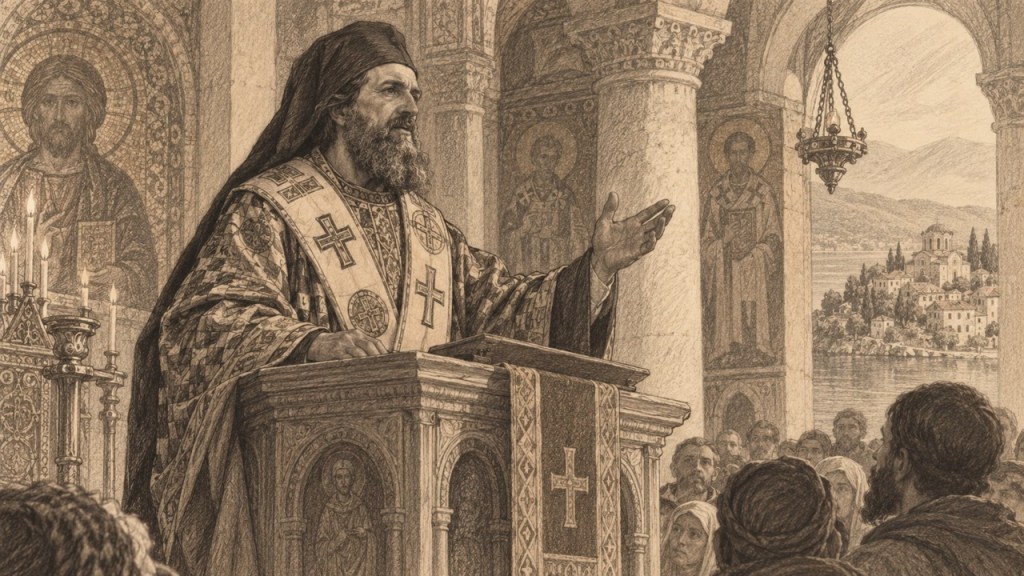
Theophylact of Ohrid (c. 1050–c. 1108), archbishop of Ohrid in Bulgaria, wrote commentaries on the Gospels and the Pauline epistles that distil and clarify Chrysostom for later readers. His exposition of Colossians follows Chrysostom’s line closely while smoothing the homiletic form into continuous commentary, and it circulated widely in the West through sixteenth-century Latin translations. The present translation is made from the Latin version of Johannes Lonicerus.
SOURCE: Theophylact of Ohrid. Commentarii in omnes Divi Pauli Apostoli epistolas. Translated into Latin by Johannes Lonicerus. Paris: Jérôme and Denise de Marnef, 1548. Google Books.
TRANSLATION: Theophylact of Ohrid. Exposition on the Epistle to the Colossians. Translated by Phil Thompson. Greenville, SC: Institute for Colossians Studies, 2026.
Licensed under Creative Commons Attribution 4.0 International (CC BY 4.0): https://creativecommons.org/licenses/by/4.0/
Text
[page 1r] Theol. 897-897(1)
Theophylact, ARCHBISHOP OF BULGARIA, Commentaries on all the Epistles of St. Paul the Apostle, recently and most faithfully translated into Latin from a very ancient Greek archetype by Dr. Johannes Lonicerus.
PARIS, By Jérôme and Denise de Marnef, on Rue Saint-Jacques, at the sign of the Pelican, 1548.
[page 234v]
THE EPISTLE OF PAUL TO THE COLOSSIANS through Theophylact, Archbishop of Bulgaria
ARGUMENT
Marginalia: Paul’s epistles from prison are most holy.
All the epistles of St. Paul are indeed holy, but especially those sent while he was in chains. It is as though he wrote them having already achieved the first ranks in battle, won the victory, and set up a trophy in the midst of the slaughter. He himself knew that this is a great thing and pertains to honor. For writing to Philemon, he says, “Whom I have begotten in my chains” (Phlm 10). He said this so that we might not be saddened by certain dangers, but rather consider it an honor for us to bear disgrace for Christ. There are many such epistles—namely, to the Ephesians, to Philemon, to Timothy, and to the Philippians, as well as this very one to the Colossians, which he wrote while in his chains. Just as he wrote to the Romans and to the Hebrews even though he had not seen them beforehand, for the same reason he sends a letter to these people whom he had not previously seen. Philemon and Archippus lived among them, and it seems to me that Archippus had even established a certain church. He writes to the Colossians for the following reason. A certain perverse and impious dogma had invaded them and had already flourished. They thought they were brought to God the Father not through the Son, but through angels, considering it absurd that the Son of God should appear in the last times when all things in the Old Testament had been done through angels. They also kept many Jewish and Greek observances, observing days, times, and foods. Since all these things needed correction, they moved the apostle to write this epistle.
[page 235r]
“Paul, an apostle of Jesus Christ by the will of God.”
Right at the beginning, he secretly destroys their dogma, for he is not the apostle of angels, but of Jesus Christ. And this is the will of God, that he be the apostle of Christ, not of angels. But if I am an apostle by the will of God, it is clear that I preach the truth. And what are these truths? That we are brought to the Father by the Son, and that we have been set free from both Jewish and Greek observances. Note here that he attributes the preposition “by” to the Father.
“And Timothy, our brother.”
Therefore, he too was an Apostle. It was fitting that he should also become known to them.
“To the saints and faithful brothers in Christ at Colossae.”
Colossae is a city in Phrygia, which is now called Chonae, as is clear from the fact that Laodicea is nearby. From where did you become holy? Was it not through baptism into the death of Christ? From where are you faithful? Is it not because you believe in Christ? Is it not because such great mysteries have been entrusted to you by Christ? We are called faithful not only because we believe, but because the secrets of God have been entrusted to us, which not even the angels knew. Why brothers? Was it through your own works or operations of virtue? Not at all, but rather in Christ. How then do you attribute your access and approach to God to angels?
“Grace to you and peace from God our Father.”
He does not add the name of Christ here, although it is his custom, lest by opposing them right at the beginning of the epistle he should cause them to shrink back from the rest of the letter’s argument. But let those who diminish the authority of the Spirit tell us here on what basis God is called our Father? Is it not through the Spirit? Who gave us such great things that exceed the capacity of our intellect? Was it not the Spirit? How then do you diminish his authority?
“We give thanks to God, the Father of our Lord Jesus Christ, praying always for you.”
Jesus Christ is our Lord; are the angels therefore not servants? He shows his love not only through thanksgiving, but also through constant prayer for them. [page 235v] For he constantly holds in his heart those whom he had never seen.
“Hearing of your faith in Christ Jesus.”
We give thanks, he says, because we heard about your faith from Epaphras—not the faith you have in angels, but the faith you have in the Lord Jesus. Through these words he anticipates their objections. Furthermore,
Marginalia: Matt 1.
these names, Christ and Jesus, are symbols of his beneficence. For he himself was anointed for us, and he himself saved the people from their sins.
“And of the love that you have toward all the saints.”
Not toward this person or that person, but toward all, and therefore toward us as well; for this reason you will listen to us gladly. These words are meant to win them over. It seems here that by love he means the affection of mercy toward poor brothers, by which they share anything with them, just as in other passages.
“Because of the hope laid up for you in heaven.”
Marginalia: 1 Cor 9; Phil 4.
You love the saints, he says, not for the sake of any human advantage, but because you hope for future good things. Or because we give thanks that you will obtain incorruptible goods. For they are not laid up on earth, where they might decay, but in the heavens, so that they might have stability. Therefore, do not doubt this hope, for it is stored safely. This pertains to those who are tempted, so that they do not seek rest here, nor grow weary in their trials, as those who expect a great reward.
“Of which you previously heard in the word of the truth of the Gospel.”
Marginalia: The Gospel, the word of truth.
He did not say “of the preaching,” but “of the Gospel,” to remind them of God’s benefits. For the Gospel is about good things. But if it is the word of truth, there is no lie in it. How then do you make him out to be a liar by not believing, just as you were previously taught by him, that salvation comes through Christ? Who was it that preached there? Epaphras, as becomes clear in what follows.
“Which is present among you, just as it is in the whole world.”
He spoke of it as if it were a living thing, saying that it is present. It did not just come to you, he says, and then leave you, but it is present and rules among you. Through these words he cheers them up. Because most people are strengthened more when they have others sharing in their dogmas, he therefore adds, “and in the whole world.” For it is everywhere, and everywhere it stands firm.
“And bearing fruit and growing.”
It bears fruit through works, and it grows in that many people everywhere are received into the faith. Yet it would not have borne fruit unless it had been firmly established. For when trees are supported and strengthened, they produce a great deal of fruit.
“Just as it does also among you.”
He anticipates them just as he did above with praises, [page 236r] so that they do not fall away on their own. For if the Gospel has been preached to all people, then it has been preached to you as well. How is it then that some people now hand down and teach different things?
“For from the day you heard and recognized the grace of God in truth.”
The Gospel, he says, bears fruit and grows in you from the day you recognized grace. How? Not in deception and reckless words, but in truth—that is, in wondrous signs and works.
“Just as you learned from Epaphras.”
You also recognized grace by the works themselves, he says, just as Epaphras taught you. For it was not that one set of things was done while he taught something else. He, as it seems, preached to the Colossians.
“Our beloved fellow servant.”
Here he declares the man’s authority. For I, Paul, would not love him unless I knew him to be a true herald, nor would I call him a fellow servant.
“Who is a faithful minister of Christ on your behalf.”
He ministered for you, he says, in matters pertaining to Christ, when he evidently went to Paul, comforted him in his chains, and informed him of the situation of the Colossians. But if Epaphras is a minister of Christ, how can you claim that you are brought to God through angels?
“Who also made known to us your love in the Spirit.”
That is, the spiritual love you have for me. For love in the Spirit is stable. By contrast, natural love—such as that of parents
Marginalia: Love from the Spirit is stable.
for their children, children for their parents, and friends for friends—is unstable.
“For this reason we also, from the day we heard it, do not cease praying for you.”
For this reason—what reason? Because, he says, we heard of your faith and love, conceiving a good hope concerning the good things that will come to you, we pray for you not just for one or two days, but continually from the time we heard these things. Through these words, he simultaneously demonstrates his love for them and secretly rebukes them. For although they have been helped by his prayers, they have not yet completely gathered themselves together, nor have they corrected themselves. Observe here that we need many unceasing prayers; for Paul prays without interruption, and even if he achieved nothing, he still did not give up.
“And asking that you may be filled with the knowledge of his will.”
Through this he indicates that they are neither completely imperfect nor completely perfect. For he did not say, “that you may receive,” but “that you may be filled.” You have it, but not yet completely. Because you have been brought to God, you have indeed recognized him; but what you lack, and do not know well enough, is that this happens through the Son of God. Therefore I pray that this may be fulfilled in you. For the will and good pleasure of God is that he gave his Son for us, not angels. Therefore, understand “knowledge” as an appendix to recognition.
[page 236v]
“In all spiritual wisdom and understanding.”
Because the philosophers were deceiving them,
Marginalia: Deceitful philosophers.
he says, I want you to learn the instruction and doctrine of the Gospel through spiritual wisdom, not according to the wisdom of men, by which you were deceived and think you have knowledge. But if you need spiritual wisdom to learn the will of God, what will one say of those who boast that they have known the essence of God from external wisdom?
“So that you may walk worthily of the Lord.”
I pray, he says, that you may learn that you have been saved by the Only Begotten, so that you may walk—that is, so that you may live according to virtue. For whoever has learned of the mercy of God—that he gave his Son for us—how will he not strive to dedicate himself to the labors of virtue, and to such an extent that he takes up his cross? To walk indeed pertains to life and conduct, as has been said. Moreover, he everywhere connects the rule of life and morals to faith. But above all, we do not pray that you only learn, but that you also demonstrate it by your works. For whoever knows the will of God and does not do it will be punished. Note, moreover, how he always calls life and conduct a “walking,” showing that just as it is always necessary for us to walk, an excellent life is also necessary.
“Fully pleasing to him, in every good work.”
That you may live in such a way, he says, that you please God in all things. But how does this happen? In no other way than in every good work. For where every good work is present, there also is the entirely good will of God. Consider how he applies “every” everywhere: in every wisdom, in everygood work, fully [every] pleasing, and for all long-suffering, showing that while they possess it now, they do not yet have it fully, so they must look toward the end.
“Bearing fruit and growing in the knowledge of God.”
Just as, he says, you have known God more perfectly than those who lived in the past, in the same way you ought to grow in your life according to the measure of your knowledge. For whoever has been endowed with such great goods—that he should know God and be a son of God—does he not need great virtue by which to shine? Or, because you ought to bear the fruit of good works, but in such a way that you possess the knowledge of God as is fitting, not as you now seem to have it. For what is the benefit of your life and conduct if you are ignorant of the Son of God? But consider that earlier he said they needed knowledge in order to walk worthily of the Lord; now again he demands of them that they grow in good works so that they may also simultaneously know God. [page 237r] For each is constitutive of the other.
“Strengthened with all power.”
We pray that you may be filled, strengthened with all power. For what? Against temptations and persecutions, so that you do not become sluggish or despair.
“According to the might of his glory.”
So that he may give you such power as is fitting for him to give—namely, ineffable and infinite, yet such as can be received by a human being. Moreover, his patience is great and abundant. He did not say
Marginalia: Long-suffering.
“power,” but “might,” strength, kingdom (for this is what κράτος means), which is greater. It is as if he were saying, “His glory reigns or holds command everywhere.” Therefore, do not languish in harsh and sorrowful circumstances, for you will be strengthened as is fitting, since you serve a Lord who is so strong and glorious.
“For all endurance and patience.”
Strengthened for all endurance toward those who are outside, and for patience, which should exist among yourselves. For a person is patient toward those whom he could fend off, but he endures those whom he can neither fend off nor take revenge upon. For this reason, waiting or endurance is not said of God, but rather patience, since he can indeed destroy whomever he wishes, yet he endures them. However, he says “for all” with respect to the present state of affairs, for after death there will no longer be a need for this kind of endurance. Therefore, to summarize the argument, he is saying: We pray that you may perfectly receive the knowledge of the dogma—not in worldly wisdom, but in spiritual wisdom—and that you may have a life crowned with virtues, so that you can stand firmly against temptations, strengthened as it is fitting to be strengthened by God, so that you may demonstrate endurance toward outsiders and patience toward your brothers.
“Joyfully giving thanks to the Father.”
Since he is about to accuse them of not holding the correct position concerning dogmas, he softens his speech so that he does not appear to accuse them as an enemy. Therefore, since he had previously said, “I pray for you, that these and those good things may happen to you,” which is entirely not the action of an enemy, he now says, “With joy I give thanks for the good things that are in you.” Therefore, I do not accuse you out of hatred, but out of love. I would certainly wish that I could completely commend you, but out of necessity I am led to accuse you. He does the same in the Epistle to the Corinthians. Moreover, he quietly leads them to the discussion of the Son. If, then, I give thanks with joy, the good things that were previously in you are therefore great. But these were given not by a servant angel, but by the Lord, the Son. Why, however, did he say, “I give thanks with joy”? For this reason: that it is permissible to give thanks even in sorrow, [page 237v] just as Job also gave thanks when he was established in sorrow,
Marginalia: Job 1.
“The Lord gave, the Lord has taken away” (Job 1:21). For no one could take a bite out of him; thus that calamity did not bite him, for in that case it would also have taken away his praise, since he persevered as if insensible to it. But he was indeed bitten, yet he was not wounded.
“Who has made us sufficient.”
What then are the things that were given? That he not only makes you wealthy, but also grants you sufficiency and virtue, so that you may be seen to receive these things worthily. For example, if some king entrusts and commits his empire to a person of meager fortune, he has indeed given him dignity, yet he has not made him sufficient to receive the leadership worthily and to be able to govern it. Hence, the honor has often made a person ridiculous. But God has honored us and made us sufficient to receive the honor. It is a doubling of the honor that he has prepared us and made us suitable.
“For a portion of the inheritance of the saints.”
That is, placing us with the saints; and not just simply placing us, but granting us to enjoy the same things, which he indicates by “portion.” For it is possible to be placed and ordained in the same city, yet not have the same portion; and conversely, to be in the same inheritance, but not have the same portion, just as all of us churches are in the very same inheritance, yet one has one portion and another a different one. But here he has given us both the same inheritance and the same portion. Moreover, he everywhere calls it an “inheritance” to show that just as an inheritance is not a matter of human diligence or effort, but rather seems to belong to fortune, in the same way we are judged worthy of and granted the kingdom not because of our virtues, but it is entirely a matter of divine grace. For this reason he says, “When you have done all things, say that we are useless servants, because we have done what we ought to have done” (Luke 17:10).
“In light.”
Both future and present, that is, in knowledge. For now he has also illuminated us and shone upon us, revealing his mysteries to us, and in the future he will give them more openly.
“Who has delivered us from the power of darkness.”
It is not only this that is great—that he granted us the kingdom—but that he also granted it to those who were far from him. For it is not the same thing to give something to the worthy as to the unworthy. As he says in the Epistle to the Romans: “For scarcely does anyone die for a righteous person” (Rom 5:7). Therefore, he liberated us who were under the power of darkness, that is, under the tyranny of error or deception of the devil. He did not simply say “of darkness,” but “of power,” for he had much power over us and ruled over us. Furthermore, it is difficult simply to be under the devil; but to be powerfully subjected to him, this is far more difficult. However, he did not say “he cast out,” but “he delivered,” showing that we were afflicted as captives [page 238r] and were detained in captivity.
“And transferred us to the kingdom of the Son of his love.”
It is a difficult thing to deliver us from darkness, but to simultaneously bring us into the kingdom is far greater. And not simply that, but so that we might reign together with the Son of his love—that is, his beloved—we who were enemies and plunged in darkness. As he says in another place: “If we suffer with him, we will also reign with him” (2 Tim 2:12). He did not say “he transposed,” which would entirely belong to the one doing the transposing, but “he transferred,” so that it would also be something of our own. By this word he also indicates the ease of God’s power, just as if someone were moving a soldier from one place to another.
“In whom we have redemption, the forgiveness of sins.”
So that when you hear that the Father delivered us, you do not think that the Son shows us nothing good, he immediately says: The Son gave us something greater, and he himself is the cause of our being transferred into the kingdom, granting us redemption, that is, the forgiveness of sins. For unless we had been delivered and released from these things, we would not have been transferred into the kingdom. Therefore, he himself prepared the way for us by the gift of the Spirit. Moreover, he did not say λύτρωσιν, that is, liberation, but ἀπολύτρωσιν, that is, redemption; meaning, he perfectly delivered us, so that we would no longer stumble, nor become mortal as those subject to Adam’s sin. If, then, he himself delivered you and brought you to the Father, how can you say that this happened to you through angels? Observe here that “in whom” refers to the Son.
“He is the image of the invisible God.”
He sets forth the renown of his nature and the majesty of the dignity of the Only Begotten in this place. He is the image of God, he says; therefore he is unchangeable. For you do not have a measure of his greatness so that you might say how much he is diminished. For if he were the image insofar as he is man, you could say something—namely, that the image does not reach the first exemplar and the primary form. But because he is the image insofar as he is God, and the Son of God, he is the unchangeable image of God, specifically the invisible image of the invisible God. In our case, however, because human art makes images—which often fail—the image does not have unchangeability; it is not exempt from alteration. But where God is, there is no lapse, no error. Therefore, change does not fall upon him. But if the Son does not have the capacity to be invariable with the invisible God, what prevents angels from also being images, since they themselves are invisible? Yet an angel is nowhere called an image. Note here the precise form of Scripture. It explicitly names man as the image [page 238v] of God, and the Son, but it never names an angel. For in that case, the height of angelic nature would immediately have cast men headlong into impiety, making them think that an angel is of the same dignity as God. But in man, his insignificance and lowliness protect and strengthen us, lest we suspect any such thing. Gather from this, therefore, that since the Only Begotten, who is invisible and the image, differs by both these qualities—first, that he is the image, he differs from the angels, who are indeed invisible but not images; and second, that he is invisible, he is separated from men, who are indeed called images, yet are not invisible. Therefore, he alone is properly and unchangeably the image. But if the Arians still insist that the image is not a likeness with the first exemplar, let them tell us: when Scripture affirms that Seth is the image of Adam (Gen 5:3), was he not of a similar essence or substance with him? Artificial images, therefore, are not homoousian, they are not of a similar essence; but natural images are absolutely of a similar essence.
“The firstborn of all creation.”
Because he said that he is the image of the invisible God, he immediately introduces this: that he is the firstborn of creation. But here the enormous deceit of the Arianizers arises. For after he has been called the firstborn of all creation, they say, he is the first among created things. Yet he did not say “first created,” but “firstborn.” Otherwise you will also give him brothers, and he will be the firstborn with respect to a mouse, a frog, a stone, and the most vile things, and will be homoousios with all these things, that is, of equal substance. For whoever is the firstborn is homoousios with those of whom he is the firstborn. But let this blasphemy turn back upon your own head! For to understand such things about the incomparable glory of the Creator is impious. Furthermore, “firstborn” in Scripture is not exclusively applied relative to those who follow, but absolutely, meaning simply “born first.” For this reason, the virgin mother of God, Mary, gave birth to him according to the flesh as her firstborn, even though he did not have brothers after him. For he is the Only Begotten by reason of his virgin mother. In this way, he is the firstborn from the Father, not in respect to the rest of the creatures, but absolutely. For he is the Only Begotten according to that supreme and eternal birth. Why is it, then, that Paul still presses the argument with which the Colossians were being urged, and refutes the Colossians’ opinion? So that they do not think Christ is either inferior or younger than the angels; since formerly they were brought to God by them, but now they are said to be brought by him. Therefore, he wants to demonstrate that [page 239r] the Son is before every creature and therefore before the created world. How? By generation. Therefore, by this reasoning as well, he is prior to the angels, since he himself created them. If the angels administered anything in the Old Testament, does it not therefore equally belong to him? Notice Paul’s wisdom here. So that you do not think that because he is before every creature he therefore lacks a ruler or a head, he teaches you for this reason that he has a Father; he is generated equally by him. For since both he and all things are from God, it indicates this very fact: that these things are from God in one way, while he is from God in another way—that is, he as the Son from the Father, but things as creatures founded through this very Son. Therefore, he infers:
“Because in him all things were created, things in heaven and on earth.”
“In him” means “through him,” just as he himself indicates in what follows. Moreover, what was ambiguous—namely, concerning heavenly things—he placed first. If therefore the angels themselves were created by him, how are they prior to him?
“Visible and invisible, whether thrones, or dominions, or principalities, or powers.”
Passing over a detailed discussion of visible things, as being matters about which there was no controversy, he speaks specifically about the ambiguous things, about which there was doubt—namely, the invisible things. Yet he did not express the heavenly ranks completely one by one, but rather indicating the lesser ones from the greater, and thus making it clear. For invisible things also include angels indeed, and archangels, and our souls, because this is also gathered from them.
“All things were created through him and for him.”
Look: what Paul said slightly earlier as “in him,” he now says “through him,” just as the evangelist John says: “All things were made through him” (John 1:3). However, when saying “all things,” he does not include the Spirit, for the Spirit is not one out of all those things, but is absolutely one, just as there is one God and one Lord. Therefore, all things whatever that were made, were founded through him. Then, lest you think he is a minister or a sub-creator, he adds “and for him,” that is, all things depend on him and from him. Nor did he merely create them, but he himself also sustains them. Therefore, if they are torn away from his providence, they perish. He did not say, “they belong to him,” but what is more precise, “they look to him” and depend on him. And this very looking to him is sufficient for him to sustain and simultaneously encompass them. Now this is no less a thing than to create; for as far as those things that proceed from us are concerned, it is by far the greatest. For instance, we make [page 239v] some common cloak, or we build a house; but we cannot preserve it from decay. He, however, both made them and preserves them.
“And he is before all things, and in him all things hold together.”
He immediately turns the same points over again, radically tearing out the destructive dogma with a continuity of words acting as a barrage of dense blows. Observe, moreover, that he did not say, “he was made before all things,” but “he is,” which is most proper to God. Where is Paul of Samosata here, who affirms that he began and took his origin from Mary? Furthermore, they consist in him as in a foundation: thus he is also the firstborn before creation, as a foundation. Now this does not mean that he has the same nature or equal essence with the creatures, but that all things are borne and moved in him.
“And he is the head of the body, the church.”
After discussing the dignity of the Son, he next speaks of his mercy. For he who is so supremely the creator and preserver of all things joined himself to inferior things. He did not say “of the fullness of the church,” but “of the body,” to show the exact property of his relation to us, and that he assumed flesh homoousian with us, not from heaven. For Paul took the church to stand for the entire race of mortals, as if to say: In his generation according to the flesh, he is the first of men, like a head.
“Who is the beginning, the firstborn from the dead.”
He is the firstfruits of the resurrection, he says, because he rose before all others. And after he loosed the pains of death, he is rightly called the firstborn. Indeed, as firstfruits he has others following him; for firstfruits are the firstfruits of certain things. And just as when one sheaf is offered as firstfruits, the whole harvest is commended, so through him we are all sanctified and brought to the Father; and by rising in one body, the entire nature has been judged worthy of resurrection.
“So that in everything he might have the supremacy.”
In all things that are considered concerning him. For he was born of the Father before all things, and thus he is the first of all, as the head of the church; and he rose before everyone, granting immortality, as firstfruits. For even if others rose before him, they died again, but he rose with a perfect resurrection. Reflect here that he is the firstborn as the firstfruits of the resurrection, because the regeneration is the same; but there he is not the firstfruits of creation, even though he is the firstborn. For the rationale of essence is indeed the same, but he was born in a different way, whereas a creature [page 240r] is a creature by this very name of creation.
“For in him all the fullness was pleased to dwell.”
The fullness of divinity; that is, if there was anything that the Son the Word was, it dwelt there, not as some act but as essence. However, he cannot state another reason except that it pleased God, and so it seemed good to him.
“And through him to reconcile all things to himself.”
“Through him,” that is, he himself working acquired this salvation for us. But lest you think he is in the position of a minister, he says “to himself,” that is, he reconciled men to himself. Yet elsewhere he said that he reconciled them to God. Therefore, those things that belong to the Father are also common to the Son. However, he did not say “to conciliate,” but “to reconcile,” that is, to pay back, as it were, a certain debt by which one was formerly bound, and to make peace perfectly, so that he is no longer hostile. For not only was conciliation rendered, but the very manner of the reconciliation—that is, the slaying of the Son—availed exceedingly.
“Making peace by the blood of his cross, through him.”
Conciliation indicates enmity, but making peace indicates war; for we were enemies and foes of God. Therefore, to reconcile is a great thing. But what he says, “through him,” is greater: first, that it was through blood, and then through the cross of a disgraceful death. For he did not reconcile us by making speeches like an ambassador, but by giving himself. He did not say “of the cross” and stop there, but he added “his,” lest you think the cross can do anything by itself. For it was not simply the cross that saved us, but his cross.
“Whether things on earth, or things in heaven.”
Those things which are on earth, rightly so. For everyone was at odds both with himself and with others, and as for the angelic life, we were enemies. But how those things which are in heaven? The earth was separated and torn away from heaven; but the angels were provoked and rendered enemies by men when they saw their Lord being insulted, and for this reason they were also sent for punishment, as against David, against the Sodomites, in the valley of weeping (2 Sam 24; Gen 19). Therefore, the Son, leading man to the heavens—that is, the enemy—made the angels on earth also be seen singing in harmony, and accompanying every single one of the faithful (Acts 1). It seems to me, moreover, that Paul was caught up (2 Cor 12) so that he might be taught how men are in heaven, and that the Son was received there. Therefore, in earthly things there is a twofold peace, with respect to heavenly things and to themselves; in super-heavenly things it is a single peace. For from then on they struck a covenant with us, and they rejoice over our salvation.
How then do you Colossians say that you are brought to God through angels? For [page 240v] so far were they from bringing us, that they were even our enemies, and unless Christ had reconciled us to them as well, we would not have had peace.
“And you, who once were alienated and enemies in your mind through wicked works.”
Above he said that we were under the power of darkness; now he proceeds to affirm that we were enemies in our mind and intention, not saying the same thing, but lest in hearing those things you think there was a necessity, he introduces these words to show that he considered us worthy of reconciliation even when we were unworthy. For he who suffers affliction and evil out of necessity is worthy of pity; but he who suffers it of his own free will deserves hatred. Therefore, he says, he reconciled us who were not unwilling or forced, but voluntary, shrinking back from him of our own accord, and entirely unworthy. Now he says these things because he had mentioned heavenly things, hinting that all the enmity had its beginning not from the heavenly beings, but from us: since the angels wanted what God wanted, but you did not want it. For this reason he did not simply say “enemies,” but “alienated,” that is, not expecting a return. For you were enemies in mind, that is, in will and purpose. And the danger did not extend only this far, but also into wicked works, that is, you were enemies, and you did the things of enemies. Through all these things he indicates that the angels could neither persuade you nor deliver you from the devil, since they too were our enemies, and the one who detained us was not yet bound. Christ, however, both bound the strong man and persuaded us to depart from him.
“Now he has reconciled in the body of his flesh through death.”
Again he sets forth the manner of the reconciliation, that it happened in the body. How? Merely beaten with whips, or struck with fists? No, but simultaneously dying the most shameful death.
“To present you holy and immaculate and blameless before him.”
Again he sets forth another benefit, which he also reviewed above when he said, “To him who has made us sufficient.” He says the same thing now. For he did not merely deliver us from sins, he says, but he also imparted to us a sanctification that is not ordinary, but valid before him, immaculate and blameless, so that not even the slightest blameworthy action might be committed by us.
“Provided that you persevere in the faith.”
Because he attributes everything to the Son, as one who transacted these things by his death, so that they may not say in the future, “We have no need of our own labors,” he says: It is necessary that you persevere in the faith, so that you are not lazy, nor slide back into the sin of unbelief.
[page 241r]
“Firmly established and steadfast, and not moved away from the hope of the Gospel.”
Because someone could remain and yet be shaken in the meantime, he introduces “firmly established and steadfast,” that is, not shaken, and not only this, but not even moved. I ask nothing burdensome of you, he says, but only that you are not transferred or moved from Christ. For he is the hope of the Gospel, and as many as embrace the Gospel ought to hope in him, as the one who made peace. Consequently, he who attributes peace to angels has been moved away from Christ. Now, in virtue it is not permitted to be moved or shaken even the slightest bit; but in faith it is possible. Thus he asks nothing burdensome or troublesome.
“Which you heard, which has been preached to every creature under heaven.”
He brings forth the Colossians as the first witnesses, then the whole world. He did not say, “which is being preached,” but “which has been preached,” that is, which is already believed. Let this, therefore, shame both you and all other people who believe otherwise.
“Of which I, Paul, became a minister.”
And this contributes to the authority of the Gospel, that Paul himself is the herald. For his name was immense, resounding among all people, and had already occupied the world. By calling himself a minister, he compels them more strongly to believe. For I do not speak my own things, he says, but those of another minister, namely God, and so you will believe him.
“Now I rejoice in my sufferings for you.”
This indeed seems to be a non sequitur, but it follows very logically. For after he had said that he was made a minister of the Gospel, from which he does not want them to fall away, nor is it worthy that they defect, he demonstrates that this is so true that I even suffer. And I not only suffer for this, he says, but I even rejoice in afflictions. Now these afflictions of mine are for you, so that I can help you.
“And I fill up in my flesh what is lacking in the afflictions of Christ.”
This appears to be the speech of a boaster and of someone packed with madness: but it is not, rather he is filled with a great deal of love for Christ. For he wants to persuade them that Christ is still suffering for them today, because you were not brought to God through us apostles, but through him, even if we are ministers of the Gospel. What then are you doing shrinking back from him who risked himself to the very point of death for you? But what he says means this: If Christ still had to suffer for you, but had departed and had not paid the debt, I am paying this. It is as if an army commander departs, and the subordinate commander, fighting on behalf of the phalanx and standing in his place, receives the wounds himself. For this reason he also said ὑστερήματα, that is, what is lacking, to show that he thinks he has not yet [page 241v] suffered everything he ought to have. He loves you so much, he says, that as if his former passions and afflictions were not enough, he still suffers after death in my body. For he is not yet satisfied with death, but still undergoes innumerable sufferings. Therefore, Paul is not saying these things to exalt himself, but wanting to show that Christ still cares for them.
“For the sake of his body, which is the church.”
Because he had said, “even if I suffer, yet the afflictions are Christ’s,” he gives credence to this argument by saying, “These things are done for his body.” Therefore, do not think this is an arrogant speech, but believe that he who did not disdain to join the church to himself still suffers for her in my flesh. If, then, the church is the body of Christ, and she is joined to him who is the head, how can you bring angels into the middle and dissect the unity?
“Of which I became a minister.”
He shows that he has done nothing by himself, since he is a deacon. But if I am a deacon, how can you produce angels as ministers?
“According to the dispensation of God, which was given to me for you, to fulfill the word of God.”
The dispensation of God; he either means this: that having been taken up into heaven, he left us here to preach the word, so that you do not despair as if abandoned (Acts 9; Gal 1). Or he means this: that for this very reason above all others he ordained that I should be a persecutor of the church, so that I might be a trustworthy herald. Or because he did not seek works or virtues, but faith and baptism. And this is the greatest dispensation: for who would have been saved if works were required? Or simply, the dispensation of God given to me for you—that is, toward you who have believed from among the Gentiles—means the grace and sufficiency he gave him to illuminate the Gentiles. For to persuade those seized by darkness, foolish, and disobedient, and to lead them to the point where they receive such dogmas, is not a matter of Paul’s virtue, but of God’s dispensation. And just as he showed his afflictions to be Christ’s, so he says it is God’s to fulfill the word toward them. Now when he says “to fulfill,” he shows that they are lacking something. Understand this too, that the dispensation of God is still called a mystery, when you have been made accepted. For God doing all things by divine providence, did this also entirely according to his dispensation, that he would reveal the mystery today when men were most ready to receive it. Therefore, those are empty who take offense here because the Son is said to bring us to God in the last times.
“The mystery hidden from ages and generations.”
Having stated what we have been given, he also shows [page 242r] another intention, namely that no one before us learned it; and he calls it a mystery because no one knew it except God; and not simply hidden, but concealed (ὃ κεκρυμμένον, ἀλλὰ ἀποκεκρυμμένον). As for his saying “from the ages,” it is the same as if he were saying “from the beginning.”
“But now manifested to his saints.”
This is his dispensation, that it should now be manifested. He did not say “it was made,” but “it was manifested,” and yet not even now to all people, but to his saints; therefore it is still hidden from others even now. Do not let them deceive you, then, for they do not know.
“To whom God willed to make known the riches of the glory of this mystery among the Gentiles.”
So that you do not ask for what reason it was manifested only to the saints and not to all, he introduced, “To whom he willed.” Now his willing is not without reason. He could have said the Gospel was manifested to the unworthy, but instead he wants them, as those bound by grace, to have moderate views rather than, having obtained it worthily, to think too highly of themselves. Furthermore, adding weight to what was done, he did not simply say “to make known the glory of the mystery,” but rather “the riches of the glory,” which have been manifested most of all among the Gentiles, just as he says in another place: “That the Gentiles might glorify God for his mercy” (Rom 15:9), a fact that is clear enough in others, but not as much as in those who are more senseless than stones, who worship both stones and serpents. This is exactly as if someone taking a scabby dog that cannot move, turns it into a man and places it on a royal throne; he will seem to be honored with greater glory than if he had shown these things to a man laboring under moderate poverty. Moreover, he spoke beautifully of “this mystery”; for there are also other sacraments and hidden matters, but this is truly a mystery that no one knew, which is beyond common custom and expectation, namely that the Gentiles were to be taken up.
“Which is Christ in you, the hope of glory.”
Interpreting what those riches are, or what the mystery is, he says, Christ, or the knowledge of Christ, who is in you. But he sets this down with praises and commendations so that he might draw them rather. For if Christ is in you, how do you claim angels as your benefactors? Furthermore, the hope of glory is that through him we hope that we will obtain everlasting glory, or that our glorious hope, which does not put us to shame, is Christ.
“Whom we proclaim.”
Not us, the angels: how then do you have them as ministers? But he significantly said “proclaiming,” evidently bringing him down from the heavenly realms.
[page 242v]
“Admonishing every man, and teaching every man.”
Not with a command or necessity, for this too belongs to divine kindness, that no one is brought or seized tyrannically, but with exhortation and teaching. You will understand exhortation to be about works, and teaching to be about dogmas.
“In all wisdom.”
For to be able to teach such things requires all wisdom, both that which is from Scripture, and that which is taken from reason and arguments, and that which is learned from the Greeks themselves, just as he instructed the Athenians from the altar (Acts 17).
“That we may present every man perfect in Christ Jesus.”
Why do you say “every man”? Truly, he says, we attempt this, and even if it does not happen, that is nothing to us. But perfect not in the law, nor in angels, but in Christ Jesus, that is, in the knowledge of Christ: for that is not perfect, namely wishing to be perfected either by the law or by angels.
“For this I also labor, striving.”
He was not content with the word “labor,” but added “striving,” to show his keeping watch, his strict way of life, and all the other things that belong to those who struggle. But if I labor for your good, how much more should you?
“According to his working, which works in me with power.”
Because he said that he labored and was wearied by laboring, he shows that this is divine: for the Strong One equips me for this, obviously he wills this. Just as he said at the beginning, “an Apostle by the will of God.” By this he also shows that many fight against him, but this is seen rather as the power of God, since there were many adversaries who opposed themselves.
“For I want you to know how great a struggle I have for you, and for those in Laodicea, and for as many as have not seen my face in the flesh.”
Being about to introduce dogma and instruction, he first sets before their eyes the immense affection of his love, so that it might be more acceptable. I struggle, he says, for you. Moreover, he joins the Laodiceans and simply others to them, so that they do not become disturbed, thinking that it is a mark of weakness that Paul is afflicted. But why do you labor in a struggle? Do you condemn us? For this reason, he says, that you have not seen my face. He added “in the flesh,” miraculously showing that he always looked upon them in spirit.
“That their hearts may receive comfort, being joined together in love.”
Next he ascends now into the dogma, and begins it, not [page 243r] plainly accusing them, nor entirely freeing them from accusation. Now this is the repayment. I, he says, sustain the struggle so that something might happen: so that they do not hold different views, but rather that all might be advanced and joined together in one faith. How? Not by necessity or violence, but in love. He said this as if force and necessity produce schisms and heresies.
“And into all the riches of the full assurance of understanding.”
That is, so that they doubt about nothing, so that in all things their intellect may be abundantly made more certain and strengthened—that is, the knowledge of the mystery. He did not simply say “to riches,” but “to all riches.” I know indeed that you have an intellect for mysteries, but I seek in you a rich certainty of this intellect; or because I want you to be made certain with intellect, not stupidly and irrationally.
“To the knowledge of the mystery of God the Father and of Christ.”
But what is this mystery of God? That through the Son of God access to the Father is made, and not through angels.
“In whom are hidden all the treasures of wisdom and knowledge.”
He alone, he says, knows all things. But if he alone is wise, he therefore came wisely in the last times, and not long ago; and some madmen vainly criticize this. When he says “treasures,” he shows abundance; when he says “all,” he shows that nothing is hidden from him; when he says “hidden,” that he alone knows it, and therefore wisdom and knowledge must be sought from him. Observe here, even if he seems to be saying something great, nevertheless he said this by concession on account of the simpler people: “In whom are the treasures,” clearly. For he is a treasure by himself, and knowledge by himself.
“I say this to you, so that no one may deceive you with persuasive words.”
I said this, he says, that Christ alone knows all things, so that no one may deceive you. For what does it matter if he speaks persuasively? For he knows nothing, and this is truly all deception and empty sophistry.
“For even though I am absent in the flesh, yet I am with you in spirit.”
The logical sequence would have been to say, “For although I am absent in the flesh, yet in spirit I see the impostors,” but he turns the speech into an encomium. Listen, then.
“Rejoicing and seeing your good order, and the solidity of your faith in Christ.”
That is, your good arrangement. For not only have you not fallen, but no one has hindered your arrangement and your solid faith. For just as in a military battle line, a good arrangement of order makes the phalanx firm, so too in the church, when the good order of love is establishing all things, if sects are absent, there is strength, solidity, and a firm foundation. But faith itself is a firm foundation by itself, which does not allow thoughts to creep in, which [page 243v] suggesting ambiguity, would shake it.
“Therefore, just as you have received Christ Jesus the Lord, so walk.”
We introduce nothing new, but what you have received, that we also demand: again, the Lord Jesus, not angels.
“Walk in him.”
This is the way leading us to the Father. Do not walk in angels, for that way does not lead there.
“Having been firmly rooted.”
That is, holding unchangeably, and not relying at one time on Christ, and at another time on angels. For what has struck roots can never be transferred or moved.
“And built up in him.”
He shows that they had fallen so much that they needed a superstructure, that is, a second or alternative structure, which is placed on the foundation of Christ.
“And established in the faith.”
That is, stably containing Christ through faith, not through reasonings and persuasive speeches. For a building, even if it is placed upon a foundation, is deceptive if it does not stand firmly.
“Just as you were taught, abounding in it with thanksgiving.”
Again he sets down “just as,” so that if nothing else, they might respect themselves. Therefore, what he says, “just as you were taught,” is like a certain foundation; what he says, “abounding,” is itself the repeated structure. Therefore, one ought not to transgress the dogmas previously laid down, but rather advance in them, and speak of them gloriously and honorably, so that we may thus demonstrate something excellent in the faith, giving thanks to God, who has deigned to shower us with such great grace, not attributing progress or success to ourselves.
“See to it that no one plunders you.”
He is a thief, he comes up secretly, he secretly digs under your walls to strip and plunder your mind: beware, therefore.
“Through philosophy and empty deception.”
He shows the way through which the thief comes and so sneaks in: namely, philosophy itself. But because the word “philosophy” seems like something heavy, he added, “and empty deception.” For there is also a good deception, as Jeremiah says, “You deceived me, Lord, and I was deceived” (Jer 20:7); just as Jacob also seems to deceive Isaac, which ought not to be called deception, but providence.
“According to the tradition of men.”
Do you notice where the deception comes from? Because human thoughts and reasonings mediate. For this reason they are also called heresies, for they are the opinions of men. But the faith of Christians is not a human dogma; therefore it will not acquire such a name, namely heretics.
“According to the elements of the world.”
He next begins to reprimand the observation of days, calling the sun and moon the elements of the world, by which a day is seen to be set or behave in this or that way. [page 244r] And he did not say “the observation of days,” but he mentioned the whole world, to demonstrate abundantly and broadly that which is less. For if the whole world is nothing, how much more will the elements be nothing?
“And not according to Christ.”
Even if it were highly permissible to serve partly Christ and partly the elements, one still should not have accommodated them; but now they completely transfer you away from Christ. Moreover, such observations were not only Greek, but also Jewish: some from philosophy, and others of the Jews from the law.
“Because in him dwells all the fullness of the Godhead bodily.”
That is, if the God the Word is anything, he dwells in him. But when you hear “dwelt,” lest you think that he operated just as the prophets did (for God also resided in them, according to that: “I will dwell in them and walk among them” (Lev 2612; 2 Cor 616)), he added “bodily,” that is, not as an act or a certain operation, but as nature and substance, and, as it were, bodied (pardon the expression) and of one substance with that which he assumed. Or, according to the opinion of St. Cyril (Cyril of Alexandria, Scholia on the Incarnation, sec. 8 [https://earlychurchtexts.com/public/cyrilofalex_scholia_on_the_incarnation.htm]), you will be able to understand it in this way, just as the soul resides in the body, and it itself resides in the body essentially and indivisibly, and without mixture. Yet the soul itself is separated from the body by death, while God the Word was never separated from the assumed flesh; rather he was also present in the tomb, preserving it incorruptible, and the soul was present among the dead, preaching or granting remission to the captives. Otherwise, the conjunction was of both, namely the soul and the body, even when they were dissociated by his voluntary death.
“And you have been filled in him.”
Wow! What did he say? You are nothing less than him, he says, but you too have been filled with divinity; nevertheless, “in him,” that is, through assumption. For after our nature was joined to God, we also became partakers of his divine nature. For Paul everywhere wants to bring us very close to Christ, as when he says: “He raised us up and seated us in the heavenly places in Christ” (Eph 26); and, “If we endure, we will also reign with him” (2 Tim 212); and we will be joint heirs (Rom 8:17).
“Who is the head of all principality and power.”
He does not set him up as a homoousian head, but (as remembered above) as the author and cause. How then, having dismissed this, do you assent to angels, running to them? “Who is the head.” He completely pierces, dilutes, and demolishes the dogma concerning angels.
“In whom you were also circumcised with a circumcision not made by hand.”
He brought up an admirable benefit, that you were circumcised in Christ. [page 244v] For it is not the hand of a man that brings this circumcision of the flesh, but the Spirit; and he circumcises not a part, but the whole man.
“By the stripping off of the body of the sins of the flesh, in the circumcision of Christ.”
There, indeed, a member was stripped through circumcision, with the fleshly covering removed; but here our body strips off the sins that we commit through the flesh. Moreover, it is not the law, but Christ who circumcises with such a circumcision in baptism, stripping us of the old life subject to sins, and thus entirely from the flesh.
“Buried with him in baptism.”
What he called circumcision, he now calls burial, presenting something greater than circumcision itself. For circumcision was not cast away, but perished and was corrupted. Therefore, whoever is washed by baptism is buried with Christ through a triple immersion, prefiguring the completed three-day burial, and dying concerning the old and peccable man.
“In which you were also raised through faith in the working of God, who raised him from the dead.”
Baptism is not only a burial, but also a raising. How? Through faith. For believing that God is able to raise, and having a certain proof of this matter in Christ, whom he likewise raised from the dead, we too have thus risen in a twofold way: first, because hoping for the resurrection, we are already seen to attain it, even if it is still future; second, because spiritually we have cast away the destruction of the works of sin, which he additionally inserts.
“And you, who were dead in trespasses and the uncircumcision of your flesh, he made alive together with him.”
Christ, he says, when he had sustained bodily death, was made alive by the Father—not because he could not make himself alive, but because all things are referred to the Father. For he affirms that he also raised himself: “In three days,” he says, “I will raise up the temple” (John 219); and again, he presented himself alive after the passion (Acts 13). But you, sustaining the death of sins, and having a foreskin—that is, bearing a great and superfluous fleshly thought and affection, which was killing you—were made alive together with Christ. For as he resurrected in the body, we will similarly resurrect in both spirit and body. Otherwise, the great John (John Chrysostom, Homilies on Colossians, Homily 6 [https://www.newadvent.org/fathers/230306.htm]) indicates this must be understood as someone who was slain. For because of trespasses you were placed under the condemnation of death.
“Forgiving us all our trespasses.”
Which caused the destruction. Observe from what great penalties he delivered us who were worthy of them.
“Erasing the handwriting of decrees that was against us, which was contrary to us.”
Because he had said, “he forgave us,” lest you should think that he dismissed [page 245r] them but in such a way that they remained and appeared: No, he says, not this, but he erased, or rubbed out, eradicated it. But we will understand “handwriting” either as the confession that the Israelite people themselves wrote when they said to Moses, “All things whatever God has said, we will do and hear” (Exod 198); or the covenant that the Lord made with Adam, saying, “On whatever day you eat, you will die” (Gen 217). For the devil retained this handwriting, and this very thing stood against us, not allowing us to emerge, for he held the legal right itself. Christ erased this in the decrees, that is, in faith: for it is not by works, but by the dogmas of faith that this is loosed.
“And he took it out of the way, nailing it to the cross.”
He not only eradicated it, but also snatched it from the midst and took it away, that is, he made it so that it would no longer appear to us. And he neither gave it to us, nor did he keep it himself, but fastening it to the cross, he tore and shredded it, which is the act of one who remits with joy. Indeed we were all subject to sins and penalty: but he, upon whom no sin fell, being punished for us on the cross, washed away and removed the sin and the punishment. There, therefore, he also tore up the handwriting.
“Having stripped principalities and powers.”
He means the diabolical powers, since human nature put them on; or because he himself, having been made man, also received it as it were, he had this very thing insofar as he was a man. Therefore he stripped off what he received; that is, he was found blameless by the principalities and powers. But if he had assumed a sinful nature, you could learn, apart from sin, that it is spoken of in this way. Satan ruled over human nature through two things: through pleasure, and through sorrow. Therefore the Lord assumed human nature for this reason, so that he might now fight for us against the principalities and powers. I omit to say here that immediately at the beginning of the assumption of his holy flesh he wounded these, being conceived without pleasure, and generated without sorrow. Furthermore, after he had been born, and had already grown up, and matured into a man, he was indeed tempted by the delights and allurements of pleasure: first on the mountain, he was tempted, I say, by gluttony, by the love of wealth, and by vainglory, with the enemy attacking him openly, and he conquered for us (Matt 4). Then the tempter strove and hurried to corrupt him with the machinations of sorrow, so that by this reasoning he might be driven to hatred of his neighbors, weaving a snare for him through the Pharisees and scribes, and through those who received a benefit from him; but he could not accomplish what he wanted. Finally, he even fastened him to the cross, thus bringing far stronger machinations: but the Lord granted to him so little of what he wanted [page 245v] that he even prayed for his crucifiers (Luke 23). Thus, in this way, he most perfectly stripped, bared, disarmed, and plundered the principalities and powers, acquiring and securing for us this stripping, who were clothed with these things, because he was a sharer of our nature.
“He made a public spectacle of them in confidence.”
That is, he made them unseemly, rendered them ignominious, disfigured them, shamed them. For the devil was never so shamed. For expecting to hold Christ himself, he lost those others he had. “In confidence” means openly, publicly, with everyone seeing. For the devil would have done everything, if he had been able, to persuade mortals that Christ did not die. For this was the huge ruin and dissolution of the devil: to subject to death a man devoid of all sin, who could not sin. Hence Satan also incited innumerable heresies, falsely teaching that his death was fictitious and apparent in appearance. For this reason, the Lord died publicly for all, but he did not resurrect publicly. For the future time would also bear witness to his resurrection, but no other time than the one that then was could be a witness to his death.
“Triumphing over them in himself.”
That is, showing the demons prostrated and overcome on the cross. For a triumph is declared when someone, returning after having won a victory from his enemies, makes a public procession, or a public joy and celebration of it, and thus testifies to his glory, showing his conquered enemies bound to everyone. Therefore, setting up a trophy on the cross, the Lord triumphed over the demons, as if in a public theater of Greeks, Romans, and Jews. But if the angels did not suffer at all for you, but Christ did, how do you affirm that you are brought to the Father through them?
“Therefore let no one judge you in food or drink, or regarding a festival, or a new moon, or sabbaths.”
Up to this point he said covertly and obscurely, “Let no one plunder you”: but now he does the same thing more openly, after having recounted his benefits. For if you have attained such great things, why do you submit yourselves to paltry things, and make yourselves liable? Therefore, do not endure anyone to pardon you, as though you were not observing Jewish ceremonies and sanctions in food and drink. By this he now commends them, inasmuch as they disregard and destroy those Jewish practices. But he says “regarding a part” of a feast day, as if they had not dared to observe the entire festivity: for even if they celebrated the Sabbath, they nevertheless did not do so strictly, as those who were already dedicated to Christianity. [page 246r] Therefore, he shows that an observation of this kind is vain unless the whole of it is observed, and because the whole of it is now destroyed from this point. For if it was good, it ought to have been kept entirely, and completely.
“Which are a shadow of things to come.”
He calls the goods of the New Testament “future”: for they were future with respect to the Old Testament, which was present at that time, namely in its own time and duration.
“But the body is of Christ.”
Let no one deceive you. Some people here make a perfect punctuation mark after “Christ,” so that the meaning is: the things of the Old Testament are a shadow; but the body, that is, the truth, is of Christ, or is Christ himself. Therefore, what need is there to hold the shadow when the body is present? Some connect these words to what follows, so that we understand it thus: The body of Christ, that is, you, let no one καταβραβευέτω, that is, calumniate, offend. For καταβραβεύειν is when one person indeed obtains the victory, but another receives the brabeum, that is, the prize of victory. And so you have conquered the devil, and have been made superior to him. Why then do you again subjugate yourselves to sin through the observation of the law, which cannot justify, but rather detains us elsewhere? Christ, not the law, conquered: therefore the prize ought to be with the one who won the victory. Moreover, the body of Christ will be among you: how then do you think this was given to the law? For it is evident that if we judaize, we still hold the law of the Lord, by whom we seem to be blessed. Therefore, if the law is a shadow, but the Gospel of Christ is the body, it was worthwhile that we first grew accustomed to the shadow. Rightly, therefore, he became incarnate in the last times, to bring us to God.
“Wanting to defraud you through humility and the religion of angels, entering into things he has not seen.”
Since he filled them with indignation, showing that they are being deprived and robbed of the prize, and moreover are being circumvented, he describes the heretical dogma. They want to defraud us, he says, through a humility that is seen. For they said it is unworthy of the majesty and greatness of the Only Begotten that we should be brought to the Father through the Only Begotten, and that it is too great to suit human insignificance. Hence it is more convenient to say that angels (they say) served our being brought to God, and worked secretly to achieve it. Therefore, from this they introduced the religion of angels, persuading the simpler people to pay attention to them: for they were the ones, I mean the angels, who had saved us. And those who had never seen angels, so commented about them as if they had seen them.
“Vainly puffed up by his fleshly mind.”
Vainly, he says, is he puffed up because of this dogma, by his carnal, not spiritual, opinion. For how [page 246v] is it not characteristic of a carnal and thus coarse mind to reject the things that are spoken by Christ? “God so loved the world, that he gave his Son for men” (John 316); and again, “For them I sanctify myself” (John 1719); and, “I lay down my life for the sheep” (John 1015); and elsewhere, “I have other sheep, which I must bring” (John 1016), and countless things of this kind. How then did he say above that they are puffed up in a humility that is not true, but counterfeit? They swell up indeed, as teachers defending their own dogma, and not allowing themselves to be taught the truth by someone else. Furthermore, they commend their own instruction, and thus their own dogma, through humility, not the humility they themselves possess, but asserting that it is too great a thing to suit men that the Only Begotten should be slain for us.
“And not holding fast to the Head, from whom the whole body…”
He who hands this down, he says, does not hold the head, that is, the Son: for he is the head of the angels, as their creator and founder. In addition, he is also the head of the entire church, both according to this very fact, and insofar as we are his body and members, since he shares these things with us. Therefore, the entire body of the church is from him, and simply has its being, and its well-being, from him. If, then, anyone falls away from him, he is immediately destroyed. For just as the sensory spirit is diffused from the brain into the whole body through the nerves, and all sensation and motion is from the head, in this way the body of the church is supplied by Christ, that is, it receives its living and spiritual growth. But from where does it have this? When it is constructed and joined together, that is, when it has a connection to him and with him. For the Holy Spirit through the joints and connections gives the supply and thus the construction of growth. Therefore, if the body has not been connected and compacted to the head, it is not joined together to him, that is, it is not composed, nor does the supply of the Spirit follow anymore, nor the growth of God, that is, of the best life and conduct according to God.
“If you died with Christ from the elements of the world, why, as though living in the world, are you troubled by traditions?”
By baptism, he says, having died together with Christ, you simultaneously died to your entire former life, so that you no longer serve even the elements themselves, to which you were previously subjected. Why then, as if still living the former life, are you subjected to them? For you are taught that this day is good, but this one is execrable: these are Greek observations. But see how he silently carps at them. You are instructed, he says, completely like elementary children, [page 247r] and you sit listening to instruction and exhortation about what you ought to do.
“Do not touch, nor taste, nor handle, which all perish with use.”
He recites another observation of theirs, which is regarding foods, especially Jewish, just as the observation of days was Greek. But pressing down the arrogance of those dogmatists or teachers, he says, These are not great things, but they end in corruption for those using them: corrupted in the flesh, they flow out through the latrine. Therefore, these things by themselves neither benefit nor harm.
“According to the commandments and doctrines of men.”
These are not divine institutions, but the commandments of men. What then? Is the law not the doctrine of God? It was indeed, when it flourished in its own time; but today it is not, since its time has been fulfilled. Or because the elders among the Jews corrupted it, handing down their own things outside the law, just as Christ says in the Gospel (Matt 15). Or he is noting the dogmas of the Greeks.
“Which indeed have an appearance of wisdom in superstition and humility, and in severe treatment of the body, but are of no value against the indulgence of the flesh.”
They have the appearance of wisdom, not the virtue, nor the truth. For he who hands these things down seems to be a certain pious man, reverent and moderate, and to despise his own body, because he abstains from foods. But God honored the body, and gave foods so that the flesh might persist filled with them, and voluntarily seek them out; but they do not use the body in any honor, depriving it, and taking away its power, nor do they allow it to voluntarily seek out food.
“If then you were raised with Christ, seek those things which are above, where Christ is, sitting at the right hand of God: set your minds on things above, not on things on the earth.”
Since he had said, “You have died with Christ,” evidently through baptism, and through what is left unsaid, giving to understand that you were also simultaneously raised up, and rose together with him (for baptism, just as through submersion or dipping it denotes death, so through emergence or extraction it denotes resurrection), he now infers: If you have been raised together with Christ, you ought hereafter to be in heavenly things, where he is, where there is no longer this kind of observation, and to savor heavenly things. For the things commanded concerning foods and drinks, and days, are earthly, having nothing high or spiritual: since they are the commands of earthly men. He was not content, however, to say “heavenly things,” nor “where Christ [page 247v] is,” but he added, “sitting at the right hand of God,” to draw our minds further away from the earth.
“For you died, and your life is hidden with Christ in God.”
He prepares them from both sides, so that they do not seek the things that are here, both from death and from life; for you are dead, he says, to inferior things, and you ought not to seek them hereafter. Again, your life is in heavenly things, so care for heavenly things as well. For he strives to show that they sit in heavenly things, and live another life, which is evidently in God, and by no means visible to the eyes. Christ does not appear, so neither does your life: why then do you seek visible things? But he forewarns them with these things, so that he may soon fall into a moral discourse. For it is Paul’s custom that while tackling one thing, he leaps to other things, as in the Epistle to the Corinthians, when he was discussing those who preempted suppers, he suddenly slipped into the tradition of the mysteries.
“When Christ, who is your life, appears, then you also will appear with him in glory.”
At the second coming Christ will be manifested, and he will appear to everyone in glory arriving together with the angels (for now he is so hidden that for this very reason he is accused by the impious); then therefore you will also be manifested, not simply, but in glory. Therefore, desire that day, not this one: hasten to live in that one, for then your true life will be manifested; for the present one is death, since it consists of decay, flux, and reflux. Do not covet honors and glories here, for your glory is there. A pearl remains hidden as long as it is in the oyster shell; but as soon as that is broken open, then it shines in glory. In this way, you too, as long as you are in this corruptible body, ought to live as if hidden, alienated from all desire for glory. For when this corruptible thing is dissolved, then there will be the proper place for our glory, if we are seen to be worthy of this through our works.
“Therefore put to death your members which are on the earth.”
He did not say “cast away,” but “kill,” in such a way that they never rise again. Moreover, by “members on earth,” he perhaps also means the members of the body, which, as long as they do not perform heavenly things, are said to be on earth: but when heavenly things are performed through them, they are no longer on earth. For example, when we see or hear viciously, we are not on earth. Or perhaps those things are also called members on earth which are the sins committed on earth through the members of the body, which also remain on earth, and are corrupted there: since indeed the members of the body, even if they are from the earth, nevertheless do not remain on earth [page 248r] and are corrupted, but they will be incorruptible when they have resurrected. But how is it that, since he had said above, “You were buried with Christ,” because you stripped off the body of the sins of the flesh, he now says again, “Kill”? Because the prior mortification was the gift of baptism, which killed the sin previously committed by us: but the killing that is proposed now belongs to our will, obscuring sins and exterminating those that are admitted after baptism, nay not even allowing them to revive at all, in that it slays the affection of the flesh. Just as if someone, renewing with bronze a statue covered with filth, and rendering it bright and smooth, were to remind the person who possesses it to strive to remove the rust—not the rust that he has already completely wiped away, but that which will come hereafter.
“Fornication.”
Look, he interpreted what those members are, and first he mentions fornication, because this evil reigns supreme.
“Uncleanness, passion.”
He omitted saying specifically those things that are not beautiful or honorable to say: hence through impurity and passion he encompassed all species of shameful mixtures. For passion is truly a madness of the body, just like a fever, or a wound, or another sickness.
“Evil desire.”
Look, he again spoke of the whole generally: every depraved desire. But there is also a good desire, for God and divine things, just as Daniel was a man of desires (Dan 9:23).
“And covetousness, which is the service of idols.”
The firstborn son of evil desire is circumvention and greed, πλεονεξία, which he named idolatry, as serving gold and silver. For the idols of the gentiles are silver and gold (Ps 115:4).
“Because of these things the wrath of God is coming upon the sons of disobedience.”
Both future wrath, and in the present, often seizes such people. Moreover, he calls them sons of disobedience, depriving them of pardon, showing that they are not in such afflictions out of ignorance, but out of disobedience, which they have so exercised that they both adopted themselves to it as sons, and were manifested and marked out by it.
“In which you yourselves once walked, when you lived in them.”
The speech here is not without an encomium, as though they do not now live in these things. But once, he says, you lived in these things, when you were gentiles: but now you have put off all these things. How then, since he had said above, “You once lived in them,” and indicating that they do not live so now, does he say again, “Put off all things”? For how can they put off what they do not have? Therefore, it can [page 248v] be answered that what he says, “When you lived,” cooperates with the things that are now being said. For it is as if he indicated this: that formerly indeed sin ruled over you, and contained your life, and exercised tyranny, namely before baptism, and it was exceedingly difficult to be liberated from sins, and thus from depraved affections: but now, with sin killed and dead in you through baptism, it is easy to put off sins, like a cloak. And there is no reason for you to pretext that you live a life under a tyrant and affections, for you have been slain to them.
“Anger, wrath, malice.”
He calls vengeance and the remembrance of injury “malice,” which some have also named bitterness, when anyone keeps malice in himself in order to avenge himself.
“Blasphemy.”
He understands insults here.
“Foul language out of your mouth.”
He significantly said “from your mouth,” that is, which is sanctified through the communication of the Lord’s body. For it is absurd that your mouth, which receives Christ, should be defiled by blasphemy and foul language.
“Do not lie to one another.”
Putting on Christ, who said, “I am the truth” (John 146) how do you now clothe yourselves with another form, namely that of a lie? For from this it becomes clear that you have stripped off that character which sealed you with truth.
“Stripping off the old man with his deeds.”
Why does he call the corrupt life, and likewise the life distinguished by virtues, members and a body and a man? To show that the will is more powerful than essence and nature, and that we are rather named from it, not from essence. For Scripture also names those who, by the name of their will and their morals, are equated to beasts of this kind, as horses, dogs, and foxes (Jer 58; Phil 32; Luke 1332). Therefore, it is our will, not our essence, that leads us both into Gehenna and to the eternal kingdom. Therefore, he calls the old man the corrupt will for this reason he also inferred, “with his works,” that is, the will with the works. Moreover, he named him “old,” wanting to place his foulness and deformity before their eyes, and his weakness. Observe how he recounted the members of the old man: the mind through the lie, the heart through fury, the mouth through blasphemy, the eyes through fornication; the hidden members, like the liver, through evil desire; the hands through avarice and circumvention.
“And put on the new man, who is renewed in knowledge.”
The new man is the will according to God, which does not grow old, but is always lively and flourishing for the knowledge of both God and divine things, and the more gifts it has been endowed with, the more vigorous it shows itself to be.
[page 249r]
“According to the image of him who created him.”
That is, of Christ, since he himself did not reach old age. For he was so beautiful and elegant that this beauty cannot be adequately expressed in words, about which the prophet thus states: “Fair in beauty beyond the sons of men” (Ps 45:2). For he did not commit sin, which wears out and corrupts a man with old age. And we therefore, having been created by him according to his image, ought to strip off and scrape away the corruption and aging that is born from sins. Through this new creation, you will also be able to understand the innovation of life, and excellent morals, which it is fitting to shine forth in the baptized.
“Where there is neither Greek nor Jew,”
That is, a proselyte, and a Jew by ancestry.
“Circumcision and uncircumcision, Barbarian, Scythian, slave, or free, but Christ is all and in all.”
Behold another encomium of the new man according to Christ, that in him there is no discrimination, and thus no respect, of race, dignity, or ancestry, but that Christ is his mark. For in all those whose life is formed conspicuous with virtues, Christ is all things, that is, both race and dignity. Or you will be able to understand it by another reasoning, namely that you have all been made one Christ, since you are his body.
“Therefore, as the elect of God, holy and beloved, put on.”
He indicates the easy preparation of virtue. For just like a cloak, so we can also receive this: and then we ought to possess it continually, and use it as an ornament, so much so that he who lacks this is deformed and unseemly. Moreover, he mixes an excellent encomium with the exhortation. For many of the Jews were also made holy, but they are not elect nor even beloved: but to you all these things have fallen.
“Bowels of mercies.”
He did not say, “put on mercy,” but “the bowels of mercy,” partly so that he does not despise those who are worthy of pity, and partly to show that it is worthwhile that they be bent and moved from their inmost affection toward the miserable, and not as brothers toward brothers, but as parents toward children. For do not say to me, “Why should I pity him? He lived publicly in sins”: for it is for that very reason that I demand mercy from you.
“Kindness, humility, meekness, longsuffering.”
Whoever bears the bowels of mercy, these things necessarily follow him. For what father is not beneficent toward his son? Who is not of a moderate mind toward him, not contending with him, but permitting him everything? Who is not long-suffering? Learn the excellent order here. Beneficence generates a humble and moderate mind. For he who is cultivated by goods and [page 249v] benefits is likewise humble, not of a proud mind. From a humble affection that does not aspire to high things comes meekness. For he who is proud is also of a more agitated mind. From meekness comes long-suffering, that is, magnanimity.
“Bearing with one another, and forgiving yourselves, if anyone has a complaint against another.”
That is, carrying and bearing one another, so that you tolerate him, and he indeed tolerates you, not bitterly exploring one another’s lapses, but considering them small, and worthy of not being looked at. Notice here how he himself diminished them, calling them a complaint.
“Even as Christ forgave you, so you also must do.”
As he always does, he exhorts them from Christ, bringing him forth as an example. And above he made their mutual errors and vices seem small, calling them a slight complaint. But when he produces Christ as an example, he persuades us that even if the offenses are great, and even if we are the benefactors of those who injured us, and even if we are great and they are of the lowest rank, we nevertheless forgive everything, and not only this, but we even die for them, if the matter requires it, and thus testify our benefit to them by our death, just as Christ imparted benefits to us both in death and after death. The particle “even as” certainly demands all these things.
“But above all these things put on love, which is the bond of perfection.”
Because it can happen that he who forgives does not do so from a pure mind, but for appearance and out of hypocrisy or simulation, he shows us the way by which we can pursue true forgiveness. It can also happen that someone appears meek and humble, and yet does not love: for this reason he says, “Over all these things put on love.” What he adds, “which is the bond,” means that when this is present it encircles and connects all these things: they argue that hypocrisy and deceit are absent, and they are completely dissolved, and reduced to nothing. For just as in a house, unless there are dovetail joints, and customary ties as they are called, and in a body unless there are connections, there is no usefulness of the other parts, in this way love contains all the things that make perfection, and without this no one is perfect, and even if he seems to have all things, he is imperfect.
“And let the peace of God obtain the prize in your hearts.”
We are often affected by injury from someone: hence two thoughts struggle within us, one inciting us to revenge, the other to long-suffering. For if the peace of God stands in you, as a certain just brabeuta, that is, a judge and arbiter of the contest, and gives the brabeum, that is, the prize of victory, to the one who commanded that you be long-suffering, your adversary will cease. Therefore let it, I mean love, judge in you, not fury, not anger, not contention, not human peace, for that is born from revenge, from an enemy: but the peace of God, which is stable and indissoluble, which is made for the sake of no worldly advantage, just as God’s peace toward us was made for the sake of no advantage which he derived from it, but simply on account of mercy and love he removed the enmity which he had toward us. But how is it that, having mentioned love, he again begins to dispute about peace? This admonition seems moreover superfluous, since peace is also contained under love. It can therefore [page 250r] be said that a friend often accuses a friend, and out of love and on account of friendship, contentions, injuries, and battles arise. I do not want this, he says, but with love to also have the peace of God, both ordering and judging all things.
“To which also you were called in one body.”
That is, calling us to peace, Christ made us one body, having himself become the head. For who are we, and for what other reason are we one body, than that, as members of one another, we might preserve this peace, and not disagree? Or because you were called to peace, that is, you have been endowed with innumerable goods through peace. For unless we had peace with God, we would not have been called by him to be his servants, and partakers of his goods.
“And be easy to forgive.”
That is to be ἐυχάριστον, easily forgiving or remitting, treating your fellow servants just as God has treated you. For he who gives thanks to God that he has forgiven his offense, will not easily take revenge on the one by whom violence was done to him. For he who avenges an injury does not remember with what great benefits he himself is divinely affected, according to that man, who when countless talents were forgiven him, nevertheless refused to forgive his fellow servant a hundred denarii (Matt 18). Let us therefore give thanks, and forgive whatever we may suffer, and from whomever, for we will receive the crown of martyrdom.
“Let the word of Christ dwell in you richly.”
He demonstrates to us beforehand the way by which we will be easy to forgive. For if the word of Christ dwells in us, that is, the teaching and dogmas and exhortations by which he reminds us, and teaches us to despise both the present life and its goods, we will yield to no difficulties, but bearing all things perseveringly and constantly, we will forgive those things that happen to us, and thus we will give thanks. He did not say, however, [page 250v] simply, “let it be in you,” but “let it dwell,” and “dwell richly.” For if we are rich in the knowledge of the Scriptures, we will bear all calamities with a calm mind, just as a wealthy man can bear the loss of money or his possessions.
“In all wisdom.”
That is, in all virtue. For he calls virtue wisdom, just as David also calls sin foolishness: “The fool says in his heart” (Ps 141); and, “My wounds have grown foul from the face of my foolishness” (Ps 385).
“Teaching and admonishing yourselves in psalms and hymns and spiritual songs.”
Because reading involves labor, and there is much annoyance in it, he did not lead them to histories, but to psalms, so that you might simultaneously charm the soul by taking care, and cheat the labor. Moreover, he added hymns to psalms, as a certain more perfect thing: for to sing psalms is for men, but to contain hymns is for angels.
“Singing with grace.”
That is, with grace and spiritual pleasure. For as human songs seem to have grace, even if not spiritual, in this way divine songs have spiritual delight. Or because it had fallen to them by gift that they should sing.
“In your heart to the Lord.”
Not simply with the mouth, but with the heart, that is, with attention. For this is to sing to God, while the former is to the air. Otherwise, in the heart, not for demonstration: for if you are in a gathering, you can sing within yourself with no one hearing.
“And whatever you do in word or deed, do all in the name of the Lord Jesus.”
If you eat, or drink, or travel, do all things in the name of God, that is, invoking him as helper. When you have first poured out prayers to him, then finally you may begin your works. For the name of God casts out demons: nor will your works be easy for you, unless you invoke the Lord Jesus. Or because, he says, you have named the Lord Jesus, it follows that you do not adduce angels as your saviors.
“Giving thanks to God the Father through him.”
If you invoke the Son, you invoke the Father himself through him: if you give thanks to the Son through him, you also give thanks to the Father. Or just as the Son himself brought us to the Father, so he himself also carries our thanksgiving to the Father, existing for us as the mediator of all goods.
“Wives, submit to your own husbands, as is fitting in the Lord.”
Why does he not command these things in all epistles, but in this one, and to the Ephesians, and in the epistles to Timothy and Titus? Either because it is likely that in these cities there were such dissensions, [page 251r] or because the church here was firm, and the remaining things were well with them, and correctly transacted, he next speaks about these things as well. Furthermore, to others suffering a failing in higher dogmas, it was more necessary to write about those things as well, and to omit exhortations of this kind. Moreover, there is much similarity in these matters between the epistle to the Ephesians and this one. But what does “in the Lord” mean? In place of saying, “obey because of the Lord”: for I do not exact from you only the obedience you owe them from nature. For he indicates this by saying “as is fitting,” that is, as is convenient and proper, but especially also that which is on account of the Lord.
“Husbands, love your wives, and do not be bitter toward them.”
Notice how, conversely, he reminds each in their own matters: wives to obey, husbands to love: for love is not demanded as much from a subject to a ruler, as from a ruler toward a subject. Furthermore, by the love with which a wife is loved, she too becomes lovable, and while she serves her husband, he is rendered gentle to her. But because it can happen that someone loves, and yet is nevertheless bitter and exasperated, yet these bitternesses exist mostly between loved persons: for this reason he says, “Do not be exasperated.” For indeed this happens from much bitterness, that someone disagrees against his own member.
“Children, obey your parents in all things, for this is well pleasing in the Lord.”
Again, in the Lord. For he does not want us to do this here from nature alone, but because it also seems good to God, so that we may have a reward as those doing it for God’s sake. However, speaking to the children of pious parents, he said “in all things”: for impious parents are not to be obeyed in all things. For when they compel toward impiety, they must not be obeyed.
“Fathers, do not provoke your children to wrath, lest they lose heart.”
That is, do not bitterly and exactly investigate everything whatever they do, but there are things that should be overlooked by you, so that you do not make them more contentious, and cast them into sorrow and desperation. Observe the wisdom here, how he broke the parents, and bent their bowels through what he said, “lest they lose heart.” For the entire care of parents is devoted to this, that they do not sadden their children, nor drive them to desperation and unhappiness.
“Slaves, obey your masters according to the flesh.”
Immediately he brought up the law of obedience, not the name of servant itself, but he brought it forward for this reason, so that they would not be distressed by the name of their servitude. Masters, he says, according to [page 251v] the flesh. The better part of you, the soul, is free; your servitude is temporary: therefore submit your soul rather, so that the servitude is voluntary.
“Not with eyeservice, as men-pleasers.”
Ensure, he says, that the servitude you owe by law is done out of the fear and love of Christ, so that you serve out of the love of Christ. For when the master is not watching, and you have performed the duty of a faithful servant, it is clear that you do this because of God’s eye: but if you only act correctly when the master is watching, you are a men-pleaser. However, since you are such a person, you will harm yourself: for the Lord scattered the bones of those who please men (Ps 53:5).
“But in simplicity of heart, fearing the Lord.”
For this is to fear the Lord, when with no one seeing we do nothing evil; this is also the simplicity of the heart, not to look to men. Therefore he who pleases men is not simple.
“And whatever you do, do it heartily, as to the Lord and not to men.”
He wants them to be free not only from deceit and simulation, but also from the body: nay, he makes them free instead of servants, as those who do not have need of the presence of masters. What he says, “from the soul,” that is with goodwill, not with servile necessity, but to do it with liberty and will.
“Knowing that from the Lord you will receive the reward of the inheritance.”
Masters do not often make their servants heirs, even if they have served them well ten thousand times. But the Lord will give you the reward of the inheritance that is in heaven, if you guard goodwill toward your masters.
“For you serve the Lord Christ.”
Who destined this order and subjection for you. But because you serve in Christ, it is clear from this that he himself will be your future rewarder.
“But he who does wrong will receive for the wrong which he has done, and there is no partiality.”
The servant who affects his master with injury, either because he serves negligently, or because he stole what belongs to his master and converted it to his own use, will have his reward and compensation from God. For God is not a respecter of persons, so that he pities the servant, as the weaker party, who also sanctioned by law that a judge should not pity a poor man in judgment (Lev 1915). Or otherwise Let a Christian servant affecting a Greek and infidel master with injury not think that he will escape condemnation. For Christ is not an inspector of a person, so that he would forgive him as a Christian what he committed against an infidel master. And although it seems to be said to the servants, “There is no respect of persons,” nevertheless let masters also accept this as being said to themselves, again and again as appropriate.
[page 252r]
“Masters, provide your slaves with what is just and fair.”
What is just? To make an exchange, and to answer them, so that they also have enough for all their labors, and do not lack other things necessary for them. For after you have heard that they are going to receive a reward from God, will you deprive them of those things by which you are bound to them on account of their labors?
“Knowing that you also have a Master in heaven.”
Just as they have you as masters, so you too have a Master. With whatever measure you measure out to your servants, therefore, your Lord will also measure out to you. Or because you are also claimed with them to the Lord, for here he made servitude common.
“Persevere in prayer, being watchful in it with thanksgiving.”
The devil knows how great a good prayer is, and for this reason he makes us shrink back from it: therefore Paul says, “persevere.” But because he who perseveres is often led to sluggishness and defection, he adds, “watching,” that is, being sober so that you are thus always fresh for the work of prayer. Moreover, “in thanksgiving,” that is, doing this with thanksgiving. For this is true prayer, which contains thanksgiving for all things that we know and that we do not know, from which we have received a benefit, or have even been afflicted; and for common benefits.
“Praying at the same time also for us.”
Observe Paul’s humble mind, that he himself needed their prayers.
“That he would open to us a door, to speak the mystery of Christ, for which I am also in chains, that I may make it manifest, as I ought to speak.”
That is, that he give me freedom, not that I be freed from chains, but that I speak the mystery of Christ, as I ought to speak, that is, not with submission, but with great boldness. But how does a chained man exhort others, and ask them to receive what he had? Not only tasting and breathing moderately, but simultaneously indicating the force of a soul loving the brothers. For he himself also needed heavenly enkindling, which the brothers’ prayer was going to give greater and more abundant. At the same time, he induces them to pray. For if they ought to intercede for him, how much more will they pray for themselves?
“Walk in wisdom toward those who are outside.”
What the Lord said, “Behold, I send you out as sheep in the midst of wolves: be therefore prudent as serpents, and simple as doves” (Matt 1016) this he also now says. Be, [page 252v] he says, cautious: neither give any occasion against yourselves to those who are outside as unbelievers, since they do not harm you, nor offend them when they are simple. “They are outside,” that is, they are not accustomed to us, nor are they of the same fold with us, and even if they dwell in the same world with us, they are outside, as living far from the church and the kingdom of God. Therefore one must converse and deal with them prudently. For here he calls prudence wisdom. For toward family and friends there is no need for such great security. Moreover, he gives them courage, while he calls those who have not given their names to Christ, the Greeks, to be outside or outsiders.
“Redeeming the time.”
He says these things not wanting us to be variable or hypocrites, but he says this. The opportunity of the time is not yours: but it is theirs. You can therefore make the time itself yours as well, if you walk with prudence, if you do not receive untimely fights, but grant them fitting honor, if you are not harmed in your souls, and your faith is not shaken. Listen to Paul himself speaking thus to Agrippa: “I consider myself blessed, to render an account of myself before you” (Acts 26:2). Thus we will make those who are outside to be inside, attracting them to the word through meekness.
“Let your speech always be seasoned with salt, with grace.”
Let pleasantness be in your speech, he says, nevertheless let it not fall into diffusion, nor dissolution, but let it also constrain and seal, for salt indicates this: nor let it be pleasant and lovable beyond measure, nor austere beyond measure: as food, if it lacks salt, is unpleasant; but if it is too salty, it is completely disagreeable to the taste. In either way, however, whether it lacks salt, or is seasoned with it too much, it cannot be eaten. Do you not see Daniel, by what reasoning he cures an impious man (Dan 4)? Do you not see the three young men, how there is nothing rash or troublesome in them, but they showed fortitude and liberty (Dan 3)? For to be rash is not a mark of liberty or confidence, but of vainglory.
“That you may know how you ought to answer each one.”
Differently indeed to a rich man, differently also to a poor man. For the soul of this one, as if weak, needs much permission: but the poor man’s is more solid, so he can also bear it if you deal with him somewhat more severely. If no necessity presses, do not call a Greek polluted, nor attack him insultingly. Furthermore, if you are brought to a ruler, grant him decent honor. But if you are questioned about their dogma, say that it is both [page 253r] profane and impious. Paul certainly speaks amicably with the Athenians, but he curses Elymas, because he was worthy of it (Acts 17, 13).
“Tychicus will make all my matters known to you.”
It is a mark of wisdom not to insert everything into epistles, but only the necessary and pressing things, first so that he does not make them excessively long, and then so that the arriving messenger also has something to recount. For from this he will be considered more honored. Thirdly, he shows with what affection he was imbued toward him. For he would not have entrusted to him such things, which perhaps were not to be indicated by letter, unless he had held him faithful and very dear to himself. Therefore he adds:
“A beloved brother, faithful minister, and fellow servant in the Lord.”
If beloved, he knows all things: if faithful, he will not lie: if a fellow servant, he is a partaker of temptations.
“Whom I sent to you for this very purpose, that he may know how your affairs stand, and that he may comfort your hearts.”
Here he indicates his love toward them. Since he sent him for this reason, to ascertain their situation, not to declare his own things to them: and moreover to comfort them. He also shows that they, being subject to temptations, have need of comfort.
“With Onesimus, a faithful and beloved brother, who is one of you.”
This Onesimus is that servant of Philemon. Wow, to what great dignity he arrived, that he is even Paul’s brother! Paul is not ashamed here to be the brother of a servant. It turns to the praise of their city that he says, “Who is from you,” so that they may boast that they produced such a man.
“They will make known to you all things which are done here.”
That is, the chains, and other things detaining me: for if these were not present, I would have come to you.
“Aristarchus my fellow prisoner greets you.”
This is he who was brought back together with him from Jerusalem. But Paul said something greater here than the prophets. For they called themselves only guests and pilgrims, but he names himself a captive. For truly he was treated and driven like a captive, nay even worse than a captive. Because those who captured them care for captives, as their own possessions: but everyone troubled him in various ways as an enemy and a foe. This is said to them for consolation, since their teacher suffers such things.
“And Mark, the cousin of Barnabas.”
He commends this man from his kinship: for Barnabas was highly esteemed.
“Concerning whom you have received commands. If he comes to you, receive him.”
Perhaps they had received commands from Barnabas to receive this Mark honorably. A period can be placed here after “commands,” and then read as a new beginning: “If he comes to you, O Colossians, [page 253v] receive him honorably.”
“And Jesus who is called Justus.”
Perhaps this man was a Corinthian.
“Who are of the circumcision. These alone are my fellow workers for the kingdom of God.”
Having spoken each one’s own praise, he now also sets down a public one. For it seemed a great thing to be from the Jews. But because he mentioned captivity, lest he cast down the listener’s mind, he relaxes that captivity, subsequently saying, they cooperate with me in the things that lead to the kingdom. Consequently, those who are allies in captivity will also be partakers of the kingdom. But St. John Chrysostom (John Chrysostom, Homilies on Colossians, Homily 11 [https://www.newadvent.org/fathers/230311.htm]) reads it this way: As if he obscurely noted the Jews, saying, “These alone are from the circumcision.” For there were more from the gentiles.
“Who have become a comfort to me.”
He shows that he was in great afflictions, and that they were certain great men, because they were a consolation to Paul. Observe how he who comforts a captive is simultaneously proclaimed to be a partaker of the kingdom with him. Therefore those who are afflicted for Christ’s sake are to be helped and supported.
“Epaphras, who is one of you, a servant of Christ, greets you.”
Both in the beginning of the epistle, and now, he commends him, so that they may love him back as someone diligent, and gladly hear him if he teaches anything. For a preceptor and teacher being in honor results in the advantage of the disciples obeying him in the things he says. Now it is a huge commendation of him, that he is a servant of Christ. Therefore he is your glory, since he is such a man, and is from you.
“Always striving for you in prayers.”
Not simply praying, but struggling, and trembling for you, not only now, but always.
“That you may stand perfect.”
He tacitly bites them as imperfect. For they limped entirely in the dogma concerning angels. But because someone can be perfect, and yet not stand, just as when someone has known all things, he nevertheless does not stand firmly: for this reason he says, “that you may stand perfect,” evidently in doctrine and life.
“And filled with all the will of God.”
That is, that you do no other will, except the divine one. For this is to be complete and perfect. Furthermore, he shows through these things that they partly have something, and partly also lack something.
“For I bear him witness that he has a great zeal for you, and for those who are in Laodicea, and in Hierapolis.”
Both contain intensity, and vehemence, and exaggeration, both because he says “zeal” and because “much.” He also commends him to the Laodiceans and Hierapolitans. For when this epistle is entirely read, they heard about him.
[page 254r]
“Luke the beloved physician greets you.”
This is Luke the evangelist, whose encomium is not small, that he is beloved to Paul. Nor did he place him in the last position to diminish him, or lessen his authority, but so that he might make Epaphras highly regarded and venerated among his fellow citizens. Moreover, it is likely that there were also others by this name.
“And Demas.”
For he had not yet, as it seems, left the teacher.
“Greet the brethren who are in Laodicea.”
Notice how he glues and joins them mutually to one another.
“And Nymphas, and the church that is in his house.”
This was a great man here, who kept his whole house faithful, so that it was called a church: for this reason Paul also does him a favor, greeting him privately. He does this so that he might provoke others as well to a similar zeal for the Gospel, so that if they too want to be honored, they may imitate this Nymphas.
“And when this epistle has been read among you, see that it is also read in the church of the Laodiceans, and that you read the epistle from Laodicea.”
According to my opinion there were some things written in this one that they needed to hear, and again in that one which these needed to learn. For there is greater advantage when, as others are accused, some recognize their own sins. But what was the epistle from Laodicea? The first to Timothy indeed, for that was written from Laodicea. Some say that it was the one the Laodiceans sent to Paul: but I do not know what benefit that would have brought them for correction.
“Tell Archippus.”
Why does he not write to him? Perhaps because he only needed a slight reminder, not letters.
“See to the ministry which you have received in the Lord, that you fulfill it.”
This is a terrifying word from every angle. “See to it that no one plunders you,” “See that your power now.” In a similar way here, “See,” he says, “that you fulfill the work you received in the Lord,” that is, through the Lord. For he gave it to you, not I. But what kind of work was it? That he be the Ephor of the Colossians, and thus the bishop, the overseer. Furthermore, he confirms two things through what he says, “in the Lord,” and makes him more diligent, so that he may perform it like a master’s work: and he subjects them to him, as one who instructs them divinely. For this reason entirely it was written to them, “Tell Archippus,” so that when Archippus rebukes them, they do not accuse him as being bitter, recognizing of course that this is Paul’s command, and that their own mouth said to Archippus the things Paul announced to him. Therefore, so that Paul might block [page 254v] them, he accomplished this skillfully and cleverly: since otherwise it was absurd for disciples to dispute about their teacher.
“Remember my chains.”
That is, make memory of me, who am bound and condemned. But this is the greatest consolation for them for any affliction, to remember Paul bound.
“Grace be with you. Amen.”
With this present, even if you have afflictions and chains, nothing will be able to stand against you. For this too belongs to grace, to be held bound. “They returned,” he says, “from the prison rejoicing, because they were judged worthy to suffer disgrace for the name of Christ” (Acts 5:41). Do you see that it is a dignity and an honor to suffer disgrace? And truly this is a great dignity. Therefore may it also befall us who are unworthy, to be judged worthy and gifted by divine grace in afflictions, so that as it endures our weakness, they may yield themselves to our advantage, squeezing out and wiping away the thick mass of our sins, to the glory of the Father, and of the Son, and of the Holy Spirit, to whom be honor forever and ever. Amen.
Written from Rome by Tychicus and Onesimus.
[page 1r] Theol. 897-897(1)
Theophylacti BVLGARIAE ARCHIEPISCOPI, in omnes D. Pauli Apostoli Epistolas enarrationes, iam recèns ex uetustissimo archetypo Græco per D. Ioannem Lonicerum fidelissimè in Latinum conuersa.
PARISIIS, Apud Hieronymum & Dionysiam de Marnef, in vico Iacobæo, ad insigne Pelicani, 1548.
[page 1v] D rúmque virtutis apud illos meminerit, alioqui enim nó potuisset eos in desiderium eorum pertrahere, vt salutarent ipsos. Gratia domini nostri Iesu Christi cum omnibus vobis. Amen. Est in more Paulo, voto claudere epistolam, pariter eos docens, vt si virtutes quas habeant, eas ex gratia dei habere se nouerint, & credant, & non propter eas extollantur: sic futurú vt gratia nunquam non sit permásura, si non extollátur inqua. Contingat autem & vos omni virtute, maximè ea qua aliis impertiamus, abundare per gratiam Christi, vt & nosipsi adiuti, propterea quod omnibus indigentibus impertiamus, potissimum verò iis qui pro Christo patiuntur, fruamur diuitiis bonitatis ipsius, cui gloria in secula. Amen.
Scripta est ex Roma per Epaphroditum.
AD COLOSSENSES EPISTOLAE PAVLI per Theophylactum Bulgariæ archiepiscopum
ARGVMENTVM.
Marginalia: Pauli epistolæ è vinculis, sanctissimæ.
E OMNES quidem diui Pauli epistolæ sanctæ sunt, maximè verò quæ à vincto ipso mittuntur, tanquàm iam primas in bello consecutus, & victoria parta, in media cæde trophæum statuens eas conscripserit. Nouit autem & hoc ipse hoc magnum esse atque ad honorem pertinere. Philemoni enim scribens ait. Quem genui in vinculis meis. Hoc autem dixit, ne & nos contristemur ob pericula quædam, sed potius honori no bis ducamus propter Christum contumeliam ferre. Sunt autem multæ huiusmodi Epistolæ, ad Ephesios nimirum, & ad
F Philemoné, ad Timotheum, & Philippenses, atque hæc ipsa ad Colossenses, quas ipse in vinculis suis conscripsit. Quéadmodum auté Romanis, cùm nó vidisset antea, tum Hebræis scripsit, pari ratione hisce antea nó visis literas mittit. Apud hos autem erat Philemon & Archippus, qui & mihi videtur ecclesiam quandam instituisse. Scribit autem Colossensibus tali de causa. Prauum quodpiam & impiú dogma in eos inuaserat, lamq́ue floruerat. Arbitrabantur enim non per filium, sed per angelos sese ad deum & patrem adduci, absurdum putantes filium dei in extremis temporibus apparere, quum in veteri testamento per angelos omnia facta sint. Habebant autem obseruationes multas & Iudaicas & Græcas dies obseruantes, & tempora, & cibos: quæ omnia cum indigerent correctione, mouerunt apostolum vt scriberet hanc epistolam.
CAPVT
[page 235r]
Caput Primum.
A PAVLVS Apostolus Iesu Christi per voluntaté dei. Principio statim tollit dogma eorum clanculum, non enim angelorum est apostolus, sed Iesu Christi, atque hæc est voluntas dei, vt illius sit apostolus, non angelorú. Quòd si per volútatem dei sum apostolus, planú est quòd vera prædicem. Quæ autem sunt hęc? quòd à filio adducti sumus ad
B patrem, quòd liberati sumus, & ab Iudaicis & Græcis obseruationibus. Animaduerte, hîc, quòd præpositionem (per) patri tribuerit. Et Timotheus frater. Igitur & ipse Apostolus fuit. Erat autem par & húc ipsis innotescere. Sanctis qui sunt Colossis, & fidelibus in Christo. Vrbs est Phrygiæ, Colossæ, quæ nunc dicuntur Chonæ, quod inde perspicuum est, quòd Laodicea huic sit vicina. Vnde autem sancti facti estis? Nóne per baptisma in mortem Christi? Vnde fideles? nóne quia in Christú creditis? nóne quia tanta sunt vobis à Christo credita mysteria? Fideles auté non ideo tantú vocamur, quia credimus, sed quia credita sunt nobis de deo arcana, quæ ne angeli quidem norát. Vnde fratres? num per propria opera, vir-
C tutisve operationes? Minimè, verùm in Christo. Ecquî igitur angelis adscribitis accessum & adductioné ad deum? Gratia vobis & pax à deo patre nostro. Christi nomen hîc non apponit, licet id ei sit in more, ne si statim in epistolæ exordio eis repugnet, à reliquo argumento harum literarú eos resilire faciat. Dicant autem hîc qui spiritus authoritatem eleuant, vnde pater noster deus dicatur, ánne per spiritú? Magna adeóque ingenij nostri captum excedentia quis donauit? nónne spiritus? quomodo igitur authoritatē imminuis? Gratias agimus deo & patri domini nostri Iesu Christi semper pro vobis orantes. Iesus Christus est dominus noster, nōne igitur angeli sunt serui? Nó solùm autem per gratiarum actionem, verumetiam per assiduam pro ipsis precationem, charitatem suam ostendit.
[page 235v] D dit. Quos enim non viderat, hos semper in corde suo habet. Audientes autem fidé vestram, quæ est in Christo Iesu. Gratias agimus, inquit, eò quòd audiuimus ab Epaphra fidem vestram, non eam quam in angelos, sed quam in dominum Iesum habetis. Per hæc autem præoccupationem facit. Quin-
Marginalia: Matth. 1.
etiam nomina hæc, Christus & Iesus, beneficentiæ sunt symbola. ipse enim vnctus est pro nobis, & ipse seruauit populum à peccatis suis. Et charitatem quam habetis erga omnes sanctos. Nó erga hunc vel illum, sed erga omnes, quare & erga nos: quare audietis nos libenter. Conciliantis autem eos sibi hęc verba sunt. Videtur autem hîc per charitatem, misericordiæ in pauperes fratres affectum, quo ipsis impertiút quicquam, significare, perinde ac in aliis locis. Propter spem repositam
Marginalia: 1 Cor. 9. Philip. 4
vobis in cælis. Diligitis, inquit, sanctos, non humani cuiuspiam commodi gratia, verùm quia futura bona speratis, vel
E quia gratias agimus quia incorruptibilia bona consecuturi estis. Non enim in terram sunt reposita, vt corrumpantur, sed in cælos, vt stabilitatem habeant. Ne igitur ambigatis de spe, in tuto enim reposita sunt. Hoc autem pertinet ad eos qui tentantur, vt ne hîc quietem inquirant, neque defatigentur tentationibus, vt qui magnam retributionem expectent. Quam antea audistis in verbo veritatis Euangelij. Non di-
Marginalia: Euágelium, sermo veritatis.
xit prædicationis, sed Euágelij, vt commonefaciat eos beneficiorum dei. propter bona enim Euangelium est. Si autem verbum veritatis est, nullum mendacium est in ipso. Quomodo igitur vos mendacem ipsum facitis, non credētes, quemadmodum iam antea instituti estis ab ipso, quòd per Christú
F fit salus? Quis autem erat qui illic prædicauerat? Epaphras, perinde ac in sequentibus planum fit. Præsentis apud vos, quemadmodum & in vniuerso mundo. Tanquam de re animata dixit, quod præsens est. Non aduenit ad vos, inquit, ac defecit à vobis, sed præsens est ac dominatur apud vos. per hæc auté exhilarat eos. Quia verò plerique firmantur potius quando & participes habuerint dogmatú, addit, propterea, & in omni mundo. Vbique enim est, & vbique consistit. Et fructum adhuc ferens & crescens. Fructum profert per opera, crescit autem, quòd multi ad fidem recipiantur vndique. Atqui fructú non protulisset, nisi firmatú fuisset. arbores enim quando fultæ firmatæque fuerint, plurimú fructus proferunt. Quemadmodum & in vobis. Anteuertit eos perinde, ac suprà laudibus,
[page 236r] A vt ne sponte deficiant. Si enim ad omnes, ergo ad vos etiam est prædicatum euangelium: quomodo nunc igitur nonnulli diuersa tradunt ac docent? A quo enim die audiuistis & agnouistis gratiam dei in veritate. Fructum, inquit, profert, ac crescit euágelium in vobis, ab eo die quo agnouistis gratiam. Quomodo? Nó in impostura & verbis temerariis, sed in veritate hoc est, signis & operibus admirandis. Quemadmodum & didicistis ab Epaphra. Sic & agnouistis ipsis, inquit, operibus gratiam perinde ac docuit vos Epaphras. non enim alia quidem facta sunt, alia autem docuit. Ille enim, quemadmodum videtur, prædicauit Colossensibus. Dilecto conseruo nostro. Viri hîc authoritatem denunciat. Non enim diligeré eú ego Pau-
B lus, nisi scirem eum esse verum præconem, nec conseruum ipsum nominarem. Qui est verus pro vobis minister Christi. Pro vobis, inquit, in rebus ad Christum pertinentibus ministrauit cùm videlicet ad Paulum abiit, eúmque consolatus est in vinculis, quúmque indicauit ei res Colossensium. Si autem Christi minister est Epaphras, quomodo affirmatis vos per angelos adduci? Qui & indicauit nobis charitaté vestram in spiritu. Hoc est, spiritualé charitaté quá habetis erga me. ipsa enim stabilis est in spiritu dilectio. Amor enim naturalis, vt paren-
Marginalia: Amor ex spiritu stabilis.
tum erga liberos, liberorúmque erga parentes, & amicorum amicarúmque, instabilis est. Propter hoc & nos à quo die audiuimus, non cessamus pro vobis orantes. Propter hoc, quale hoc? Quia, inquit. audiuimus fidem vestram & dilectionem, bonam spem concipientes de obuēturis vobis bonis, oramus pro vobis non vnum diem neque duos, sed omni tépore à quo ista audiuimus. Monstrat autem per hæc simul charitatem suam er-
C ga eos, ac clanculum illos reprehendit. siquidem orationibus eius adiuti, nondum tamen seipsos perfectè recollegerunt, non emendarunt. Obserua hîc quòd multis orationibus nobis opus sit, & assiduis: nam & Paulus citra intermissioné orat, ac etiamsi nihil proficeret, nondum tamen destitit. Ac petentes, vt impleamini agnitione voluntatis eius. Neque omnino imperfectos neque omnino perfectos per hæc significat, Non enim dixit, vt accipiatis, verùm vt impleamini. Habetis enim, sed nondum totum. Et quia adducti estis, agnouistis quidem: quod verò per filium dei, hoc deest vobis, nec satis nostis: quare oro hoc impleri in vobis. Voluntas enim & dei beneplacitum est, quod filium suum pro nobis dederit, non angelos. Agnitionem
[page 236v] D igitur, cognitionis appendicen intellige. In omni intellectu & sapientia spirituali. Quia eos philosophi decipiebant, volo,
Marginalia: Philosophi fallaces.
inquit, vos per spiritualem sapientiam discere institutioné ac doctrinam euangelij, non iuxta sapientiam hominum, per quam decepti, arbitramini vos nouisse. Si autem vt voluntatem dei discatis, spirituali vobis sapientia opus est: quid dicet aliquis de iis qui sese Dei essentiam ex externa sapientia nouisse gloriantur? Vt vos obambuletis dignè domino. Oro, inquit, vt discatis vos, quod seruati sitis per vnigenitú, vt ambuletis vos, hoc est, vt secúdum virtutem viuatis. Qui enim clementiá dei didicerit, quòd filium suum pro nobis dederit quomodo non studebit seipsum dedere virtutis laboribus, adeoque eò, vt crucem ipsius tollat? Obambulare nanq; ad vitam & conuersationé pertinet, vt dictum est. Vbique autem fidei, vitæ rationem moresque cōnectit. Maximè verò nō oramus vt discatis tátummodo, verùm vt operibus quoque de-
E monstretis. qui enim nouit voluntatem dei, & non facit, punietur. Animaduerte autem, quomodo semper obambulacrum vitam conuersationemque appellat, ostendens quòd perinde ac nunquam non obambulare nobis necessarium est, sic & optima vita. Ad omnem complacentiam, in omni opere bono. Vt sic, inquit, viuatis, vt per omnia placeatis deo. Quî verò hoc sit? Non aliter, nisi in omni opere bono. vbi enim omne opus bonum est, ibi & omnis bona voluntas dei. Considera auté quomodo vbique omne apponat, In omni sapientia, & in omni opere bono, ad omnem complacétiam, & ad omnē longanimitatem, ostendens quod habeant quidem & nunc, nondum tamen totum, quare finem eos expectare oportet. Fructum
F ferentes, & crescentes ad omnem agnitionem dei. Quemadmodum, inquit, nouistis deú perfectius quàm qui olim vixere, hanc ad rationem debetis & in vita crescere iuxta mensurá cognitionis. Qui enim tátis est donatus bonis, vt deú sciret, vtque filius dei esset, nōne magna virtute opus habet qua renideat? Vel quia oportet vos proferre fructum bonorum operum, sed vt agnitioné dei habeatis quemadmodum conuenit, non autem quemadmodum nunc videmini habere. Quę enim commoditas vitæ & conuersationis vestræ, si ignoretis filium dei? Contemplare autem qui suprà eos cognitione dixerit idigere ad hoc vt dignè obambularent domino: nunc rursus exigit ab eis vt crescant in operibus bonis, vt simul deum etiam agnoscant.
[page 237r] A agnoscant. vtrunque enim vtriusque est constitutiuum. In omni potentia confortati.Precamur vt impleamini in omni potentia confortati. ad quid? aduersum tentationes, & persecutiones, vt ne torpeatis neque desperetis. Iuxta imperium gloriæ suæ. Vt huiusmodi det vobis potentiam, qualem decet eum dare, ineffabilem & infinitam videlicet, veruntamen qualem possibile est ab homine accipi. Multa auté & magna
Marginalia: Longanimitas.
est longanimitas. Non enim dixit potentiam, sed imperium, robur, regnum (hoc enim κράτος significat) quod maius est: quasi dicat, vbique gentium gloria eius regnat imperiúmve occupat. Ne igitur & vos in rebus asperis ac tristibus langueatis: confortabimini enim vt par est, vt qui domino adeò forti ac celebri seruiatis. Ad omnem patientiam & longanimita-
B tem. Confortati ad omnem patientiam erga eos qui foris sunt: longanimitatem, quæ sit inter vos mutuo. Est enim aliquis longaminis erga eos quos arcere possit, sustinet autem quos non potest neque arcere, nec de quibus vlcisci sese queat Propterea & de deo non dicitur expectatio seu patientia, sed longanimitas, vt qui possit quidem quos velit excindere, sustineat tamen. Ad omnem autem dicit, quatenus ad præsentem rerum statum, post fata enim non porrò erit opus huiusmodi patientia. Vt igitur in summam contrahamus sermonem, hoc dicit oramus vt perfectè accipiatis agnitionem dogmatis, non in sapientia mundana, sed spirituali, vtque vitam virtutibus redimitá habeatis, vt possitis firmiter stare aduersus tentationes, confortati, vt par est à deo confortari, vt erga exteros etiam patientiam ostendatis ergáque fratres longa
C nimitatem. Cum lætitia gratias agentes patri. Accusaturus eos quod circa dogmata non rectè habeant, præmitigat sermonem vt ne videatur eos tanquá hostis accusare. Quum igitur antea dixisset. Oro pro vobis, vt hæc & illa vobis bona contingant quod omnino non est hostis: ait nunc. Cum gaudio gratias ago propter bona quæ in vobis sunt. itaque nó ex odio accuso vos sed ex charitate. Optarim quidem omnino me posse vos commendare, ex necessitate autem ad accusandum vos adducor, Sic & in epistola ad Corinthios facit. Tacitè auté eos perducit ad sermoné de filio. Si igitur cum gaudio gratias ago, sunt ita que magna quæ antea in vobis bona fuere. Hæc auté non serui angeli, sed dominus filius dedit. Quomodo auté dixit, gratias ago cum lætitia? ideo, quòd & in mærore gratias agere li-
[page 237v] D ceat, quéadmodum & Iob gratias agebat in mærore constitu-
Marginalia: Iob. 1.
tus, Dominus dedit, dominus abstulit. Non enim ab eo morsum quispiam abstulerit, vt adeò non momorderit eú calamitas ista, sic enim & laudem eius abstulerit, quandoquidem tanquá insensibilis perseuerabat. Atqui mordebatur quidem, sed nó sauciabatur. Sufficientes reddenti vos. Quænam igitur sunt quæ data sunt? vt nedú opulentos vos reddat, verūetiam sufficientiá vobis & virtuté largiatur, vt hæc dignè accipere videamini. Exempli gratia, Rex quispiá, tenuis fortunæ cuipiá imperiú suum credens atque cōmittens fortasse, dignitaté quidem dedit, nec tamen sufficienté fecit, vt acciperet principatum dignè, atque vt posset gubernare ipsum: vnde & sæpenumero ridiculū honor fecit. Deus auté nos honorauit, ac sufficientes
E fecit vt acciperemus honorem. Duplatio autem honoris est, quòd nos pararit ac fecerit idoneos. In partem sortis sanctorum. Hoc est, cum sanctis collocanti, nec id sic simpliciter, verú iisdem etiam frui exhibenti, quod per partem significat. Licet enim in eadé vrbe collocari ordinarique, nec tamen eádem habere parté: ac rursus in eadē sorte esse, sed non eádem habere partem, vt in ipsa sorte ecclesiæ omnes sumus, verùm alius aliá partem habet. Hîc auté & eadé nos sorte donauit,
Marginalia: Sors in sacris literis
& eadé parte. Sortem auté vbique vocat, vt ostendat quòd quōadmodum sors non est humanæ diligentiæ neque conatus, sed fortunæ potius videtur: hanc ad rationé nos non ex nostris virtutibus imperio digni iudicamur donamurque, sed diuinæ totú est gratiæ. Propterea cū omnia perfeceritis, inquit, dici-
Marginalia: Luce 17.
F te quòd inutiles serui simus, quod enim debuimus facere, fecimus. In lumine. Et futuro & præsenti, id est agnitione. Nunc enim illuminauit etiam nos, & illuxit nobis reuelans nobis mysteria, & in futuro apertius dabit. Qui liberauit nos à potestate tenebrarum. Non hoc solum magnum est, quòd imperio nos donarit, verú quod eos etiá donarit qui procul ab eo erant, non enim perinde est dignis quicquá vel indignis dare. Quod
Marginalia: Rom. 5.
& in epistola ad Romanos inquit: Vix enim pro iusto quis moritur. Qui igitur sub potestate tenebrarum erát, hoc est, erroris vel seductionis tyránidis diaboli. Nec dixit tenebrarum simpliciter, sed potestatis: multá enim nostri potestatem habebat, ac dominabatur. Porrò difficile & simpliciter sub diabolo esse: verú potēter ei subiici, hoc longè est difficilius. Non dixit autē eiecit, sed liberauit, ostendens quod tanquam captiui affligebamur,
[page 238r] A ínque captiuitate detinebamur. Ac transtulit in regnum filij dilectionis suæ. Ardua res est ab tenebris nos liberare, at in regnum pariter nos introducere, est longè maius: nec simpliciter, verùm vt simul regnemus cum filio dilectionis, hoc est, dilecto, qui hostes eramus, ac tenebris immersi: quod & alio in loco ait: Si compatimur, & conregnabimas. Non dixit auté transposuit, quod totum transponentis erat, sed trás-
Marginalia: 2 Tim. 2.
mutauit, vt esset aliquid etiam nostrum. Indicat auté per eam dictionem, facilitatem etiam potentiæ dei, perinde ac si quis militem de loco in locum traducat. In quo habemus redem-
B ptionem, remissionem peccatorum. Vt ne cùm audis quòd libesarit nos pater, existimes filium nihil boni nobis demonstrare, deinceps ait: Quod maius est, dedit nobis filius, quódque nos in regnum transtulerit, ipse est causa, donans nobis redemptionem, hoc est remissionem peccatorum. Nisi enim liberati essemus, atque ab his dimissi, non essemus translati in regnum. Itaque ipse iter nobis præstruxit dono spiritus. Non dixit autem λύτρωσιν, hoc est liberationem, sed ἀπολύτρωσιν, hoc est redemptionem, id est, perfectè nos liberauit, vt ne deinceps impingeremus, neque efficeremur mortales, tanquam obnoxij peccato Adami. Si igitur ipse vos liberauit, & ad patrem attulit, quomodo dicitis hoc per angelos vobis obtigisse? Obserua hîc, quòd (in quo) ad filium pertineat. Qui est imago dei inuisibilis. Naturæ celebritatem,
Marginalia: Imago dei.
C dignitatisque vnigeniti maiestatem, hoc loci ponit. Imago, inquit, est dei, igitur est impermutabilis. non enim habes mensuram magnitudinis, vt dicas quantum imminuatur. Si enim imago esset quatenus est homo, poteras aliquid dicere, nempe quòd imago non perueniat ad exemplar primum, primámque formam. Quia verò imago est quatenus est deus, deíque filius, impermutabilis est imago de deo, inuisibilis nimirum dei inuisibilis imago. In nobis autem, quia ars humana imagines efficit, quæ sæpenumero impingit, non habet immutabilitatem, non est aliena à permutatione imago. Vbi autem deus est, ibi nusquam lapsus, nusquam error. propterea in eum non cadit mutatio. Si autem filius non habet quòd possit esse inuariabilis cum inuisibili deo, quid prohibet quo minus & angeli sint imagines, quandoquidem & ipsi sint inuisibiles? attamen angelus nusquam imago dicitur. Contemplare autem hîc accuratam scripturæ formá. Hominem nominat quidem imaginem
[page 238v] D imaginem dei, & filium, angelum autem nusquam. Illic enim angelicæ naturæ altitudo statim ad impietatem homines præcipitasset, existimantes eiusdem esse dignitatis angelum cum deo. In homine autem tenuitas & humilitas munit nos firmatque, ne tale quiddam suspicemur. Collige igitur quoniam vnigenitus, qui inuisibilis est, & imago, per vtraque, tum quòd imago sit, discrepat ab angelis, qui inuisibiles quidem sunt,
Marginalia: Arrianorum error. Gene. 1. Seth, Adæ imago
non autem imagines: tum quòd inuisibilis, ab hominibus disseparatur, qui & ipsi quidem imagines dicuntur, non inuisibiles tamen. Solus igitur ipse propriè & impermutabiliter imago est. Quòd si adhuc instent Arriani, quòd imago non sit similitudo cum primo exemplari, dicant nobis, cùm scri-
E ptura Seth affirmet esse imaginem Adami, num fuerit similis cum eo essentiæ vel substantiæ? Artificiales igitur imagines non sunt homoousiæ, non sunt similis essentiæ: naturales autem omnino sunt similis essentiæ. Primogenitus omnis creaturæ. Quia dixit eum esse inuisibilis dei imaginem, hæc iamnunc insert, nempe quòd sit primogenitus creaturæ. Hîc verò Arrianizantium ingens dolus suboritur. Postquam enim (inquiunt) primogenitus dictus est omnis creaturæ, primus est inter creata. Atqui non dixit, primò conditus, sed primogenitus: vel fratres etiam ei dabis, erítque primogenitus respectu mei, ranæ, lapidis, rerúmque vilissimarum, cúmque his omnibus homoousius, hoc est, paris substantiæ. Qui enim
F primogenitus est, homoousius est cum his quorum est primogenitus. verùm in caput isthæc blasphemia tuum vertatur. talia enim de incomparabili gloria conditoris intelligere est impium. Quinetiam primogenitus non omnino ad sequentes pertinet aut dicitur in scriptura, sed absolutè, sic primus natus. Hac itaque ratione deipara virgo Maria peperit eum secundum carnem primogenitum, qui non habuerit fratres
Marginalia: Vnigenitus dei filius.
post sese. Vnigenitus enim ratione virginis matris. Hunc ad modum ex patre est primogenitus, non cæterarum creaturarum respectu, sed absolutè. vnigenitus enim secundum supernam istam & æternam natiuitatem. Quid igitur est quòd Paulus etiamnum ad argumentum quo vrgebantur Colossenses, instat, atque refutat Colossensium opinionem? vt ne existiment Christum esse vel inferiorem vel iuniorem angelis: siquidem olim quidem per illos adducebantur ad deum, nunc verò ipsis adducere dicitur. Vult itaque commonstrare, quòd
[page 239r] A re, quòd ante omnem creaturam adeóque conditum mundum sit filius, quomodo? per generationem. quare & hac ratione primus est angelorum, quippe qui eos condiderit. Nónne igitur si quid angeli in veteri testamento administrarunt, ipsius pariter est? Sapientiam itaque Apostoli hîc animaduerte. Ne arbitreris quum audis eum ante omnem esse creaturam, propterea carere principe vel capite, docet idcirco te quòd patrem habeat, æquè ipso est genitus. Quia enim & ipse & omnia ex deo sunt, illud ipsum indicat, quòd alia ratione hæc, alia verò ratione ille ex deo sit: tum quòd ille ceu ex patre filius, res verò ceu creaturæ per hunc ipsum filium conditæ. Infert igitur. Quoniam in ipso condita sunt
B omnia, quæ sunt in cælis, & super terram. In ipso est proper ipsum, perinde ac in sequentibus ipse indicat. Porrò quod ambiguum erat, de rebus nempe cœlestibus, primùm posuit. Si igitur angeli per eum ipsi conditi sunt, quomodo sunt priores ipso? Visibilia & inuisibilia, siue throni, siue dominationes, siue principatus, siue potestates. De visibilibus subtiliter loqui prætermittens, vt de quibus nihil esset controuersiæ: de ambiguis, de quibus dubitabatur, inuisibilibus nimirum, speciatim disserit. Non prorsus supernos tamen ornatus sigillatim expressit, veluti ex maioribus minora etiam indicans, atque adeò patefaciens. Inuisibilia nanque sunt etiam angeli sanè & archangeli, & nostræ animæ, quòd ex illis hoc etiam colligatur. Omnia per ipsum & in ipsum sunt condita. En quod Paulo ante dixit in ipso, iam per ipsum ait, æquè ac euangelista Ioannes, Omnia per ipsum facta sunt. Omnia au-
Marginalia: Ioan. 1.
C tem dicens, spiritum non comprehendit, non enim spiritus vnus est ex illis omnibus, sed vnus est absolutè, quemadmodum vnus deus, & vnus dominus. Omnia igitur quæcunque facta sunt, per ipsum sunt condita. Deinde ne putes ipsum esse ministrum vel subconditorem, adiicit, & in ipsum, id est, in ipsum & ex ipso pendent omnia. Nec ipse ea tantum condidit, verumetiam ea ipse continet. Itaque si ab eius prouidentia auellatur, pereunt. Non dixit autem, ad ipsum pertinent, sed quod exactius est, in ipsam respiciunt, & ex eo pendent Atque hoc ipsum in eum respicere, satis est vt contineat atque pariter ea cingat. Hoc autem non minus est quàm creare, quantum enim ad eas res quæ ab nobis proficiscuntur, est multo maximum. Et enim nos conficimur pallium
[page 239v] D pallium quoddam vulgare, vel domum extruimus: conseruare autem ipsum à corruptione non possumus. Ipse autem & fecit & conseruat. Et ipse est & ante omnia & omnia in ipso consistunt. Continuò eadem vertit, verborum continuitate tanquam quibusdam densis ictibus radicitus euellens perniciosum dogma. Obserua autem quòd non dixerit, factus est ipse ante omnia sed est, quod deo maximè proprium. Vbi
Marginalia: Paulꝰ Samosatesis.
hîc Paulus est Samosatésis, qui à Maria ipsum cœpisse atque initium duxisse affirmat? In ipso porrò consistunt, tanquam in fundamento: sic & primogenitus est ante creaturam, tanquam fundamentum. Hoc autem non eandem cum naturis parémve essentiam significat ad creaturas, sed quòd omnia in ipso ferantur moueantúrque. Et ipse est caput corporis ec-
E clesiæ. De filij dignitate postquam disseruit, de clementia deinceps verba facit. Qui enim adeò supremus omnium est creator & conseruator, seipsum inferioribus copulauit. Nec dixit de plenitudine ecclesiæ, sed corporis: vt ostendat accuratam sui erga nos proprietatem, & quòd homoousiam nobis carnem assumpserit, non ex cœlis. Ecclesiam enim pro
Marginalia: Ecclesia.
vniuerso mortalium genere accepit Paulus, æquè ac si dicat, In generatione secundum carnem primus est hominum tanquam caput. Qui est primitiæ vnigenitus ex mortuis. Primitiæ, ait, resurrectionis est, quippe qui præ cunctis resurrexerit. Postquam autem soluit dolores mortis, meritò primogenitus dicitur. Habet quidem tanquam primitiæ, sequentes eum & alios: primitiæ enim quorundam sunt primitiæ. Et
F quemadmodum vno manipulo, veluti primitiis, allato, tota messis commendatur, sic per ipsum omnes sanctificati sumus, adductíque ad patrem: vnóque corpore resurgere, vniuersa natura digna est resurrectione iudicata. Vt sit in omnibus ipse primas tenens. In omnibus, quæ circa ipsum con-
Marginalia: Christus ante oīa genitus.
siderantur. Etenim ante omnia natus est ex patre adeóque primus est omnium, tanquam caput ecclesiæ, atque præ omnibus resurrexit, donans immortalitatem, ceu primitiæ. Etsi enim alij ante hunc resurrexerunt, rursus tamen mortui sunt, ipse autem perfecta resurrectione resurrexit. Reputa autem tecum hîc, eum esse primogenitum, tanquam primitias resurrectionis, quòd regeneratio sit eadem: illic autem non est primitiæ creationis, etsi primogenitus. Nam ratio quidem essentiæ est eadem, verùm aliter quidem natus est, creatura
[page 240r] A creatura verò, hoc ipso creationis nomine nimirum, creatura est. Quoniam in ipso placuit omne plenitudinem inhabitare. Plenitudinem diuinitatis, hoc est, si quid erat filius verbum, illic habitauit, nó actus quíspiam sed essentia. Non potest autem aliam dicere causam, nisi quia placuit deo, itaq; ei visum est. Et ipsum per reconciliare omnia in ipsum. Per ipsum, hoc est, ipse hanc nobis salutem operans acquisiuit. Ne verò existimes quòd ministri loco sit, inquit, in ipsum, hoc est, ipse sibiipsi homnes reconciliauit. alibi tamen dixit quod deo recōciliarit. communia igitur sunt filio etiam, quę sunt patris. Nó dixit autem conciliare, sed recōciliare, hoc est, reddere veluti debitum quoddam, quo olim obstrictus fuerit, ac perfectè pacem facere, vt non porrò sit infensus. Non enim conciliatio tantum reddebatur, verumetiam modus reconciliationis, hoc est, occisio filij plurimum valuit. Pacem faciens
B per sanguinem crucis eius, per seipsum. Conciliatio inimicitiam ostendit, pacem verò facere, bellum: etenim nos inimici eramus deo, hostésque. Magnum igitur est recōciliare. quod autem dicit, per seipsum, maius est, tum quòd per sanguinem, deinde per crucem ignominiosæ mortis. Non enim verba faciens instar legati, reconciliauit, sed seipsum dans. Non dixit autem crucis, & constitit, verùm adiecit suæ, ne existimes crucem quicquam per sese posse. non enim simpliciter crux seruauit, sed crux ipsius. Siue ea quæ sunt super terram, siue quæ sunt in cælis. Quæ super terram sunt, meritò. quilibet enim & secum ipse, & cum aliis diffidebat, tum quod ad an
C gelicá vitam attinet, hostes eramus. Quæ verò sunt in cœlis, quomodo? Terra ab cœlo discissa est atq; diuulsa: ab hominibus auté prouocati fuere & inimici redditi angeli, quū viderent dominū suum iniuria affici, propterea & ad suppliciū mittebantur, vt aduersus dauidé, aduersus Sodomitas, in val-
Marginalia: 2 Re. 24.
le ploratus. Filius igitur hominem ad cœlos ducens, nimirū
Marginalia: Gene. 19.
hostem, & angelos super teram fecit cōspici concinnétes,
Marginalia: Acto. 1.
ac quemlibet fidelium comitantes. Videtur autem mihi Pau-
Marginalia: 2 Cor. 12.
lus propterea raptus esse, vt doceretur quomodo homines essent in cœlo, & quòd filius illuc receptus sit. In rebus igitur terrestribus duplex pax est, respectu cœlestium, suíque ipsorum: in supercœlestibus simplex. nobiscum enim deinceps fœdus percusserunt, lætantúrque super nostra salute. Quî igitur per angelos, vos Colossenses, dicitis vos adduci? Tantum
[page 240v] D Tantum enim abest vt illi nos adducant, vt & inimici nobis fuerint, & nisi Christus illis etiam nos reconciliasset, non habuissemus pacem. Et vos qui olim eratis abalienati, & inimici mente in operibus prauis. Suprà dixit nos sub potestate tenebrarum fuisse, nunc pergit affirmare quòd mente ac sententia hostes fuerimus, non idem dicēs, verùm vt ne illa audiens existimes necessitatem esse, infert hæc, vt ostendat quòd indignos etiam reconciliatione dignatus sit. Qui enim neces-
Marginalia: Inimicitia omnis à nobis cœpit.
sariò afflictionem malúmque sustinet, dignus est miseratione: qui verò suapte sponte, odium meretur. Nos igitur, inquit, non inuitos neque coactos, sed voluntarios, adeóque sponte ab eo resilientes, ac prorsum indignos reconciliauit. Hæc autem dicit, quia cœlestium meminerat, innuens quòd
E omnis inimicitia, non ex supernis, verùm ex nobis habuerit exordium: siquidem angeli volebant quod deus, vos autem noluistis. Propterea non dixit inimicos simpliciter, sed abalienatos, hoc est, non expectantes reditum. Inimici enim eratis mente, hoc est, voluntate ac proposito: neque hucusque tantummodo periculum extendebatur, verùm & in opera praua, hoc est, & hostes eratis, & quæ hostium erant agebatis. Per hæc omnia indicat quòd angeli non potuerint neque persuadere vobis, neque liberare ab diabolo, tanquam & ipsi inimici nobis essent, necdum ligato eo qui nos detinebat. Christus autem & fortem ligauit, & nobis ab eo desicere persuasit. Nunc autem reconciliauit in corpore carnis suæ
F per mortem. Rursus reconciliationis modum ponit, quòd in corpore contigerit, quomodo? flagrísne tantum cæsus, vel colaphis verberatus? Non, verumetiam turpissima simul morte moriens. Vt exhiberet vos sanctos & immaculatos, & inculpatos coram ipso. Rursus aliud beneficium ponit, quod & supra recensuit quum diceret, Ei qui nos sufficientes reddidit: idem & nunc dicit. Non enim nos liberauit tantum, inquit, à peccatis, verumetiam sanctificationem nobis impertiit non vulgarem, sed coram ipso valentem, immaculatam & irreprehensibilem, vt à nobis ne minima quidem reprehensione dignum quicquam transigatur. Siquidem perseueratis in fide. Quia totum filio attribuit, vt qui hæc sua morte transegerit: ne dicant in posterum, non habemus opus laboribus nostris: ait, Necessum est vt in fide perseueretis, vt non segnes sitis, neq; relabamini in peccatum incredulitatis. Fundati
[page 241r] A Fundati & firmi, & non transmoti à spe euangelij. Quia possit quisquam permanere, & interim tamen concuti, insert, fundati & firmi, hoc est, non cōcussi, nec hoc solum, sed ne permoti quidem. Nihil, inquit, graue ab vobis postulo, sed ne transseramini moueaminíve à Christo. ille enim est spes euangelij, & quotquot amplectuntur euangeliū, in ipsum sperare debeant, ceu eū qui pacem fecerit. Proinde qui angelis pacem adscribit, à Christo est amotus. In virtute auté ne tantillum quidem moueri licet aut concuti: in fide autem possibile est. Itaque nihil graue molestúmve postulat. Quod audiuistis prædicatum omni creaturæ quæ sub cœlo est. Colossenses primos profert testes, deinde vniuersum terrarum orbē. Nec dixit, quod prædicatur, sed quod prædicatum est, hoc est, quod iam creditum est. Itaque pudeat & vos, & omnes a-
B lios homines aliter credentes. Cuius factus sum ego Paulus
Marginalia: Paulus euangelij præco.
minister. Atque hoc ad authoritatem euangelij facit, Paulum ipsum esse præconem. Ingens enim eius nomen erat, quod apud omnes insonabat, atq; iam terrarum orbem occupauerat. Ministrum autem seipsum dicés, magis eos vt credant cōpellit. Non enim mea, inquit, dico, sed alij ministro, deo videlicet, itaq; illi credetis. Nunc lætor in afflictionibus meis pro vobis. Videtur quidem hoc esse inconsequens, est autem consequens valde. Postquá enim dixerat sese factum euangelij ministrum, à quo nó vult eos excidere, neq; dignum est vt deficiant, monstrat hoc adeo esse verum, vt & patiar. Nec solùm pro hoc patior, inquit, verùm lætor etiam in afflictionibus. Afflictiones auté hæ meæ pro vobis sunt, vt vos iuuare queam. Ac suppleo defectus afflictionum Christi in carne mea.
C Videtur ostentatoris atque dementia stipati hîc sermo esse: atqui nō est, enimuero multa refertus est erga Christum dilectione. Nam & vult persuadere eis quod Christus etiam pro iis hodie patiatur, quod per nos apostolos non estis adducti, sed per illum, etiam si nos simus ministri euangelij. Quid igitur facitis resilientes ab eo, qui pro vobis ad ipsam vsq; mortem periclitatus est? Quod verò ait, est huiusmodi. Si adhuc deberet pati pro vobis Christus, abiisset autem, nec reddidisset debitum, ego hoc reddo: quemadmodum si duce exercitus. abeunt, subimperator pro phalange dimicans, in illius locum stans, vulnera ipse recipiat. Propterea & ὑστερήματα, hoc est defectus dixit, vt ostēdat quod existimet nondū eum omne passum
[page 241v] D passum esse quod debuerit. Adeò, inquit, diligit vos, vt tanquam non sufficiát priores passiones & afflictiones, post mortem etiam patiatur in meo corpore nondum enim cōtentus est morte, sed adhuc innumera facit. Non igitur seipsum attollens Paulus hæc dicit, sed monstrare volens quod Christus etiamnum pro ipsis curam gerat. Pro corpore ipsius, quod est ecclesia. Quia dixerat, etiam si ego patior, Christi tamen sunt afflictiones, fidem huic arguméto facit inquiens, Pro corpore eius hæc fiunt. Ne igitur fastuosum putetis esse sermoné, verùm eum qui non dedignatus est sibi copulare ecclesiam, credite etiamnum pro ipsa pati in carne mea. Si igitur corpus Christi ecclesia est, eíque coniuncta est, qui caput est, quomodo vos angelos in medium profertis, dissectísque vni-
E tatem? Cuius factus sum ego minister, Ostendit quod nihil ipse per sese fecerit, siquidem diaconus est. Si autem ego sum diaconus, quomodo angelos producitis ministros? Iuxta dispensationem dei, quæ data est mihi ad vos implere verbum dei. Dispensationem dei, vel hoc dicit, quod ipse in cœlū assumptus
Marginalia: Acto. 9. Galat. 1
nos hîc reliquerit prædicare verbum, vt ne tanquam derelicti desperetis. Vel illud ait, quod propter hoc maximè omniū ordinauit vt ego essem persecutor ecclesiæ, vt fide dignus essem præco: Vel quia non opera quæsiuit, neque virtutes, sed fidem & baptisma. Atque hæc est maxima dispensatio: quis enim seruatus esset, si opera quærerentur? Vel simpliciter dispensationé dei datam mihi ad vos, hoc est, erga eos qui ex gentibus credidistis, gratiam dicit & sufficientiam
F quam dedit ei deus, vt illuminet gentes. Nam tenebris correptos, stolidos, inobedientes persuadendo, eò perducere vt huiusmodi dogmata recipiant, non est Pauli virtutis, sed dispensationis dei. Quemadmodum autem adflictiones suas Christi ostendit esse, sic dei esse dicit, complere ad ipsos sermonem. Quum autem dicit implere, ostendit quod quicquam eis desit. Intellige autem & hoc, dispensationem dei etiamnum dici mysterium, quando accepti facti estis. Deus enim omnia diuina prouidentia faciens, & hoc fecitiuxta dispensationem omnino, vt hodie reuelaretur mysterium quando homines hoc maximè accepturi erant. Proinde vani sunt qui hîc offenduntur eò quod filius in nouissimis temporibus dicatur nos adducere. Mysterium absconditum à seculis & generationibus.Quum dixisset quibus donati sumus, ostendit, &
[page 242r] A dit, & aliam intētionem, nimirum quòd ante nos nemo didicerit: ac mysterium nominat, quod nemo norat præter deū: nec simpliciter occultatum, sed abditú, ὃ κεκρυμμένον, ἀλλὰ ἀποκεκρυμμένον. Quòd ait à seculo, est perinde quasi dicat à principio. Nunc autem manifestatum est sanctis eius. Hæc est dispensatio eius, quòd nunc manifestetur. Non dixit autem factum est, sed manifestatum est, veruntamen ne nunc quidem omnibus, sed sanctis eius: itaque etiamnum adhuc aliis occultatur. Ne igitur vos decipiant illi, non enim nouerunt. Quibus voluit deus patefacere diuitias gloriæ mysterij huius inter gentes. Vt ne interroges, cuius rei gratia solis sanctis manifestatum sit, & non omnibus, intulit, Quibus voluit, velle autem ipsius non caret ratione. Potuisset di-
B cere indignis manifestatum esse euangelium, enimuero vult eos tanquá gratiæ obnoxios mediocria sapere potius, quàm dignè consecutos nimium sapere. Porrò ei quod factum est, pondus apponens, non dixit simpliciter patefacere gloriam mysterij, verumenimuero diuitias gloriæ, quæ maximè in gentibus patefactæ sunt, perinde ac alio in loco dicit: Gentes prò misericordia glorificare deum, id quòd in aliis qui-
Marginalia: Rom. 8.
dem satis apparet, non tamen adeo quantum in iis qui lapidibus sunt insensatiores, qui cùm lapides, tum serpentes adorant. Quod perinde est, ac si quis canem scabiosum qui moueri non possit, accipiens, hominem ex eo faciat, atque in regium solium collocet, maiori afficiendus gloria videbitur, quàm si homini mediocriter pauperie laboranti hæc exhibuerit. Bellè autem dixit mysterij huius, sunt enim & alia
C sacramenta, résque arcanæ, cæterùm hoc reuera mysterium
Marginalia: Mysteriū maximū.
est quod nemo norat, quod præter cōmunem cōsuetudinem & expectationem est, nempe quòd gentes assumendæ erant. Qui est Christus in vobis spes gloriæ. Interpretans quid sint opes illæ, quídve mysterium, Christus, inquit, siue Christi cognitio, qui est in vobis. Cū præconiis autem & laudibus hoc ponit, vt ipsos potius attrahat. Si enim Christus in vobis, quomodo angelos benefactores adseritis? Spes autem gloriæ est, quòd per eum speramus, sempiternam nos cōsecuturos gloriam, vel quod spes nostra celebris, quæ nos non pudefaciat, sit Christus. Quem nos denunciamus. Non, nos angeli: quomodo igitur illos ministros habetis? significanter autem dixit denunciantes, à supernis ipsum videlicet deducentes. Adhor-
[page 242v] D Adhortantes omnē hominem, ac docentes omnem hominem. Non cum imperio neque necessitate, nam & hoc diuinæ est benignitatis, non tyrannicè adduci quempiam vel arripi: verùm cū adhortatione & doctrina. Intelliges autē adhortationem, de operibus: doctrinam verò, de dogmatibus. In omni sapientia. Talia enim posse docere, omni sapiētia opus habet, tum ea quæ est è scriptura, tum ea quæ sumitur ab ratione atq; argumentis, & ea quæ discitur ab ipsis Gręcis, perinde ac Athe-
Marginalia: Act. 17.
nienfes instituebat ab ara. Vt exhibeamus omnem hominē perfectum in Christo Iesu. Quid dicis omnem hominē? Næ, inquit, hoc conamur, quod etiam si non cōtingat, nihil ad nos. Perfectū autem non in lege, neque angelis, sed in Christo Iesu, hoc est, in cognitione Christi: illud enim non est perfe-
E ctum, nempe vel lege, vel angelis perfici velle. Ad quod & laboro certans. Non fuit cōtentus laboris vocabulo, sed apposuit certans, vt ostendat excubias, atque exactam victus rationem, aliaque itidem quæcunque sunt certantíum. Quòd si ego laboro pro vestris bonis, quanto potius vos? Secundum operationem eius, qui operatur in me in potentia. Quia dixit laborare sese, ac laborando fatigari, ostendit hoc diuinum esse: fortem enim is me ad hoc facit, nimirū hoc vult. quemadmodum principio dixit, per voluntatem Dei Apostolus. Ostendit autem per hoc, quod multi pugnent aduersus ipsum, verùm hoc potentia potius Dei videtur, quando multi fuerint aduersarij qui sese opponant.
CAPVT. II.
F VOLO autem vos scire quantū certamen habeā pro vobis, & Laodicea agentibus, & quotquot non viderunt faciem meam in carne. Inducturus dogma & institutionem, ingentem primùm dilectionis suæ affectum ob oculos ponit, vt eo sit gratior. Certo, inquit, pro vobis. Connectit autem ipsis & Laodicenses, aliósque simpliciter, vt ne turbentur, putantes hoc esse imbecillitatis quod Paulus affligatur. Quamobrem verò in certamine laboras? Nunquid nos condemnas? Propterea, inquit, quod non videritis faciem meam. Adiecit autem in carne, mirificè monstrás quod nunquam non spiritu eos intueretur. Vt consolationem accipiant corda eorum, simul ducti in dilectione. Deinceps inscendit iam in dogma, illúdq; auspicatur, nō accusans eos, neque planè
[page 243r] A planè ab accusatione liberans. Hic autem est redditio. Ego, inquit, certamen sustineo, vt aliquid fiat, vt ne diuersa sapiát, verùm promoueantur coniungantúrque omnes in vnam fidem. quomodo? non necessitate aut violentia, sed in charitate. Hoc autem dixit, quasi vis & necessitas schismata heresésq;
Marginalia: Vis, hæreses parit.
que pariant. Et in omnes diuitias certitudinis intellectus. Hoc est, vt pro nullo ambigant, vt in omnibus intellectus eorum abundè reddatur certior atque firmetur, hoc est, mysterij cognitio. Nō dixit autem ad diuitias simpliciter, sed ad omnes diuitias. Noui sanè quòd vobis intellectus sit ad mysteria, verùm certitudinem intellectus huius diuitem quæro in vobis, vel quia cum intellectu volo vos certificari, non stolidè & irrationabiliter. Ad agnitionem mysterij dei & patris Christi. Quid verò hoc mysteriū dei est? quòd per filium dei acces-
B sus fiat ad patrem, & non per angelos. In quo sunt omnes thesauri sapientiæ & cognitionis absconditi. Ipse solus, inquit, omnia nouit. Quòd si ipse solus sapiens, sapienter igitur in nouissimis temporibus venit, & non olim, ac frustra nonnulli demétium isthuc carpunt. Cùm dicit thesauros, copiam ostendit: cùm omnes, ostendit eo nihil esse clam: cùm abscōditi, quòd solus ipse nouerit, ab ipso igitur sapientia & cognitio petenda est. Obserua hîc, etiamsi videatur magnum aliquid dicere, hoc tamen ob simpliciores ex permissu dixit. In quo sunt thesauri videlicet. Nam ipsius est per sese thesaurus, & per sese cognitio. Hoc autē dico vobis, vt ne quis vos decipiat per blandiloquentiam.Hoc dixi, inquit, quòd Christus solus omnia nouit, vt ne quis vobis imponat. Quid enim est si persuasibi-
C liter etiá dicat? nihil enim nouit, ac reuera est deceptio hoc totum, & inania sophismata. Etsi enim carne absum, spiritu tamen vobiscum sum. Consequens erat dicere, Etsi enim carne absum, spiritu tamen video impostores: is verò in encomium vertit sermonem. Audi ergo. Gaudens & videns vestrum ordinem, ac soliditatem fidei vestræ in Christum. Hoc est, boná ordinationem vestrá. nō solū enim nō cecidistis, sed ne ordinationem quidem vestram quisquá impediit, solidamq; fidem vestrá. Vt enim in acie militari, bona ordinis collocatio phalangem firmá efficit, sic & in ecclesia quãdo bonus ordo charitatis fuerit omnia constituentis, si sectæ absint, sit robur & soliditas ac firmamētum. At fides ipsa per sese firmamentum est, quæ non sinit cogitationes irrepere, quæ ambiguitatem sugge-
[page 243v] D suggerentes cōcutiant. Quemadmodū igitur accepistis Christū Iesum dominum, sic ambulate. Nihil noui introducimus, sed quod accepistis, illud etiá exigimus, rursus dominum Iesum, non angelos. In ipso obambulate. Hæc est via perducés nos ad patrem. Non in angelis ambulate, illa enim via eò nó perducit. Radicem impactá habentes. Hoc est, impermutabiliter habentes, & nó alias quidē Christo, aliàs verò angelis innitétes. Quod enim radices egit, transferri moueríq; nunquá poterit. Ac superædificati in ipso. Ostendit eos cecidisse adeò, vt opus haberent superędificatione, hoc est secunda alteráve structura, quæ ponatur in fundamentū Christum. Ac stabi ti in fide. Hoc est, stabiliter continentes Christū per fidé, nō per ratiocinationes & persuasibiles sermones. Ná ædificium
E etiam si fundamēto suprapositū sit, si nō firmiter cōfistat, fallax est. Quéadmodum docti estis, abundātes in ipsa in gratiarum actione. Rursus quemadmodū ponit, vt si nihil aliud, ipsi seipsos vereátur. Quod igitur ait, quéadmodum docti estis, veluti quoddá fundamentum est: quòd abúdare ait, ipsa est iterata structura. Transgredi igitur non oportet antehac subiecta dogmata, verùm in ipsis potius promouendum est, deq́; iis celebreter & honorificè dicēdum, vt adeò eximium quiddam in fide demonstremus, gratias agentes deo, qui nos tati tantáque gratia perfundere dignatus est, nō nobis ipsis progressum aut successum adscribētes. Videte ne quis vos depra-
F detur. Fur est, clanculum subit, perfodit subter parietes vestros clanculum, vt spoliet ac deprædetur mentem vestram: cauete igitur. Per philosophiā & vanā deceptionem. Ostendit viam per quam venit fur adeoq́; subintrat, ipsam nempe philosophiam. Quia verò graue videtur quiddam philosophiæ vocabulum, adiecit, & vanā deceptionem. Est enim & bona
Marginalia: Hier. 20. Gene. 27.
deceptio, vt Hieremias dicit, Decepisti me domine, ac deceptus sum: quali & Iacob imponere videtur Isaaco, quæ neq; deceptio est vocanda, sed prouidētia. Secundū traditionē ho-
Marginalia: Hæreses vnde dictæ.
minū. Animaduertis vnde sit deceptio, quòd humanæ cogitationes & ratiocinationes intermedient. Propterea & hæreses dicuntur, ná hominū sunt opiniones. Christianorū autem fides est, nō humanum dogma: propterea neq; tale nomē adsequetur, hæretici nimirū. Iuxta elementa mūdi. Reprehendere incipit deinceps dierum obseruationem, elementa mundi solé lunáq; dicens, per quæ vidétur dies sic vel sic poni, seu habere
[page 244r] A habere sese. Nec dixit dierum obseruationé, sed mūdi totius meminit, vt quod minus est, abundáter ac largè demōstret. Si enim mundus totus nihil est, quanto magis nec elementa quicq̄ erunt? Et non secundum Christum. Quod si vel maximè liceret partim Christo, partim verò elementis seruire, neque sic mos illis erat gerundus: nunc verò prorsus vos à Christo transferunt. Obseruationes autē huiusmodi nō tantú Gręcę fuerunt, verūetiá Iudaicæ, aliæ quidem ex philosophia, aliæ verò Iudæorum ex lege. Quoniam in ipso inhabitat omnis plenitudo diuinitatis corporaliter. Hoc est, si quid est deus verbum, in ipso habitat. Ne auté quū audis habitauit, existimes quod operatus sit æquè ac prophetæ (commorabatur enī & in illis deus iuxta illud: Inhabitabo in ipsis & obambulabo)
Marginalia: Leuit. 26 2 Cor. 6
adiecit corporaliter, hoc est, non vt actus vel operatio quædam, verū vt natura & substātia, ac veluti corporatus (sit ve-
B nia dictioni) & vna substantia cum eo quod adsumpsit. Vel hunc ad modum intelligere iuxta diui Cyrilli sententiā poteris, perinde ac in corpore immoratur anima, immoratur autem ipsa corpori essentialiter & indiuifibiliter, ac citra mixturam. Enimuero anima ipsa per mortem à corpore separatur, deus autem verbum nunq̄ ab assumpta carne separa-
Marginalia: Deus verbū assumptā carnē nūquā dēseruit.
tus est, verùm sepulchro etiam aderat, ipsam incorruptibilem seruans, animáq; apud inferos aderat prædicans, siue donans captiuis remissionem. Aliàs autē coniunctio erat vtrorumq;, animæ videlicet & corpori, & quando voluntariæ eius morte dissociata sunt. Et estis in ipso impleti. Papæ! quid dixit? Nihil (inquit) eo minores estis: verúm & vos diuinitate impleti estis, veruntamen in ipso, hoc est per assum-
C ptionem, Postq̄ enim natura nostra deo copulata est, nos
Marginalia: Ephe. 2. 2 Tim. 2. Rom. 8.
etiam diuinæ eius naturæ facti sumus participes. Vbiq; enī Paulus vult nos proxime ad Christū adducere, veluti quū dicit: Excitauit & collocauit in cœlestibus in Christo: &, Si sustinemus, conregnabimus etiam: & cohæredes erimus. Qui est caput totius principatus & potestatis. Non veluti homoousium caput ipsum ponit, sed (vt suprà cōmemoratum) tanquam authorem & causam. Quî igitur hoc dimisso angelis assentimini, ad eos accurrentes? Qui est caput. Omnino hoc perfodit, diluit, ac demolitur de angelis dogma. In quo & circuncisi estis circuncisione non manu facta. Admirandum beneficium attulis, quòd in Christo circuncisi estis. Non
[page 244v] D Non enim manus hominis adducit circuncisionem carnis hanc, sed spiritus: & non partem, sed totum hominē circuncidit. In exutione corporis peccatorum carnis, in circūcisione Christi.Illic quidem exuebatur membrum per circuncisioné, carneo tegumento ablato: hîc verò exuit corpus nostrū peccata, quæ per carnem persicimus. Tali auté circuncisione non lex, sed Christus circuncidit in baptismate, exuens nos à vetere vita peccatis obnoxia, adeoque à carne prorsus. Conse-
Marginalia: Roma. 6.
pulti ipsi in baptismate. Quod circuncisionem vocauit, id nūc sepulturam appellat, maius quiddam ipsá circuncisione exhibens. non enim abiecta est circūcisio, sed periit & corrupta est. Qui igitur baptismate abluitur, consepelitur Christo, per trinam submersionem, triū dierum spaciū cōpletam se-
E pulturam figurás, & emoriens quod ad veterem & peccabilem hominem attinet. In quo & excitati estis per fidem operationis dei, qui excitauit eum ex mortuis. Nō solum sepultura, verū etiá excitatio est baptisma, Quomodo? Per fidem. Credētes enim quod deus possit excitare, atq; huius rei certum indicium habentes Christum, quē itidem excitauit ex mortuis, sic surreximus & nos gemina ratione, tum quod resurrectionem sperantes, iam videmur hanc adsequi, etiāsi dum futura sit: tum quod spiritualiter interemptionem operū peccati abiecerimus, quod & potius insert. Et nos, qui mortui eramus delictis & præputio carnis nostræ, conuiuificauit cū ipso. Christus, inquit, quum corporalem mortē sustinuisset, viuificatus est à patre,
F non quod ipse non potuerit seipsum viuificare, sed quod omnia ad patrem referantur. Nam quòd & ipse se excitarit, affirmat:
Marginalia: Ioan. 2. Acto. 1.
In tribus diebus (inquiens) excitabo templum, & iterum. Exhibuit seipsum viuentem post passionem. Vos autem peccatorum mortem sustinentes, ac præputiū habentes, hoc est multam ac superfluá carneam cogitationem ac affectū gerétes, qui vos occidebat, conuiuificati estis cū Christo. Vt enim is corpore resurrexit, consimilem ad modum & spiritu resurgemus & corpore. Secus autem magnus ille Ioánes interemptum huncce intelligendū indicat. Propter delicta enim sub condēnatione mortis positi eratis. Donans nobis omnia delicta. Quæ interemptionem faciebant. Obserua quátis pœnis dignos nos liberauerit. Delens quod aduersum nos erat chirographum in dogmatibus, quod erat contrarium nobis. Quia dixerat, donauit nobis, ne putares quod dimise-
[page 245r] A rit ea sic tamen vt manerent & apparerent: Non, inquit, non hoc, sed deleuit, aut extriuit, exculpsit. Chirographum autem
Marginalia: Chirographum. Exod. 19. Gene. 2.
intelligemus, vel consessionem quam populus Israëliticus ipse scripsit cùm diceret ad Mosen, Omnia quæcunque dixit deus, faciemus & audiemus. vel fœdus quod pepigit dominus cum Adamo, Quacunque, inquiens, die ederis, morieris. Hoc enim chirographum retinebat diabolus, atque hoc ipsum nobis restitit, non sinens nos emergere: ius enim ipsum habebat. Hoc deleuit Christus in dogmatibus, hoc est, in fide: non enim per opera, verùm per fidei dogmata hoc solutum est. Atque ipsum tulit ex medio, affigens illud cruci. Non exculpsit tantummodo, verumetiam rapuit ex medio atque tulit, hoc est, fecit ne porrò nobis appareret. Ac neque nobis dedit, neque ipse custodiuit, sed affigens ipsum cruci, disci-
B dit dilaniauitq;, quod remittentis est cum gaudio. Siquidem omnes eramus obnoxij peccatis & pœnæ: ipse auté, in quem nullum peccatum cadebat, punitus pro nobis in cruce, diluit ac sustulit peccatum atque supplicium. istic igitur & chirographum dirupit. Exutis principatibus ac potestatibus.Diabolicas potentias dicit, quandoquidem eas humana natura induit: vel quia ipse homo factus, tanquam & ipse acceperit, habebat hoc ipsum quatenus homo erat: exuit ergo quod accepit, id est, irreprehensibilis inuentus est principatibus & potestatibus. Quòd si peccatricem naturam assumpsisset, citra tamen peccatum discere posses isthuc sic dici. Satanas per duo hæc dominabatur in humanam naturam, per voluptatem, atque mærorem. Dominus igitur propter hoc
C humana natura adsumpta, vt iam pro nobis dimicet aduersus principatus & potestates, hîc dicere prætermitto quòd protinus in principio assumptionis sanctæ carnis suæ has sauciauerit, citra voluptatem conceptus, citráq; mærorem genitus, quinetiam postquam natus esset, iamq́; adoleuisset, ac in
Marginalia: Matth. 4
virum creuisset, tentatus est quidem à voluptatis deliciis inescationibusq́;: prius in monte, tentatus est, inquam, ab gula, ab opum amore, & vana gloria, hoste corá in ipsum inuadēte, ac vicit pro nobis. Deinde mæroris machinamentis studebat ac festinabat tentator eum peruertere, vt hac ratione in odium proximorum adigeretur, dolum ei nectens per Pharisæos & scribas, atq; per eos qui ab ipso beneficium accipiebant: non potuit autem hoc quod voluit efficere. Tandem & cruci
[page 245v] D cruci affixit, longè fortiores machinas ita adducens: atqui dominus adeò nú concedebat ei quæ volebat, vt & pro cru-
Marginalia: Luce 23.
cifigentibus oraret. Húc itaq; ad modū perfectissimè exuit, nudauit, exarmauit, spoliauit principatus & potestates, nobis exutionem hanc acquirens atq; comparans, qui hisce in duti eramus, quippe quia naturæ nostræ erat consors, Traduxit in fiducia Hoc est indecoros esse fecit, ignominiosos reddidit, deturpauit, pudefecit. Nunquá enim adeò pudefactus est diabolus. expectás enim ipse Christum tenere, quos alios habuit, amisit. In fiducia, est propalam, publicè, cunctis cernentibus. Omnia enim fecisset diabolus, si potuisset persuadere mortalibus Christum nō esse mortuum. Hæc enim ingens diaboli fuit strages ac dissolutio, hominé omnis pec-
E cati expertem, qui peccare nō potuit, morti subiugare. Hinc
Marginalia: Hæreses à diabolo excitata.
& satanas innumeras hæreses excitauit, mortem eius fictitiam, ac in speciem apparentem fuisse falsò docēs. Propterea & dominus mortuus est omnibus palàm, non resurrexit
Marginalia: Christus palà mortuꝰ, resurrexit clā.
autem palàm. Ná resurrectioni eius futurum etiá tempus te stimonium dicturú erat, mortis autem aliud tempus, quàm quod tum fuit, testis esse non potuit. Triumphans eos ipso. Hoc est, dæmones in cruce prostratos exuperatosque mon-
Marginalia: Triūphans.
strans. Triūphus enim dicitur, quum quis parta ab hostibus victoria reuersus, publicam pōpam, publicúmve gaudium ac celebritatem sui fecerit ac testatus fuerit adeoq́; gloriá, deuictos hostes omnibus vinctos ostendens. In cruce igitur trophæum statuens dominus, tanq̄ in publico theatro Græ
F corum, Romanorū, Iudæorū, dæmones triūphauit. Quòd si angeli pro vobis haudquaquá sunt passi, sed Christus, quomodo per illos affirmatis vos ad patrem esse perductos? Ne igitur quisquam vos iudicet in cibo aut potu, aut in parte feriarum, vel neomeniæ, vel sabbati. Hactenus opertè & obscurè dixit, Ne quis vos deprædetur: nunc verò apertius idem agit, postquam beneficia eius recēsuit. Si enim talia tátaq; estis ad secuti, quid rebus vos exiguis subditis, atque obnoxios facitis? Ne igitur sustineatis vt quisquá vos cōdonet, tanquá nō obseruetis Iudaicas ceremonias atque sanctiones in cibis & potu. Per hoc autem cōmendat iam eos, quippe qui Iudaica ista posthabeant ac dissoluát. In parte auté diei festi, inquit quasi non totam ausi fuissent festiuitaté obseruare: etsi eni sabbatum celebrarēt, nō exactè tamen faciebát, vt qui Christianismo
[page 246r] A stianismo iá essent dediti. Ostendit igitur vanam esse huiusmodi obseruationem, nisi totum ipsum obseruetur, ac quod totum iá inde destruatur. Si enim bonum erat, integrè seruari debuit, atq; vniuersum. Quæ sunt vmbra futurorum. Futura, noui testamēti bona nominat: futurum enim erat veteris respectu, quod tū erat præsto, suo nimirum tempore atq; duratione. Corpus autem Christi. Nemo vos decipiat. Quidá hîc post Christi, perfectá distinctionem faciunt, vt sit sensus: Veteris testamenti res, vmbra sunt: corpus autem, id est, veritas, Christi est, vel ipse Christus. Proinde quid opus est tenere vmbram præsente corpore? Nōnulli ista sequentibus copulát, vt sic intelligamus, Corpus Christi, id est, vos. nemo καταβραβευέτω, hoc est, calūnietur, offendat. καταβραβεύειν enim est, cùm alter quidem victoriá obtinet, alter verò brabeum, hoc est victoriæ præmiú accipit. Et vos igitur vicistis diabolum,
B eóque superiores facti estis. Cur igitur rursus subiugatis vos peccato per legis obseruationem, quæ non potest iustificare, sed nos aliàs etiá detinet? Christus, non lex vicit: apud eú ergo qui victoriá est adeptus, oportet esse brabeum. apud vos porrò erit corpus Christi: quomodo igitur hoc esse legi datum putatis? Est enim perspicuū, si iudaizemus, nos adhuc habere legem domini nostri, à quo beati videamur. Si itaq; lex est vmbra, Christi verò Euágelium corpus: erat operæpreciū vt prius assuesceremus vmbræ. Meritò igitur in nouissimis temporibus incarnatus est, vt nos adduceret. Volēs in humilitate & religione angelorum, quæ non vidit incedere. Quádoquidem impleuit eos indignatione, ostendens quòd brabeo orbentur atque priuentur, necnon circūueniantur, hæreticum
C dogma denarrat. Volunt nos fraudare, inquit, per humilitatem quæ videtur. Dicebát enim indignum esse maiestate & amplitudine vnigeniti, quòd per vnigenitū adduceremur ad patrem, esséq; maius quàm vt humanæ tenuitati conueniat. Vnde cōmodius est dicere, quòd angeli (inquiunt) nostrę adductioni inseruierint, eámque suboperati sint. Inde ergo angelorum religionem introducebant, simplicioribus persuadentes vt iis adhiberēt animum: eos enim esse, angelos dico, qui nos seruassent. Et quî nunquá angelos conspexerant, sic de illis commentabantur, tanquam eos vidissent. Temere inflati à mente carnis suæ. Frustra, inquit, inflatus est propter isthuc dogma, à carnali sua sententia, non spirituali. Quomodo
[page 246v] D modo enim non carnalis adeóque crassæ mentis est, reiicere quæ ab Christo dicta sunt? Adeò deus mundum dilexit, vt fi-
Marginalia: Ioā. 3. & 17. & 10
lium suum daret pro hominibus: & iterum, Pro ipsis ego meipsum sanctifico. &, Animam meā pono pro ouibus, & alias dum oues habeo, quas me oportet adducere, & innumera huiusmodi. Quomodo igitur suprà dixit quod in humilitate quæ non est vera, sed fucata, inflantur? Intumescunt quidē, vt doctores dogma suum tuentes, nec permittentes vt ab alio verum doceātur. Cōmendant autem suá institutionem, adeoq; proprium dogma per humilitatem, non quam ipsi habent, verùm adserentes maius esse quàm hominibus cōueniat, vnigenitum pro nobis occidi. Nec tenēs caput, ex quo totum corpus
E per compages & nexus cōpactum & constructū, crescit in augmen-
Marginalia: Christus, caput angelorū & ecclesiæ.
tum dei. Non cōtinet, inquit, qui hęc tradit, caput, hoc est, filium: ipse nanq; est caput angelorum, veluti creator & cōditor. Insuper totius etiam ecclesiæ caput est, cùm secundum hoc ipsum quidem, tum quatenus corpus ipsius sumus & mēbra, ipso nobiscum in hisce communicante. Ex ipso itaq; vniuersum corpus ecclesiæ est, esséq; suum simpliciter habet, ac bene esse. Si igitur quisquam ab eo exciderit, statim periit. Quemadmodum enim sensibilis spiritus à cerebro in totum corpus, per neruos diffunditur, & à capite omnis sensus est & motus, hunc ad modum ecclesiæ corpus à Christo suppeditatur, hoc est accipit viuere suum, & crescere spiritualiter. Vnde autem hoc habet? quando construitur coagmentatur, hoc
F est, connexionem ad ipsum & cum ipso habuerit. Spiritus enim sanctus per iuncturas & connexiones, suppeditationem adeóque constructionem augmenti dat. Quocirca si nō fuerit connexum neq; compactum ad caput corpus, non coagmentatur etiam ad ipsum, hoc est non componitur, neq; spiritus iam suppeditatio sequitur, neque augmētum dei, id est, optimæ secundum deum vitæ & conuersationis. Si mortui estis cum Christo ab elementis mundi, quid tanquá viuentes in mundo, traditionibus vexamini? Per baptisma, inquit, commortui Christo, simul obiistis omni priori vitæ, vt nō amplius ne ipsis quidem elementis seruiatis, quibus antea subiecti eratis. Qui igitur rursus, tanquá priorem adhuc vitá viuentes, subdimini illis? Docemini enim quòd hæc dies bona sit, hæc verò execrabilis: græcę sunt obseruatiōes. Vide autē quomodo tacitè eos carpat. Instituimini, inquit, instar puerorum planè elementariorum,
[page 247r] A elementariorum, ac sedetis audientes institutioné & adhortationem, quínam vos oporteat facere. Ne tangas neque attrectes, quæ omnia vergunt ad corruptionē ipso vsu. Aliam ipsorum obseruationem recitat, quæ est in cibis, Iudaicá potissimum, quemadmodum dierum erat Græca. Fastum auté dogmatistarum doctorúmve illorum deprimens, Nō magna quædá,
Marginalia: Matt. 13.
inquit, hæc sunt, sed in corruptionem desinūt ipsis vtētibus: corrupta in carne per secessum suffluunt. Neque igitur prosunt ista per sese, neque obsunt. Secundum mandata & doctrinas hominum. Non sunt diuinæ institutiones hæ, verùm hominum mandata. Quid igitur? lex nunquid est doctrina dei? Erat quidem, cùm suo tempore vigeret, hodie autem non est, cùm tempus eius expletum sit. Vel quia corrumpebant eam apud Iudæos seniores, tradentes extra legem sua, per-
B inde ac Christus in Euangelio ait. Vel Græcorum dogma-
Marginalia: Matth. 15 & 19.
ta notat. Quæ sunt rationem quidem habentia sapientiæ in superstitione & humilitate, & in non parcendo corpori, non in honore aliquo, ad satietatem carnis. Rationem habent sapientiæ, non virtutem, neque veritaté. Videtur enim qui hæc tradit, pius quispiá esse, reuerēdus & moderatus, corpusq́; suum adspernari, propterea quòd à cibis abstineat. Atqui deus corpus honorauit, cibósque dedit, vt caro illis impleta persistat, ac
Marginalia: Corporis honor.
sponte eos expetat, verùm ipsi non vtuntur corpore in honore quopiam, priuantes ipsum, potestatémque auferentes, nec permittunt ei vt sua sponte cibum expetat.
C
CAPVT III.
SI igitur cū Christo excitati estis, superna quærite, vbi Christus est in dextera dei sedēs: superna sapi-
Marginalia: Supr. 4.
te, nō quæ super terram. Quū dixisset, Mortui estis cū Christo, per baptisma videlicet, ac per hoc quod reticetur, dans intelligere quod & si-
Marginalia: Rom. 6.
mul excitati estis, consurrexistísq; (baptisma enim, vt per submersionē vel intinctionem, morté, sic per emersionem seu extractionē, resurrectionē denunciat) colligit iamnunc: Si excitati estis vna cum Christo, debetis posthac in supernis esse, vbi ille, vbi non porrò huiusmodi est obseruatio, ac cœlestia sapere. Nam quæ de cibis & potibus præcipiuntur, atque diebus, terrestria sunt, nihil alti aut spiritualis habentia: siquidem terrenorum hominū sunt mádata. Non autem contentus fuit, superna dicere, neque vbi Christus
[page 247v] D stus est, sed adiecit, in dextra dei sedens, vt magis à terra nostrum animum abducat. Nam mortui estis, & vita vestra abscondita est cum Christo in deo. Ipsos vtrinque præparat, ne quæ hîc sunt quærant, tum ex morte, tum ex vita, mortui enim estis inquit, rebus inferioribus, posthac eas quærere non debetis. Rursus, vita vestra in supernis est, quare & superna curate. Contendit enim ostendere quòd in supernis sedeant ipsi, aliamque viuant vitá, quæ in deo est nimirum, haudquaquam oculis conspicuam. Non apparet Christus, sic neque vita vestra: quî ergo apparentia quæritis? His autem eos premunit, vt mox in moralem incidat sermonem. Nam moris est Paulo, vt aliud aggrediens, ad alia transiliat, vt in episto-
E la ad Corinthios, cùm de iis qui cœnas præoccupabát, dissereret, repente in mysteriorū traditionem delapsus est. Cùm Christus autem manifestatus fuerit, vita vestra: tum & vos manistabimini cum ipso in gloria. In secundo aduentu manifestabitur Christus, & omnibus apparebit in gloria simul cum ange lis adueniens (nunc enim vsque adeò absconditus est, vt & hoc nomine criminetur ab impiis) tum igitur & vos manifestabimini, non simpliciter, sed in gloria. Quare diem illá desi
Marginalia: Vita præsens, mors est.
derate, non hanc: in illá viuere properate, tum enim vera manifestabitur vita vestra: præsens nanque mors est, siquidem per corruptionem consistit, fluxū & refluxum Ne hîc honores gloriásque concupiscatis. ná illic gloria vestra est. Delite-
F scit margarita tantisper dum in cōchyli fuerit: simulac verò illud perfractum fuerit, tum in gloria relucet. Hunc ad modum & vos quandiu in corruptibili isto corpore fueritis, tanquam latentes viuere debetis, ab omni gloriæ cupiditate alieni. Quando enim dissolutū fuerit hoc corruptibile, tunc gloriæ nostræ suus erit locus, si hac digni per opera visi fuerimus. Enecate igitur membra vestra quæ in terra sunt. Non dixit abiicite, sed interficite, ita vt nunquá resurgant. Membra autem in terra, fortè corporis quoq; membra dicit, quæ dum cœlestia minimè operátur, in terra esse dicuntur: cùm autem per ipsa persiciútur quæ cœlestia sunt, non iam in terra sunt. vt cùm aut vitiosè videmus aut audimus, in terris non sumus. Fortasse autem & membra in terra dicuntur, quæ in terra per membra corporis committuntur peccata, quæ & in terra manent, & ibidē corrumpuntur: quandoquidem cor poris sanè membra tametsi è terra sint, nō tamē in terra permanent
[page 248r] A manent corrumpuntúrque, sed incorruptibilia erunt cum resurrexerint. At quomodo cùm supra dixisset, Consepulti estis cum Christo, quod exueritis corpus peccatorū carnis: nunc iterum dicit, Enecate? Quoniam prior quidem mortificatio,
Marginalia: Mortificatio duplex
baptismatis erat donum, quæ interficiebat antea à nobis cōmissum peccatum: quæ verò nunc proponitur enecatio, nostræ est voluntatis, obscurans peccata & exterminans quæ post baptisma admittuntur, imò ne reuiuiscere quidem omnino sinens, eò quòd affectum carnis interimat. Quemadmodum si quis statuam sordibus obsitam, ære renouans, ac lu cidam leuémque reddens, commonefaciat eum qui hanc possideat, vt studeat deponere rubiginem, nō eam quam omnino deterserit iam, sed quæ posthac ventura sit. Fornicatio-
B nem. Ecce interpretatus est quæ sint illa membra, primum autem fornicationis meminit, quòd hoc mali potissimū regnet. Immunditiam, passionem. Prætermisit speciatim dicere quæ non sunt pulchra honestáve dictu: vnde per impuritatem & passionem omneis cōplexus est turpium mixtionum species. Verè enim passio est rabies corporis, & quemadmodum febris, aut vulnus. aut alia ægritudo. Concupiscentiam malam. Ecce generatim rursus vniuersum dixit, omnis concupiscentia praua est. Est autem & bona cupiditas, dei
Marginalia: Cupiditas bona.
diuinarúmque rerum, quemadmodum & Daniel vir desi-
Marginalia: Danie. 9.
deriorum erat. Et circunnentionem quæ est idolorum seruitus. Primogenitus filius malæ concupiscentiæ, est circuncuen-
C tio & auaritia, πλεονεξία, quam idololatriam nominauit, ceu auro & argento seruientem. Nam idola gentium, argentum
Marginalia: Psal. 113.
& aurum. Propter quæ venit ira dei super filios inobedientiæ. Et futura ira, & in præsentia, sæpenumero apprehendit tales: Inobedientiæ autem filios dicit, venia eos priuans, ostendens quòd ex ignorantia non sint in huiusmodi afflictionibus, verùm ex inobedientia, quam sic exercuerunt, vt & seips sos huic adoptarent in filios, & ex ipsa manifestarentur signarenturque. In quibus & vos ambulastis quondam, quando eratis in ipsis. Non caret encomio hîc sermo tanquam nunc non viuant in his. Sed olim, inquit, viuebatis in hisce, quum gentes essetis: nunc autem vos hæc omnia deposuistis. Quomodo igitur, cùm supra dixisset, Quondam in iis viuebatis, ac indicans quòd nunc non ita viuant, rursum dicit. Depo nite omnia? quî enim deponant, quod non habent? Potest igitur
[page 248v] D igitur responderi, quod illud, quod ait, Quando viuebatis, cooperetur eis quæ nunc dicuntur. Quasi enim hoc indicet, quod olim quidem dominabatur vestri peccatū, vitamque vestram continebat, ac tyrannidem exercebat, ante baptisma videlicet, eratq; difficile admodū à peccatis liberari, adeoque affectibus prauis: nunc autem per baptisma occiso & mortuo in vobis peccato, facile est deponere peccata, táquam pallium. Nec est quod prætexatis vos sub tyranno vitá viuere atque affectibus, estis enim eis interēpti. Iram, furorem, malitiam. Vindictam iniuriæque recordationem, malitiam dicit, quá nonnulli & amarulentiam nominarunt, quando quisquam seruarit malitiam in seipso, vt sese vlciscatur. Blasphemiam. Conuitia hîc intelligit. Turpiloquentiam ex ore vestro. Significan
E ter dixit ex ore vestro, hoc est, quod sanctificatur per cōmunicationem dominici corporis. Absurdū enim est fœdari per blasphemiam turpiloquentiamque os vestrum, quod Christum recipit. Ne mentimini alter alteri. Christū induentes, qui
Marginalia: Ioan. 14.
dixit, Ego sum veritas: quomodo nunc alia forma amicimini, mendacij nimirum? Planum enim hinc fit quod illum characterem exueritis, qui vos veritate signauerit. Exuentes veterem hominem cum operibus suis. Quídnam membra & corpus & hominem vocat corruptam vitam, ac rursus vitam virtutibus insignem pariter? Vt ostendat voluntatem essentia ac natura esse potiorem, nósque ab ea potius nominari, non ab essentia. Nam scriptura etiam equos, canes, & vulpes no-
F minat eos qui voluntatis & morum suorum nomine, huius-
Marginalia: Hiere. 5. Philip. 3. Luc. 13.
modi belluis adæquantur. Proinde & in gehenná, & ad æternum regnum nos inducit voluntas non essentia. Veterem igitur hominem, corruptam voluntatem dicit: propterea & intulit, cum operibus, hoc est voluntatem cum operibus. Veterem autem nominauit, turpitudinem eius ac deformitatem ob oculos ponere volens, & infirmitaté. Obserua autem quomodo veteris hominis membra recensuerit, mentem per mendacium, cor per furorem, os per blasphemiá, oculos per fornicationem: abdita membra, vt hæpar, per concupiscentiá malam, manus per auaritiá & circunuentionem. Et induite nouum, renouatum ad cognitionem. Nouus homo est vo-
Marginalia: Nouus homo.
luntas secundum deú, quæ non consenescit, sed nunquá non viuax est & florens ad cùm dei, tum diuinarum rerum agnitionem, pluribúsque donata fuerit, hoc valentiorem sese exhibens.
[page 249r] A exhibens. Secundum imaginem eius qui condidit ipsum. hoc est, Christi, quandoquidem & ipse ad seniū non peruenerit. Adeò enim formosus erat & elegans, vt ea pulchritudo non possit satis verbis exprimi, de qua propheta sic habet, Specio
Marginalia: Psaln. 4.
sus forma præ filiis hominum. peccatū enim nō fecit, quod hominem senio cōficit ac corrūpit. Et nos igitur ab illo con diti secundū imaginē eius, exuere & abradere debemus quę ex peccatis nascitur corruptionem & inueterationem. Per creaturam istam nouá, poteris etiá intelligere innouationē vitæ, & optimos mores, quos in baptizatis refulgere conue nit. Vbi non est Græcus, neq; Iudæus, Hoc est proselytus, & Iudæus ex maioribus. Circuncisio & præputium, Barbarus, Scytha, seruus, liber, sed omnia & in omnibus Christus. En aliud
B encomiū noui hominis secundum Christum, quod neque gentis, neque dignitatis, neq; maiorum in eo discrimen adeóq; respectus habeatur, sed Christum eius esse signum. In omnibus enim vita virtutibus cōspicua formatis, omnia est Chri stus, hoc est, & genus, & dignitas. Vel aliam ad rationé intel ligas licebit, nempe quod omnes vnus Christus facti sitis, quū corpus eius estis. Induite igitur tanquam electi dei, sancti ac dilecti. Facilem virtutis apparatum indicat. vt enim pallium, sic & hanc recipere possumus: deinde nos oportere eá assi duè habere, eáq; ceu ornamento vtí, adeò vt qui hac careat deformis & indecorus sit. Encomion autem admiscet adhor tationi eximium. Nam & Iudæorū plurimi sancti facti sunt sed nó electi neque etiam dilecti sunt: vobis autem hæc omnia obtigerunt. Viscera miserationum. Non dixit, induite
C misericordiam, sed misericordię viscera, partim vt ne illos vi lipendat qui digni sunt miseratione, partim vt ostendat ope ræprecium esse vt ex affectu intimo inflectantur cōmouean túrque; erga miseros, & non vt fratres erga fratres, verùm vt
Marginalia: Peccatorū etiā publicorū miserendum.
parentes erga liberos. Ne enim mihi dicas, Cur eius miserear? in peccatis publicè vixit: ob eam nanq; causam abs te misericordiam exigo. Benignitatem, humilitatē, mansuetudinem longanimitatem. Qui miserationis viscera tulerit, eum neces sariò hæc sequuntur. Quis enim pater aduersus gnatū suum non est beneficus? quis non erga eú moderato est animo, nō contendens cum eo, sed nihil non ei permittens? ecquis non est longanimis? Disce hîc optimum ordinē. Beneficentia ge nerat humilem moderatámq; menté. qui enim bonis & be- neficiis
[page 249v] D neficiis est excultus, is iuxta humilis, non superbæ mentis est. Ab humili nec alta spirante affectu, mansuetudo est. qui enim superbus est, is & concitatioris est animi. A mansuetudine longanimitas, id est, magnanimitas. Tolerantes vos mutuo, ac donantes vobispipsis, siquis erga quenquam habeat querimoniam. Hoc est, portantes ferentésque vos mutuò, vt tu illum, ille verò te sanè toleret, non amarulenter alter alterius lapsus explorantes, sed exiguos eos putantes, dignósque quos non intueamini. Expende hîc quomodo ea ipse inminuerit, querimoniam ea nominans. Quemadmodum & Christus donauit vobis, sic & vos. Vt semper facit, à Christo eos adhortatur, illū in exemplū proferēs. Ac suprà
E mutuos eorum errores atque vitia exigua videri fecit, exilem ea querimoniam appellans. Quum verò Christū exem plum producit, persuadet nobis, vt etiamsi grandia delicta fuerint, ac etiam si nos benefactores simus eorum qui nos lę serunt, etsi nos magni, ipsi verò infimæ sortis fuerint, nos ta men omnia dimittamus, nec hoc solùm, verùm vt emoriamur etiá pro iis, si res ferat, adeóq; morte nostra illis bene ficiū nostrū testemur, perinde ac Christꝰ & in morte & post morté nobis beneficia impertiit. Particula quéadmodum, certè hæc omnia exigit. Super hæc omnia verò charitatē, quæ est connexio perfectionis. Quia fieri potest, vt qui remittat, isthuc ex pura mente non faciat, sed in speciem & ex hypo crisi vel simulatione, iter nobis ostēdit quo possumus per
F sequi veram condonationem. Potest etiam fieri, vt quispiá
Marginalia: Charitatis cōmunio.
mansuetus videatur & humilis, nec tamen diligat: propterea inquit, Super omnia hæc induite charitatem. Quod adiicit, quæ est copula, significat quòd ista præsens hæc omnia cingat & connectat: absit arguunt ista hypocrisin & fucum, planéque dissolútur, ac in nihilum rediguntur. Quemadmodum enim in domo nisi fuerint subscudes, & consueta vt dicuntur vincula, & in corpore nisi fuerint colligationes, nulla est reliquorū commoditas, hūc ad modum charitas omnia continet perfectionem facientia, citráque hanc nemo est perfectus, ac etiá si omnia videatur habere, imperfectus est. Et pax dei brabeum acquirat in cordibus vestris. Sæpenumero iniuria sumus à quopiam affecti: hinc & geminæ apud nos cogitationes certant, altera ad vindictam nos concitans, altera ad longanimitatem. Si enim pax
[page 250r] A dei in vobis steterit, vt iustus quispiam brabeuta, id est iu dex, certaminísque arbiter, dederítque brabeum, hoc est, præmium victoriæ, ei qui iusserit vt sis longanimis, desinet aduersarius tuus. Ipsa igitur, charitas dico in vobis iudi-
Marginalia: Pax dei.
cet, non furor, non ira, non contentio, non humana pax, ea enim ex vltione nascitur, ex hoste: sed dei, quæ stabilis & indissolubilis, quæ ob nullam mundanæ rei commoditatem fit, æquè atque dei erga nos pax, nullius commodi, quod inde retulerit, causa facta est, verùm simpliciter ob clementiam & dilectionem sustulit inimicitiam, quam ergo nos habebat. Quî verò quum charitatis meminisset, rursus de pace incipit disputare? Videtur porrò superuacanea hæc esse admonitio, cùm sub charitate pax etiam contineatur. Po-
B test igitur dici, quòd non rarò accuset amicus amicum, atque ex charitate & propter amicitiam, contentiones, iniuriæ, & prælia oriantur. Non hoc, inquit, volo, sed cum dilectione pacem etiam dei habere, omnia cùm ordinatem, tum iudicantem. Ad quam vocati estis in vno corpore. Hoc est, ad pacem vocans, Christus, fecit nos vnum corpus, caput ipse factus. Qui enim, & quam aliam ob causam sumus vnum corpus, quàm vt veluti membra alter alterius, pacem hanc seruemus, & non dissideamus? Vel quia ad pacem vocati estis, hoc est, innumeris bonis estis donati per pacem. Nisi enim pacem habuissemus apud deum, non essemus vocati ab eo vt serui eius essemus, bonorumque eius participes. Ac faciles ad condonationem sitis. Hoc est esse ἐυχάρισον, faci-
C lè donantem aut remittentem, æquè vti cōseruis atque deus te vsus est. Qui enim deo gratias agit quòd sibi noxam remiserit, is non facilè vlciscetur sese de eo à quo sibi vis
Marginalia: Matth. 18
facta est. Nam qui vindicat iniuriam, non meminit quantis ipse sit beneficiis diuinitus affectus, iuxta illum, cui quum dimissa essent innumera talenta, centum denarios conseruo dimittere tamen noluerit. Gratias igitur agamus, & remittamus, quicquid etiam patiamur, & à quocunque, martyrij nanque coronam accipiemus. Verbum Christi inhabitet in vobis abundè. Viam nobis præmonstrat, per quá faciles ad cōdonationem erimus. Si enim in nobis commoretur verbum Christi, hoc est, doctrina & dogmata & adhortationes quibus nos commonefacit, atque docet cùm præsentem vitam, tum bona eius aspernari, nulli difficilium cedemus, verùm omnia
[page 250v] D omnia perseueranter ferentes ac constanter, remittemus ea quæ nobis accidunt, adeóq; agemus gratias. Non dixit auté simpliciter, sit in vobis, sed inhabitet, ac diuiter inhabitet. Si enim diuites fuerimus in cognitione scripturarum, omnes calamitates æquo animo feremus, perinde ac opulétus pecuniarum rerúmve suarum iacturam ferre potest. In omni
Marginalia: Psal. 13. & 37.
sapientia. Hoc est, in omni virtute. Sapientiam enim virtutem appellat, sicut & peccatum insipientiam, Dauid: Dixit insipiens in corde suo: &, Male oluerunt vibices meæ à facie insipientiæ meæ. Docentes & adhortantes vos ipsos psalmis, & hymnis, & cantilenis spiritualibus. Quia lectio laborem habet, multumque illi molestiæ inest, nō ad historias du xit, verùm ad psalmos, vt simul & animum cauens oblectes,
E laborémq; fraudes. Psalmis autē hymnos subiunxit, ceu rem quampiam perfectiorem: psallere náque hominum, hymnos verò continere angelorum est. In gratia canentes. Hoc est, cum gratia & voluptate spirituali. Vt enim humanæ cantiones gratiam habere videntur, etiamsi non spiritualem, hunc ad modum diuinæ cantilenæ spiritualem habent oblectationem. Vel quia ex dono illis obtigerat vt canerent. In corde vestro domino. Non simpliciter ore, sed corde, id est, cùm attentione. Hoc enim est deo canere, illud verò aëri. Aliàs in corde, non ad demonstrationem: nam si in concione fueris, potes secundum teipsum canere nemine audiente. Et quicquid feceritis in verbo aut opere, omnia in nomine domini
F Iesu. Si edas, vel bibas, vel peregrineris, omnia in nomine
Marginalia: In noīe Iesu quicquā agere
dei age, hoc est ipsum adiutorem inuocans. Vbi primùm preces ad eum fuderis, tum demum opera tua aggrediaris. Dei enim nomen dæmones eiicit: nec opera tua facilia tibi erunt, nisi dominum Iesum inuoces. Vel quia, inquit, dominum Iesum nominastis, sequitur quòd angelos non adducatis tanquam seruatores vestros. Gratias agentes deo & patri per ipsum. Si filium inuoces, ipsum patrem inuocas per ipsum: si filio gratias agis per ipsum, etiam patri gratias agis. Vel perinde ac nos ipsos filius ad patrem adduxit, sic & ipse gratiarum actionem nostram ad patrem perfert, omnium bonorū me-
Marginalia: Vxorum munus.
diator nobis existens. Vxores, obedite maritis vestris, vt decet in domino. Cur non in omnibus epistolis, sed in hac, & ad Ephesios, & in epistolis ad Timotheū ac Titum hæc præcipit? Vel quia verisimile est quòd in his vrbibus tales dissensio-
[page 251r] A sensiones fuerint, vel quia firma erat hîc ecclesia, ac reliqua apud eos bene habebant, rectéque transigebantur, deinceps etiá de hisce loquitur. Porrò aliis in altioribus dogmatibus deliquium patientibus, magis erat necessarium de iis etiam scribere, ac huiusmodi adhortationes prætermittere. Multa autem in hisce similitudo est epistolæ ad Ephesios cum hac. Quid autem est, in domino? pro eo quod est, propter dominum obedite: non enim tantùm ab natura obediētiam quam eis debetis, à vobis exigo. Hoc enim indicat per hoc quod ait, quemadmodum decet, hoc est, vt conueniens est & deco rum, sed potissimum etiam eam quæ est propter dominum. Viri, diligite vxores, & ne sitis amari erga ipsas. Animaduerte quomodo ex aduerso vtrūque in suis rebus commonefaciat
Marginalia: Virorū et vxores munus.
vxores vt obediant, maritos vt diligant: non enim adeò à subdito ad principem dilectio quæritur, vt à principe erga
B subditum. A dilectione porrò qua vxor diligitur, & ipsa sit amabilis, ac dum ipsa marito inseruit, redditur ei mansuetus. Quia verò fieri potest vt quisquam diligat, & interim tamen sit amarulentus exasperetúrque, maximè tamen inter amatas personas hæ sunt amarulentiæ: propterea inquit, Ne exasperemini. Reuera enim ex multa hoc fit amarulentia, quòd quisquam dissideat aduersus membrum suum. Liberi, obedi-
Marginalia: Liberorū munus.
te parentibus per omnia, hoc enim bene placet in domino. Rursus in domino. Non enim ab sola natura nos hîc vult facere, verùm quia & deo videtur, vt mercedé habeamus ceu dei causa facientes. Piorum autem parentum liberis verba faciens, dixit, per omnia: nam impiis parentibus non est per omnia obtemperandum. non enim quando ad impietatem cogunt, eis est obediendum. Patres ne ad iram prouocetis liberos ve-
C stros, vt ne despondeant animum. Hoc est, ne omnia quæcūque
Marginalia: Parētum munus.
agunt, amarulenter & exactè inquirite, sed sunt quæ à vobis sint negligenda, vt ne contentiosiores eos faciatis, atque in mærorem coniiciatis ac desperationem. Obserua hîc sapientiam, quomodo infregerit parentes, eorúmque viscera inflexerit per hoc quod dixit, vt ne despondeant animum. Vniuersa enim parentum cura in hoc incumbit, vt ne liberos cōtristent, neque ad desperationem ac infœlicitatem adigant. Serui, obedite dominis secundum carnem. Statim ius obediene
Marginalia: Seruorum munus.
tiæ, non ipsum serui nomen attulit, sed ideo protulit, vt ne seruitutis suæ nomine angerentur. Dominus, inquit, secundú carnem.
[page 251v] D carnem. Potior tui pars, anima, est libera, seruitus tua est tem poraria: animam igitur potius submitte tuam, vt voluntaria sit seruitus. Non vt hominibus placeatis oculari seruitute. Effice, inquit, vt quam ex lege debes seruitutem, ex metu amoréque Christi fiat, vt ex Christi amore seruias. Cùm enim he ro non cernente functus fueris fidelis serui officio, perspicuū est quòd ob dei oculum isthuc agas: si autem solummodo rectè agis cùm herus conspexerit, hominibus places. Talis au-
Marginalia: Psal. 52.
tem cùm sis, teipsum lędes: dominus autem dispersit ossa hominibus placentium. Sed in simplicitate cordis metuentes domi num. Id enim est metuere dominum, quando nemine vidē-
Marginalia: Timoris veri argumentum.
te nihil agimus mali, hæc etiam cordis est simplicitas, nō ad homines respicere. Qui hominibus igitur placet, non est simplex. Et omne quod feceritis, ex animo operamini, tanquam do-
E mino, & non hominibus. Non solùm à fuco & simulatione, ve rumetiam à corpore eos vult esse liberos: imò ipsos pro seruis liberos facit, quippe qui non opus habeant dominorum præsentia. Quòd ait ex animo, id est cum beneuolentia, non cum seruili necessitate, sed libertate & voluntate facere. Scientes quòd à domino accipietis retributionem hæreditatis. Domini non faciunt sæpe seruos hæredes, etiamsi decies mil lies eis bene seruierint. Dominus autem, hæreditatis quæ in cœlis est, retributionem vobis dabit, si beneuolentiam erga dominos custodiatis. Domino enim Christo seruitis.Qui or dinem vobis hunc destinauit & subiectionem. Quia verò ser uitis in Christo, planum est ex eo quòd ipse sit vester futurus
F remunerator. Qui autem iniustè agit, feret quod iniustè egit, & non est respectus personarum. Qui dominum suū iniuria seruus afficit, vel quòd negligenter seruiat, vel quòd sublegerit quæ sunt heri sui, & in suum vsum conuerterit, mercedem & compensationem ab deo habebit. Nō enim personarum ac-
Marginalia: Leuit. 19.
ceptor est deus, vt misereatur serui, ceu infirmæ partis, qui & lege sanciuit ne iudex pauperis misereatur in iudicio. Vel aliter: Christianus seruus Græcum & infidelem herum iniuria adficiens, non arbitretur euasurum sese condemnationé. non enim personæ est inspector Christus, vt ipsi ceu Christiano remittat quod aduersus infidelem dominum deliquit. Etsi au tem ad seruos videatur dicere, Non est personarum respectus: domini tamen hoc etiam ceu sibi dictum etiam atque conueniens accipiant,
[page 252r]
CAPVT IIII.
A DOMINI, quod iustum est & æquum, seruis præ state. Quid est iustum? facere permutatio nem, atque respōdere eis, vt pro omnibus la boribus etiam suis satis habeant, nec indi geant aliis rebus sibi necessariis, Non enim postquam audiuisti quod à deo sint mercedé acce-
Marginalia: Domino- rum erga seruos mu nus.
pturi, tu eos priuabis iis quibus illis ob labores suos obstringeris. Scientes quod & vos habeatis dominum in cælis. Per inde ac illi vos dominos habent, sic & vos dominū habetis. Quo igitur mensu’ mensi fueritis vestris seruis, metietur & vobis dominus vester. Vel quia & vos cum illis ad dominū asserimini, hîc enim communem seruitutem fecit. In ora-
B tione perseuerantes, vigilantes in ipsa in gratiarum actione. Nouit diabolus quantum bonum sit oratio, vnde propterea nos ab ea resilire facit: quocirca dicit Paulus, perseuerate, Quia verò qui perseuerat, sæpenumero ad socordiam ac defectionem perducitur, adiicit, vigilantes hoc est, sobrij existentes vt adeò semper sitis recentes ad opus orationis. Insuper in gratiarum actione. hoc est, cum gratiarum actione hanc facientes. hæc enim vera est oratio, quæ gratiarum actionem
Marginalia: Oràtio ve ra
continet pro omnibus quæ scimus & quæ nescimus, à quibus beneficium accepimus, aut etiá afflicti sumus; & pro cō munibus beneficiis. Orantes simul & pro nobis. Obserua humilem Pauli mētem, quòd ipse indiguerit horū precibus.
C Vt aperiat nobis ianuam, vt loquar mysterium Christi, propter quod & ligatus sum, vt manifestem ipsum quemadmodum oportet me loqui. Hoc est, vt libertatem mihi det, non vt liberer à vinculis, verùm vt loquar mysterium Christi, quemadmodū oportet me loqui, hoc est, non cum submissione, cæterum cum magna fiducia. Quomodo autem vinctus alios adhorta tur, & rogat accipere quod habebat? non solú moderatè sa piés ac spirans, cęterùm vim iuxtà animæ fratrum amátis si gnificans. Indigebat enim & ipse cœlesti inflammatione, quá fratrum oratio maioré vberioremq́; datura erat. Simul autem inducit eos ad orandum. si enim pro eo intercedere debeant, quanto potius pro se ipsi orabunt? In sapientia obam bulate ad eos qui foris sunt. Quod dominus dixit, Ecce eman.
Marginalia: Matth. 10
do vos tanquam oues in medio luporū sitis igitur prudētes vt serpentes, ac simplices vt columbæ: hoc & ipse nūc ait: Si tis,
[page 252v] D tis, inquit, cauti: neque vllam detis, occasionem iis qui foris sunt incredulis, aduersum vos, quum vos non lędant, neque simplices eos offendatis. Foris sunt, id est, non assueuerunt nobis, nec eiusdem sunt nobiscum stabuli, ac etiam si eundem nobiscum mundum immorentur, foris sunt, tanquam procul agentes ab ecclesia, regnoque dei. Quare prudenter cum eis conuersandum & agendum. sapientiá enim hîc pru dentiam dicit. erga familiares enim & amicos non tanta o pus est securitate. Addit autem illis animum, dum eos qui non dederunt nomina Christo, Græcos, extra esse vel exte ros appellat. Tempus redimentes. Non varios nos esse vo lens aut hypocritas, hæc dicit, verùm id ait. Nó est vestra op portunitas temporis: sed illorum est. Potestis igitur tempus ipsum etiam vestrum facere, si cum prudentia obambuletis,
E si non pugnas intempestiuas recipiatis, verùm conuenientem ipsis honorem tribuatis, si animis vestris non lædamini, neque fides vestra labefactetur. Audi ipsum adeò Paulū
Marginalia: Acto. 26.
Agrippæ loquentem: Beatum meipsum puto, coram te rationem mei redditurus. Sic eos qui foris sunt, intus esse faciemus, per mansuetudinem ipsos ad verbum attrahentes. Sermo vester semper sit sale conditus in gratia Sermoni ve-
Marginalia: Sermo iu cundus sit
stro insit iucunditas, inquit, verúntamen in diffluxum non incidat, neque dissolutionem, cæterú constringat etiam atq; obturet, id enim sal indicat: neq; sit supra modum iucundus & amabilis, nec supra modum austerus: vt cibus si sale careat, iniucundus est: si verò præsalsus sit, gustui est ingratus omnino. Vtroq; modo autem, nimirum si vel sale careat, vel
F nimium eo sit conditus, edi non potest. Nónne vides Danielem, quánam ratione hominem impium curet? Nōne vi
Marginalia: Danie. 4 & 3.
des treis pueros, quomodo nihil in ipsis est temerarium aut molestum, sed fortitudinem & libertatem ostendebant? Temerarium enim esse, non est libertatis aut fiduciæ, sed vanæ gloriæ. Vt sciatis quomodo oporteat vos vnicuique respon dere. Aliter quidem diuiti, aliter etiam pauperi. Huius enim animus veluti infirmus multo permissu eget: pauperis autem solidior est, quare potest etiam ferre si grauius qua dantenus cum eo agas. Si nulla necessitas vrgeat, ne voces Græcum pollutum, neque contumeliosè eum incessas. Præ terea si ad principem adducaris, decentem ei honorem tri bue. sin de dogmate ipsorum interrogeris, dic ipsum esse- & pro-
[page 253r] A & prophanum & impium. Paulus sanè cum Atheniensibus amicè colloquitur, Elymæ auté maledicit, quia dignus erat.
Marginalia: Act. 17. & 13.
Res meas omneis patefaciet vobis Tychicus. Sapientiæ est non omnia epistolis inserere, sed necessaria tantùm, atque vrgen-
Marginalia: Epistolæ rū cōditio
tia, primum vt eas non supra modum prolixas faciat, deinde vt adueniens tabellarius habeat etiam quod recenseat. hinc enim honoratior habebitur. Tertiò ostendit quónam erga ipsum affectu imbutus fuerit. non enim ei talia credidisset, quæ literis indicanda forsan non erant, nisi fidelem eum si bíque admodum charum habuisset. Quare subiicit. Dile ctus frater, & fidelis minister, & conseruus in domino. Si dile ctus, omnia nouit: si fidelis, non mentietur: si conseruus, par ticeps est tentationum. Quem misi ad vos ad hoc ipsum, vt a gnoscat quæmodo res vestræ habeant, & vt consoletur corda vestra.
B Hîc charitatem erga ipsos indicat suam. Siquidem propterea misit, vt res illorum agnoscat, non vt sua ipsis denunciet: quinetiam vt eos consoletur. Ostendit autem eos tentatio nibus obnoxios opus habere solamine. Cum Onesimo fideli ac dilecto fratre, qui est ex vobis. Onesimus hîc, est Philemonis ille seruus. Papæ, ad quantam dignitatem peruenit, vt frater etiam Pauli sit! Paulus hîc non pudefit frater esse serui. Cedit in laudem vrbis eorum quod ait, Qui est ex vobis, vt glo rientur quòd talem protulerint. Omnia vobis patefacient quæ hîc geruntur. Hoc est, vincula, aliáque me detinentia: si enim hæc non essent, venissem ad vos. Salutat vos Aristarchus concaptiuus meus. Hîc est qui vnà cum ipso ab Hierosolymis
C est reductus. Maius autem quippiam prophetis hîc Paulus dixit. nam illi sese hospites tantùm & peregrinos vocabant,
Marginalia: Prophetæ peregrini, & hospi te, Paulꝰ captiuus.
hîc verò & captiuum seipsum nominat. Reuera enim capti ui instar tractabatur agebatúrque, imò peius etiam quàm ca ptiui. Siquidem captiuorum, vt suarum possessionum, qui eos ceperunt, curam gerunt: hunc autem ceu inimicum & ho stem nemo non diuexabat variis modis. Hoc illis in conso lationem dicitur, quandoquidem præceptor eorum huius modi patiatur. Et Marcus consobrinus Barnabæ. Hunc à co gnatione commendat: magno enim in precio erat Barna bas. De quo accepistis mandata. Si venerit ad vos, suscipite eum. A Barnaba forsan acceperant mandata, vt Marcum hunc ho norificè susciperent. Potest hîc punctum post mandata ap poni, deinde nouo quodam principio legi, Si venerit ad vos ô Colos-
[page 253v] D ô Colossenses, excipite eum honorificè. Et Iesus qui dici tur iustus. Fortasse hîc fuit Corinthius. Qui sunt ex circun cisione. Hi soli sunt cooperarij ad regnum dei. Cùm propriam cu iusque laudem dixisset, nūc publicam etiam ponit. magnum enim videbatur ex Iudæis esse. Quoniam autem captiuita tis meminit, ne deiiciat auditoris animum, remittit captiui tatem illam, deinceps inquiens, cooperantur mihi in iis quæ ad regnum inducunt. Proinde qui socij sunt captiuitatis, erunt etiam participes regni. Diuus autem Ioannes Chry sostomus hunc ad modum legit: Quasi obscurè notauerit Iudæos, inquiens, Hi soli sunt ex circuncisione. plures nan que ex gentibus fuerunt. Qui facti sunt mihi consolationes. Ostendit sese in magnis afflictionibus fuisse, eósque magnos
E esse quosdam, quippe quia Paulo consolationi fuerint. Ob serua quomodo is qui captiuum consolatur, simul particeps esse regni prædicetur cum eo. Sunt igitur qui propter Chri stum affliguntur, iuuandi fouendíque. Salutat vos Epaphras, qui ex vobis est, seruus Christi. Et in principio epistolæ, & nunc ipsum commendat, vt veluti diligentem ipsos reda ment, ac libenter eum audiant si quid doceat. Præceptorem enim ac doctorem in honore esse, in commoditatem disci pulorum cedit, obtemperantium ei in iis quæ dicit. Ingens autem eius præconium est, seruum eum esse Christi. Glo ria igitur vestra est ille, talis cùm sit, atque ex vobis sit. Semper certans pro vobis in orationibus. Non simpliciter o rans, sed certans, ac tremens pro vobis, non nunc solùm, sed
F semper. Vt stetis perfecti. Tacitè eos mordet ceu imperfe ctos. claudicabant enim omnino in dogmate de angelis. Quia verò potest quispiam esse perfectus, nec stare tamen, quemadmodum cùm aliquis omnia nouerit, non consistat tamen firmiter: propterea dicit, vt stetis perfecti, videlicet in doctrina & vita. Ac impleti omni voluntate dei. Hoc est, vt nullam aliam voluntatem faciatis, præter diuinam. hoc enim est completum & perfectum esse. Ostendit autem per hæc eos partim habere quiddam, partim etiam illis quicquá deesse. Testimonium enim ei perhibeo, quòd habeat zelum mul tum pro vobis, & iis qui sunt Laodiceæ, & Hierapoli. Vtraque intensionem & vehementiam, & exaggerationem habent, cùm quòd zelum dicit, tum quòd multum. Commendat au tem eum Laodicensibus & Hierapolitanis. omnino enim epistola
[page 254r] A epistola hæc lecta, de eo audiuerunt. Salutat vos Lucas me dicus dilectus. Lucas hîc euangelista est, cuius non exiguum
Marginalia: Lucas eua ngelista
est encomion, eum esse Paulo dilectum. Neque hunc vltimo loco posuit, vt eum imminueret, eiúsve authoritatem eleua ret, verùm vt Epaphram apud conciues magni faceret, vene raretúrque. Verisimile est autem alios etiam hoc nomine fuisse. Ac Demas. Nondum enim, vt videtur, reliquerat doctorem. Salutate fratres qui sunt Laodiceæ. Animaduerte qui eos conglutinet ac copulet inter se mutuò. Et Nym pham, & quæ in domo eius est ecclesiam. Magnus hîc vir fuit, qui domum suam totam fidelem habuerit, vt adeò ecclesia vocaretur: propterea & gratificatur ei Paulus, priuatim eum salutans. Facit autem hoc, vt & alios ad consimilem zelum
B Euangelij prouocet, vt si & ipsi honorari velint, Nympham hunc imitentur. Et cùm lecta fuerit epistola apud vos, curate vt & Laodicensium ecclesia legatur, atque vt vos Laodicensium epistolam legatis. Iuxta meam sententiam fuerunt nonnulla in hac scripta, quæ oportebat eos audire, ac rursum in illa quæ necessum erat hos discere. Maior est autem commodi tas, quando aliis accusatis, alij sua peccata agnoscunt. Quæ verò fuit epistola ex Laodicea? Ad Timotheum sanè prima, nam ea ex Laodicea scripta est. Quidam aiunt quòd ea fue rit quam Paulo Laodicenses miserint: verùm haud scio quid illa ipsis emolumenti ad emendationem attulerit. Dicite Archippo. Cur non scribit ad ipsum? Fortasse quòd exigua tantùm commonefactione, non literis opus habebat.
C Vide ministerium quod accepisti in domino, vt ipsum impleas. Terrentis hoc est verbum vndique. Videte ne quis vos de-
Marginalia: Suprà 2.
prædetur, Videte ne iam potestas vestra hæc. Consimilem ad modum hîc, Vide, inquit, vt impleas opus quod accepisti in domino, hoc est, per dominum. ipse nanque tibi dedit, non ego. Quale autem erat opus? vt Colossensium esset Ephorus, adeóque episcopus, obseruator. Duo autem confirmat per hoc quod dicit, in domino, ipsumq́; diligentiorem facit, vt perficiat veluti herile opus: illosq; huic subiiciat, vt qui eos diuinitus instituat. Omnino enim propterea scriptum est eis, Dicite Archippo, vt quando ipsos obiurget Archippus, non accusent ipsum tanquam amarulentum, nimirum agnoscen tes, quòd Pauli hoc sit mandatum, & quòd suum ipsorum os Archippo dixerit quæ Paulus ei nunciauerit. Vt igitur ob struat
[page 254v] D struat eos Paulus, artificiosè ac scitè hoc perfecit: quando. quidem aliàs absurdum erat discipulis de præceptore dispu tare. Mementote vinculorum meorum. Hoc est, mei memo riam facite, qui vinctus sum & condemnatus. Hęc autem ma xima est eis consolatio ad quamuis afflictionem meminisse Pauli vincti. Gratia vobiscum. Amen. Hac præsente, etiamsi afflictiones habueritis & vincula, nihil aduersum vos pote-
Marginalia: Act. 5.
rit. Nam & hoc gratiæ est, ligatum teneri. Reuertebantur e nim, inquit, à carcere gaudentes, quòd digni iudicati essent contumelia affici pro nomine Christi. Viden’ dignitatem & honorem esse, contumelia affici? ac reuera magna hæc est di gnitas. Contingat igitur & nobis indignis, diuina gratia di gnos iudicari atque donari in afflictionibus, vt hac perferen-
E te imbecillitatem nostram, ad commoditatem ipsæ nobis ce dant, multam peccatorum nostrorum crassitiem exprimen tes ac delentes, in gloriam patris, & filij, sanctíque spiritus, cui honor in secula seculorum, Amen.
Scripta est ex Roma per Tychicum & Onesimum.
 Institute for Colossians Studies