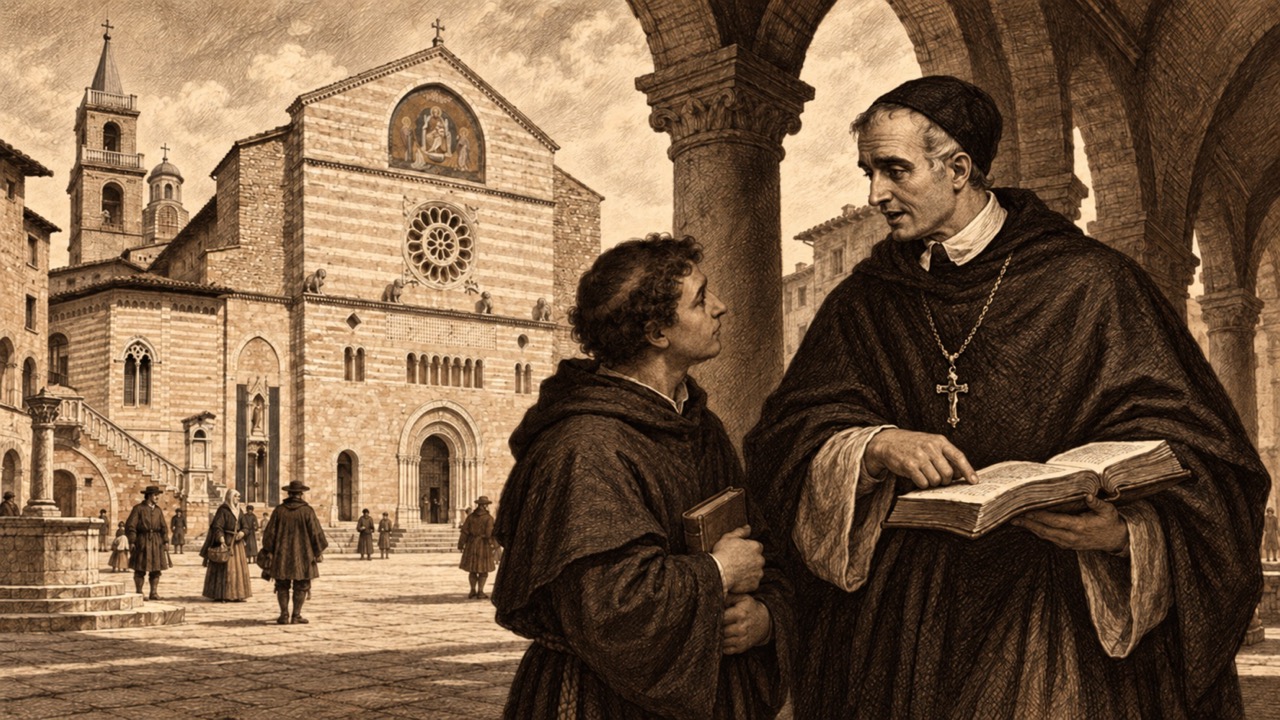
Isidoro Chiari (1495–1555), known in Latin as Isidorus Clarius, was a Benedictine of Brescia who became abbot of Cesena and bishop of Foligno, and who took part in the Council of Trent. He issued a corrected Latin Bible with annotations in 1542, a project that drew censure for the freedom of its emendations. His notes on Colossians are brief and philological, and they reach us here through the great seventeenth-century anthology of biblical criticism rather than in their original setting. The comments are sporadic and the source does not include comments on the first ten verses nor the final chapter of the book.
Source: Clarius, Isidorus. “Annotata in Epistolam D. Pauli ad Colossenses.” In Annotata ad Actus Apostolicos, Epistolas & Apocalypsin, sive Criticorum Sacrorum Tomus VII, edited by John Pearson, Anthony Scattergood, Francis Gouldman, and Richard Pearson, 3551, 3567–70, 3583–85, 3590. Londini, Oxonii, et Cantabrigiæ: Excudebat Jacobus Flesher; prostant apud Cornelium Bee, Guilielmum Wells, Richardum Royston, Samuelum Thomson, Thomam Robinson, et Guilielmum Morden, 1660. https://archive.org/details/bim_early-english-books-1641-1700_annotata-ad-actus-aposto_pearson-john-bp_1660_7/page/n719/mode/2up.
Translation: Clarius, Isidorus. Annotations on the Epistle to the Colossians. Translated by Phil Thompson. Greenville, SC: Institute for Colossians Studies, 2026.
Licensed under Creative Commons Attribution 4.0 International (CC BY 4.0): https://creativecommons.org/licenses/by/4.0/
English Translation
Notes on the Epistle of St. Paul to the Colossians
Chapter 1
Colossians 1:11
“The power of glory”
A glorious power, demonstrated by clear evidence.
Colossians 1:13
“The Son of his love”
This is now a well-worn Hebraism meaning “the most beloved Son.”
Colossians 1:15
“Who is the image of the invisible God”
The word invisibilis (“invisible”) is in the genitive case, modifying Deum (“God”), not imaginem (“image”). Why, then, does he add “invisible,” rather than simply saying, “who is the image of God”? I believe it is so that when you hear that he is the “image of the invisible God,” you must necessarily understand that he himself is also invisible. And since this title belongs properly to God alone—as you read elsewhere, “to the King of the ages, immortal, invisible” (1 Tim 1:17)—it also follows that he is God.
Moreover, he calls him the “image” as a kind of expression of archetypal beauty. After all, it belongs to the perfection of an image that it reflects its model in every respect. For if you were to look at someone’s son, you would not properly call him the “image” of his father unless he represented his father in every respect.
“The firstborn of all creation”
You should understand two things at once: both that he is the “firstborn,” which here means the same thing as “only-begotten”; and that he was begotten “before all creation,” namely, from eternity. And to prevent anyone from daring to place him among created things, Paul adds that all things were created “in him,” that is, “through him,” just as John says, “All things were made through him” (John 1:3). But if he himself were a creature, either not all things were created through him, or he created himself—and you can deduce for yourself whether that is possible.
Colossians 1:16
“All things were created through him and unto him”
He is both the creator and the preserver of all things. Not only did all things proceed from him, but they also depend on him. Alternatively, it means all things were created for his praise, glory, and veneration.
Colossians 1:18
“So that he might be in all things”
He is not only the firstborn by reason of his divine nature, but also as a man he is “the firstborn from the dead” (Col 1:18), so that he himself might have first place in all things and be the beginning of everything.
Colossians 1:20
“Whether things on earth or things in heaven”
We were at odds both with ourselves and with the angels, who were indignant that their Lord was suffering insult from human beings. But he brought peace to all things, so that at his birth the angels announced peace (Luke 2:14). And observe how Paul, no matter what subject he writes about, always ascends to an immense loftiness of thought.
Colossians 1:24
“I fill up what is lacking”
He is saying: I do not want you to credit what I suffer to me, but to Christ, who is still suffering in us, that is, in his members. For this was the one thing that could be lacking in him, since in himself he can no longer suffer anything. Alternatively, it means: I fill up what Christ wanted me to suffer in my flesh for the benefit and glory of the church, which is his body.
Colossians 1:27
“The riches of the glory of this mystery”
This is an immense benefit given to the Gentiles: that what has been made known to them is not just the “mystery,” and not just the “glory of the mystery,” but “the riches of the glory of this mystery.”
“The hope of glory”
To me, this seems to be a Hebraism familiar to Paul, meaning “a glorious hope.”
Chapter 2
Colossians 2:2
“Unto all the riches of the fullness”
The Greek word Πληροφορίας (plērophorias) means “of certainty” and of secure conviction. And here, indicating not only the treasures but also the most certain truth of our philosophy, he said, “unto all the riches of the secure conviction of understanding.”
“Of God and the Father and of Christ”
Here too, there is a frequent usage in which he says Dei & Patris (“of God and the Father”) instead of Dei Patris (“of God the Father”), that is, of God who is also the Father. And notice the majestic words that follow: “in whom are hidden all the treasures of wisdom and [page 3570] knowledge” (Col 2:3). He points out why he says this: “so that no one may deceive you with persuasive speech” (Col 2:4). It is as if he is saying: Do not let the pomp of words and the empty boasting of the wisdom of this age move you; here—right here—are the vast and true “treasures” both “of wisdom and knowledge.”
Colossians 2:5
“Even though I am absent in the flesh”
It would logically follow for him to say: Yet surely in spirit I am present to see those deceivers who are trying to disrupt your order. However, he veiled the matter, lest he seem too harsh.
Colossians 2:8
“Through philosophy and empty deceit”
That is, which by itself contains nothing for obtaining eternal life.
“According to the elements of the world”
For human wisdom must necessarily proceed from the contemplation of these visible things. And perhaps he is also alluding to what he wrote to the Galatians when he said, “we were enslaved under the elements of this world” (Gal 4:3).
Colossians 2:9
“Bodily”
He means substantially—not through a figure or an appearance, but just as the soul is in the body; that is, he essentially took on our nature, so that God and man might become one person.
Colossians 2:11
“Of the body of the sins of the flesh”
This is like the phrase, “so that the body of sin might be destroyed” (Rom 6:6). It is a προσωποποιΐα (“personification”).
Colossians 2:12
“Through faith in the working of God”
You were raised up at the same time, he says, as long as you believe that you too will be raised by the efficacy and power of God.
Colossians 2:13
“In the uncircumcision of your flesh”
According to Hebrew custom, a certain kind of uncleanness is understood by the term “uncircumcision,” just as, conversely, cleanness is signified by the term “circumcision.” Therefore, just as earlier when he said, “in whom you were also circumcised” (Col 2:11), he signified purity and sanctification, so here by “uncircumcision” he means impurity.
Colossians 2:14
“By decrees”
He used this same word in Ephesians, and in almost the same sense, so that what he there called “the law of commandments” (Eph 2:15), he here calls “the record of debt that stood against us.” For the law, unless grace is present, burdens us rather than helps us. There are some who understand the “record of debt” to be what God said to Adam: “In whatever day you eat of it, you shall die” (Gen 2:17). Others understand the “record of debt” to be sin, which “stood against us.”
Colossians 2:16
“Therefore let no one judge you”
Since full and complete salvation has been secured for you through faith in Christ, and no observance of the requirements of the law is any longer necessary, no one should be able or dare to judge and condemn you on the basis that you do not discriminate in matters of food, and so forth.
Colossians 2:17
“But the body belongs to Christ”
By “body” here, he means the truth and substance of things, and he contrasts the “body” with a “shadow.” Therefore, just as a shadow certainly traces the image of a body but is not itself the body, so those ceremonies of the law were like a kind of “shadow,” whereas the solid reality of these things belongs to Christ.
Colossians 2:18
“Delighting in humility”
There were some among them who, with a pretense of humility, kept people from approaching the grace of Christ, treating them as unworthy of such a great thing. They taught that the angels should rather be petitioned to present us to God, since they were the ones who previously mediated a general access to him, but that using Christ as a mediator for this purpose is too great a thing to be fitting for us. For this reason, they introduced the worship of angels, and these same individuals also seem to have been the authors of Jewish superstitions.
Colossians 2:20
“From the elements of the world”
This has been discussed in the commentary on Galatians.
Colossians 2:21
“Do not touch”
He indignantly quotes the words of those who were introducing Jewish customs.
Colossians 2:22
“All of which things”
He is saying: All these things that they value so highly, commanding you to abstain from them, were instituted so that we might use them. For they perish with use (Col 2:22), and there is no divine law concerning them that prohibits them. Instead, these things are inventions and “teachings of men,” resting on no divine foundation. They “have only an appearance of wisdom” (Col 2:23) in that they project a certain kind of “religion” and “humility,” and they cast down the soul, which ought to have been lifted up by the magnificent promises of the gospel. They teach “not sparing the body,” but in reality, they take away the “honor” that God implanted in created things, which he instituted for the very purpose of honoring mankind, so that human beings might have various kinds of food to satisfy and fulfill the necessities of the body.
Chapter 3
Colossians 3:3
“For you have died”
He is providing the reason why he commanded them no longer to care for earthly things, but only for heavenly things. He says: The one who has now professed Christ and is enrolled in that heavenly city has also professed that his life is Christ. Therefore, he is dead wherever Christ is not present. But Christ is “seated at the right hand of God” (Col 3:1). Consequently, each person must consider his life to be only in the place where Christ is.
“Is hidden”
That is, placed in a most secure location.
Colossians 3:5
“Which is idolatry”
More than other sins, greed has acquired this particular name, so that it is called (a horrifying name!) the worship of idols. After all, what is money but a kind of idol, either silver or gold, which greedy people love more and pursue with far greater worship and honor than God himself?
Colossians 3:14
“The bond of perfection”
The perfect bond, he says, which is love, is nothing other than a certain reality that gathers all good things into one, because love is what causes everything else to be good.
Colossians 3:16
“With spiritual songs in grace”
To me, the phrase “in grace” seems to mean that these things must be done seasonably, fittingly, and, as the saying goes, “with grace.”
Colossians 3:17
“In word or in deed”
How beautiful the Christian world would be if these apostolic commands were kept! As he also instructs elsewhere, “whether we eat or drink, let all things be done to the glory of God” (1 Cor 10:31).
Source Text
Annotata in Epistolam D. Pauli ad Colossenses
Source
Turabian citation: Clarius, Isidorus. “Annotata in Epistolam D. Pauli ad Colossenses.” In Annotata ad Actus Apostolicos, Epistolas & Apocalypsin, sive Criticorum Sacrorum Tomus VII, edited by John Pearson, Anthony Scattergood, Francis Gouldman, and Richard Pearson, 3551, 3567–70, 3583–85, 3590. Londini, Oxonii, et Cantabrigiæ: Excudebat Jacobus Flesher; prostant apud Cornelium Bee, Guilielmum Wells, Richardum Royston, Samuelum Thomson, Thomam Robinson, et Guilielmum Morden, 1660. https://archive.org/details/bim_early-english-books-1641-1700_annotata-ad-actus-aposto_pearson-john-bp_1660_7/page/n719/mode/2up.
Clarius
Chapter 1
Colossians 1:11
“Potentiam gloriæ”
Potentiam gloriosam & manifestis argumentis declaratam.
Colossians 1:13
“Filii dilectionis suæ”
Jam tritus est Hebraïsmus, pro Filio dilectissimo.
Colossians 1:15
“Qui est imago Dei invisibilis”
Ut illud invisibilis sit secundi casûs, & referatur ad Deum, non ad imaginem. Cur autem addit invisibilis, neque tantùm dixit qui est imago Dei? Opinor, ut cùm audis imaginem esse invisibilis Dei, intelligas necessariò & ipsum esse invisibilem. Quæ appellatio cùm solius Dei propria sit, ut alibi legis Regi seculorum, immortali, invisibili, sequitur etiam ut sit Deus. Imaginem autem dixit quasi expressionem quandam archetypæ pulcritudinis. Ad perfectionem enim Imaginis hoc pertinet, ut ex omni parte exemplar referat. Neque enim si cujusquam filium intuearis, illum imaginem esse patris propriè dixeris nisi omnibus partibus patrem repræsentet.
“Primogenitus omnis creaturæ”
Duo intelligas simul: & Primogenitum illum esse, quod nunc idem est quod unigenitum; & quòd ante omnem creaturam genitus sit, nempe ab æterno. Et nè quis auderet eum inter creaturas collocare, addit omnia creata esse in ipso, h. e. per ipsum, ut Joannes ait, Omnia per ipsum facta sunt. Quòd si ipse creatura esset, aut non omnia per ipsum creata essent, aut ipse se creasset: quod an fieri possit tu collige.
Colossians 1:16
“Omnia per ipsum & in ipsum creata sunt”
Omnium est & autor & conservator. Nec solùm omnia ab ipso profecta sunt, verùm & ab ipso pendent. Vel, omnia in laudem & gloriam & venerationem ipsius.
Colossians 1:18
“Ut sit in omnibus”
Non solùm est primogenitus ratione naturæ Divinæ, verùm etiam ut homo primogenitus ex mortuis est, ut ipse sit in rebus omnibus primatum tenens, & cujusque rei principium.
Colossians 1:20
“Sive quæ in terris sive quæ in cœlis sunt”
Eramus nos & nobiscum ipsis discordes & cum Angelis, qui indignabantur suum Dominum ab hominibus affici contumeliâ : at is omnia pacavit, ut ipso nascente Angeli pacem annunciaverint. Et vide ut semper, quacunque de re scribat, Paulus in ingentem rerum celsitudinem ascendat.
Colossians 1:24
“Adimpleo ea quæ desunt”
Hoc, inquit, quòd patior nolim ut mihi acceptum referatis, sed Christo, qui in nobis, h. e. in membris suis, adhuc patitur. Hoc enim unum ei deesse poterat: nam in sese pati ampliùs nihil potest. Vel, adimpleo quod Christus me pati voluit, in carne mea, ad utilitatem & gloriam Ecclesiæ, sive corporis illius.
Colossians 1:27
“Divitiæ gloriæ mysterii hujus”
Ingens Gentibus datum beneficium, notum factum esse illis, non solùm mysterium, neque solùm gloriam mysterii, verùm divitias gloriæ mysterii hujus.
“Spes gloriæ”
Mihi videtur familiaris Paulo Hebraïsmus, pro spes gloriosa.
Chapter 2
Colossians 2:2
“In omnes divitias plenitudinis”
Πληροφορίας certitudinis, certæque persuasionis. Et hîc significans non solùm thesauros verùm etiam certissimam veritatem nostræ Philosophiæ, dixit in omnes divitias certæ persuasionis intellectûs.
“Dei & Patris & Christi”
Et hîc frequens est usus, ut dicat Dei & Patris pro Dei Patris, h. e. Dei qui idem & Pater est. Et observa plena majestatis verba quæ sequuntur, in quo sunt omnes thesauri sapientiæ & sci- [page 3570] entiæ absconditi. Et cur hoc dicat admonet, nè quis vos decipiat in persuasibili sermone: q. d. Non vos moveat pompa verborum, & inanis jactantia sapientiæ hujus seculi: hîc, hîc sunt ingentes thesauri ac veri & sapientiæ & scientiæ.
Colossians 2:5
“Etsi carne absens sum”
Consequens erat ut diceret, Certè tamen spiritu deceptores illos qui vestrum ordinem perturbare conantur; sed obtexit rem, nè videretur vehementior.
Colossians 2:8
“Per Philosophiam & inanem fallaciam”
- Quæ soli ad vitam æternam consequendam nihil habet.
“Secundùm elementa mundi”
Nam humana sapientia necesse est ut ex harum rerum visibilium contemplatione proficiscatur. Et fortasse alludit etiam ad illud quòd Galatis scripsit, cùm ait, sub elementis hujus mundi eramus servientes.
Colossians 2:9
“Corporaliter”
Substantialiter, non per figuram aut habitum, sed ut anima in corpore, h. e. essentialiter, accepit nostram naturam, ut fieret Deus & homo una Persona.
Colossians 2:11
“Corporis peccatorum carnis”
Sicut & illud, ut destruatur corpus peccati : προσωποποιΐα.
Colossians 2:12
“Per fidem operationis Dei”
Simul resuscitati estis, inquit, dum creditis efficaciâ & potentiâ Dei etiam vos esse resuscitandos.
Colossians 2:13
“Præputio carnis vestræ”
Vocabulo præputii more Hebræorum intelligitur immundities quædam; sicut contrà, nomine circumcisionis signatur mundities. Ut ergò cùm suprà dixit, in quo & circumcisi estis, significavit puritatem & sanctificationem, ità hîc per præputium intelligit impuritatem.
Colossians 2:14
“Per decreta”
Eodem verbo usus est ad Ephesios & in eundem sensum ferè, ut quod ibi vocavit legem mandatorum hîc appellet chirographum, quod erat contrarium nobis. Nam Lex, nisi adsit gratia, aggravat potiùs quàm juvat. Sunt qui per chirographum intelligant illud quod dixit Deus Adæ, Quocunque die comederis, morte morieris. Sunt qui per chirographum intelligant Peccatum, quod erat contrarium nobis.
Colossians 2:16
“Nemo ergò vos judicet”
Cùm per fidem in Christum plena integráque comparata sit vobis salus, neque ulla jam Legalium rerum observatio sit necessaria, nemo possit ac audeat vos judicare & damnare ex eo quòd non discernitis in cibis, &c.
Colossians 2:17
“Corpus autem Christi”
Corpus hîc intelligit veritatem & substantiam rerum: & opponit corpus umbræ. Igitur sicut umbra refert quidem imaginem corporis, non tamen est corpus, sic illæ Legis ceremoniæ velut umbra quædam erant, verùm soliditas rerum pertinet ad Christum.
Colossians 2:18
“Volens in humilitate”
Erant quidam apud eos qui simulatione humilitatis prohibebant eos ad gratiam Christi accedere, tanquam indignos tantâ re; & docebant rogandos potiùs Angelos qui nos exhiberent Deo, ut qui & priùs communem accessum sint operati: majus autem esse quàm nobis conveniat, intercessore uti Christo ad hoc. Ob hanc causam introducebant religionem Angelorum; & iidem etiam Judaicarum superstitionum autores fuisse videntur.
Colossians 2:20
“Ab elementis mundi”
De his ad Galatas dictum est.
Colossians 2:21
“Nè tetigeris”
Cum indignatione verbis utitur eorum qui Judaicos mores introducebant.
Colossians 2:22
“Quæ sunt omnia”
Hæc omnia, inquit, quæ tanti fiunt, & jubent ab eis abstineri, instituta sunt ut eis utamur: nam usu ipso corrumpuntur, & non est de ipsis Divina lex quæ ea prohibeat. Sed ista inventa sunt & documenta hominum, nullo Divino fundamento nixa: quæ speciem tantùm habent sapientiæ, dum religionem quandam & humilitatem præ se ferunt, ac dejiciunt animum, quem magnificis Euangelii promissionibus erigi oportuerat, & docent non esse parcendum corpori, sed revera auferunt honorem quem Deus rebus inseruit, quas idcirco instituit ut honestaret Hominem, qui diversa haberet alimentorum genera ad satiandas explendásque corporis necessitates.
Chapter 3
Colossians 3:3
“Mortui enim estis”
Reddit causam cur jusserit nè posthac terrena ista curent, sed cœlestia tantùm. Is, inquit, qui jam Christum professus est & ascriptum in illam cœlestem civitatem, professus etiam est vitam suam esse Christum. Mortuus ergò is est ubicunque non sit Christus: at Christus est ad dexteram Dei sedens: Vitam ergò quisque suam existimare debet ibi duntaxat esse ubi Christus est.
“Abscondita est”
- Tutissimo loco collocata.
Colossians 3:5
“Quæ est simulacrorum servitus”
Præter cætera peccata Avaritia peculiare hoc nomen assecuta est, ut dicatur esse (horrendum nomen!) cultus simulacrorum. Nam Pecunia quid aliud est quàm simulacrum quoddam vel argenteum vel aureum, quod homines avari plùs amant & longè majore cultu atque honore prosequuntur quàm ipsum Deum?
Colossians 3:14
“Vinculum perfectionis”
Vinculum perfectum, Charitas, inquit, nihil est aliud quàm res quædam bona omnia in unum colligens: nam ea est quæ cætera efficit ut sint bona.
Colossians 3:16
“Canticis spiritualibus in gratia”
Mihi videtur illud in gratia significare, opportunè, aptè hæc facienda, & quod dicitur, cum gratia.
Colossians 3:17
“In verbo aut in opere”
Quàm pulcer esset Christianus orbis si hæc Apostolica præcepta servarentur! ut alibi etiam admonet ut sive edamus, sive bibamus, omnia ad gloriam Dei fiant.