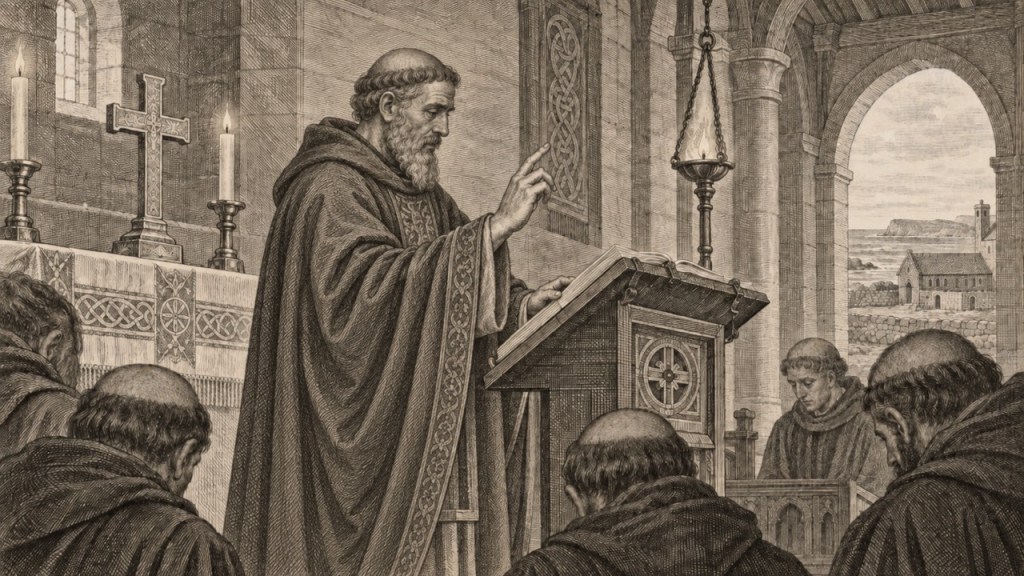
Bede (c. 672–735) was one of the most prolific writers of the Early Middle Ages and produced the first florilegium (literary excerpts) of Augustine arranged into a commentary on the Pauline Epistles. Others, such as Florus of Lyon, would follow in his footsteps, leading to a longstanding misattribution of the more extensive work of Florus with the simpler work of Bede. What follows is the first freely available print edition of Bede’s work on Colossians, sourced directly from two handwritten Latin manuscripts: Saint-Omer, Bibliothèque d’agglomération, MS 91 and Vatican City, Biblioteca Apostolica Vaticana, Urb. lat. 102. As a result, an editorial introduction from Phil Thompson is included with this digital edition.
The Latin edition of this work should be cited as:
Bede. In epistolam ad Colossenses: From the Collectio ex opusculis sancti Augustini in epistulas Pauli apostoli. Edited by Phil Thompson. Greenville, SC: Institute for Colossians Studies, 2026.
The English translation of this work should be cited as:
Bede. On the Epistle to the Colossians: From the Collectio ex opusculis sancti Augustini in epistulas Pauli apostoli. Translated and edited by Phil Thompson. Greenville, SC: Institute for Colossians Studies, 2026.
Licensed under Creative Commons Attribution 4.0 International (CC BY 4.0): https://creativecommons.org/licenses/by/4.0/
Contents
The text edited here is the Colossians section of the Venerable Bede’s Collectio ex opusculis sancti Augustini in epistulas Pauli apostoli (CPL 1360): an early eighth-century, lemma-by-lemma anthology in which Bede rearranged passages scattered across Augustine’s writings so that they could be read as an Augustinian commentary on Paul.
That description requires two qualifications from the outset. First, the surviving prose is Augustine’s, but the selection, sequence, segmentation, biblical lemmata, and source rubrics constitute Bede’s work as compiler or editor. Second, this is not the much larger Expositio in epistolas beati Pauli ex operibus sancti Augustini made by Florus of Lyon in the ninth century. The two works were confused from the later Middle Ages into modern scholarship, and Florus’s compilation was repeatedly printed under Bede’s name. This mistaken attribution will be dealt with in detail, below.
Title, authorship, and date
The long modern title, Collectio ex opusculis sancti Augustini in epistulas Pauli apostoli, is a convenient scholarly designation rather than a title demonstrably supplied by Bede. The strongest external testimony to the work is Bede himself. Near the end of the Historia ecclesiastica, in the autobiographical catalogue of his writings, he records:
In Apostolum quaecumque in opusculis sancti Augustini exposita inueni, cuncta per ordinem transcribere curaui.
“On the Apostle, I took care to transcribe in order everything that I found expounded in the works of Saint Augustine.”
This notice provides two important insights. First, it gives Bede’s own account of his method: he found Pauline exposition dispersed through Augustine’s opuscula and transcribed it per ordinem, in the order of the Pauline corpus. Second, it provides the terminus ante quem for the work: the Collectio must predate the completion of the Historia ecclesiastica in 731. No more exact date is certain. Its natural setting is Bede’s lifelong scholarly work at Wearmouth–Jarrow, where the unusually rich library assembled by Benedict Biscop, Ceolfrith, and their successors enabled him to consult a range of patristic books exceptional in early eighth-century Northumbria.
The complete work contains 457 fragments drawn, after corrections to older inventories, from roughly forty Augustinian writings. It comments on Romans, 1–2 Corinthians, Galatians, Ephesians, Philippians, Colossians, 1–2 Thessalonians, 1–2 Timothy, Titus, and Hebrews; it has no section on Philemon. Nicolas De Maeyer and Anthony Dupont describe its contents and Bedan compilation methods in their study of fragment 315; De Maeyer’s 2019 dissertation gives the fullest account of the work’s structure, sources, transmission, and the edition of its Romans section.
A florilegium arranged as commentary
Although the work may be referred to in a functional sense as a “commentary,” it is not a continuous exposition written in Bede’s own voice. Its basic unit is:
- a Pauline lemma, usually written as a heading;
- a rubric naming an Augustinian work, book, chapter, sermon, letter, or homily;
- an excerpt from that source, sometimes divided by et post aliquanta or et paulo post when Bede skips intervening matter.
The best generic description is therefore an Augustinian florilegium (literary excerpts) reorganized as a Pauline commentary. “Catena” is suggestive but potentially misleading, since the work draws almost entirely on one source rather than chaining many authorities together. “Postil” accurately conveys its use as a sequence of glosses on selected biblical words, but the Collectio predates the fully developed scholastic postilla and does not comment on every verse.
Compilation is not intellectual passivity. Bede determines which of Augustine’s thousands of Pauline citations become commentary, how much surrounding argument is retained, which extracts are juxtaposed, how Augustine’s works are identified, and where a new unit begins. Augustine never wrote a continuous commentary on Colossians. Bede effectively constructs one from De trinitate, anti-Manichaean treatises, letters, sermons, Johannine tractates, De Genesi ad litteram, and other works. The result tells us at least as much about Bede’s Augustinian reading and priorities as it does about the original settings of Augustine’s sentences.
Was the work ever “finished”?
The Collectio has no authorial prologue, no division into books, and no consistently standardized system for naming or numbering Augustine’s works. Its organization is also occasionally irregular. In the present Colossians section, for example, the gloss on Colossians 2:9 precedes the gloss on 2:3. Such features need not be accidents of the two witnesses; they may preserve the state of Bede’s working dossier.
De Maeyer has accordingly proposed that the Collectio was left unfinished: perhaps a set of excerpting notes or slips brought into Pauline order but never subjected to a final editorial revision. The argument is summarized in The Medieval Review’s account of Flores Augustini. This should remain a hypothesis rather than a license to regularize the text. The very inconsistencies that trouble a modern reader may be direct evidence for Bede’s method and for the work’s state at his death.
How Bede knew Augustine
Bede’s Augustinian library should not be reconstructed by assuming that every extract proves his possession of a complete copy of the named work. He sometimes used Augustine directly, but he also knew passages through earlier anthologies. The most important predecessor is Eugippius, abbot of Castellum Lucullanum near Naples, whose early sixth-century Excerpta ex operibus sancti Augustini gathered several hundred passages for monastic reading. Bede used Eugippius, yet he was not merely rearranging Eugippius’s collection: he selected extensively from works and passages absent from it, and in some cases the surviving readings point to direct Augustinian transmission rather than to Eugippius. De Maeyer and Dupont’s textual study is especially useful for seeing why the route must be tested excerpt by excerpt.
A still earlier Augustinian commentary on Paul, associated by Cassiodorus with a Peter of Tripoli, has been proposed as another possible intermediary. It is lost and cannot be positively identified as Bede’s source. It belongs to the background of the genre, not to the secure genealogy of this text.
This mixed access—complete works, sermon collections, and florilegia—helps explain why the Collectio is so important. It is an indirect witness to Augustine’s text, a record of what Augustinian material reached early Anglo-Saxon England, and a map of how that material was classified. Its rubrics may preserve old titles and chapter divisions absent from, or different from, modern editions. Conversely, a reading that differs from a modern Augustine edition must not automatically be “corrected”: it may be a genuine Bedan or pre-Bedan witness to an older branch of Augustine’s transmission.
The Colossians section
Extent and arrangement
The section edited here comprises twenty-three excerpt units, several sharing the same Pauline lemma. It begins at Colossians 1:13 and ends at 3:11. It contains no gloss on chapter 4 and does not attempt to cover every intervening verse. In a selective florilegium, silence normally means that the compiler did not include a suitable Augustinian passage; it does not by itself demonstrate a lost leaf or defective exemplar. Whether every omission belongs to Bede’s archetype can ultimately be tested only against the full manuscript tradition.
The sequence is selective rather than atomistic. Several verses receive two or three extracts because placing Augustine beside Augustine produces a composite interpretation:
- Colossians 1:24 is read through the doctrine of the totus Christus, the one Christ as head and ecclesial body.
- Colossians 2:15 is glossed both through Contra Faustum and Letter 149, aligning Christ’s victory over the powers with the church’s stripping away of carnal vice.
- Colossians 3:1–5 joins present spiritual resurrection, future bodily resurrection, death to the world, and moral mortification.
- Colossians 3:9–11 draws on De trinitate and De Genesi ad litteram to locate the divine image in the rational mind and to explain baptismal renewal beyond bodily sex or social status.
Theological profile
The opening excerpts are densely Christological. Christ is the Son of the Father’s love and substance (1:13); he is at once only-begotten Word and firstborn in relation to creation (1:15–16); in him the fullness dwells and cosmic reconciliation is effected through the cross (1:19–20). Colossians 2:3 and 2:9 then identify in the incarnate Christ the treasures of wisdom and knowledge and the bodily dwelling of deity. Bede’s ordering makes Augustine’s anti-Manichaean and Trinitarian reasoning serve a concentrated reading of the Colossian hymn.
Ecclesiology enters through Colossians 1:24. The church’s sufferings are Christ’s because head and body form unus Christus. This is not merely a metaphor of sympathy: it is Augustine’s mature doctrine of the whole Christ, drawn from Sermon 341 augmented and the Johannine tractates.
The middle of the section is polemical and sacramental. Augustine’s attack on pagan allegories of the classical gods is applied to Paul’s warning about philosophy and the elements of the world (2:8). Circumcision, food laws, festivals, new moons, and sabbaths are interpreted typologically as shadows fulfilled in Christ (2:11–17), while the warning about angels and prohibitions such as “do not touch, do not taste” is read as a critique of empty observance (2:18, 21).
The final movement is ascetical and anthropological. Resurrection is already real in hope and moral conversion, although bodily resurrection remains future. A person dies to idolatry, drunkenness, lust, and avarice when those habits cease; the renewed person is restored in the knowledge of God according to the Creator’s image. The selection thus moves from Christ’s cosmic primacy to the re-creation of the Christian mind and life.
Pauline lemmata and the Latin Bible
The bold biblical headings should not be silently forced into the wording of a modern Vulgate edition. A lemma may reproduce the biblical text embedded in Augustine’s source, Bede’s own biblical text, an intermediate florilegium, or later manuscript adjustment. Forms such as regnum/regno, word order, and the extent of a quoted verse therefore belong to the textual history of the commentary. The Vulgate is an essential comparator, not an automatic source of emendation.
Rubrics that require special care
The source rubrics are historical data, not dependable modern bibliographical citations. Four cases in this section illustrate the problem.
- “De tribus uirginibus.” The excerpt is from Sermon 341 augmented, whose fuller title ends de tribus virgis Iacob—“on Jacob’s three rods,” not “three virgins.” The modern Latin text and the exact excerpt may be inspected here. Uirginibus is best treated as a meaningful rubrical corruption or expansion error and reported, not silently converted into a modern title.
- Johannine homily numbers. The rubrics “Homily 105” and “Homily 62” correspond to Tractates 108 and 65 in the widely used modern numbering. Medieval collections divided and numbered Augustine’s Johannine preaching differently. The Saint-Omer form SEXTA DECIMA II at the second location is nevertheless plainly corrupt.
- “De unico baptismo, book III.” The passage is found in De baptismo contra Donatistas IV in the linked modern text. Vatican Urb. lat. 102 itself reads book IV. The variation may preserve competing rubrical systems or a simple numeral error; the source identification should be modernized in commentary, while the transmitted rubric remains visible in the apparatus.
- “Post baptismum peccati.” The current reading at Colossians 3:9–11 differs sharply from Augustine’s post lapsum peccati (“after the fall into sin”) in De Genesi ad litteram III.20.32, visible in the online Latin text. This is a strong candidate for inherited corruption, but the source text alone cannot decide whether an editor should print Augustine’s wording as Bede’s. The reading should first be collated across the independent witnesses and indirect tradition.
These examples show why the Collectio must be edited as a work in its own right. Correcting every difference from Augustine would erase evidence for the exemplars Bede used; preserving every manifest accident without comment would obscure the sense. A critical edition must distinguish the text of Augustine, the text selected by Bede, and the readings introduced in the later transmission.
Manuscript transmission
The wider tradition
Twelve direct manuscripts of the Collectio are currently known, all of continental origin. Most are Carolingian, with important witnesses at Rouen, Cologne, Orléans, Saint-Omer, Würzburg, Florence, and elsewhere; later copies include Monte Cassino 178 and Vatican Urb. lat. 102. The list with dates is given in the Cambridge study. De Maeyer’s reconstruction also identifies five, perhaps six, indirect witnesses—later works that quote or reorganize Bede and can preserve readings independently useful for establishing his text.
The absence of a surviving Insular witness is striking but not suspicious. The ninth-century continental concentration reflects the movement of Bedan books across the Channel and the appetite of Carolingian scholars for authoritative patristic exegesis. The transmission itself is evidence of the work’s reception.
The two witnesses used in the present edition
Siglum Manuscript Date and significance Online access S Saint-Omer, Bibliothèque d’agglomération, MS 91 Ninth century; an early, substantially complete witness and the base manuscript of the present text. Its age makes it important, but it represents one branch and is not automatically identical with the archetype. IRHT/Saint-Bertin catalogue notice V Vatican City, Biblioteca Apostolica Vaticana, Urb. lat. 102 Copied between 1474 and 1482. Modern stemmatic analysis identifies it as a descendant of the Florence witness F (Biblioteca Medicea Laurenziana, San Marco 648), so it is not an independent second branch at the highest level of reconstruction. It remains useful for local readings, rubrics, and the history of the text. Complete Vatican digital facsimile The relationship of V to F is not conjectural: the published stemmatic discussion states that Urb. lat. 102 can be excluded from a higher-level collation precisely because it is “clearly a descendant of F” (discussion and note 114). Thus S and V should not be described as two equally independent authorities.
What the present Latin edition is—and is not
The present text is a valuable two-witness critical reading text: it makes the Colossians section accessible, records substantive differences between S and V, and uses the early Saint-Omer manuscript as its base. It is not yet a critical edition of the complete tradition in the strict sense. Such an edition would collate all independent direct witnesses, consult the indirect transmission, justify the stemma, distinguish source contamination from ordinary scribal change, and provide both an apparatus criticus and an apparatus fontium.
The policy of silently correcting obvious blunders is reasonable for readability, but every correction depends upon a judgment about what counts as “obvious.” The cases of uirginibus/virgis and baptismum/lapsum show why a future edition should identify even compelling emendations and explain whether they arise from another Collectio witness, Augustine’s direct tradition, or editorial conjecture. The current apparatus is selective rather than exhaustive, and the text should be cited accordingly.
Three works that must be distinguished
Work Compiler and date Form and scale Relationship to this text Excerpta ex operibus sancti Augustini Eugippius, early sixth century A broad Augustinian anthology of several hundred excerpts, not organized solely as a Pauline commentary An important source or intermediary for a limited portion of Bede’s material; not Bede’s Collectio and not sufficient to explain it Collectio ex opusculis sancti Augustini in epistulas Pauli apostoli Bede, before 731 457 fragments from about forty works, reordered according to the Pauline epistles The work edited here Expositio in epistolas beati Pauli ex operibus sancti Augustini Florus of Lyon, mid-ninth century A monumental Pauline anthology of 2,218 Augustinian fragments Later than Bede, much larger, and demonstrably dependent on Bede in places; the work most often misidentified as Bede’s Florus’s 2,218-fragment scale and mid-ninth-century date are described in the recent open study of the transmission of his Expositio. Bede’s relationship to Florus runs in the opposite direction from the old attribution: Florus used Bede. De Maeyer’s study of Bede’s early medieval reception also identifies Bede’s Collectio as a source for Hrabanus Maurus, Sedulius Scottus, the Romans commentary in Paris BnF lat. 11574, the anonymous Pauline commentaries in Avranches 79, and homilies of Hrabanus.
How Florus came to be called Bede
The confusion is understandable. Both Bede and Florus rearranged passages from Augustine into the order of Paul’s epistles; both could circulate with rubrics emphasizing Augustine rather than the compiler; and both belonged to a family of Augustinian florilegia that also included Eugippius. A manuscript lacking an unambiguous authorial prologue could easily acquire a prestigious attribution to Bede.
The error had a long afterlife. Geoffrey Boussard’s Paris edition of 1499 printed Florus’s Expositio as a newly discovered work industriously collected by Bede. The same false identity passed through later bibliography and into the Bedan corpus printed in Patrologia Latina 119. André Wilmart’s paired studies in 1926 decisively distinguished Bede’s shorter Collectio from Florus’s much larger Expositio, but catalogue errors persisted. Brandon W. Hawk’s case study of Strasbourg, BNU MS 0.309 is a particularly clear demonstration: medieval prologue, nineteenth-century label, and modern catalogue all called the manuscript Bede, while comparison of the excerpts proves that its text is Florus.
The practical consequence is simple but important: a printed “Bede on Paul” such as Migne’s PL 119 is not the same as Bede’s Collectio.
Historical importance
Between patristic and medieval exegesis
The Collectio is the oldest surviving Augustinian Pauline commentary of this particular type. It stands at a decisive junction: fourth- and fifth-century African exegesis is selected in an eighth-century Northumbrian monastery, then transmitted chiefly in ninth-century continental books and absorbed into Carolingian commentary. The work is therefore not merely a derivative aid to Augustine. It is evidence for the transformation of patristic learning into medieval exegetical infrastructure.
A witness to Bede as reader
Bede is often seen most vividly as historian, computist, or author of continuous biblical commentaries. Here one encounters him as a research reader: identifying Pauline passages across a large and uneven corpus, copying them, assigning titles, abbreviating their contexts, and constructing a new order. The work enlarges our picture of the Wearmouth–Jarrow library and of the practical technologies—lists, excerpting notes, marked exemplars, or loose slips—behind early medieval scholarship.
A witness to Augustine
Because Bede’s exemplars predate the surviving copies of many Augustinian works, a Collectio reading can be text-critically valuable. Rubrics can preserve old work titles, book divisions, and chapter numbers; excerpts from rare sermon collections can attest forms otherwise poorly transmitted. The anthology must therefore be collated both as a Bedan work and as an indirect witness to Augustine. The two tasks are related but not identical.
A source for Carolingian intellectual culture
The continental manuscripts and later reuse show that the work became a quarry for ninth-century scholarship. Florus, Hrabanus, Sedulius Scottus, and anonymous compilers did not simply preserve Bede; they selected and recombined him in turn. The history is thus a chain of mediated reading: Paul read by Augustine, Augustine reorganized by Bede, Bede mined by Carolingian scholars, and those Carolingian texts later printed or catalogued under unstable names.
Edition and translation history
For much of modern scholarship the genuine Bedan Collectio remained unprinted even while Florus circulated under Bede’s name. Paul-Irénée Fransen described the Bedan collection systematically in 1961; later work by Gert Partoens, Jérémy Delmulle, Nicolas De Maeyer, and others reconstructed its witnesses, sources, authenticity, and stemma.
David Hurst’s 1999 English translation made the complete work broadly accessible, although it is not a substitute for a full critical Latin edition and its presentation of the relationship to Eugippius reflects an older, simplified account.
The Corpus Christianorum editio princeps is now in progress. As of 20 September 2026, Brepols lists volume CCSL 121B—Nicolas De Maeyer, Jérémy Delmulle, and Gert Partoens, eds., Collectio ex opusculis sancti Augustini in epistulas Pauli apostoli: Rom.–I Cor.—as forthcoming in December 2026. The publisher’s description makes clear that this first volume covers only Romans through 1 Corinthians. The Colossians section in the present file therefore lies outside the announced first fascicle and remains especially useful as a provisional Latin text.
Online source guide for the Colossians excerpts
The table gives modern identifications for the rubrics in the present text. Links point directly to the relevant passage when the host supports browser text fragments. Some links provide Latin, others an accessible English translation; they are locators, not a replacement for consulting a critical edition of Augustine.
Colossians Rubric in the present text Modern source identification and online passage 1:13 De trinitate XV, tit. XVII Augustine, De trinitate XV.17 (English, passage highlighted) 1:15–16 Contra epistulam Secundini Manichei Augustine, Contra Secundinum (English, passage highlighted) 1:19–20 Enchiridion, tit. LXII Augustine, Enchiridion 62 (English, passage highlighted) 1:24 Sermo de tribus uirginibus Augustine, Sermon 341 augmented, de tribus virgis Iacob (Latin, exact excerpt) 1:24 Homily on John CV Augustine, In Iohannis evangelium tractatus 108 (English, exact excerpt) 2:8 Sermon against the pagans on the Kalends of January Augustine, Sermon 198 augmented (Latin, exact excerpt) 2:9 De praesentia Dei ad Dardanum Augustine, Letter 187 (Latin, exact excerpt) 2:3 De trinitate XIII.14 Augustine, De trinitate XIII.14 (English, passage highlighted) 2:11 De trinitate XIV.16 Augustine, De trinitate XIV.16 (English, passage highlighted) 2:13; 2:15; 2:18, 21 Ad Paulinum Augustine, Letter 149 (Latin at 2:13; Latin at 2:15; Latin at 2:18, 21) 2:15 Contra Faustum XVI Augustine, Contra Faustum XVI (English, passage highlighted) 2:16–17 Contra Faustum VI Augustine, Contra Faustum VI (English, passage highlighted) 3:1–2 Contra Faustum XI Augustine, Contra Faustum XI (English, passage highlighted) 3:1–3; 3:5 Sermon on the resurrection of the dead Augustine, Sermon 362 (Latin at 3:1–3; Latin at 3:5) 3:3 Homily on John LXII Augustine, In Iohannis evangelium tractatus 65 (English, passage highlighted) 3:5 De unico baptismo III Augustine, De baptismo contra Donatistas IV (Latin, passage highlighted) 3:9–11 De trinitate XII.7 Augustine, De trinitate XII.7 (English, passage highlighted) 3:9–11 De Genesi ad litteram III, tit. IX Augustine, De Genesi ad litteram III.20.32 (Latin, exact passage) 3:9–11 De trinitate XIV.16 Augustine, De trinitate XIV.16 (English, passage highlighted) 3:11 Contra aduersarium legis I Augustine, Contra adversarium legis et prophetarum I (Latin, exact passage) Citation
The Latin edition of this work should be cited as:
Bede. In epistolam ad Colossenses: From the Collectio ex opusculis sancti Augustini in epistulas Pauli apostoli. Edited by Phil Thompson. Greenville, SC: Institute for Colossians Studies, 2026.
The English translation of this work should be cited as:
Bede. On the Epistle to the Colossians: From the Collectio ex opusculis sancti Augustini in epistulas Pauli apostoli. Translated and edited by Phil Thompson. Greenville, SC: Institute for Colossians Studies, 2026.
Select bibliography and digital resources
- Bede, Historia ecclesiastica gentis Anglorum V.24, especially the autobiographical catalogue of works.
- Nicolas De Maeyer, Iuxta uestigia Patrum: The Venerable Bede’s Collectio… (doctoral dissertation, KU Leuven, 2019).
- Nicolas De Maeyer and Anthony Dupont, “Patrum vestigia sequens: The Transmission and Reception of Augustine’s Exegesis of Eph. 3:17–18…”, Traditio 72 (2017): 21–59.
- Nicolas De Maeyer, “Beda Venerabilis’ Augustinian Florilegium as a Source for Early Medieval Bible Commentaries and Homilies”, Augustiniana 70.2 (2020): 227–281.
- Jérémy Delmulle, “La Collectio in Apostolum de Bède le Vénérable: tradition manuscrite, codicologie et critique d’authenticité”, Scriptorium 70.2 (2016): 199–251.
- Brandon W. Hawk, “The Expositio in epistolas beati Pauli ex operibus S. Augustini by Florus in Strasbourg, BNU MS 0.309”, Revue bénédictine 124 (2014): 60–65.
- Bede the Venerable, Excerpts from the Works of Saint Augustine on the Letters of the Blessed Apostle Paul, trans. David Hurst, Cistercian Studies 183 (1999).
- Nicolas De Maeyer, Jérémy Delmulle, and Gert Partoens, eds., Beda Venerabilis, Collectio… Rom.–I Cor., CCSL 121B (forthcoming December 2026).
ON THE EPISTLE TO THE COLOSSIANS1
Colossians 1
Colossians 1:13
“HE WHO HAS RESCUED US FROM THE POWER OF DARKNESS AND TRANSFERRED US INTO THE KINGDOM2 OF THE SON OF HIS LOVE.”
FROM BOOK 15 OF ON THE TRINITY, CHAPTER 17.
When the text says “the Son of his love,” this should be understood as nothing other than his beloved Son, and ultimately, as the Son of his substance. Indeed, the love of the Father, which exists in a nature that is ineffably simple, is nothing other than his very nature. Because of this, the Son of his love is none other than he who is begotten of his substance.
Colossians 1:15–16
“HE WHO IS THE IMAGE OF THE INVISIBLE GOD, THE FIRSTBORN OF ALL CREATION.”
FROM THE BOOK AGAINST THE EPISTLE OF SECUNDINUS THE MANICHEE.
The Catholic faith, which distinguishes between the Creator and the creation of God, endures no difficulty in understanding these two names. It accepts him as “only begotten” according to what is written: “In the beginning was the Word, and the Word was with God, and the Word was God” (John 1:1). It accepts him as “the firstborn of all creation” according to what the apostle says: “So that he might be the firstborn among many brothers” (Rom 8:29). The Father begot these brothers for fraternal fellowship with him, not by an equality of substance, but by the adoption3 of grace. AND A LITTLE LATER: Therefore, Christ is the “only begotten” according to the fact that he is the Word of God with God, equally unchangeable and equally eternal, “not considering equality with God something to be grasped” (Phil 2:6); and he is “the firstborn of all creation” according to the fact that “in him all things were created in heaven and on earth, visible and invisible” (Col 1:16).
Colossians 1:19–20
“FOR IN HIM ALL THE FULLNESS WAS PLEASED TO DWELL, AND THROUGH HIM TO RECONCILE ALL THINGS TO HIMSELF.”
FROM THE BOOK ENCHIRIDION, CHAPTER 62.
Through that unique sacrifice in which the mediator was immolated—a single sacrifice that the many victims in the law prefigured—heavenly things are made peaceful with earthly things, and earthly things with heavenly things. For as the apostle says, “In him all the fullness was pleased to dwell, and through him to reconcile all things to himself, making peace by the blood of his cross, whether things on earth or things in heaven” (Col 1:19-20). This peace, as it is written, “surpasses all understanding” (Phil 4:7), and it cannot be known by us unless we have attained it. For how are heavenly things brought into peace except with us, that is, by being in harmony with us? After all, in heaven there is always peace among all the intellectual creatures themselves and with their Creator. This peace, as has been said, surpasses all understanding—but certainly it surpasses our understanding, not the understanding of those who always see the face of the Father (cf. Matt 18:10).
Colossians 1:24
FROM THE SERMON ON THE THREE VIRGINS (SERMON 341, AUGMENTED).
Therefore, whether I say “the head and the body,” or whether I say “the bridegroom and the bride,” understand them as one. For this reason, when the same apostle was still Saul, he heard: “Saul, Saul, why are you persecuting me?” (Acts 9:4). This shows how his body is joined to the head, and that as a preacher of Christ he would suffer from others the very things he had done as a persecutor. “In order to complete,” he says, “what is lacking of Christ’s afflictions in my flesh” (Col 1:24). By pointing out who was suffering regarding “Christ’s afflictions,” this cannot be understood according to the head, because the head, which is already in heaven, endures no such thing. Instead, it must be understood according to the body, that is, the church, because this body together with its head is one Christ.
FROM HOMILY 105 ON THE GOSPEL OF JOHN (TRACTATE 108 IN THE LINKED EDITION).
He did not say “my afflictions,” but “Christ’s,” because he was a member. And in his own persecutions—the kind of persecutions that Christ must suffer in his whole body—Paul himself was also filling up his afflictions according to his own measure.
Colossians 2
Colossians 2:8
“SEE TO IT THAT NO ONE DECEIVES YOU THROUGH PHILOSOPHY AND EMPTY DECEIT, ACCORDING TO HUMAN TRADITION, ACCORDING TO THE ELEMENTS OF THIS WORLD, AND NOT ACCORDING TO CHRIST.”
FROM THE SERMON AGAINST THE PAGANS ON THE KALENDS OF JANUARY (SERMON 198, AUGMENTED).
What, then, is Juno? Juno, they say, is the air. Long ago, the enemy was inviting us to worship the sea in Neptune, or to worship the earth in the image of Tellus. Now he invites us to worship the air. These are the elements of which this world consists. Therefore, the apostle Paul, giving a warning beforehand in his epistle, says: “See to it that no one deceives you through philosophy and empty deceit, according to the elements of this world” (Col 2:8). For he was striking at those who explain idols as though they were doing so rather wisely. This is why, when he said “through philosophy,” he immediately added in the same place “according to the elements of this world,” warning us to beware not just of random worshipers of statues, but of the supposedly4 more learned interpreters of these signs.
Colossians 2:9
“FOR IN HIM THE WHOLE FULLNESS OF DEITY DWELLS BODILY.”
FROM THE BOOK ON THE PRESENCE OF GOD, TO DARDANUS (LETTER 187).
It does not say “bodily” because God is corporeal. Rather, he either used the word metaphorically to mean that God did not dwell bodily—that is, in prefiguring signs—in a temple made by human hands. For he calls all those observances “shadows of things to come” (Col 2:17), also using a metaphorical word. For the Most High God, as it is written, “does not dwell in temples made with hands” (Acts 7:48). Or, alternatively, it is definitely said “bodily” because God dwells in Christ’s body, which he assumed from the Virgin, as in a temple. This is why, when he had said to the Jews who were asking for a sign, “Destroy this temple, and in three days I will raise it up” (John 2:19), the evangelist, explaining immediately afterward what this meant, says: “But he was speaking about the temple of his body” (John 2:21).
Colossians 2:3
“IN WHOM ARE HIDDEN ALL THE TREASURES OF WISDOM AND KNOWLEDGE.”
FROM BOOK 13 OF ON THE TRINITY, CHAPTER 14.
To what extent the apostle knew these treasures, how deeply he had penetrated them, and what heights he had reached within them—who can know? Nevertheless, I proceed according to what is written: “To each is given the manifestation of the Spirit for the common good. To one is given through the Spirit the utterance of wisdom, and to another the utterance of knowledge according to the same Spirit” (1 Cor 12:7-8). If these two concepts differ from one another in such a way that wisdom is attributed to divine things and knowledge to human things, I recognize both in Christ, and every one of his faithful recognizes them with me. And when I read, “The Word became flesh and dwelt among us” (John 1:14), I understand the true Son of God in the Word, I recognize the true Son of Man in the flesh, and I see both joined together into one person of God and man by the ineffable bounty of grace. AND A LITTLE LATER: Therefore, Christ is our knowledge. This same Christ is also our wisdom. He himself instills faith in us concerning temporal things; he himself reveals the truth concerning eternal things. Through him we proceed, and toward him we press on—through knowledge to wisdom. Yet we do not depart from the one and same Christ, “in whom are hidden all the treasures of wisdom and knowledge” (Col 2:3).
Colossians 2:11
“IN HIM ALSO YOU WERE CIRCUMCISED WITH A CIRCUMCISION MADE WITHOUT HANDS, BY PUTTING OFF THE BODY OF THE FLESH.”
FROM BOOK 14 OF ON THE TRINITY, CHAPTER 16.
He certainly did not want two different things to be understood here, as if “flesh” were one thing and “the body of the flesh” were another. Rather, he says this because “body” is the name for many things, none of which is flesh. After all, there are many bodies aside from flesh: heavenly bodies and earthly bodies (1 Cor 15:40). “The body of the flesh” is the body that is flesh. Just as, indeed, “the spirit of the mind” (Eph 4:23) means the spirit that is the mind.
Colossians 2:13
“AND WHEN YOU WERE DEAD IN TRESPASSES AND THE UNCIRCUMCISION OF YOUR FLESH, HE MADE YOU ALIVE TOGETHER WITH HIM.”
FROM THE BOOK TO PAULINUS (LETTER 149).
He used the word “uncircumcision” for the thing that is signified by uncircumcision—that is, the carnal trespasses of which we must be stripped.
Colossians 2:15
FROM BOOK 16 OF AGAINST FAUSTUS.
For what does the circumcision of the flesh signify? What else but the stripping away of the mortality that we carry from our carnal birth? Because of this, the apostle says: “Stripping himself of the flesh, he made a public example of the principalities and powers” (Col 2:15). For when he says that he “stripped himself of the flesh,” in that passage by “flesh” we understand the mortality of the flesh, according to which this body is properly called flesh. This mortality is properly called flesh because it will not exist in that immortality of the resurrection. “He made a public example of the principalities and powers.” For through this mortality, demonic powers enviously lorded it over us. He is said to have “made a public example” of them because, in himself as our head, he provided the example of what will be fulfilled in his whole body—that is, the church, which is to be freed from the devil’s power in the final resurrection.
FROM THE BOOK TO PAULINUS (LETTER 149).
“He made a public example of the principalities.” That is, he provided an example concerning them, so that just as he stripped himself of the flesh, he might show that his own people must be stripped of the carnal vices through which those powers lorded it over them.
Colossians 2:16–17
“THEREFORE LET NO ONE PASS JUDGMENT ON YOU IN QUESTIONS OF FOOD OR DRINK, OR WITH REGARD TO A FESTIVAL DAY OR A NEW MOON OR A SABBATH, WHICH ARE A SHADOW OF THINGS TO COME.”
FROM BOOK 6 OF AGAINST FAUSTUS.
When he says “let no one pass judgment on you concerning food,” he declares that it is no longer necessary for these things to be observed. However, when he says “which are a shadow of things to come,” he shows how necessary it was for them to be observed during that earlier time, when the things that have now shone forth clearly to us were being foretold through such shadows of figures.
Colossians 2:18, 21
“LET NO ONE DECEIVE YOU, DESIRING IT IN HUMILITY AND THE RELIGION OF ANGELS, SPEAKING OF THINGS HE HAS NOT SEEN.”
FROM THE BOOK TO PAULINUS (LETTER 149).
In these words, a certain kind of expression must be employed in one’s face and tone of voice. Indeed, it is through mockery that he set down the words of those who say: “Do not touch, and do not taste” (Col 2:21)—even though “to the pure, all things are pure” (Titus 1:15). He recognized that this devotion to empty observances, disguised under the name of knowledge, must be guarded against, both from those who are called philosophers and from Judaism. In the latter, the shadows of things to come had to be removed, because Christ, their light, had already come.
Colossians 3
Colossians 3:1–2
“IF THEN YOU HAVE BEEN RAISED WITH CHRIST, SEEK THE THINGS THAT ARE ABOVE.”
FROM BOOK 11 OF AGAINST FAUSTUS.
We have certainly not yet been resurrected in the way Christ was. But he testifies that we have already been raised with him solely according to the hope we have in him. This is why he also says: “According to his mercy he saved us5 through the washing of regeneration” (Titus 3:5), as though this same salvation had already been given. Indeed, in another place he states very clearly: “For in hope we were saved” (Rom 8:24).
Colossians 3:1–3
FROM THE SERMON ON THE RESURRECTION OF THE DEAD (SERMON 362).
The transformation that will have no corruption will belong to the saints; it will belong to those who now have the resurrection of the spirit. Concerning this resurrection the apostle says: “If then you have been raised with Christ, seek the things that are above, where Christ is, seated at the right hand of God. Set your minds on things that are above, not on things that are on earth. For you have died, and your life is hidden with Christ in God” (Col 3:1-3). Just as we die according to the spirit and are resurrected according to the spirit, in the same way we later die according to the flesh and are resurrected according to the flesh. What is the first death? It is not doing what you used to do, and not believing what you used to believe. Suppose a person used to serve idols, but now he has come to know the one God: he has died in idolatry, and he has been resurrected in faith. A person was a drunkard, but now he is sober: drunkenness has died, and sobriety has been resurrected. Therefore, all the evil deeds that we cease doing constitute a kind of death in us.
Colossians 3:3
FROM HOMILY 62 ON THE GOSPEL OF JOHN (TRACTATE 65 IN THE LINKED EDITION)6.
For nothing will be lacking to our desire when God will be “all in all” (1 Cor 15:28); such a thirst has no end. No one dies there, because7 no one arrives there unless he dies to this world. This happens not by the death common to everyone, in which the body is forsaken by the soul, but by the death of the elect. By this death, even while a person still remains in mortal flesh, his heart is set on things above. Concerning this kind of death, the apostle Paul said: “For you have died, and your life is hidden with Christ in God” (Col 3:3). Perhaps this is why it is said, “Love is as strong as death” (Song 8:6). For it is by this love that we, while still established in this corruptible flesh, die to this world and our life is hidden with Christ in God. Indeed, this love itself is our death to the world and our life with God. For if death is when our love leaves the world, then love is indeed “as strong as death.” What is stronger than that by which the world is conquered?
Colossians 3:5
“PUT TO DEATH THEREFORE YOUR MEMBERS THAT ARE ON THE EARTH: SEXUAL IMMORALITY, IMPURITY, PASSION, ETC.”
FROM THE SERMON ON THE RESURRECTION OF THE DEAD (SERMON 362).
Therefore, when these members have been put to death, we are resurrected first in faith. However, just as death according to the spirit and the resurrection that is according to the spirit come first, so too death according to the flesh will precede the future resurrection that is according to the flesh.
“AND COVETOUSNESS, WHICH IS IDOLATRY.”
FROM BOOK 3 OF ON UNIQUE BAPTISM (BOOK 4 OF ON BAPTISM AGAINST THE DONATISTS IN THE LINKED EDITION)8.
“Neither the covetous nor robbers will inherit the kingdom of God” (1 Cor 6:10). Indeed, covetousness is compared to the worship of idols: “and covetousness,” he says, “which is the worship of idols” (Col 3:5). The blessed Cyprian emphasized this meaning so strongly in his epistle to Antonianus that he did not hesitate to compare the covetous to the sins of those who, during the time of persecution, professed by written certificates that they had offered incense9 to idols. AND A LITTLE LATER: And yet, since it is utterly obvious that it is a much more serious sin to sin knowingly than in ignorance, I would like someone to tell me: if one person falls into heresy without knowing what a great evil it is, and another person does not turn away from covetousness while knowing what a great evil it is, which of them is worse? I can also frame it like this: if one person rushes blindly into heresy, and another knowingly refuses to turn away from idolatry—because the apostle also says, “Covetousness, which is idolatry.”
Colossians 3:9–11
“STRIP OFF THE OLD SELF WITH ITS PRACTICES, AND PUT ON THE NEW SELF, WHICH IS BEING RENEWED IN THE KNOWLEDGE OF GOD ACCORDING TO THE IMAGE OF HIS CREATOR. WHERE THERE IS NO MALE AND FEMALE, JEW AND GREEK, ETC.”
FROM BOOK 12 OF ON THE TRINITY, CHAPTER 7.
If, therefore, we are renewed in the spirit of our minds, and this is the new self that is renewed in the knowledge of God according to the image of its Creator, no one doubts that humanity was made in the image of its Creator not according to the body, nor according to just any part of the soul, but according to the rational mind, where the knowledge of God can exist. Moreover, according to this renewal we are also made children of God through the baptism of Christ, and by putting on the new self we certainly put on Christ through faith. Who, then, would alienate women from this fellowship, since they are fellow heirs of grace with us, and in another place the same apostle says: “For you are all children of God through faith in Christ Jesus. For as many of you as were baptized into Christ have put on Christ. There is neither Jew nor Greek, there is neither slave nor free, there is no male and female, for you are all one in Christ Jesus” (Gal 3:26-28)? Have faithful women, then, lost their bodily sex? No. But because they are renewed in the image of God in that place where there is no sex, humanity was made in the image of God where there is no sex—that is, in the spirit of its mind.
FROM BOOK 3 OF THE LITERAL MEANING OF GENESIS, CHAPTER 9 (SECTION 20.32 IN THE LINKED EDITION).
For in this way, after the baptism for sin, a person is renewed in the knowledge of God according to the image of his Creator. And so, in creation itself, humanity was created before growing old through transgression, from which state it must once again be renewed in this same knowledge.
FROM BOOK 14 OF ON THE TRINITY, CHAPTER 1610.
This renewal and reformation of the mind is “according to God”—that is, according to the image of God. But it is said to be “according to God” so that it might not be thought11 to occur according to some other creature. Furthermore, it is said to be “according to the image of God” so that this renewal may be understood to take place in that faculty where the image of God resides—that is, in the mind. Therefore, we should not understand “according to the image of his Creator” to mean that there is one image according to which it is renewed, and a different image that is itself being renewed.
Colossians 3:11
FROM BOOK 1 OF AGAINST THE ADVERSARY OF THE LAW.
“The Lord has sworn and will not change his mind: ‘You are a priest forever, according to the order of Melchizedek’” (Ps 110:4). Those who read this know what Melchizedek brought forth when he blessed Abraham (Gen 14:18), and if they are already partakers of him, they see that such a sacrifice is not offered throughout the whole world. God’s oath, moreover, is a rebuke to unbelievers, and the fact that God will not change his mind is an indication that he will not change this priesthood.
Textual notes
- ON THE EPISTLE TO THE COLOSSIANS] HERE ENDS PHILIPPIANS. HERE BEGINS COLOSSIANS S; Epistle to the Colossians V. ↩
- kingdom] regno V. ↩
- adoption] per adoptionem (by adoption) V. ↩
- supposedly] omitted in V. ↩
- saved us] nos saluos V. ↩
- 62] SEXTA DECIMA II S (scribal error). ↩
- because] quo V. ↩
- 3] iiij (4) V. ↩
- that they had offered incense] turificatiuros (that they were about to offer incense) V. ↩
- 14] IIII (4) S (scribal error). ↩
- be thought] putaretur (might be thought) V. ↩
IN EPISTOLAM AD COLOSSENSES1
Colossenses 1
Colossenses 1:13
QUI ERUIT NOS DE POTESTATE TENEBRARUM ET TRANSTULIT IN REGNUM2 FILII DILECTIONIS SUAE.
EX LIBRO DE TRINITATE XV. TITULO XVII.
Quod dictum est filii caritatis suae nihil aliud intellegatur quam filii sui dilecti, quam filii postremo substantiae suae. Caritas quippe patris quae in natura est ineffabiliter simplici nihil est aliud quam eius ipsa natura, ac per hoc filius caritatis eius nullus est alius quam qui de substantia eius est genitus.
Colossenses 1:15–16
QUI EST IMAGO DEI INUISIBILIS PRIMOGENITUS UNIUERSE CREATURAE.
EX LIBRO CONTRA EPISTULAM SECUNDINI MANICHEI.
Fides uero catholica quae inter creatorem creaturamque dei distinguit nulla patitur in his duobus nominibus intellegendi difficultatem, unigenitum eum accipiens secundum id quod scriptum est: In principio erat uerbum et uerbum erat apud deum et deus erat uerbum. Primogenitum autem uniuersę creaturę secundum id quod apostolus ait: Ut sit ipse primogenitus in multis fratribus, quos ei pater ad fraternam societatem non aequalitate substantiae sed adoptione3 gratię generauit. ET POST ALIQUANTA: Cum itaque Christus et unigenitus sit secundum id quod uerbum est dei apud deum pariter incomutabilis et pariter aeternus, non rapinam arbitratus esse se aequalem deo; et primogenitus omnis creaturę secundum id quod in ipso condita sunt omnia in caelis et in terra uisibilia et inuisibilia.
Colossenses 1:19–20
QUONIAM IN IPSO COMPLACUIT OMNEM PLENITUDINEM INHABITARE ET PER EUM RECONCILIARI OMNIA IN IPSUM.
EX LIBRO ENCHIRIDION TITULO LXII.
Per illud singulare sacrificium in quo mediator est immolatus, quod unum in lege multę uictimę figurabant, pacificantur caelestia cum terrestribus et terrestria cum cęlestibus. Quoniam sicut apostolus dicit, In ipso complacuit omnem plenitudinem habitare et per eum reconciliari omnia in ipsum pacificans per sanguinem crucis eius siue quae in terris sunt siue quae in cęlis. Pax ista praecellit sicut scriptum est omnem intellectum, neque sciri a nobis nisi cum ad eam uenerimus potest. Quomodo enim pacificantur cęlestia nisi nobis id est concordando nobiscum? Nam ibi semper pax est inter se uniuersis intellectualibus creaturis et cum suo creatore, quae pax ut dictum est praecellit omnem intellectum, sed utique nostrum non eorum qui semper uident faciem patris.
Colossenses 1:24
EX SERMONE DE TRIBUS UIRGINIBUS.
Siue ergo dicam caput et corpus, siue dicam sponsus et sponsa, unum intellegite. Ideoque idem apostolus cum esset adhuc Saulus audiuit: Saule, Saule quid me persequeris? Quomodo corpus eius capiti adiungitur et quoniam praedicator Christi pateretur ab aliis quę persecutor ipse fecerat. Ut suppleam, inquit, quae desunt pressurarum Christi in carne mea. Ad pressuras Christi ostendens qui patiebatur, quod non potest intelligi secundum caput quod iam in caelo nihil tale patitur, sed secundum corpus id est ecclesiam, quod corpus cum suo capite unus Christus est.
EX OMELIA IN EUANGELIUM IOHANNIS CV.
Non dixit pressurarum mearum Christi quia membrum erat et in suis persecutionibus quales Christum in toto corpore pati oportebit, etiam ipse pressuras eius pro sua portione adimplebat.
Colossenses 2
Colossenses 2:8
CAUETE NE QUIS UOS DECIPIAT PER PHILOSOPHIAM ET INANEM FALLACIAM SECUNDUM TRADITIONEM HOMINUM SECUNDUM ELEMENTA HUIUS MUNDI ET NON SECUNDUM CHRISTUM.
EX SERMONE CONTRA PAGANOS DE KALENDIS IANUARIIS.
Quid est ergo Iuno? Iuno, inquiunt, est aer. Iam dudum inuitabat ut mare coleremus in Neptuno. Terram coleremus in simulacro Telluris. Nunc inuitat ut aerem colamus. Elementa sunt ista quibus mundus iste consistit. Hoc ergo apostolus Paulus in epistula sua praemonens: Cauete, inquit, ne quis uos decipiat per philosophiam et inanem fallaciam secundum elementa huius mundi. Ipsos enim tangebat qui quasi prudentius idola exponunt. Ideo cum diceret per philosophiam, in eodem loco ait secundum elementa huius mundi, non quasi qualescumque adoratores simulacrorum, sed quasi4 doctiores interpretatores signorum cauendos esse ammonens.
Colossenses 2:9
QUIA IN IPSO HABITAT OMNIS PLENITUDO DIUINITATIS CORPORALITER.
EX LIBRO DE PRAESENTIA DEI AD DARDANUM.
Non ideo corporaliter quia corporeus est deus, sed aut uerbo translato usus est tamquam in templo manu facto non corporaliter habitauerit, id est praefigurantibus signis. Nam illas omnes obseruationes umbras futurorum uocat etiam ipso translato uocabulo. Summus enim deus, sicut scriptum est, non in manu factis templis inhabitat. Aut certe corporaliter dictum est quia et in Christi corpore qui adsumpsit ex uirgine tamquam in templo habitat deus. Hinc est quod cum Iudęis signum petentibus dixisset: Soluite templum hoc et in triduo resuscitabo illud, euangelista quid hoc esset consequenter exponens ait: Hoc autem dicebat de templo corporis sui.
Colossenses 2:3
IN QUO SUNT OMNES THESAURI SAPIENTIAE ET SCIENTIAE ABSCONDITI;
EX LIBRO DE TRINITATE XIII CAPITULO XIIII.
Quatenus nouerat apostolus thesauros istos, quantum eorum penetrauerat et in eis ad quanta peruenerat, quis potest nosse? Ego tamen secundum id quod scriptum est: Unicuique autem nostrum datur manifestatio spiritus ad utilitatem. Alii quidem datur per spiritum sanctum sermo sapientię. Alii sermo scientię secundum eundem spiritum. Si ita inter se distant haec duo ut sapientia diuinis, scientia humanis adtributa sit rebus, utrumque agnosco in Christo et mecum omnis eius fidelis. Et cum lego Uerbum caro factum est et habitauit in nobis, intelligo in uerbo uerum dei filium, in carne agnosco uerum hominis filium, et utrumque simul in unam personam dei et hominis ineffabili gratiae largitate coniunctum. ET PAULO POST: Scientia ergo nostra Christus est. Sapientia quoque nostra idem Christus est. Ipse nobis fidem de rebus temporalibus inserit, ipse de sempiternis exhibet ueritatem. Per ipsum pergimus, ad ipsum tendimus per scientiam ad sapientiam. Ab uno tamen eodemque Christo non recedimus, in quo sunt omnes thesauri sapientiae et scientiae absconditi.
Colossenses 2:11
IN QUO ET CIRCUMCISI ESTIS CIRCUMCISIONE NON MANU FACTA IN EXPOLIATIONE CORPORIS CARNIS.
EX LIBRO DE TRINITATE XIIII. TITULO XVI.
Non duas utique res intelligi uoluit, quod aliud sit caro aliud corpus carnis, sed quia corpus multarum rerum nomen est quarum nulla caro est. Nam multa sunt excepta carne corpora celestia et corpora terrestria. Corpus carnis est corpus quod caro est. Sicut utique spiritum mentis, eum spiritum quae mens est.
Colossenses 2:13
ET UOS CUM ESSETIS MORTUI IN DELICTIS ET PRAEPUTIO CARNIS UESTRAE CONUIUIFICAUIT CUM ILLO.
Praeputium uocauit quod significatur praeputio hoc est delicta carnalia quibus expoliandi sumus.
Colossenses 2:15
Quid enim significat circumcisio carnis? Quid nisi expoliationem mortalitatis quam de carnali generatione portamus? Propter hoc dicit apostolus: Exuens se carnem principatus et potestates exemplauit. Quod enim dicit exuisse se carnem, in eo loco carnem mortalitatem carnis intellegimus secundum quam proprie corpus hoc caro nominatur, quae mortalitas proprie caro appellata est quia in illa resurrectionis immortalitate non erit. Principatus et potestates exemplauit. Per hanc enim mortalitatem nobis inuide diabolicę potestates dominabantur, quas exemplasse dictus est quia in seipso capite nostro praebuit exemplum quod in toto eius corpore id est ecclesia ex diaboli potestate liberanda in ultima resurrectione complebitur.
Principatus exemplauit. Id est exemplum de illis dedit ut quemadmodum se exuit carne, sic suos ostenderet exuendos carnalibus uitiis per quae eis illi dominabantur.
Colossenses 2:16–17
NEMO ERGO UOS IUDICET IN CIBO AUT IN POTU AUT IN PARTE DIEI FESTI AUT NEOMENIAE AUT SABBATORUM QUOD EST UMBRA FUTURORUM.
Cum dicit nemo uos in escis iudicet, declarat quia non sit necesse ut iam obseruentur haec. Cum autem dicit quod est umbra futurorum, ostendit quam oportuerit ut illo tempore obseruarentur quo ista quę nobis iam manifesta eluxerunt. Per tales umbras figurarum futura praedicebantur.
Colossenses 2:18, 21
NEMO UOS SEDUCAT UOLENS IN HUMILITATE ET RELIGIONE ANGELORUM QUAE NON UIDIT DICENS.
In his uerbis adhibenda est quaedam pronuntiatio in uultu et in modo uocis. Per irrisionem quippe uerba posuit eorum qui dicunt: Ne tetigeris neque gustaueris cum sint omnia munda mundis. Hanc autem sub nomine scientiae curam uanarum obseruationum ab his qui philosophi nuncupati sunt et a Iudaismo cauendam esse cernebat, ubi erant umbre futurorum remouendę quia iam lumen earum Christus aduenerat.
Colossenses 3
Colossenses 3:1–2
SI AUTEM RESURREXISTIS CUM CHRISTO QUAE SURSUM SUNT QUAERITE.
Nondum utique resurreximus sicut Christus sed tantum secundum spem quae nobis in illo est iam nos cum illo resurrexisse testatus est. Unde et dicit: Secundum suam misericordiam saluos nos5 fecit per lauacrum regenerationis tamquam iam data esset eadem salus. Alio quippe loco dilucidissime dicit spe enim salui facti sumus.
Colossenses 3:1–3
EX SERMONE DE RESURRECTIONE MORTUORUM.
Cōmutatio uero quae corruptionem non habebit sanctorum erit; illorum erit qui modo habent resurrectionem spiritus, de qua resurrectione dicit apostolus: Si autem resurrexistis cum Christo quae sursum sunt quaerite ubi Christus est in dextera dei sedens, quae sursum sapite non quae terrena sunt. Mortui enim estis et uita uestra abscondita est cum Christo in deo. Quomodo mortui secundum spiritum et resurgimus secundum spiritum, sic postea morimur secundum carnem et resurgimus secundum carnem. Quae est prima mors? Non facere quod faciebas, non credere quod credebas. Idolis seruiebat, unum deum cognouit: mortuus est in idololatria, resurrexit in fide. Ebriosus erat, sobrius est: mortua est ebriositas, resurrexit sobrietas. Omnia ergo facta mala quae desinimus facere quasi mors in nobis est.
Colossenses 3:3
EX OMELIA IN EUANGELIUM IOHANNIS LXII.6
Nunc enim aliquid desiderio nostro non deerit quando omnia in omnibus deus erit, talis sitis non habet finem. Nemo ibi moritur quoniam7 nemo peruenit nisi huic seculo moriatur. Non morte omnium qua corpus ab anima deseritur, sed morte electorum. Qua etiam cum in carne mortali adhuc manetur, cor sursum ponitur; de quali mortalitate dicebat apostolus Paulus: Mortui enim estis et uita uestra abscondita est cum Christo in deo. Hinc fortasse dictum est Ualida est sicut mors dilectio. Hac enim dilectione fit ut in ista adhuc corruptibili carne constituti moriamur huic seculo et uita nostra cum Christo abscondatur in deo. Immo ipsa dilectio est mors nostra seculo, uita cum deo. Si enim mors est quando de mundo amor noster exit, Ualida est ergo ut mors dilectio. Quid ea ualidius per quam uincitur mundus?
Colossenses 3:5
MORTIFICATE ERGO MEMBRA UESTRA QUAE SUNT SUPER TERRAM FORNICATIONEM INMUNDITIAM LIBIDINEM ETCET.
EX SERMONE DE RESURRECTIONE MORTUORUM.
Mortificatis ergo istis membris, resurgimus in fide prius. Quomodo autem praecedit mors secundum spiritum et resurrectio quae est secundum spiritum, sic precessura est mors secundum carnem resurrectioque quae futura est secundum carnem.
ET AUARITIAM QUAE EST SIMULACRORUM SERUITUS.
EX LIBRO III DE UNICO BAPTISMO.8
Neque auari neque rapaces regnum dei possidebunt. Auaritia quippe idolorum seruituti comparatur: et auaritia, inquit, quę est idolorum seruitus. Quem sensum beatus Ciprianus sic exaggerauit in epistola ad Antonianum ut eorum peccata qui tempore persecutionis per libellos se turificati9 professi erant auaros conparare non dubitaret. ET PAULO POST: Et tamen cum manifestissimum sit multo grauius peccare scientem quam nescientem uellem mihi aliquis diceret, si quis haeresim incurrat nesciens quantum malum sit et alius ab auaritia non recedebat sciens quantum malum sit, quis eorum sit peior? Possum et ita proponere: si alius nesciens in heresem irruat et sciens alius ab idolatria non recedat, quia et apostolus dicit: Auaritia quę est idolorum seruitus.
Colossenses 3:9–11
EXPOLIATE UETEREM HOMINEM CUM ACTIBUS SUIS ET INDUITE NOUUM QUI RENOUATUR IN AGNITIONE DEI SECUNDUM IMAGINEM EIUS QUI CREAUIT EUM. UBI NON EST MASCULUS ET FEMINA IUDAEUS ET GRECUS ETCET.
EX LIBRO DE TRINITATE XII CAPITULO VII.
Si ergo spiritu mentis renouamur et ipse est nouus homo qui renouatur in agnitione dei secundum imaginem eius qui creauit eum. Nulli dubium est non secundum corpus neque secundum quamlibet partem animi sed secundum rationalem mentem ubi potest esse agnitio dei hominem factum ad imaginem eius qui creauit eum; secundum hanc autem renouationem efficimur etiam filii dei per baptismum Christi et induentes nouum hominem Christum utique induimus per fidem. Quis ergo qui ab hoc consortio feminas alienet cum sint nobiscum gratiae coheredes et alio loco idem apostolus dicat: Omnes enim filii dei estis per fidem in Christo Ihesu. Quicumque enim in Christo baptizati estis Christum induistis, non est Iudeus neque Grecus, non est seruus neque liber, non est masculus neque femina omnes enim uos unum estis in Christo Ihesu. Numquidnam igitur fideles feminę sexum corporis amiserunt? Sed quia in hoc renouentur ad imaginem dei ubi sexus nullus est ibi factus est homo ad imaginem dei ubi sexus nullus est hoc est in spiritu mentis suae.
EX LIBRO III DE GENESI AD LITTERAM TITULO IX.
Sic enim post baptismum peccati homo in agnitione dei renouatur secundum imaginem eius qui creauit eum. Ita in ipsa creatione creatus est antequam delicto ueteresceret, unde rursus in eadem agnitione renouaretur.
EX LIBRO XIIII DE TRINITATE TITULO XVI.10
Ista renouatio reformatioque mentis secundum deum id est secundum imaginem dei, sed ideo dicitur secundum deum ne secundum aliam creaturam fieri putetur11. Ideo autem secundum imaginem dei ut in ea re intelligatur fieri haec renouatio ubi est imago dei id est in mente. Non itaque sic intelligamus secundum imaginem eius qui creauit eum, quasi alia sit imago secundum quam renouatur, non ipsa quae renouatur.
Colossenses 3:11
EX LIBRO CONTRA ADUERSARIUM LEGIS PRIMO.
Iurauit dominus et non penitebit eum tu es sacerdos in aeternum secundum ordinem Melchisedech. Nouerunt qui legunt quid protulerit Melchisedech quando benedixit Abraham et si iam participes eius uident tale sacrificium non offerri in toto orbe terrarum. Dei autem iuratio incredulorum sunt increpatio et qui deum non paenitebit significatio est qui ab hoc sacerdotium non mutabit.
Apparatus criticus
- IN EPISTOLAM AD COLOSSENSES] EXPLICIT AD PHILIPPENSES. INCIPIT AD COLOSSENSES S; Epistola ad colosenses V. ↩
- regnum] regno V. ↩
- adoptione] per adoptionem V. ↩
- quasi] om. V. ↩
- saluos nos] nos saluos V. ↩
- LXII] SEXTA DECIMA II S (scribal error). ↩
- quoniam] quo V. ↩
- III] iiij V. ↩
- turificati] turificatiuros V. ↩
- XIIII] IIII S (scribal error). ↩
- putetur] putaretur V. ↩

